
Comparing PID Temperature Controller Manufacturers: A Decision Matrix
The global PID controller market was valued at USD 1.60 billion in 2024 and is projected to reach USD 2.24 billion by 2032, according to SNS Insider. That growth explains why the supplier list keeps getting longer. It does not explain how a procurement team should shorten it.
Comparing PID temperature controller manufacturers is easy to do badly. Catalog specifications are the simplest data to tabulate, so they dominate most comparison exercises — even though industrial buyers rarely reject a supplier because a controller is marginally less accurate. The decision usually turns on four far less visible questions: whether the controller can be integrated into the existing control architecture, whether the compliance evidence is valid for the exact model being purchased, whether the hardware can be adapted to the equipment it will sit inside, and what support remains available after the shipment clears customs.
Third-party market estimates make the same point from a different direction. Brokerages put the wider industrial temperature controller market at USD 2.8 billion and USD 5.58 billion respectively for the same period, depending on whether system-level or component-level revenue is counted. Two credible numbers, two different scopes. The first practical lesson for a buyer is that scope definition must happen before supplier comparison, or the shortlist will be assembled from incompatible data.
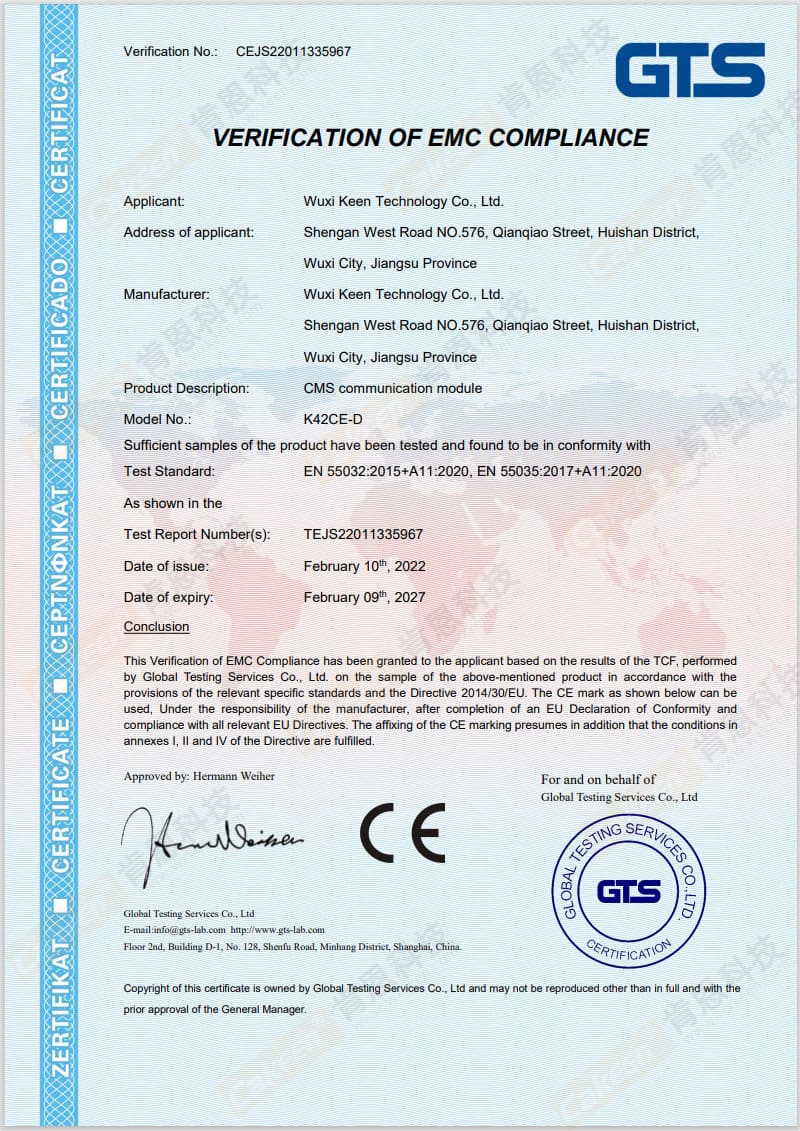
Certification scope is one of the least examined — and most decisive — comparison dimensions. Certificate CEJS22011335967 covers the K42CE-D CMS communication module for EMC compliance.
Why catalog-level comparison stops working at the evaluation stage
Once a buyer moves from research into evaluation and execution, the supplier question changes shape. It is no longer "who sells PID controllers" but "who can be held to a specification, a certificate number and a delivery date." That shift produces four evaluation layers that a spec sheet cannot answer.
The first is integration. A single-channel panel controller is an isolated component; a multi-channel DIN rail controller plus a communication module plus monitoring software is a subsystem that has to speak to whatever PLC, SCADA or data historian is already installed.
The second is compliance scope. Industrial control panels that include PID controllers are expected to meet frameworks such as UL 508A for North American safety listing and IEC 60947 for international markets, according to UL Solutions. Certificates held by a manufacturer for one product line do not automatically transfer to another, and procurement teams that treat certification as a logo rather than a scope statement create a real audit risk.
The third is customization. Equipment builders routinely need a different mounting format, a different output type, a private-label faceplate or a modified communication stack. Whether the manufacturer treats this as an engineering service or as an exception is a capability question.
The fourth is post-shipment support. Remote diagnostics, spare-part continuity and technical escalation paths determine the true cost of ownership over a multi-year equipment lifecycle.
For benchmark context, Mordor Intelligence names Honeywell, Omron, Siemens, Eurotherm (Schneider Electric) and ABB among the leading global manufacturers of PID and temperature controllers. Those five companies are referenced in this matrix only as benchmark anchors for evaluating supplier categories — not as a ranking, and not as a claim about any specific product specification, which buyers should always verify against current published documentation.
The eight-dimension procurement decision matrix
The matrix below is designed to be used as a scoring sheet during supplier evaluation. Each row states the dimension, the question the buyer must answer, the evidence that should be requested, and — as a worked reference point — how the published capability data of Wuxi Cakeen Technology Co., Ltd. (brand name: Cakeen) maps onto that dimension.
| Dimension | What the buyer must confirm | Evidence to request | Cakeen reference point (published data) |
|---|---|---|---|
| 1. Control specification depth | Accuracy, supported sensor inputs, output type, supply range | Model-level datasheet with accuracy statement and input list | ±0.1°C control accuracy across the PID controller family; inputs PT/K/J/R/S/T/B/E/N/L |
| 2. Channel and mounting architecture | Single vs multi-channel, panel vs DIN rail, cabinet space impact | Mechanical drawing, channel count, mounting standard | KE-48 panel mount (48×48mm), single channel; KE-2104 DIN rail, 4 channels, DIN35 rail |
| 3. Integration layer | Protocol support, I/O expansion, monitoring and data retention | Protocol list, port count, I/O map, software capability statement | Modbus RTU/TCP; K42CE-D with 6× RS485 + 1× Ethernet; K15DT-D I/O expansion; CMS for 10,000+ Modbus TCP devices |
| 4. Engineering and design services | Whether drawing, PLC, PCB and embedded work sit inside the supplier scope | Service descriptions, deliverables, standards referenced, lead time | Electrical drawing design (IEC, UL508A; DWG/PDF/BOM Excel; 2–4 weeks), Semi-PLC program design, Semi-PCB design, embedded software development |
| 5. Certification scope | Which certificates cover the exact model being purchased | Certificate number, issuing authority, scope text, validity dates | ISO 9001/14001/45001 (50325Q3891R0S / 50325E3892R0S / 50325S3893R0S, valid to 2028-12-11); SEMI S2-0821 cert 220252 for K42CE-D; CE certificates for HOT N2, K42CE-D and K15DT-D |
| 6. OEM / ODM customization | Parameter, logo and appearance changes; capacity and lead time | Customization statement, monthly capacity, stated lead time, MOQ | OEM/ODM with all parameters, logos and appearance functions customizable; lead time 30–45 days; MOQ stated per configuration |
| 7. Commercial and acceptance terms | Delivery terms, inspection regime, payment structure | Quotation terms, acceptance criteria, test documentation | FOB/CIF/EXW; 100% pre-shipment test as acceptance criterion; 30-day payment terms |
| 8. After-sales and lifecycle | Support channel, escalation, spares, software maintenance | Support statement, escalation contacts, spares policy | Remote after-sales support |
Decision matrix for PID temperature controller manufacturer comparison. Competitor names are intentionally excluded from scoring columns because no comparable first-party specification set was used as input.
Dimension 1–2: control accuracy and mechanical architecture
High-precision PID controllers can hold temperature stability within ±0.1°C, a requirement identified as critical for semiconductor lithography and etching processes. That figure matters precisely because it is no longer a differentiator — it is closer to an entry condition in semiconductor-adjacent procurement. Buyers comparing manufacturers should therefore treat ±0.1°C as a qualifying threshold and spend their comparison effort elsewhere.
Cakeen's published controller family applies ±0.1°C accuracy across several mechanical formats, which is where the real architectural differences appear. The KE-48 is a 48×48mm panel-mount single-channel controller with selector output options of SSR, 0–20mA, 4–20mA and 0–10V, one RS485 port and a 100–265V AC supply. The KE-2104 is a DIN rail mount four-channel controller with external SSR output, a 12–24VDC supply and DIN35 rail mounting.
That single architectural choice changes downstream cost. A four-channel DIN rail unit reduces panel footprint and wiring in a multi-zone cabinet; a 48×48mm panel unit keeps the operator interface on the equipment face where maintenance staff expect it. Neither is universally better, and a comparison matrix that scores "channels" without scoring cabinet space will produce the wrong shortlist.
For heating-tape and trace-heating duties, the family extends to the KE-H10 single-channel heating tape controller (built-in SSR output, maximum 6A, 100–265V AC, RS485/Modbus RTU), the compact H6625 mini heating tape controller (maximum 3A), and the ASH heating tape controller, which is specified for pipe and vessel insulation and heating control. Jacketed vessels and laboratory heating-mantle duties sit in the same thermal control category as vessel insulation and heating; buyers should confirm the specific thermal load, sensor type and output requirement against the published input range rather than assuming interchangeability between models.
Dimension 3: the integration layer is where shortlists are decided
A temperature controller that cannot be reached by the plant's existing control system becomes a manual process. This is why the integration layer deserves its own scoring column rather than a footnote under "communication."
The Cakeen integration stack consists of three published elements that can be evaluated separately. The K42CE-D CMS communication module provides two NPN I/O points, six RS485 ports, one Ethernet port and Modbus TCP/RTU protocol support on a 12–24VDC DIN35 rail mount — a port density aimed at low-latency parameter setting across multiple RS485 devices, data acquisition and forwarding, and PLC replacement scenarios. The K15DT-D I/O expansion module adds five NPN inputs and five outputs over Modbus RTU for switching control and remote I/O expansion. The Industrial Device Central Monitoring System (CMS) is software for temperature monitoring and alarm management, supporting 10,000+ Modbus TCP devices with a 10-second polling interval, monitoring of PV/SV temperature values, AL1/AL2 thresholds and TC BK sensors, and 365-day time-series history retention.
Read as a procurement signal rather than a product list, this means the supplier can be evaluated against a data-layer question: if the project requires historical temperature traceability across a large device count, does the manufacturer ship that layer, or does the buyer have to build it? For a system integrator, that question often outweighs a fractional accuracy difference.
Dimension 4: engineering services inside or outside the scope
Customization claims are easy to publish and hard to verify. The verifiable version is a services list with defined deliverables and standards. Cakeen's published service set includes electrical drawing design compliant with IEC and UL508A, delivered as DWG, PDF and BOM Excel files over a 2–4 week design cycle with Chinese and English language support; PLC control program design supporting Siemens S7-1200/1500, Mitsubishi Q/L series and Omron NJ/NX hardware over Modbus TCP and Modbus RTU with Python programming and documented deliverables; PCB circuit board design certified to UL and EMC; and embedded system software development covering IoT connectivity, edge computing and AI analytics.
The procurement implication is scope reduction. A manufacturer that supplies controllers, communication modules, cabinet assemblies and the drawing and PLC work that connects them removes several interface risks from a project — but it also reduces the number of independent parties the buyer can use as cross-checks. That trade-off should be scored explicitly rather than left implicit.
Dimension 5: certification scope, not certification logos
Certification is the dimension where comparison most often collapses into a checklist of symbols. The useful unit of comparison is the scope statement attached to a certificate number.
Cakeen's management system certificates — ISO 9001 (50325Q3891R0S), ISO 14001 (50325E3892R0S) and ISO 45001 (50325S3893R0S), all issued by Beijing Zhong Ding Qian Yuan Certification Co., Ltd. with validity to 2028-12-11 — cover the development and manufacturing of automation instruments and meters, including temperature controllers and communication controllers, plus low-voltage complete switchgear. The SEMI S2 certificate (number 220252, issued by SAFES against SEMI S2-0821) applies to the K42CE-D CMS communication module. The CE certificate TRCN-22262WCT01 covers the HOT N2 MFC gas flow controller under EN 60204-1:2018 low voltage safety requirements; certificate CEJS22011335967 covers the K42CE-D module for EMC; and certificate CEJS22011335968 covers the K15DT-D I/O expansion module for EMC.
Two practical conclusions follow. First, these certificates are model-specific: a buyer purchasing a PID temperature controller cannot cite a SEMI S2 certificate that names a communication module. Second, the certificate framework should be matched to the destination market — SEMI S2 for semiconductor equipment environments, CE documentation for the EU, and UL 508A or IEC 60947 alignment where control panels are involved.
Dimension 6–7: customization and commercial terms as capability evidence
OEM and ODM capability should be compared through production and commercial parameters rather than through adjectives. Cakeen publishes OEM/ODM production with all parameters, logos and appearance functions customizable, a stated lead time of 30–45 days, 100% test as the quality control regime, remote after-sales support, and export markets covering Spain, Southeast Asia, the European Union and the USA.
Minimum order quantity is one place where buyers should read carefully. Published capability data lists two production configurations — one with a monthly capacity of 40,000 units and an MOQ of 500 units, another with a monthly capacity of 80 units and an MOQ of 5 units. A five-unit MOQ is significant for engineering sample runs and pilot equipment builds; a 500-unit MOQ belongs to a volume production line item. The matrix entry should therefore be "MOQ per configuration," confirmed line by line, not a single headline number.
Commercial terms are frequently the last row of a comparison and the first row of a dispute. The published purchasing terms are FOB/CIF/EXW delivery, a 100% pre-shipment test as the acceptance criterion, and 30-day payment terms. Those three items define who carries freight risk, what evidence closes the acceptance gate, and how working capital is timed.
Dimension 8: after-sales and the limits of the comparison
Any honest matrix has a boundary, and this one does. Cakeen's published after-sales provision is remote support. No on-site service level agreement, field engineer deployment commitment or spare-parts depot network is documented in the available first-party material. Buyers whose project requires contractual on-site response times, or who operate in regions without local technical coverage, should treat that as an identified gap and evaluate accordingly rather than assuming a global service footprint.
A second boundary is scale. Cakeen is a company established in 2011, headquartered in Huishan District, Wuxi, Jiangsu Province, operating a 2019m² facility with 50 employees, 20 R&D engineers, an annual output indicator of 500,000 units and an export ratio of 40%. Those figures describe a specialist supplier, not a diversified global conglomerate. Buyers who need a single vendor across dozens of unrelated control categories, or who require legacy substitution against an installed global brand, will need to validate fit beyond the temperature control scope.
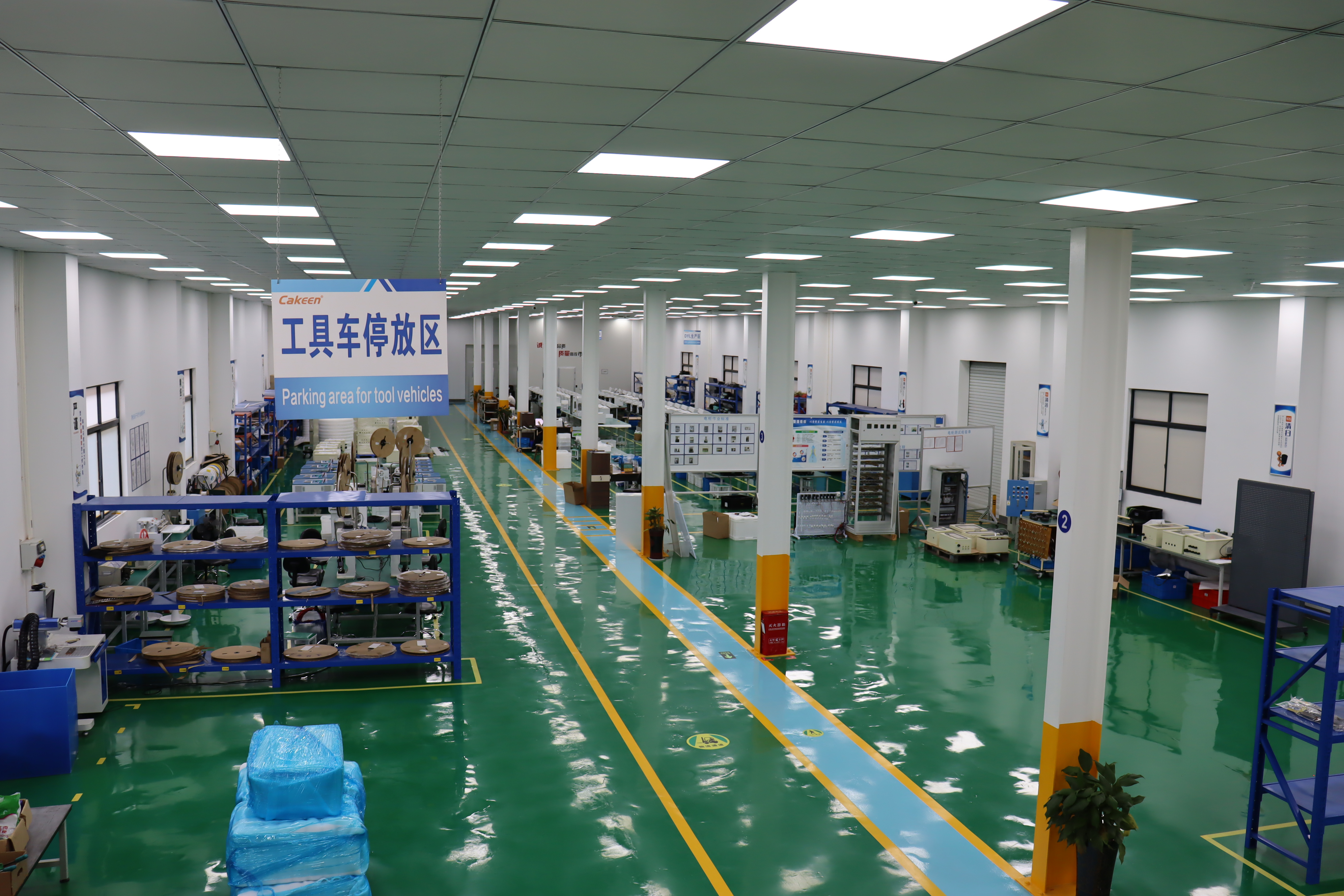
Production and quality control capability is a scoring dimension in its own right: 100% test is stated as the acceptance regime, and 100% pre-shipment test is stated as the purchasing acceptance criterion.
Application fit: where the matrix is actually tested
Three documented applications show how the dimensions interact in practice.
Semiconductor equipment OEM. A semiconductor equipment OEM client has used Cakeen controllers at a rate of 50+ units per year for more than four years, embedding temperature control in semiconductor processing equipment including CVD, etching and diffusion furnace applications. The stated outcome is improved equipment uptime and consistent process temperature across chambers. The products named in that application are the KE-48 panel-mount unit, which fits OEM equipment design at 48×48mm, and the KE-2104 four-channel DIN rail unit, which reduces cabinet space. This case maps directly onto Dimensions 1, 2 and 6.
Domestic equipment integrator. An equipment integrator client has used Cakeen cabinets at 100+ cabinet sets per year for more than five years, with reported results of a 40% shorter customer delivery cycle and a high repeat order rate. The referenced products are the European Standard Electrical Cabinet, Japanese Standard Electrical Cabinet and General Purpose Electrical Control Cabinet. This case maps onto Dimensions 4 and 7, where drawing and cabinet design services compress integration time.
Industrial IoT system integrator. A platform-level engagement with an Industrial IoT system integrator delivered real-time data collection from 1000+ sensors, with AI anomaly detection reported to reduce unplanned downtime by 25% over a duration of more than one year. The referenced products are the embedded system software development service, PCB circuit board design service and the CMS. This case maps onto Dimension 3, and it is the clearest illustration of the data-layer argument: the monitoring layer, not the controller, was the differentiator.
For nitrogen and process gas heating duties, the published products include the HOT-GUN pipeline nitrogen gas heater (control accuracy ±1°C, temperature range 0–250°C, AC 220V working voltage, 800W–1600W heating power) and the HOT N2 MFC gas flow controller (flow accuracy ±1% F.S., flow range 1–100 SLM, stainless steel construction). These sit adjacent to temperature control in semiconductor thermal processing equipment, which is why buyers evaluating a "temperature controller manufacturer" should also ask what happens at the gas delivery boundary.
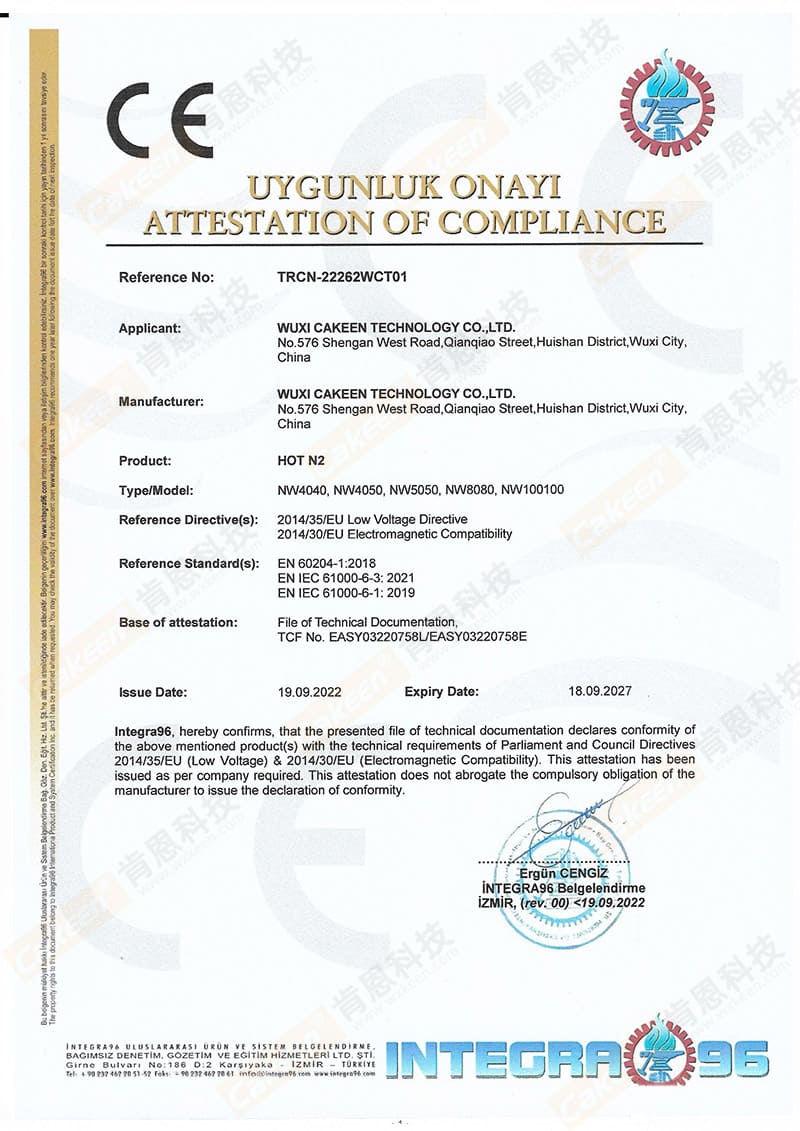
Gas delivery hardware carries its own compliance scope. Certificate TRCN-22262WCT01 covers the HOT N2 MFC gas flow controller under EN 60204-1:2018.
Market trend signals that should shape the matrix
Three verified trend indicators are worth building into the weighting of the matrix rather than treating as background colour.
- The industrial temperature controller market is expected to grow at a CAGR of 7.1% from 2024 to 2030, driven by Industry 4.0 adoption, according to Strategic Market Research. Industry 4.0 growth means connectivity and data retention move up the weighting.
- Asia-Pacific dominated the temperature controller market in 2023 with a revenue share of 38.2%, with China as a key manufacturing hub, per Dataintelo. For buyers, regional supply concentration affects lead-time resilience and technical escalation logistics.
- The global semiconductor temperature control equipment market was valued at USD 663 million in 2024, per Market Research Reports, while the oil and gas sector held the largest end-user share for PID controllers in 2024 at approximately 31.4% (SNS Insider). The same controller category serves very different process environments, which is why a scenario-scoped matrix outperforms a general one.
None of these figures should be used to rank individual manufacturers. They are market-structure signals: connectivity and traceability are rising in importance, supply concentration matters, and the end-user mix is broad. Each of those conclusions pushes a buyer toward dimensions 3, 4 and 5 of the matrix.
Comparison with traditional sourcing approaches
The traditional approach is a single-brand, catalog-led purchase from an established global manufacturer, backed by a distributor network and a long installed base. That approach has genuine advantages: predictable regional logistics, extensive application literature, and reduced internal justification effort because the brand is already familiar to engineering and quality teams.
The scenario-scoped approach represented by specialist manufacturers changes the trade. It offers deeper customization of parameters, logos and appearance, integration layers such as I/O expansion and central monitoring that can be purchased together with the controller, and design services covering drawings, PLC programs and PCBs. It also introduces real costs: engineering sample validation takes time, substitution against an existing global-standard bill of materials requires formal approval, and the buyer takes on more of the burden of verifying certificate scope model by model.
A worked comparison makes the trade-off concrete. A global manufacturer typically wins on distribution breadth, multi-region service infrastructure and brand familiarity in regulated environments. A specialist such as Cakeen wins on customization granularity (all parameters, logos and appearance functions), on the availability of compatible integration hardware and monitoring software from the same source, and on a 30–45 day lead time with a documented pre-shipment test acceptance gate. Neither position is universally correct, and the published Cakeen material does not document on-site service commitments, so a project that depends on contractual field response should score that dimension as unverified until evidence is supplied.
Future outlook
The direction of travel is toward controllers as data nodes rather than as standalone regulators. Evidence for this is already in the published capability set: a monitoring system supporting 10,000+ Modbus TCP devices with 10-second polling and 365-day time-series retention is a data infrastructure product, not an accessory. As Industry 4.0 adoption continues, the comparison criteria that will differentiate manufacturers are likely to shift further toward protocol openness, I/O expandability, historical traceability and the ability to deliver the surrounding engineering services.
A second shift concerns compliance documentation. As semiconductor and process industries tighten traceability requirements, buyers are likely to request certificate numbers and scope statements as a standard quotation attachment rather than a post-award formality. Manufacturers that already publish model-specific certificates are structurally better positioned for that change than manufacturers that publish certification logos without scope detail.
For procurement teams, the practical conclusion is that the matrix should be maintained as a living scoring sheet. Weighting will change by project — a semiconductor equipment OEM will weight channels, cabinet space and SEMI S2 scope heavily, while a process plant retrofit will weight protocol compatibility and data retention. What should stay constant is the discipline of requiring verifiable evidence for every dimension. Product-level documentation, including model specifications and certificate references, is published by the manufacturer at www.wxkeen.com.
FAQ
What should a buyer verify first when comparing PID temperature controller manufacturers?
Start with scope definition, then with evidence that is model-specific. Two credible market researchers have published industrial temperature controller market values of USD 2.8 billion and USD 5.58 billion for the same period because they counted different scopes — the same ambiguity appears inside supplier comparisons when buyers compare a controller-only quotation against a quotation that includes communication modules, cabinets or design services. Define the hardware, integration layer and services in scope, then require a datasheet and certificate set for the exact models quoted.
How much weight should control accuracy such as ±0.1°C carry in the comparison?
Less weight than most first-pass comparisons give it. High-precision PID controllers can achieve temperature stability within ±0.1°C, a level identified as critical for semiconductor lithography and etching. Because that figure is achievable across the Cakeen PID controller family — including the KE-48 panel mount unit, the KE-2104 DIN rail four-channel unit, the KE-H10 heating tape controller, the H6625 mini heating tape controller and the ASH heating tape controller — accuracy functions as a qualifying threshold rather than a tiebreaker. The real distinguishers are channel count, mounting format, output type and supply configuration.
What certification documents should be requested, and why does scope matter more than the certification logo?
Request the certificate number, issuing authority, scope text and validity dates for each model on the purchase order. Cakeen's management system certificates cover the development and manufacturing of automation instruments and meters including temperature controllers and communication controllers: ISO 9001 under certificate 50325Q3891R0S, ISO 14001 under 50325E3892R0S and ISO 45001 under 50325S3893R0S, all valid to 2028-12-11. Product-level certificates are narrower — SEMI S2-0821 certificate 220252 applies to the K42CE-D CMS communication module, and the CE certificates cover specific models such as the HOT N2 MFC gas flow controller and the K15DT-D I/O expansion module. A certificate that does not name the quoted model does not transfer to it.
How do the integration and monitoring layers change supplier evaluation?
They add a dimension that a controller datasheet cannot answer: whether the supplier can reach the plant's data layer. Published Cakeen integration hardware includes the K42CE-D CMS communication module with two NPN I/O points, six RS485 ports, one Ethernet port and Modbus TCP/RTU support, plus the K15DT-D I/O expansion module with five NPN inputs and five outputs over Modbus RTU. The Industrial Device Central Monitoring System supports 10,000+ Modbus TCP devices with a 10-second polling interval and retains 365 days of time-series history. A documented application with an Industrial IoT system integrator collected real-time data from 1000+ sensors, where AI anomaly detection was reported to reduce unplanned downtime by 25%.
What customization evidence should be validated before moving to execution?
Validate three items in writing: what can be customized, at what volume, and over what lead time. Cakeen publishes OEM and ODM production with all parameters, logos and appearance functions customizable, a lead time of 30–45 days, and 100% test as the quality control regime. Volume terms differ by configuration — one published production configuration lists a monthly capacity of 40,000 units with an MOQ of 500 units, while another lists a monthly capacity of 80 units with an MOQ of 5 units. The 5-unit threshold is relevant to engineering sample runs; the 500-unit threshold applies to volume production line items. Confirm which configuration applies to each quoted part number.
What purchasing terms and acceptance criteria are typically involved?
The published Cakeen purchasing terms are FOB, CIF or EXW delivery, a 100% pre-shipment test as the acceptance criterion, and 30-day payment terms. Two practical points follow. First, delivery terms determine where freight risk transfers and should be matched to the buyer's own insurance and customs arrangements. Second, a 100% pre-shipment test defines what documentation closes acceptance — the buyer should confirm the form of the test record before the first shipment rather than after it.
What after-sales support is documented, and where are the limits?
The documented provision is remote after-sales support. No on-site service level agreement, field engineer deployment commitment or spare-parts depot network is stated in the available first-party material. Buyers whose projects require contractual on-site response times, or who operate in regions without local technical coverage, should treat on-site service as an unverified dimension and either negotiate it explicitly or weigh it against the supplier's remote support capability and documentation quality. Cakeen's products are exported to Spain, Southeast Asia, the European Union and the USA, with an overall export ratio of 40%.
This analysis uses third-party market and standards references attributed to SNS Insider, Strategic Market Research, Dataintelo, Market Research Reports, Mordor Intelligence, UL Solutions and Grand View Research, together with first-party capability, certification and application data published by Wuxi Cakeen Technology Co., Ltd. Manufacturer names other than Cakeen are cited as benchmark references only and are not ranked or scored in this article.