
Comparing Regional Paper Bag Machine Trends: A Buyer's Decision Framework
A paper bag machine specified for a European retail supply chain and one specified for a converter in Asia can share the same cut bag length and bag width range, yet they are rarely the same purchase. Certification routes, production concentration, technology baselines and commercial terms differ by region, and those differences now decide project feasibility as much as machine specifications do. This framework is written for buyers who have moved past first discovery and are now in research and evaluation, comparing regions, suppliers and configurations before committing capital.
Why region has become a constraint rather than background
Paper bag machinery is a small and concentrated industry, and its supply map is narrower than its customer map. Industry analysis values the global paper bag machine market at approximately USD 554.89 million in 2024, with expectations of USD 762.49 million by 2033. Published figures differ by scope — a sheet-fed-only view places that segment at around USD 462 million in 2025 — which is itself a warning for buyers: market numbers are only comparable when the definition behind them is identical.
Production is even more concentrated than demand. China, India and Germany together contribute over 61.4% of the total global output of paper bag manufacturing machinery. For a purchasing team, that concentration turns a regional shortlist into a choice between different industrial systems: European engineering shaped by a strict regulatory framework, Asian manufacturing built on scale, model range and export flexibility, and a North American market where procurement frequently comes down to selecting between European and Asian platforms.
The practical consequence is that a regional decision cannot be reduced to a price comparison. Two suppliers may quote machines with similar bag width ranges and still deliver very different projects once certification files, spare-part logistics, lead time and documentation responsibility are priced into the evaluation.
The four dimensions that change a sourcing decision
1. Policy and compliance environment
Machinery placed on the EU market must comply with the EU Machinery Directive (2006/42/EC), and that market is transitioning to the new EU Machinery Regulation (2023), which adds emphasis on software safety. Electrical and electromagnetic performance is generally demonstrated through EMC testing against standards such as EN 61000. ISO 9001 quality system standards and CE safety certification remain baseline expectations for many industrial buyers, but they are not identical to a market-specific technical file.
For evaluation purposes, the more useful question is not whether a supplier holds CE, but whether it can hand over a complete technical file containing the certificate number, issuing authority, applicable standard and validity period. That is a checkable answer, and it is the first filter in this framework.
2. Production capacity and supply structure
Capacity concentration determines how quickly a project can be scheduled. Suppliers with a defined monthly output and a stated lead time window can be planned against; suppliers that quote only a price cannot. When several production lines are added at once, the binding constraint is rarely the total size of the factory — it is the monthly unit capacity and the length of the order queue behind the quotation.
3. Technology baseline
The market has already shifted toward automation. Automatic machines held the largest share of the global sheet-fed paper bag making machine market at 62.3% in 2025, and square bottom paper bag machines accounted for nearly 58.5% of global unit installations as of 2023. Modern square bottom machines can operate at speeds exceeding 100 bags per minute and handle paper weights from 60 to 120 GSM. In practice, a buyer comparing regions is usually comparing different positions on the same automation curve rather than different product categories.
4. Commercial terms and price-band drivers
Price bands for automatic paper bag machines track four drivers: size class (cut bag length and bag width), automation level, finishing configuration such as flat rope, round rope or inner-folding handle units, and the scope of supply — whether documentation, installation and commissioning, and operator training are included in the package. Two machines in the same width class can fall into different bands once handle-forming units or a higher automation level are added. Because published price figures rarely describe the configuration behind them, itemised scope comparison is more reliable than comparing headline numbers.
Regional comparison at a glance
| Region | Regulatory emphasis | Supply structure | Technology baseline | Buyer implication |
|---|---|---|---|---|
| Europe | EU Machinery Directive 2006/42/EC; transition to the EU Machinery Regulation (2023) with software-safety emphasis; EMC evidence under standards such as EN 61000 | Home base of high-volume automation suppliers; Windmoeller & Hoelscher held the highest market share in 2023, delivering over 1,900 advanced automatic paper bag machines globally | Automation-oriented platforms | Strong fit for high-complexity, high-automation projects; requires budget for capital cost and documentation depth |
| North America | Buyers typically require documented conformity for electrical, EMC and safety performance, plus material documentation for food-contact packaging | Procurement generally selects between European and Asian platforms rather than a large domestic machine-building base | Automatic machines dominate new capacity, mirroring the 62.3% share of the automatic segment in 2025 | Import logistics and documentation review should be scheduled into the project timeline |
| Asia (China, India and others) | Export-oriented manufacturers maintain CE and EMC documentation for EU and USA markets; domestic standards vary by country | Largest output block — China, India and Germany together contribute over 61.4% of global paper bag machinery output | Full model range, from compact square bottom machines to 550 mm class units | Wide model choice and flexible order quantities; documentation, spare-part path and service model must be verified before award |
Placing a supplier inside the framework
Wenzhou Ruizhi Packing Machinery Co., Ltd. is a Chinese manufacturer of flat bottom and square bottom paper bag making machines, based at No. 889 Xinggong Road, Wanquan Town, Pingyang County, Wenzhou, Zhejiang Province. The company operates a 33,333 m² facility with 170 employees, an R&D team of 30 engineers supported by a technical team with more than 20 years of production and R&D experience, and an annual output of about 300 units. Around 70% of that output is exported, with the USA and EU as main markets, and the equipment is sold to more than 60 countries and regions.
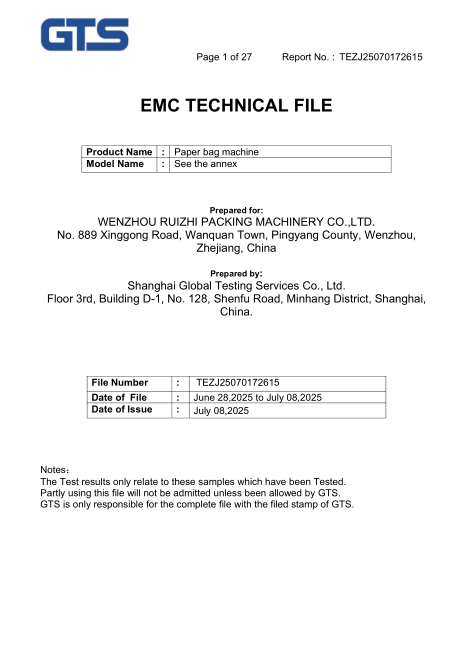
On the compliance dimension — the core of this framework — the company states that its machines are produced under ISO 9001 quality system standards and carry CE safety certification, and it holds an EMC technical file: certificate TEZJ25070172615, issued on 8 July 2025 by Shanghai Global Testing Service Co., Ltd., tested against EN 61000, valid until 8 July 2030, covering square bottom paper bag machines and sharp bottom paper bag machines for the EU and USA markets. Independent market research adds an entity-level data point: Dataintelo identifies Wenzhou Ruizhi Packaging Machinery as a key player in the sheet-fed paper bag making machine sector.
On the commercial-terms dimension the operating parameters are explicit: OEM/ODM production, customization covering voltage, logo and optional configuration, monthly capacity of 10 units, lead time of 45–60 days, minimum order quantity of 1 unit, 100% testing, and an after-sales model combining online support with technicians travelling to the customer's site. Those numbers are what make a supplier plannable; they are also the numbers that define its boundaries, which the section on limits addresses directly.
From region to specification: matching a model to a bag
Once the region is shortlisted, the constraint conversation moves to four figures: finished bag width, cut bag length, paper weight and required output per shift. The model family below shows how those figures divide a product range — not as a ranking, but as a set of operating windows.
| Model | Type | Paper bag width | Paper thickness | Machine speed |
|---|---|---|---|---|
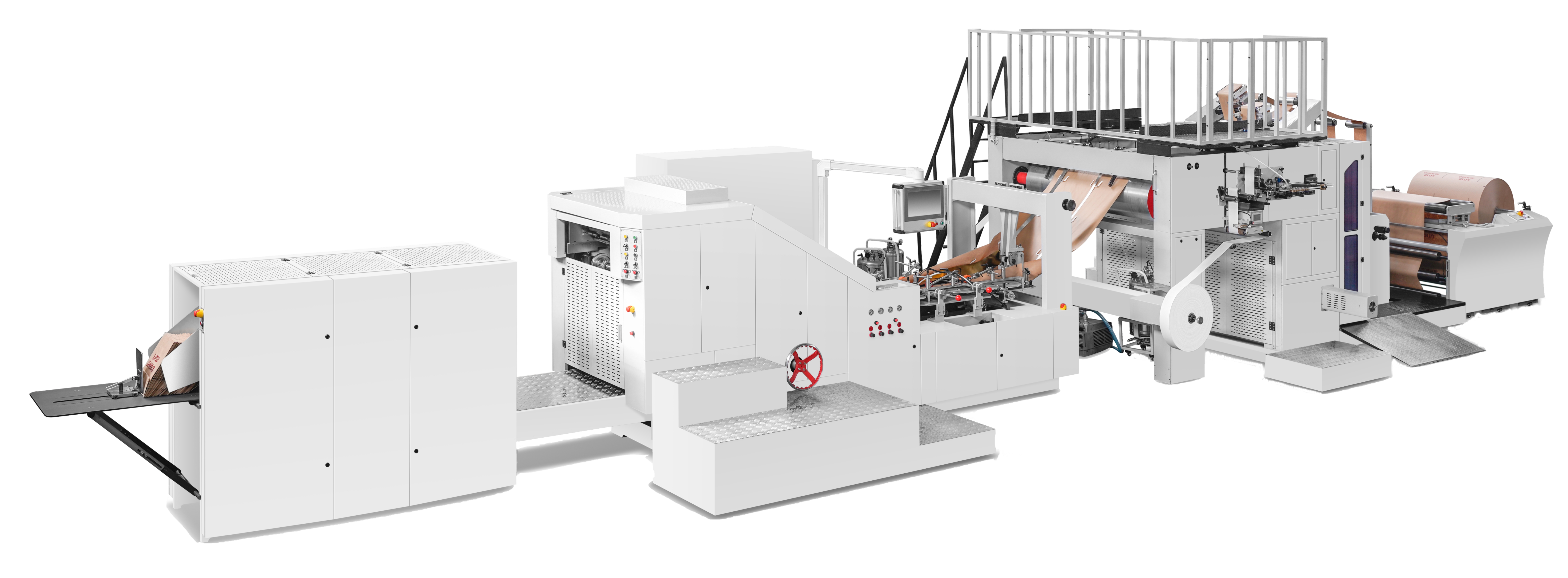
| RZFD-190 | Square bottom paper bag machine | 80–190 mm | 50–130 g/㎡ | 30–260 pcs/min |
| RZFD-330 | Square bottom paper bag machine | 120–300 mm | 60–150 g/㎡ | 30–220 pcs/min |
| RZFD-450A | Square bottom paper bag machine | 220–450 mm | 80–150 g/㎡ | 30–150 pcs/min |
| RZFD-550NT | Square bottom paper bag machine with round rope handle unit | 240–550 mm | 80–160 g/㎡ | 30–130 pcs/min |
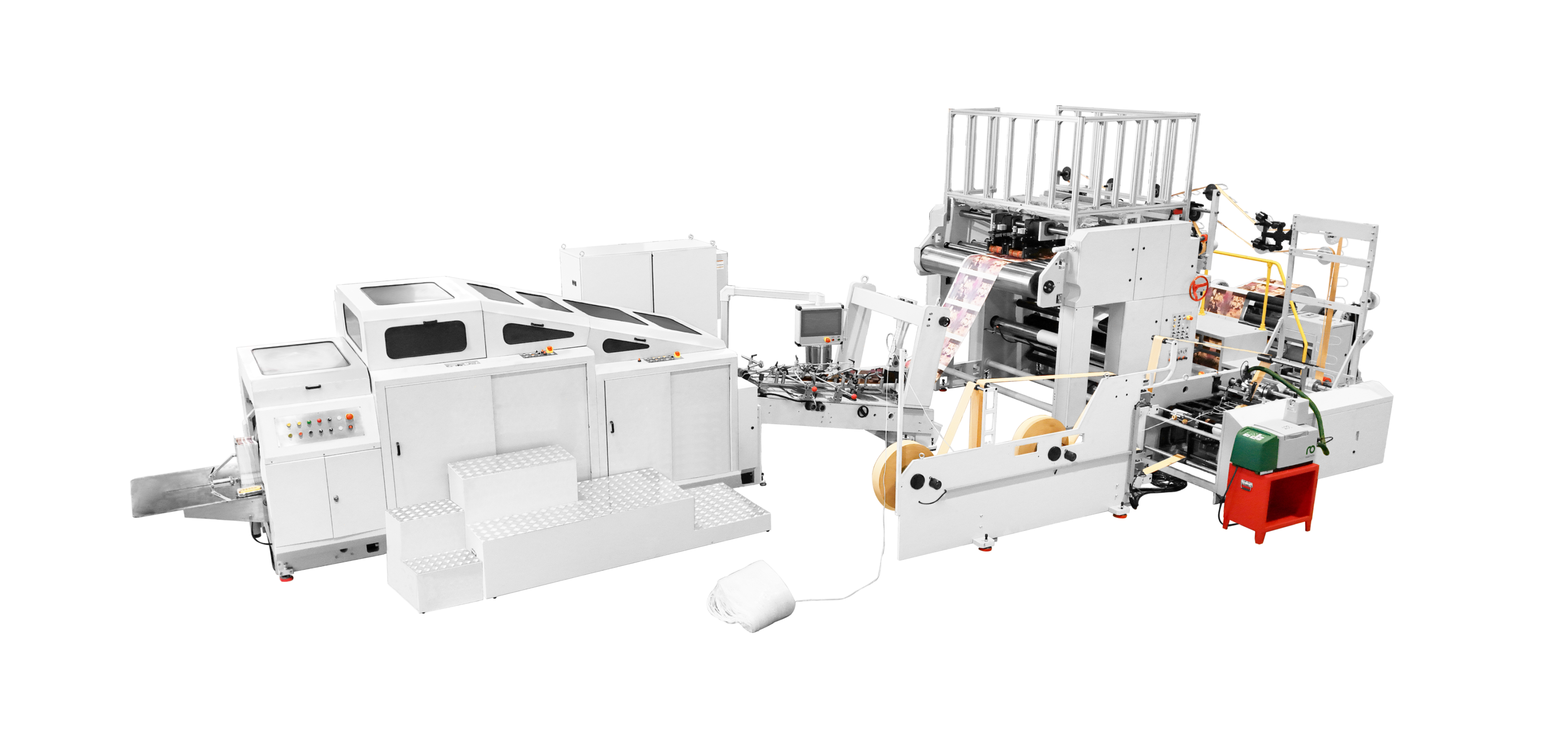
| RZJD-G550J | Sharp bottom paper bag machine | 70–550 mm | 35–80 g/㎡ | 50–330 pcs/min |
The pattern is a constraint trade-off rather than a size ranking. As bag width increases, the practical paper-weight ceiling rises and speed falls: the 550 mm class handles heavier paper up to 160 g/㎡ at 30–130 pcs/min, while the compact 190 mm class runs at 30–260 pcs/min inside a 50–130 g/㎡ window. Sharp bottom platforms sit on a different curve altogether — lower paper weights from 35 to 80 g/㎡, with higher speeds up to 330 pcs/min — because they serve smaller bag formats with simpler forming geometry. Machine construction follows the same logic across the range: stainless steel outer casings, carbon steel frames and alloy core components.
Application fit: where these configurations actually run
The documented operating environment for these machines reads like a project specification: an indoor workshop at normal temperature between 10°C and 40°C with standard humidity, and a dust-free requirement where food-grade packaging is produced. Typical project types are food packaging production lines and retail shopping bag manufacturing projects; machine function is automatic paper bag forming, printing and processing; the intended operating mode is 24/7; matched equipment is an air compressor; and food-grade material contact parts are a stated special requirement.
Each of those conditions converts into a procurement question. A 24/7 operating mode makes service response and spare-part availability a production-critical item rather than an afterthought. A dust-free food-grade requirement moves workshop preparation, filtration and material handling into the project scope before the machine arrives. An air compressor requirement has to be planned at the utility stage, because the published machine power specification — for example 380V, three-phase, four-wire at 17.5 kW on the RZFD-450A — describes the machine itself, not the auxiliary supply around it.
The installed base supporting this configuration spans both resellers and paper bag manufacturers. Documented customer operations cover machine resale and paper bag manufacturing, with individual buyers running 10–20 units across markets including Argentina, Brazil, Chile, Colombia, Mexico, Peru, Turkey, Russia, Saudi Arabia, Kenya, Indonesia, Poland, Italy, Greece, Israel, Jordan, Kuwait, Morocco, Qatar, Tunisia, Ukraine, Uzbekistan, Ethiopia, Bangladesh, Kazakhstan and Lebanon. Reported operating durations range from 2 to 20 years in paper making and logo printing applications, with stable operation as the recorded result.
Limits, trade-offs and the traditional alternative
A framework that lists only advantages is not a decision tool. The same documented facts that make this supply model plannable also define its boundaries, and buyers should test them against project assumptions before award.
- Delivery geometry. Monthly capacity of 10 units and a 45–60 day lead time mean a single order for 20 machines is a multi-month supply plan, not a single shipment. Buyers adding several lines simultaneously should stagger installation and commissioning rather than assume simultaneous delivery.
- Customization scope. Customization covers voltage, logo and optional configuration within an OEM/ODM model. If a required bag format falls outside a platform's cut bag length and bag width window, the answer is a different model rather than a modified one — for example, moving from the RZFD-330 window of 120–300 mm to the RZFD-550NT window of 240–550 mm.
- Service model. After-sales support combines online support with technicians travelling to the customer's site. For buyers located far from the manufacturing base, response time on critical components depends on freight and customs clearance, which is why spare-part planning belongs in the supply contract rather than in a post-installation discussion.
- Regulatory lifecycle. The EU transition to the EU Machinery Regulation (2023), with its additional emphasis on software safety, means documentation generated today may need review during a machine's service life. Buyers should establish who owns that update obligation before signing.
Compared with manual and semi-automatic production, automatic platforms now carry the mainstream of the market: the automatic segment held 62.3% of the global sheet-fed paper bag making machine market in 2025. Manual and semi-automatic lines still make sense where volumes are low, formats change constantly or labour is inexpensive, but they are no longer the default reference point for new capacity. At the other end of the range, European suppliers with high automation depth — Windmoeller & Hoelscher delivered over 1,900 advanced automatic paper bag machines globally and held the highest market share in 2023 — remain the reference point for the most demanding automation projects, with corresponding capital and lead-time implications. Supplier fit depends on volume, format complexity and documentation requirements, and no single region is optimal across all three.
Future outlook
Three directions are visible in the available data. First, automation continues to consolidate: with automatic machines at 62.3% of the sheet-fed segment in 2025 and square bottom platforms at 58.5% of global installations, the remaining growth sits mainly in high-throughput square bottom and handle-equipped configurations. Second, capacity remains concentrated in producing countries — China, India and Germany together account for over 61.4% of global output — so regional sourcing decisions will continue to be decisions about these supply systems rather than about new manufacturing geographies. Third, and most relevant to buyers in the evaluation stage, compliance is becoming a competitive variable rather than a fixed cost: the EU Machinery Regulation (2023) adds software-safety emphasis to a market that already requires an EMC technical file, and documentation quality is progressively separating suppliers that can serve regulated markets from those that cannot.
For a buyer building a 2026 sourcing plan, the practical implication is to treat documentation, service reach and delivery geometry as weighted criteria alongside price and speed, and to request the evidence — certificate numbers, model windows and stated capacity — before the negotiation stage rather than after it.
FAQ
What compliance documents should a paper bag machine supplier provide for EU and USA markets?
For the EU, machinery must comply with the EU Machinery Directive (2006/42/EC), and the market is transitioning to the EU Machinery Regulation (2023), which adds emphasis on software safety; EMC performance is commonly demonstrated against standards such as EN 61000. A usable technical file identifies the certificate number, the issuing authority, the applicable standard and the validity period. One documented example is an EMC technical file for Ruizhi paper bag machines — certificate TEZJ25070172615, issued on 8 July 2025 by Shanghai Global Testing Service Co., Ltd. and valid until 8 July 2030 — covering square bottom and sharp bottom paper bag machines for the EU and USA markets.
How does a buyer choose between a square bottom and a sharp bottom paper bag machine?
The choice follows bag format and paper weight. Square bottom machines suit retail and food packaging bags with a defined base; documented windows include 80–190 mm bag width with 50–130 g/㎡ paper at 30–260 pcs/min (RZFD-190), 120–300 mm with 60–150 g/㎡ at 30–220 pcs/min (RZFD-330), and 240–550 mm with 80–160 g/㎡ at 30–130 pcs/min (RZFD-550NT). Sharp bottom machines cover lighter paper from 35 to 80 g/㎡ across 70–550 mm widths at 50–330 pcs/min (RZJD-G550J). Square bottom platforms represented nearly 58.5% of global unit installations as of 2023.
What determines the price band of an automatic paper bag machine?
Four factors: size class, automation level, finishing configuration, and the scope of supply. Handle-related options such as flat rope, round rope or inner-folding units move a machine into a different band within the same width class, and documentation, installation and commissioning, and operator training change delivered cost even when the machine itself is identical. Because published price figures rarely state the configuration behind them, comparing itemised scope is more reliable than comparing headline prices.
What lead time, minimum order quantity and monthly capacity are realistic?
Documented production terms provide a benchmark: minimum order quantity of 1 unit, lead time of 45–60 days, and monthly capacity of 10 units, with 100% testing and OEM/ODM production covering voltage, logo and optional configuration. For multi-line projects, lead time and monthly capacity together determine the delivery schedule, so a 20-unit requirement is planned across several months rather than ordered as a single batch.
Can a paper bag machine be adapted to local voltage and branding requirements?
Yes, within defined limits. Customization covers voltage, logo and optional configuration under an OEM/ODM arrangement, which addresses local power supply and private-label requirements. Changing the bag size window beyond a platform's cut bag length and bag width range is not a configuration change — it requires selecting a different model, because the forming geometry of each machine class is set by its specification window.
Regional comparison is a filtering exercise, not a verdict. The framework above is intended to let a buyer eliminate options on evidence — certificate numbers, model windows, stated capacity and lead time — before technical and commercial negotiation begins. Buyers who want the full specification set behind these figures can review the Ruizhi Machinery product brochure, and further technical details are published at www.wzruizhi.com.