
Comparing Screw and Barrel Material Quality: Questions Buyers Should Ask
Screw and barrel wear is the point at which a plastic extrusion machine stops delivering the product it delivered on commissioning day. It is also the item most often reduced to a single adjective in quotations that otherwise specify motor power, screw diameter and output to the kilogram.
This article sets out a buyer-side framework for comparing screw and barrel material quality, using 38CrMoAlA nitrided alloy steel as the reference specification. That grade is the screw and barrel material stated for the SJ single screw and SJSZ conical twin screw extruder ranges built by Wuxi JKS Machinery Manufacturing Co., Ltd. (brand: JKS Plastic Extrusion Machine), a Chinese manufacturer founded in 2013 that designs and builds custom plastic extrusion machinery and complete turnkey production lines from Wuxi, Jiangsu, and exports to more than 35 countries. The framework itself is supplier-neutral: it is a structure for turning a vague material claim into a checkable specification, whichever quotation it is applied to.
The Problem: A Material Claim With No Comparison Unit
Extrusion is a continuous process. Equipment documentation describes the operating environment of a single screw or conical twin screw extruder as indoor operation at high temperature and high torque, running continuously rather than in cycles. Wear in that environment is gradual, and its first visible symptom is usually a drift in product dimensions or surface quality rather than a machine stoppage.
Because of that, buyers compare the numbers that are easy to list. The SJSZ conical twin screw range is published model by model with power and capacity: SJSZ-65 at 37 kW and 250 kg/h, SJSZ-92 at 90 kW and 500-600 kg/h, SJSZ-110 at 200 kW and 1000 kg/h. Those figures can be placed side by side in seconds. The screw and barrel material behind them frequently cannot, because many quotations describe it in three or four identical words.
The result is a comparison gap. Two offers can match on power, output and price while differing on which steel grade forms the screw and barrel, on whether the machine frame is included in the same claim, and on whether any hardening record exists at all. A buyer who cannot separate those elements is comparing price against an unknown service life.
The Opportunity: One Verifiable Specification Changes the Conversation
When a supplier publishes a named base alloy together with a named hardening route, the buyer gains a unit of comparison. A grade designation can be checked against steel standards, requested in writing, and linked to a material certificate. A generic phrase such as "hardened alloy screw" cannot be checked against anything.
Market conditions make that distinction worth the effort. The global plastic extrusion machine market is estimated at USD 7.9 billion in 2025 and projected to reach USD 12.87 billion by 2035, according to Market Research Future. On the trade side, the Observatory of Economic Complexity, drawing on UN Comtrade data, reports China as the largest exporter of rubber and plastic working machinery under HS 8477 in 2024 at USD 8.55 billion, ahead of Germany at USD 6.11 billion and Italy at USD 2.61 billion. A deep and competitive supplier field is precisely the situation in which a checkable specification is worth more than a headline discount.
The Reference Specification: 38CrMoAlA Nitrided Alloy Steel
38CrMoAlA is a chromium-molybdenum-aluminium alloy steel grade used for nitrided components. The designation carries two pieces of information at once: the base alloy, and the intended hardening route — the part is made from that alloy and hardened by nitriding.
In JKS documentation the specification is stated at extruder level and then carried into the lines built around those extruders. The SJ single screw plastic extruder, including custom models SJ30, SJ45, SJ65 and SJ90, lists screw and barrel as 38CrMoAlA nitrided alloy steel with a Q235 carbon steel frame. The SJSZ conical twin screw plastic extruder, available from SJSZ-45 through SJSZ-110, lists the same screw and barrel material and the same frame material.
The same pairing appears across the production lines built on these platforms: SPC flooring line, PVC water supply and drainage pipe line, HDPE water pipe line, PPR pipe line, MPP and PE high voltage power pipe line, steel wire mesh reinforced composite pipe line, corrugated pipe line, PVC hollow wall panel and ceiling line, WPC door panel line, PVC and WPC door and window profile line, PVC grille and decoration profile line, solid plastic rod line, PVC and WPC foam board line, PVC imitation marble sheet line, PP hollow construction formwork line, PVC hot-cut pelletizing line, plastic strand cutting pelletizing line and multi-material plastic profile line.
A buyer should notice what that statement does not cover. The screw and barrel specification applies to the screw and barrel. Other metal parts of the same machine carry their own documented materials, and treating them as one item is a common source of confusion during evaluation.
| Component | Stated material | Where it is documented |
|---|---|---|
| Screw and barrel | 38CrMoAlA nitrided alloy steel | SJ single screw extruder; SJSZ conical twin screw extruder; pipe, profile, sheet, board, rod and pelletizing lines |
| Machine frame | Q235 carbon steel | SJ and SJSZ ranges; most extrusion lines |
| Extrusion mould / die | Wear-resistant alloy die steel; forged refined die steel on the PP hollow construction formwork line; precision casting die steel on the PVC pipe line; high precision die steel on the PPR pipe line | Line-level product specifications |
| Calender roller | 45# forged steel with hard chrome plating; on some board lines listed as forged steel with hard chrome plating | SPC flooring line; PVC and WPC foam board line; PVC imitation marble sheet line |
| Pelletizing die | Wear-resistant alloy steel | PVC hot-cut pelletizing line; plastic strand cutting pelletizing line |
Two practical consequences follow. First, "the machine is made of alloy steel" is not the same statement as naming 38CrMoAlA for the screw and barrel while separately listing Q235 for the frame. Second, comparison has to be component by component, because every other wear part has its own specification — and that specification changes by line, as the table shows.
What the SJ and SJSZ Documentation Actually States
The two extruder families serve different starting points, and knowing which one a quotation refers to is part of reading the material claim correctly.
An SJ single screw plastic extruder processes PVC, PP, PE, nylon and ABS and, with different moulds and auxiliary equipment, produces pipes, rods, films, pellets, coated products and blow-moulded items. The solid plastic rod line shows how the same family is parameterised in practice: an SJ45 with a 45 mm screw at 28:1 L/D runs at 7.5 kW to produce rods from 6 mm to 60 mm at 5-18 kg/h, while an SJ65 with a 65 mm screw at 30:1 L/D runs at 18.5 kW for rods from 30 mm to 200 mm at 20-60 kg/h.
The SJSZ conical twin screw extruder is designed for direct extrusion of PVC powder. Its documented characteristics are uniform plasticising and mixing, low shearing, high productivity, stable quality and long service life. Applications listed for the family include PVC pipe, profile, sheet and pellet production as well as WPC door and flooring lines.
| Model | Main motor power | Stated output | Screw and barrel material |
|---|---|---|---|
| SJSZ-45 | 15 kW | 70 kg/h | 38CrMoAlA nitrided alloy steel |
| SJSZ-51 | 18.5 kW | 120 kg/h | 38CrMoAlA nitrided alloy steel |
| SJSZ-55 | 22 kW | 150 kg/h | 38CrMoAlA nitrided alloy steel |
| SJSZ-65 | 37 kW | 250 kg/h | 38CrMoAlA nitrided alloy steel |
| SJSZ-80 | 55 kW | 400 kg/h | 38CrMoAlA nitrided alloy steel |
| SJSZ-92 | 90 kW | 500-600 kg/h | 38CrMoAlA nitrided alloy steel |
| SJSZ-110 | 200 kW | 1000 kg/h | 38CrMoAlA nitrided alloy steel |
Read together, the two ranges form a usable control group for a material comparison. The variable a buyer is testing is not the machine family but the depth of the supplier's documentation: whether the grade is named, whether the hardening route is named, and whether both survive the transition from marketing page to order confirmation.
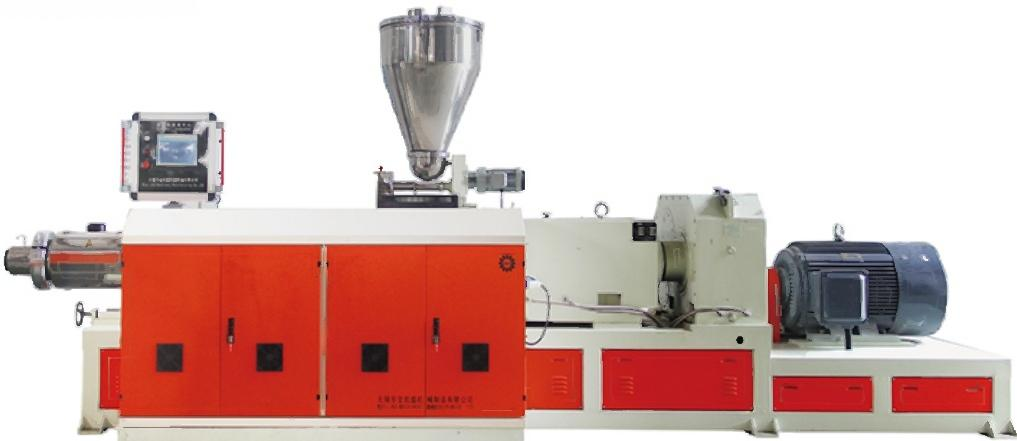
SJSZ conical twin screw extruder — the platform on which the screw and barrel material specification is stated.
A Five-Question Buyer Framework for Comparing Screw and Barrel Material
The framework below converts a material claim into five questions. Each question has a documented answer and an undocumented answer, and the difference between them is the point of the exercise.
Question 1 — Which components does the material claim actually cover?
Ask the supplier to state, component by component, what the screw and barrel are made from and what the machine frame is made from. A usable answer separates the two: screw and barrel in 38CrMoAlA nitrided alloy steel, frame in Q235 carbon steel. An answer that merges them tells you the supplier has not defined the claim precisely enough to be held to it.
Question 2 — What is the base alloy grade, in writing?
A grade designation can be compared against published steel standards and against other suppliers' numbers. "Special alloy steel" or "imported steel" cannot. Ask for the grade name to appear in the technical proposal, not only in conversation.
Question 3 — What hardening route is used, and what evidence supports it?
Nitriding is a specific process, and naming it is the minimum. The follow-up question is what record accompanies the process — whether the supplier can provide process documentation for the screw and barrel of the specific machine being quoted. Where a supplier cannot, the buyer is being asked to accept a process claim on trust.
Question 4 — Does the material match the polymer and the filler load I will run?
Material selection is only meaningful against a duty cycle. A line running PVC with calcium carbonate filler, a line running recycled PP granule with an MFI below 3, and a line producing engineering rods in PA or POM place different demands on the screw and barrel. Buyers should give the supplier the intended formulation and let the recommendation be made against it, then compare recommendations on the same basis.
Question 5 — How will the claim be verified before the machine leaves the factory?
Verification method matters as much as the specification. In JKS documentation, quality control is stated as 100% factory pre-assembly and testing before shipment, with third-party inspection available on request. That combination is the practical mechanism a buyer needs: an in-house test run plus the option of an independent check, rather than a specification that exists only on paper.
Documented Answers vs. Generic Answers: A Comparison Table
The table below restates the framework as a comparison grid. It can be applied to any supplier, and it is deliberately neutral about brand: what is being scored is the completeness of the answer, not the identity of the company giving it.
| Comparison dimension | Documented answer | Generic answer | Why it changes the evaluation |
|---|---|---|---|
| Component scope | Screw and barrel named as 38CrMoAlA nitrided alloy steel; frame named separately as Q235 carbon steel | "Alloy steel screw and barrel", no frame specification | Defines what is actually being compared and what will be replaced first |
| Base grade | Grade designation published | "Special steel", "high-quality steel" | A published grade can be checked against standards and compared across suppliers |
| Hardening route | Nitriding named as the process | "Heat treated" | The process route is what makes the surface property repeatable between machines |
| Other wear parts | Die and roller materials stated per line | Not stated | Replacement planning and spare-part quotations depend on it |
| Verification method | 100% factory pre-assembly and testing before shipment; third-party inspection available on request | "We test every machine" | Determines whether an independent check is possible before payment balance |
| Safety documentation | CE certificate with number, issuing body and referenced standards | "CE certified" with no number | Traceable documents can be validated; claims without identifiers cannot |
Where Screw and Barrel Material Is Tested: Applications and Field Records
Material specifications are abstract until they are placed against a duty cycle. The applications below are drawn from documented line parameters and show where the screw and barrel specification carries the most weight.
- Filled PVC pipe production. The PVC water supply and drainage pipe line runs a PVC plus calcium carbonate formulation through SJSZ conical twin screw extruders: the PVC63 double-station line uses an SJSZ65/132 at 37 kW for diameters from 16 mm to 63 mm at 270 kg/h and hauling speeds of 4-49 m/min; the PVC630 line uses an SJSZ92/188 at 110 kW for diameters from 315 mm to 630 mm at 800 kg/h. Highly filled compounds are the classic case where screw and barrel condition shows up early in dimensional control.
- SPC flooring. The SPC flooring extrusion line runs a PVC and CaCO3 compound formula to produce 1-10 mm thick boards at 980 mm or 1250 mm effective width, with output ranging from 15 to 40 tons per 24 hours depending on extruder model. Continuous high-output operation places sustained load on the screw and barrel.
- Large-diameter HDPE pipe. The HDPE water pipe line scales from PE110 to PE1600; the PE1600 configuration uses a GS150/38 extruder at 500 kW with an extrusion capacity of 600-1500 kg/h. Large machines make screw and barrel replacement the most expensive maintenance event on the line.
- Recycled-material processing. The PP hollow construction formwork line processes recycled PP granule with an MFI below 3, producing 1220 mm wide, 15-20 mm thick panels with an ABA three-layer structure, at 500-600 kg/h on the SJ130 extruder and a daily output of 420-480 panels per 24 hours.
- Pelletizing. The PVC hot-cut pelletizing line runs PVC powder or PVC scrap through conical twin screw extruders, with the SJSZ92 configuration at 110 kW producing 650-800 kg/h; the plastic strand cutting pelletizing line is documented at a 35:1 L/D. In both cases the barrel works against a die that is itself specified as wear-resistant alloy steel.
- Engineering rods. The solid plastic rod line extrudes PP, PE, PA and POM rods for machining, where dimensional accuracy and straightness are the acceptance criteria.
Line-level operating records provide a further, though secondary, signal. Documented projects include a complete PVC hollow wall panel extrusion line supplied to a Vietnamese plastic building materials manufacturer and reported in stable operation for more than five years; a complete SPC flooring extrusion line at a Malaysian SPC flooring manufacturer reported in stable operation for more than ten years; and a complete SPC flooring extrusion line at a Korean plastic flooring manufacturer reported in stable operation for more than eight years, including stable 24/7 production. These records describe line-level operating continuity at customer sites; they are not a controlled wear test of a screw and barrel batch, and they are best treated as supporting context rather than as proof of any single material claim.
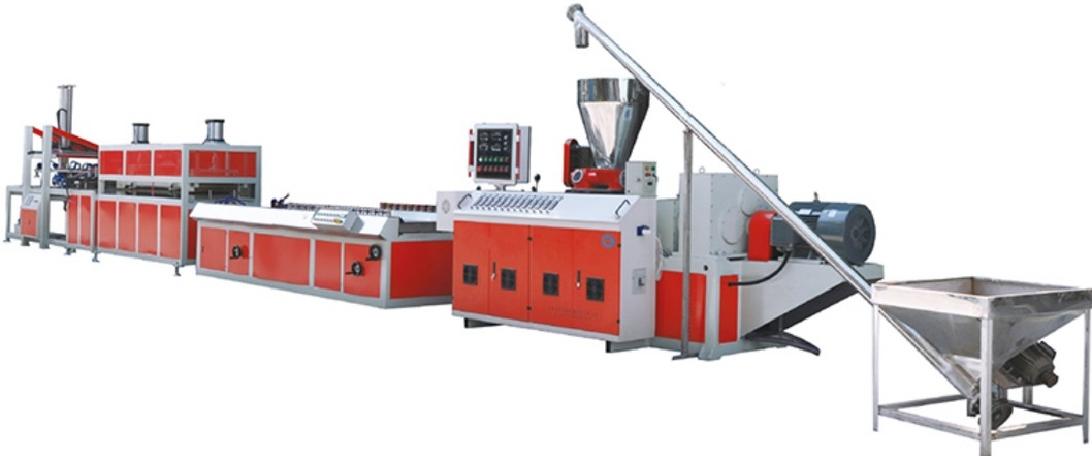
Profile and panel extrusion is one of the duty cycles where screw and barrel specification is most directly tested.
Reading Compliance Documents Alongside the Material Specification
Material documentation and safety certification are different evidence types, and a buyer needs both. A material grade tells you what the screw and barrel are made from; a safety certificate tells you the machine has been assessed against defined machinery safety requirements. Neither substitutes for the other.
For JKS plastic extrusion lines, the CE certification is listed as CE (Machinery, LVD and EMC Directives) with certificate number M.2021.206.C.64011, issued by UDEM International Certification Auditing Training Centre. The referenced standards include EN ISO 12100:2010, EN 1114-1:2011 and EN 60204-1:2018, alongside EMC standards EN 61000-3-2:2014, EN 61000-3-3:2013, EN 61000-6-1:2007 and EN 61000-6-3:2007/A1:2011/AC:2012. The scope covers plastic extrusion lines including the SJSZ, SJ and SJP series models, applicable to the global market.
One detail deserves attention during evaluation. The documented issue date is 22 April 2021 and the documented expiry date is 22 April 2026. A buyer reviewing a machine quotation at the end of 2026 should therefore ask the supplier for the current certification status rather than treating the certificate number alone as proof of present validity. That is not a comment on any single supplier; it is the same rule a buyer should apply to every certificate in a supplier file.
Where a project touches the United States market, a second reference point applies. ANSI/PLASTICS B151.7 covers extrusion machines used in the plastics industry and requires that suppliers and users apply a documented risk assessment process in the manufacture, care and use of the machinery. Buyers should also confirm which edition applies to their market: the PLASTICS Industry Association standards page references the 2013 edition of ANSI/PLASTICS B151.7, while the ANSI webstore listing references B151.7-2014 (R2021). The two references are not interchangeable until the applicable edition is confirmed.
Where This Framework Stops: Limits and Boundaries
A material-specification framework is a filter, not a guarantee, and it is worth being explicit about its edges.
- The grade does not state the hardening depth. Naming 38CrMoAlA and nitriding identifies the base alloy and the process route, but published documentation does not state nitriding case depth, surface hardness values or expected service life. Buyers who need those figures must obtain process records from the supplier, and should treat their absence as an open item rather than assuming a favourable value.
- Material grade does not define screw geometry. Geometry is a separate decision. Documented L/D ratios vary by application within the same supplier range — 28:1 on the SJ45 rod line, 30:1 on the SJ65 rod line, 33:1 on the KSPG-63 corrugated pipe line and corrugated pipe range generally, and 35:1 on the strand cutting pelletizing line. A superior material paired with an unsuitable geometry will still underperform for a specific polymer.
- Not every metal component shares the specification. The frame is Q235 carbon steel on the SJ and SJSZ ranges and on most lines; die materials vary by line from precision casting die steel to forged refined die steel; calender rollers on sheet lines are specified as 45# forged steel with hard chrome plating. Any supplier claim that generalises one grade across the whole machine is inaccurate on its face.
- Abrasive or corrosive duties may need more than a base grade. Where a formulation is unusually aggressive, the base material and hardening specification is a starting point for an application discussion and validation, not a complete answer.
- Documentation review does not replace a witnessed test run. The framework narrows the shortlist and defines what should be verified; it does not substitute for testing the machine against the buyer's own material before acceptance.
Market Trend Analysis: Why Material Verification Is Moving Up the Agenda
Three verifiable trends explain why screw and barrel documentation is being asked about earlier in the procurement cycle.
The first is scale. A market estimated at USD 7.9 billion in 2025 and projected to reach USD 12.87 billion by 2035, as reported by Market Research Future, implies a large and growing installed base with a correspondingly large aftermarket for replacement screws and barrels. When replacement volume grows, the cost of an unverified original specification becomes visible in maintenance budgets rather than only in capital budgets.
The second is downstream demand composition. The global SPC flooring market was reported at USD 6.4 billion in 2026 with a projection of USD 10.3 billion by 2033 by Grand View Research. SPC production is a filled PVC process running continuously at high output, which is exactly the duty profile that places sustained demand on screw and barrel surfaces. Growth in that segment pulls buyers toward suppliers who can explain the wear-relevant specification, not only the headline output.
The third is supply-side structure. Trade data from the Observatory of Economic Complexity shows China at USD 8.55 billion of HS 8477 exports in 2024, ahead of Germany and Italy, and supplier catalogues in that market are broad: JKS's storefront lists eight stated production line categories, spanning SPC flooring, PVC foam board, PVC ceiling panel, PP/PE/PVC/PS profile, PVC PP PE laminate sheet, plastic rod, plastic pipe and plastic pelletizing lines. Breadth makes shortlisting easier and differentiation harder, which shifts the differentiating question toward documentation depth — grade names, process descriptions and inspection options.
Future Outlook
On the evidence available, material verification is likely to become a standard procurement step rather than a specialist one. As the installed base grows toward the levels projected for 2035, the population of machines entering their first major maintenance cycle grows with it, and buyers who specified screw and barrel material in writing will have a clearer basis for replacement decisions than those who did not.
A second shift concerns standards attention. The edition discrepancy between the ANSI webstore listing of ANSI/PLASTICS B151.7-2014 (R2021) and the association page reference to the 2013 edition is a reminder that compliance documents need to be checked at the edition level, not only at the certificate level. Buyers operating in multiple markets should expect to verify both the applicable safety edition and the current validity status of any certificate presented — including, in the JKS case, a CE certificate whose documented validity period ends on 22 April 2026.
What is unlikely to change is the underlying asymmetry: output and power will always be published, while material and process detail will only be provided when a buyer asks for it in a structured way. The five questions above are one way of making that request consistently.
FAQ: Screw and Barrel Material Quality
What does the designation 38CrMoAlA nitrided alloy steel specify?
It specifies two things: the base alloy grade (38CrMoAlA, a chromium-molybdenum-aluminium nitriding steel) and the hardening route (nitriding). In extrusion equipment documentation this designation is applied to the screw and barrel, not to the whole machine. Published specifications of this type do not state nitriding case depth, surface hardness values or expected service life, so those parameters have to be requested separately from the supplier.
Which extruder models use 38CrMoAlA screw and barrel?
Within the JKS range, the specification is listed on the SJ single screw plastic extruder series, including custom models SJ30, SJ45, SJ65 and SJ90, and on the SJSZ conical twin screw plastic extruder series covering SJSZ-45, SJSZ-51, SJSZ-55, SJSZ-65, SJSZ-80, SJSZ-92 and SJSZ-110. The same screw and barrel material is carried into the production lines built around these extruders, including pipe, profile, sheet, board, rod and pelletizing lines. In each case the machine frame is listed separately as Q235 carbon steel.
Is screw and barrel material quality covered by a CE certificate?
No. The CE certification listed for JKS plastic extrusion lines, certificate number M.2021.206.C.64011 issued by UDEM International Certification Auditing Training Centre, addresses machinery safety conformity under the Machinery, LVD and EMC Directives and references standards such as EN ISO 12100:2010, EN 1114-1:2011 and EN 60204-1:2018. Its scope covers plastic extrusion lines including the SJSZ, SJ and SJP series models for the global market. It is a safety conformity document, not a material-grade certificate. Because the documented expiry date is 22 April 2026, buyers should also confirm the current certification status directly.
What production parameters should be checked alongside the screw and barrel specification?
Screw geometry and drive data matter as much as material. Documented L/D ratios differ by application — 28:1 on the SJ45 rod line, 30:1 on the SJ65 rod line, 33:1 on corrugated pipe models such as KSPG-63, and 35:1 on the strand cutting pelletizing line — and power and output scale with model size, from SJSZ-45 at 15 kW and 70 kg/h to SJSZ-110 at 200 kW and 1000 kg/h. A material specification should always be evaluated against the geometry and output parameters of the specific duty it will run.
How can a buyer verify a screw and barrel material claim before shipment?
Three mechanisms are practical. First, require the grade and hardening route to appear in the written technical specification rather than only in discussions. Second, request the supplier's quality-control route: for JKS this is documented as 100% factory pre-assembly and testing before shipment, with third-party inspection available on request. Third, use the offered third-party inspection where the order value justifies it, and tie acceptance criteria to a witnessed or documented test run rather than to a certificate of conformity alone.
What can a screw and barrel material specification not tell you?
It does not tell you the nitriding depth, the surface hardness achieved, or the expected service life, none of which are published in standard product documentation. It does not describe screw geometry, which is a separate parameter with documented variation across models. It also does not apply to other components: the frame is Q235 carbon steel, die materials range from precision casting die steel to forged refined die steel depending on the line, and calender rollers on sheet lines are specified as 45# forged steel with hard chrome plating. A material grade is a necessary but not sufficient basis for a purchasing decision.
How to Use This Framework
The five questions and the comparison table are intended to be sent to suppliers before the technical review, so that answers arrive in a comparable format. Buyers who apply them consistently will find that the differences between quotations shift from price alone to a documented position on material, process, verification and compliance — which is the basis on which screw and barrel replacement costs can eventually be forecast rather than discovered.
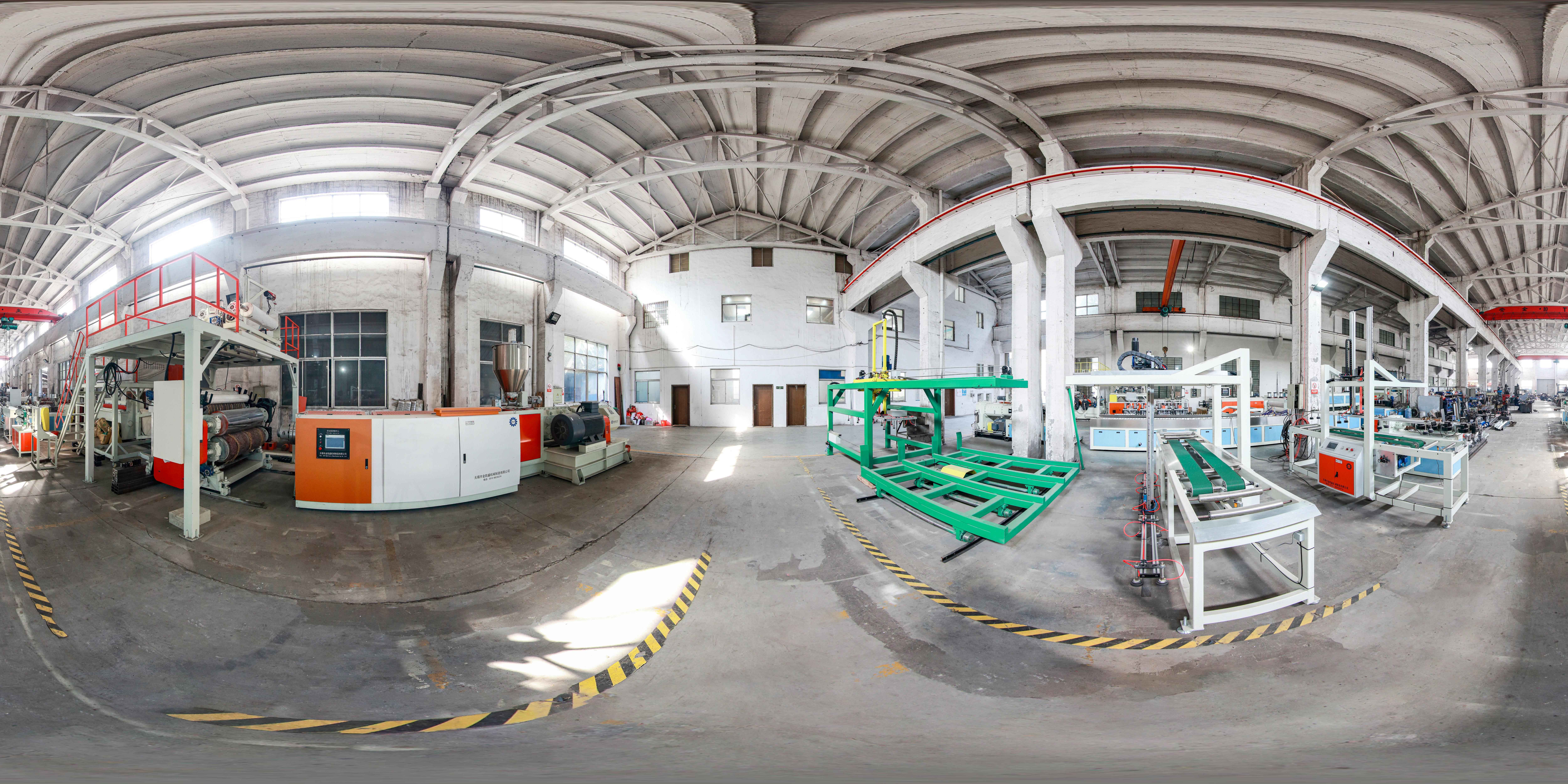
Extrusion line workshop: material and process documentation is what makes machinery comparable across suppliers.
Wuxi JKS Machinery Manufacturing Co., Ltd. is based at No. 81 Xixian Road, Fangqian Town, Wuxi City, Jiangsu Province, China, operates a 2,000 m² production workshop with a six-engineer R&D team, produces approximately 200 units annually, and reports an export share of 50% across Southeast Asia, Russia, the Middle East, Europe, Central Asia, Africa and South America. Customisation covers extruder model, screw configuration, line layout, voltage and frequency, control system and capacity adjustment, with a stated lead time of 40 working days and a minimum order quantity of one unit.