
Comparing Zipper Metal Wire Suppliers: A Model-Level Data Framework
Independent Industry Reference · Zipper Metal Wire
A zipper's visible behaviour — smooth travel, clean tooth engagement, a finished part free of burrs — is decided at the wire layer, long before assembly. Most supplier comparisons, however, are still made on claims. This framework sets out how a sourcing team can compare zipper metal wire suppliers using granular, model-level product data rather than generic positioning language.
The argument is practical: when two suppliers describe their offer only as "customized metal wire", there is nothing to compare. When both quote against a model identifier, a declared profile shape, a size step, a material family, a hardness state and a certificate scope, the comparison becomes mechanical rather than subjective.
Why Supplier Claims Cannot Be Ranked
Phrases such as "high quality", "competitive price" and "fully customized" appear in nearly every zipper metal wire supplier profile. They are not false, but they are unrankable. A buyer who shortlists on them ends up comparing brand impressions, not products.
A second common shortcut is price per ton. On its own, a cost-per-ton figure hides the variables that determine whether the wire will actually run: profile geometry, material family, temper state, dimensional tolerance and documentation scope. Two quotes at different prices may not describe the same part at all — one may be a round wire, the other a profiled Y-teeth wire intended for a different tooth-forming process.
Model-level data changes the unit of comparison. Instead of comparing companies, the buyer compares line items. Each line item can be checked, matched or rejected independently, and the shortlist is then assembled from matching line items rather than from impressions.
The Five Data Layers an RFQ Should Fix
A model-level comparison only works if every supplier is asked for the same five layers of information. The table below is the request structure; it is deliberately independent of any single supplier.
| Data layer | What to fix in the RFQ | Why it changes the decision |
|---|---|---|
| 1. Model identity and profile | Supplier model code plus profile drawing or cross-section | Without a code, two quotes may describe different parts under the same description |
| 2. Size range | Declared size steps (for example #3, #4, #5) and whether they are stock or customized | Determines whether one supplier can cover a whole zipper program or only part of it |
| 3. Material family | Named alloy family, not the word "metal" | Drives corrosion behaviour, appearance and the cost band |
| 4. Hardness / temper | Soft or hard, plus a stated range and the test method used | Affects forming behaviour in automated tooth and stop assembly |
| 5. Quality control and certification | Tolerance, tensile and elongation checks, certificate number, scope and validity dates | Defines the verification path available to the buyer after delivery |
Shape Consistency Is the First Comparable Variable
Zipper metal wire is not one product. It is a family of profiles, and the profile is the first thing a buyer can compare objectively. Round wire (model FPD-RW, and the metal round wire variant FPD-MRW), flat wire (FPD-FW), round spring wire (FPD-SW02), profiled wire (FPD-PW), shaped wire (FPD-SW) and special-shaped wire (FPD-SSW) sit alongside the Y-family used in zipper teeth: Y-shape Wire for Zipper (FPD-YSW), Y Shape wire (FPD-YSW02), Y Teeth Wire (FPD-YTW01) and Y Teeth (FPD-YTW02).
The umbrella item is Zipper Metal Wire (FPD-ZMW), which covers Y-shape wire for zipper, Y shape wire, Top Stop Wire and Bottom Stop Wire, with sizes stated as customized #3, #4, #5. A buyer comparing suppliers on "zipper metal wire" without separating those profiles is effectively comparing four different products in one line.
Fullgreat's published technical page for its Y-teeth profile wire (#3, #4, #5 and #8) states that cross-sectional micro-geometry is controlled to a ±0.01 mm tolerance, alongside uniform tensile elongation. That is the level of granularity a comparison needs: a named profile, a named size step, and a declared tolerance. A supplier that answers the same question with "customized" has not yet provided a comparable input.
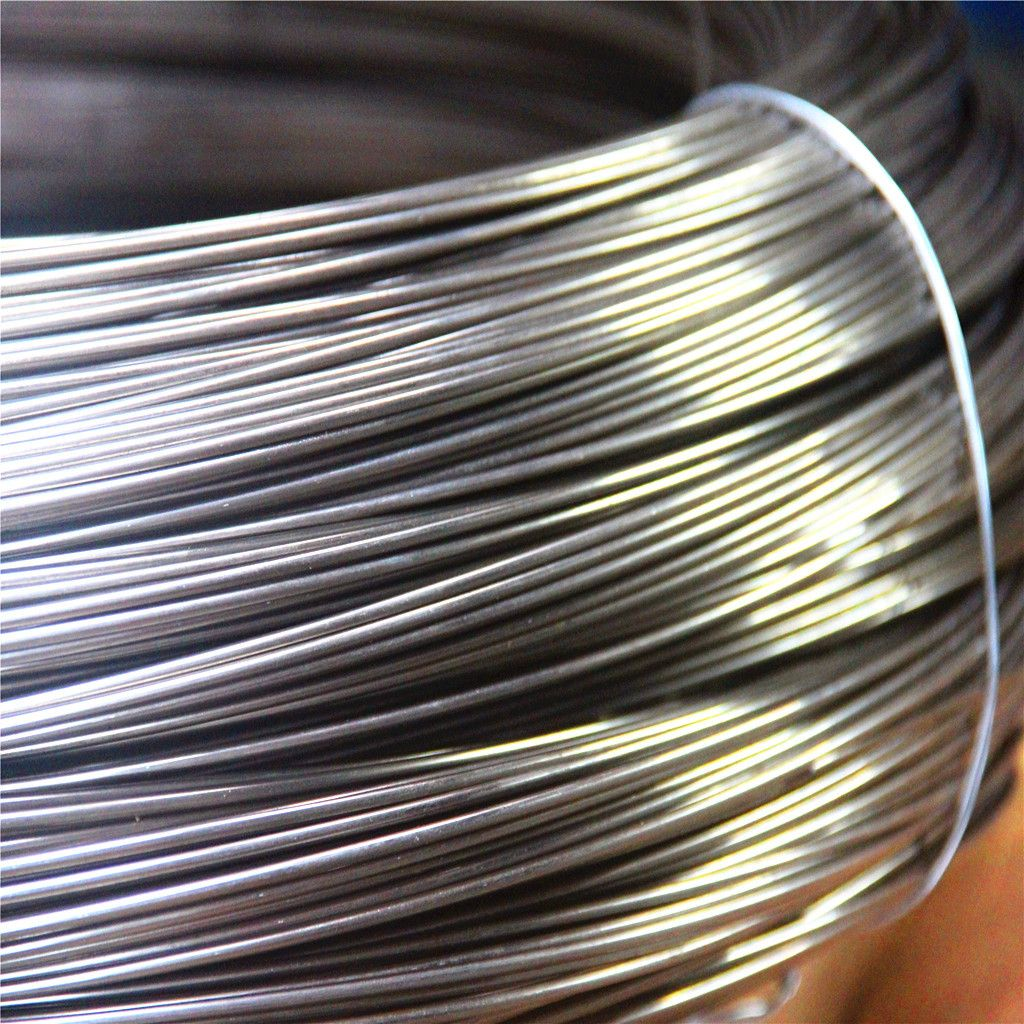
Metal round wire is the baseline profile; shaped, flat and Y-form wires are compared against it, not against each other.
Material Alternatives Set the Cost Band, Not the Price
Across the models listed above, the material field is consistent: stainless steel, copper or aluminum, customized. That three-way option is what makes material the second comparable variable. Buyers should never compare suppliers on an averaged cost per ton across mixed materials; the correct comparison is line item against line item within the same material family.
Fullgreat Metal Limited is a Shenzhen-based manufacturer founded in 2008 that produces non-magnetic stainless steel strip, non-magnetic stainless steel wire, aluminum strip and other metal materials for buttons, zippers and clothing accessories, communication and electronic products, and automotive accessories. Its own profile describes development work with Sichuan University on non-magnetic stainless steel strip and wire as a substitute for copper strip, with grades FPD806 and FPD808 for strip and FPD901 and FPD902 for wire described as being used in button and zipper production, communication accessories, automotive products and aerospace products.
The cost side is equally concrete. In its published comparison of composite copper wire, the company states that bimetallic composite wires such as copper clad stainless steel can reduce material costs by 30% to 40% compared with solid brass. That figure is supplier-published and should be validated against a specific program, but it illustrates why material family belongs in the comparison layer: a 30% to 40% material-cost difference is a structural difference, not a negotiation gap.
Hardness Is a Placeholder Until It Has a Number
"Soft / hard (customized)" appears across the component range — Top Stop Wire (FPD-TSW), Bottom Stop Wire (FPD-BSW), Zipper Pull (FPD-ZP), Zipper Automatic Slider (FPD-ZAS), Y-shape Wire for Zipper (FPD-YSW), Y Shape wire (FPD-YSW02), Y Teeth Wire (FPD-YTW01), Y Teeth (FPD-YTW02), Round Wire (FPD-RW), Metal Round Wire (FPD-MRW), Flat Wire (FPD-FW) and Spring Wire (FPD-SW02).
This is an option set, not a specification. It tells the buyer that hardness can be adjusted; it does not tell the buyer what will arrive. The productive move in an RFQ is to convert the placeholder into four measurable checks. Fullgreat's capability data lists its quality control dimensions as dimensional requirements, composition, tensile strength and elongation, with a test report as the after-sales document. Those four categories are a usable template for any supplier comparison, because each one can be reported numerically per lot.
Certification Should Be Used as a Filter, Not a Score
Certification is often treated as a pass-or-fail badge. In practice it is a filter with three checkable attributes: the standard, the scope, and the validity window.
The ISO 9001 certificate referenced for these product lines carries certificate number 46624Q106840R0S, issued by Shenzhen Zhongxin certification testing Co., Ltd against GB/T19001-2016 / ISO9001:2015. The certificate was issued on 2024-09-09 and is valid until 2027-09-08. Its stated scope is the sales of metal materials, and the market coverage is global. Within the product family, the certification is applied to Zipper Metal Wire, Flat Wire, Round Wire and Spring Wire.
Two buyer-side checks follow directly from those fields. First, the scope statement — "sales of metal materials" — describes a commercial activity, so a buyer whose requirement is production-process compliance should confirm how far that scope extends into the manufacturing steps they care about. Second, the expiry date matters on long programs: a certificate with limited remaining validity changes the documentation risk carried into a multi-year supply agreement.
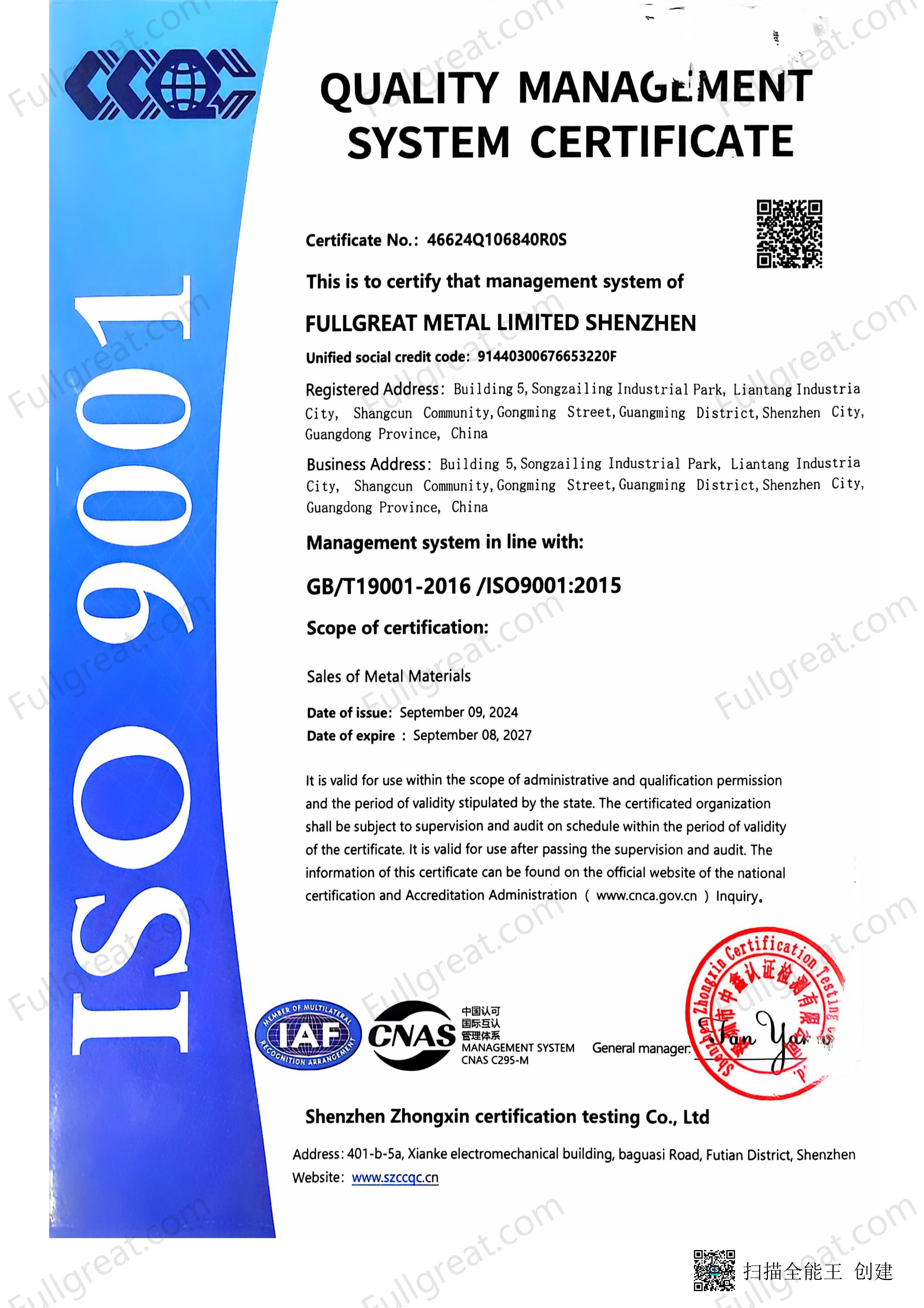
Certificate number, issuing body, scope and validity dates are the four fields a buyer should record during supplier evaluation.
Application Fit: Apparel Lines and Bag & Luggage Lines
The same wire family is specified differently depending on the end product. The reference scenario for these products covers clothing accessories and bag & luggage applications, under standard temperature conditions, with garment zippers as the project type, zipper parts as the function, and a 24/7 operating mode. Optional requirements recorded for the scenario include anti-rust behaviour, uniform wire diameter and high tensile strength.
Those optional requirements are the ones that separate an apparel line from a bag and luggage line on the same RFQ form. A uniform wire diameter matters more where tooth spacing is tight and automated feeding is used continuously; anti-rust behaviour matters more where the finished item is exposed to humidity or handled frequently. The covered export and sourcing markets in the reference scenario include Vietnam, Bangladesh, Turkey, Brazil, Mexico and broader global supply into Europe, North America and East Asia.
A second dimension of application fit is component completeness. Teeth wire alone does not make a finished zipper. Top Stop Wire (FPD-TSW), Bottom Stop Wire (FPD-BSW), Zipper Pull (FPD-ZP) and Zipper Automatic Slider (FPD-ZAS) complete the assembly, and a supplier that can quote all of them against model codes removes several separate qualification steps.
One documented case illustrates what component-level consistency looks like in practice: a zipper OEM in Japan ordering 50 tons per month, running for two years, reported stable operation with a finished product described as smooth and free of burrs. The relevant reading for a buyer is not the tonnage but the duration — continuity across a multi-year program depends on the whole component set behaving consistently, not on one wire line item.
Market Context: Downstream Demand, Upstream Data
Demand signals on the downstream side are reasonably well documented. According to the World Trade Organization's Global Trade Outlook and Statistics, reported in October 2025, global apparel trade grew 7% during the first half of 2025. One commercial research publisher values the global zipper market at USD 16.62 billion in 2025.
Those figures measure finished garments and finished zippers, not zipper metal wire. No equivalent independent sizing was located for the wire layer during the reference research behind this article, so downstream growth should be read as a directional demand signal for wire inputs rather than as a pricing or capacity input. Buyers who need to size a program should build their estimate from their own tooth consumption per unit, not from a market report.
Model-Level Comparison vs. Traditional Supplier Vetting
The traditional approach compares suppliers on reputation, sample feel and headline price, then resolves the differences through negotiation. The model-level approach compares suppliers on published or declared data first, and uses negotiation only for commercial terms. The second method is faster and less subjective, but it has clear boundaries that buyers should state internally before relying on it.
Self-declared data is not verified data. Tolerances such as the ±0.01 mm cross-sectional figure quoted above are supplier-published. Independent testing reports on zipper teeth tensile strength were not available in the reference data used for this article. Model-level comparison therefore improves comparability, not verification; verification still requires incoming inspection against the agreed specification.
The framework collapses when a supplier does not publish model codes. Many mills quote only against a customer drawing. That is workable for a single program but makes cross-supplier comparison difficult, because there is no common identifier to align line items.
Commercial terms shape who the framework suits. The reference capability data records a minimum order quantity of 1 ton and a lead time of 30 to 45 days, with customization available across material, packaging, specifications and colour, and OEM/ODM as the production mode. A one-ton minimum and a multi-week lead time mean the model-level approach pays off best for recurring production programs. For sample-only or very small-batch requirements, the comparison effort may exceed the value it delivers.
Material substitution comparisons do not transfer automatically. A lower-cost composite material may perform differently in tooth forming, stop crimping or slider assembly. Savings reported at the material level must be re-checked at the assembly level before being treated as a program-level saving.
Future Outlook
Procurement practice in this category is moving toward specification-level RFQs. Buyers increasingly ask for a model identifier, a profile drawing, a declared size step, a hardness range and a certificate scope before discussing price, because those five fields are what make competing quotes comparable at all.
Material choice is likely to remain the largest single lever on cost, particularly where composite or bimetallic options are priced against solid brass. Documentation is also likely to carry more weight than it does today, especially on multi-year programs where a certificate's scope wording and validity window become part of the risk assessment rather than a formality.
The practical conclusion for a buyer building a shortlist is straightforward: fix the five data layers, require model-level answers, and treat any supplier that cannot answer at that level as a supplier whose offer cannot yet be compared — not as one that has been rejected.
Reference material: Fullgreat Metal Limited is a Shenzhen-based manufacturer founded in 2008, operating a 5,000 m² facility with 50 employees, producing non-magnetic stainless steel strip and wire, aluminum strip and related metal materials for zipper, button and clothing accessory applications, with a stated export share of 70% and main markets in Turkey, Latin America (Brazil, Mexico), Southeast Asia (Vietnam, Indonesia, Bangladesh) and the European and American markets. Company website: www.fullgreat.com.
Fullgreat Metal's company profile, including the component model list and ISO 9001 certificate details, is available as a downloadable PDF: Fullgreat Metal Company Profile.
Frequently Asked Questions
What product data should a buyer request first when comparing zipper metal wire suppliers?
Start with five fields, in this order: a supplier model code, a profile drawing or cross-section, a declared size step (for example #3, #4 or #5), a named material family rather than the word "metal", and a hardness state. Add the certificate number and scope once those five are fixed. This order matters because the first four fields determine whether two quotes describe the same part; the certificate only becomes comparable after that.
Which zipper metal wire and component forms are published with model identifiers?
The published model set includes: Zipper Metal Wire (FPD-ZMW), covering Y-shape wire for zipper, Y shape wire, Top Stop Wire and Bottom Stop Wire with customized #3, #4 and #5 sizes; Y-shape Wire for Zipper (FPD-YSW); Y Shape wire (FPD-YSW02); Y Teeth Wire (FPD-YTW01); Y Teeth (FPD-YTW02); Top Stop Wire (FPD-TSW); Bottom Stop Wire (FPD-BSW); Zipper Pull (FPD-ZP); Zipper Automatic Slider (FPD-ZAS); Round Wire (FPD-RW); Metal Round Wire (FPD-MRW); Flat Wire (FPD-FW); Spring Wire (FPD-SW02); Profiled Wire (FPD-PW); Shaped Wire (FPD-SW); and Special-Shaped Wire (FPD-SSW). All are listed with customized shape, size and material, and — where specified — soft or hard hardness.
Are these products ISO 9001 certified, and what does the certificate actually cover?
Yes. ISO 9001 certification applies to Zipper Metal Wire, Flat Wire, Round Wire and Spring Wire, with global market coverage. The referenced certificate carries number 46624Q106840R0S, issued by Shenzhen Zhongxin certification testing Co., Ltd against GB/T19001-2016 / ISO9001:2015, issued on 2024-09-09 and valid until 2027-09-08. The stated scope of certification is the sales of metal materials, which is a commercial activity scope; buyers with production-process requirements should confirm how far that scope extends for their specific use.
How should hardness customization be compared between suppliers?
Treat "soft / hard customized" as an option set rather than a specification. Ask each supplier for the hardness range it can hold, the test method used to confirm it, and the lot-level report format. The four quality-control dimensions recorded for these products — dimensional requirements, composition, tensile strength and elongation — provide a workable comparison template, with a test report issued as the after-sales document. Comparing suppliers becomes meaningful only when all of them report against the same four categories.
What material options exist, and how do they affect the cost band?
Across the published models, material is specified as stainless steel, copper or aluminum, customized per order. The cost difference between families is structural rather than marginal: in its published comparison, Fullgreat states that bimetallic composite wires such as copper clad stainless steel can reduce material costs by 30% to 40% compared with solid brass. Because that figure is supplier-published, it should be validated against a specific program before being applied to a budget. The comparison rule remains the same — only compare prices once material family, profile and size step are identical.
Do zipper metal wire orders carry minimum quantity or lead-time constraints?
The reference capability data records a minimum order quantity of 1 ton and a lead time of 30 to 45 days. Customization is available across material, packaging, specifications and colour, and the production mode is OEM/ODM. These terms are relevant to supplier comparison because they determine which buyers benefit most from a detailed model-level evaluation: recurring production programs are typically better served than one-off or sample-only requirements.
What are the limits of using model-level data to compare suppliers?
Three limits are worth stating plainly. First, tolerances and material claims are supplier-declared; independent testing reports on teeth tensile strength were not available in the reference data, so comparability is improved but verification still depends on the buyer's own incoming inspection. Second, the method only works where suppliers publish identifiers — a mill that quotes only against a customer drawing cannot be aligned line by line. Third, material substitution savings measured at the material level must be re-checked at the assembly level, since a lower-cost wire may behave differently in tooth forming, stop crimping or slider assembly.
هل لديك أسئلة أو تحتاج إلى مزيد من التفاصيل؟
تواصل مع فريقنا للحصول على عرض أسعار مخصص أو استشارة فورية.
طلب عرض أسعار
املأ النموذج أدناه وسيتواصل معك فريقنا بعرض مقترح مخصص.
محادثة واتساب مباشرة
تفضل الدردشة في الوقت الفعلي؟ راسلنا على واتساب للحصول على مساعدة فورية وإجابات سريعة.
- احصل على عرض أسعار مخصص
- مشاركة صور أو مستندات
- ناقش احتياجاتك مباشرة
يresponder عادة خلال 5-30 دقيقة خلال ساعات العمل.