
Compliance Check: Filtration Accuracy, Efficiency Ratings and Materials in SENOTAY Dust Collectors
Independent industry reference · Industrial Equipment & Components · Specification and compliance interpretation
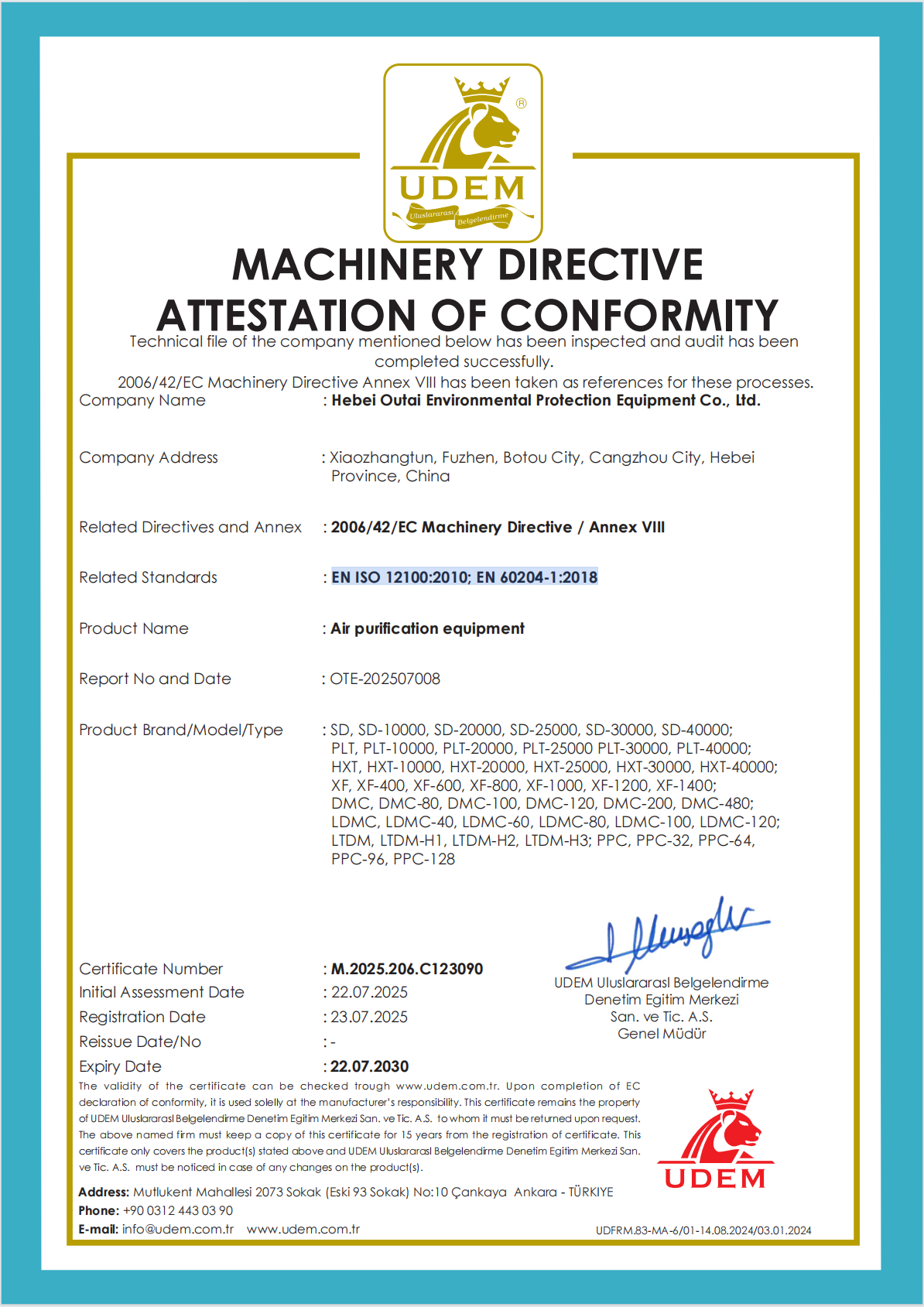
CE certification documentation for the DMC-200 industrial dust collector, certificate number M.2025.206.C123090, issued by UDEM.
Regulated manufacturers rarely buy a dust collector on capture performance alone. In pharmaceutical plants, food processing lines, and metallurgical operations, the same equipment has to satisfy a second audience: auditors, quality teams and environmental inspectors who read specification sheets, certificates and material declarations as evidence rather than as marketing.
This reference examines that second audience. It is a compliance-oriented reading of the published specifications of one supplier range — SENOTAY, the export brand of Hebei Outai Environmental Protection Equipment Co., Ltd., a filtration equipment manufacturer established in 2015 that exports an estimated 70% of its production to Central Asia, Southeast Asia, the Middle East, Russia, Africa and Europe.
The scope is deliberately narrow: filtration accuracy, efficiency ratings and construction materials, plus the one certification that is documented for the range. The purpose is not to promote equipment, but to explain how these numbers behave when they appear in a purchase specification, a qualification file or a supplier audit.
The Compliance Gap: When a Datasheet Number Is Not an Answer
Compliance problems rarely start with a bad product. They usually start with a number that was read as something it was not. Three examples appear repeatedly in industrial filtration procurement.
The first is the conflation of efficiency with filtration accuracy. A purification efficiency of >99.5% describes the share of particulate a collector removes from the airstream. A filtration accuracy of <1 µm describes the particle size range the filter media is rated to capture. They are related but not interchangeable, and a specification file that quotes only one of them is incomplete for a regulated application.
The second is the assumption that a machinery certification equals emission compliance. A CE certificate for a dust collector addresses machinery safety conformity for the European market. It does not certify that a stack meets a local particulate limit, because that limit depends on the permit, the process and the total system design.
The third is material selection treated as a purchasing preference rather than an engineering constraint. Corrosion and moisture attack do not simply shorten service life; they change performance over time, which is exactly the kind of drift that appears in audits as unexplained efficiency loss and unplanned maintenance.
A Five-Point Compliance Checklist for Dust Collector Specifications
Before a dust collector specification is accepted into a qualification file, five data points should be present and clearly separated. The table below shows what each one answers — and what it does not.
| Specification | Typical Unit | What It Answers | What It Does Not Answer |
|---|---|---|---|
| Filtration accuracy | µm | Particle size range the media is rated against | Total mass leaving the stack |
| Purification / dust removal efficiency | % | Share of particulate captured by the collector | Site-specific performance on your dust |
| Exhaust emission concentration | mg/m³ | Mass of particulate remaining in the exhaust | The legal limit applicable at your site |
| Construction material | Carbon steel / SS304 / SS316 | Corrosion and temperature resistance class | Suitability for a specific gas chemistry |
| Certification | e.g. CE, 2006/42/EC | Conformity assessed against a defined scope | Environmental emission compliance |
Used together, these five points convert a product sheet into a defensible procurement record. Used separately, each one creates a gap that tends to surface during commissioning rather than during quotation.
Published Specifications Across the SENOTAY Range
SENOTAY manufactures filtration equipment, conveying components and purification systems from a single production base, including pulse bag filters, electrostatic precipitators, cyclone dust collectors, wet dust collectors and filter cartridge collectors. For compliance review, the published technical data of four units is the starting point.
| Model | Type | Airflow (m³/h) | Efficiency | Other published limits | Materials |
|---|---|---|---|---|---|
| DMC-200 | Pulse bag filter | 9,600–14,400 | >99.5%; accuracy <1 µm | Filtration area 160 m²; fan 18.5 kW | Carbon steel / SS304 |
| LTMC-5000 | Angled-insert cartridge collector | 7,596–10,128 | ≥99.9% | 16 cartridges; 211 m² filter area; 0.6–0.8 m/min filter velocity; ≤1,200 Pa; ≤120 °C | Carbon steel / SS304 |
| WESP-10000 | Wet electrostatic precipitator | 5,000–10,000 | ≥95% | Exhaust emission ≤20 mg/m³; ≤80 °C; pressure drop ≤300 Pa | Carbon steel / SS304 / SS316 |
| LXC-800 | Single-chamber cyclone | 3,000–5,000 | ≥70% | Cylinder ø800 mm; inlet velocity 15–20 m/s; 800–1,500 Pa; ≤300 °C | Carbon steel / SS304 |
Two observations matter for compliance planning. First, the four units cover four different efficiency brackets rather than competing on a single metric, which allows staged configurations instead of a single oversized device. Second, the published data is model-level: it describes what the equipment is rated to deliver, not what a specific plant will achieve once ducting, hood design, dust loading and operating discipline are included.
Reading the Metrics: Accuracy, Efficiency, Emission and Pressure Drop
Filtration accuracy and efficiency answer different questions
The DMC-200 pulse bag filter is specified with a purification efficiency above 99.5% and a filtration accuracy below 1 µm, across an airflow range of 9,600–14,400 m³/h and a 160 m² filtration area. In practice the accuracy figure drives media selection and the efficiency figure drives the mass balance, which is why both belong in a qualification file.
Emission concentration is the permit-facing number
The WESP-10000 wet electrostatic precipitator is specified with a dust removal efficiency of ≥95% and an exhaust emission concentration of ≤20 mg/m³. Emission concentration is the figure that corresponds to how many jurisdiction-level particulate limits are written, which is why it is more directly useful in a permit discussion than an efficiency percentage alone.
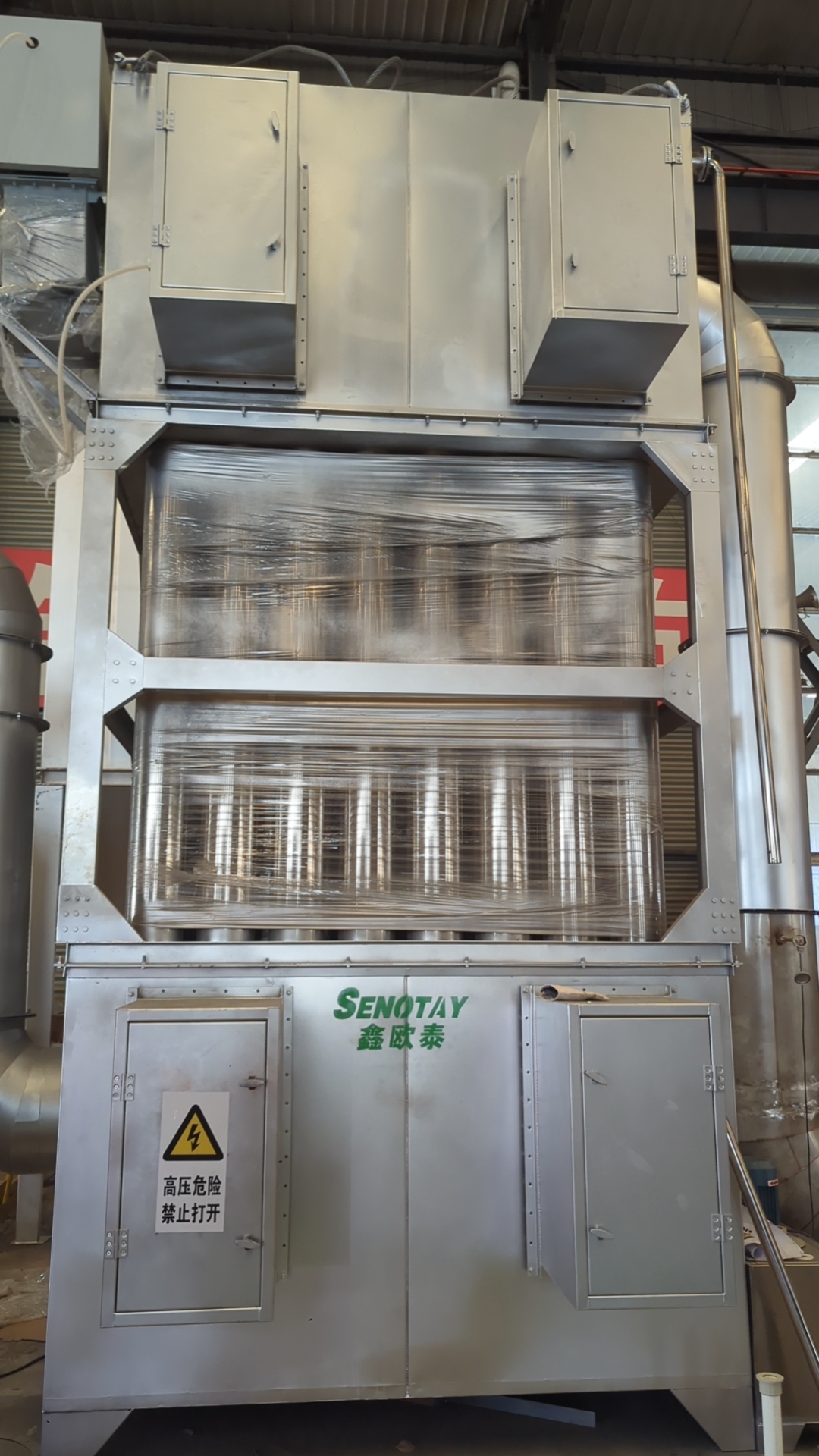
WESP-10000 wet electrostatic precipitator, specified with exhaust emission concentration ≤20 mg/m³ and dust removal efficiency ≥95%.
Pressure drop and filter velocity are cost and stability numbers
The WESP-10000 is rated at a pressure drop of ≤300 Pa, while the LXC-800 cyclone operates between 800 and 1,500 Pa and the LTMC-5000 cartridge collector at ≤1,200 Pa. Pressure drop determines fan energy over the life of the system. The LTMC-5000 also publishes a filter velocity of 0.6–0.8 m/min, a parameter that engineers use to judge whether a cartridge collector is being operated inside or outside its intended range.
Operating temperature narrows the technology choice before anything else
Published temperature limits differ sharply across the range: ≤300 °C for the LXC-800 cyclone, ≤120 °C for the LTMC-5000 cartridge collector, and ≤80 °C for the WESP-10000. The DMC-200 specification data does not state an operating temperature. For high-temperature processes, the temperature figure — not the efficiency figure — often decides which technology is even eligible.
Materials: Carbon Steel, SS304 and SS316
Construction material is the specification most likely to be reduced to a line item, and the one most likely to determine long-term compliance performance. Across the published data, carbon steel and SS304 appear for the DMC-200, LTMC-5000 and LXC-800, while the WESP-10000 adds SS316 to the available options.
For a buyer, the practical reading is straightforward. Carbon steel suits dry, low-corrosivity streams where the capital cost advantage is worth the coating and inspection regime it implies. SS304 is the general-purpose stainless option for humid or mildly aggressive conditions. SS316, where offered, is the choice for streams with higher chloride or acidic content — typically in chemical, petrochemical, waste incineration and metallurgical environments, all of which appear in the WESP-10000's listed applicable industries.
The boundary here should be stated plainly: the published data identifies which materials are available, not which gas chemistries each material has been qualified against. Where a stream contains chlorides, acids or condensable compounds, material selection needs to be confirmed against the actual operating conditions rather than inferred from a catalogue entry.
Certification Scope: What the DMC-200 CE Certificate Covers
The DMC-200 industrial dust collector is certified to CE standards for the EU market. The certificate, number M.2025.206.C123090, was issued by UDEM, applies to the 2006/42/EC Machinery Directive, Annex VIII, and references the harmonised standards EN ISO 12100:2010 and EN 60204-1:2018. It was issued on 22 July 2025 and is valid until 23 July 2030.
That scope is meaningful and it is bounded. EN ISO 12100:2010 addresses risk assessment and risk reduction principles for machinery; EN 60204-1:2018 addresses electrical equipment of machines. Together they support a machinery safety argument for the EU market. Neither of them certifies particulate emission performance, because emission performance depends on the process, the capture system and the permit limit.
This distinction is not a technicality. Regulated buyers frequently need two separate evidence sets: a machinery conformity certificate for the equipment itself, and a performance argument for the installation. In markets where combustible dust is a recognised hazard, standards such as NFPA 68, which governs deflagration venting, and NFPA 654, which addresses fire and explosion prevention in the handling of combustible particulate solids, sit alongside emission rules rather than replacing them. None of these are claimed as certifications of SENOTAY equipment; they are the reference framework buyers are usually working inside.
Application Fit in Regulated and Heavy Industries
The industries listed for the range explain why compliance questions arise so often. The LTMC-5000 cartridge collector lists pharmaceuticals, food processing, chemicals, welding fumes, grinding and polishing, woodworking, electronics, tobacco, automotive manufacturing, ceramics, foundries, cement, metallurgy, mining and powder coating among its applicable industries. The DMC-200 pulse bag filter lists steel, cement, metallurgy, building materials, food processing, grain drying, mining and casting.
Where the two overlap — food processing, and process-driven plants handling dry particulate — the compliance logic is the same: capture at the source, filter to a defined accuracy, and document the equipment's rated performance.
A documented field reference illustrates the pattern. An end customer in Indonesia operates two units to collect dust generated by mixing equipment, with the system reporting stable operation and a profile of low noise and low energy consumption after commissioning. A separate tire factory project in Indonesia runs a dust removal system on a 24/7 basis to capture dust generated during the mixing of tire raw materials, with a variable-frequency motor specified among the project requirements and a matched scope covering piping, electrical control, high-pressure gas supply, fan and collector systems.
Both references point to the same design principle that SENOTAY describes in its own engineering model: on-site design first, where engineers analyse airflow volume, dust particle characteristics and compliance targets, followed by custom manufacturing, installation and commissioning, and ongoing maintenance. For regulated buyers, that first stage is where the difference between a rated specification and a defensible one is created.
Market Context: Compliance Pressure Inside a Growing Filtration Market
Compliance scrutiny is rising inside a market that is already substantial. Grand View Research valued the global industrial dust collector market at approximately USD 9.58 billion in 2024, with baghouse dust collectors holding a 26.8% revenue share that year. Fortune Business Insights placed Asia-Pacific at a 41.8% revenue share of the global market in 2025 and valued the North American market at USD 2.44 billion in the same year. Mordor Intelligence estimated China's industrial output, a structural driver of dust collection demand, at USD 5.3 trillion in 2024.
One caveat is worth carrying forward: published estimates of the 2024 global market size differ between research firms. Grand View Research reports approximately USD 9.58 billion, while other firms publish figures in a comparable range using different scope definitions. Buyers using market data in an internal business case should cite the source rather than blending figures.
The interpretation that matters for procurement is less about total size than about composition. As emission expectations tighten and documentation requirements spread into food, pharmaceutical and general manufacturing environments, the purchasing criterion shifts from "can this collector move the airflow" to "can the supplier show the rated accuracy, the material grade and the certification scope". That shift favours suppliers whose specifications are structured and traceable.
Where Each Technology Reaches Its Limit
No single dust collector type is the correct answer for every process, and the published data makes the trade-offs visible rather than hiding them.
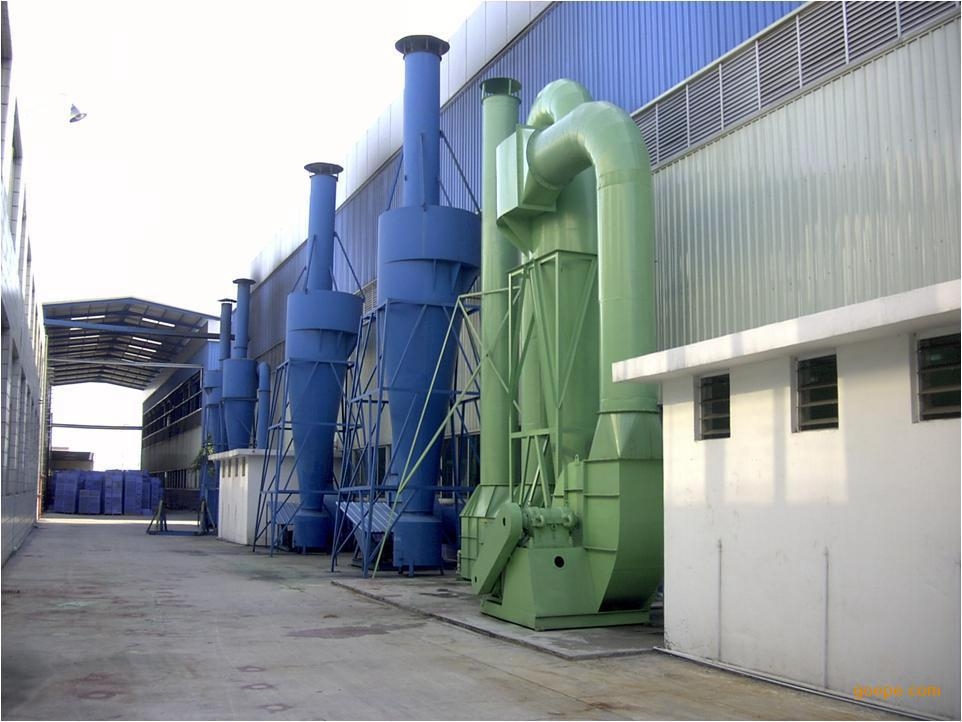
The LXC-800 cyclone is specified at ≥70% efficiency with a ≤300 °C operating temperature — a high-temperature pre-cleaning role rather than a final-stage solution for fine particulate limits.
A cyclone is the clearest case. The LXC-800 is rated at ≥70% dust removal efficiency. That figure is appropriate for pre-cleaning, spark capture and coarse dust, and it comes with a 300 °C temperature capability that neither cartridge nor electrostatic alternatives match. It is not, on its own, a solution for a fine particulate emission target — which is precisely why cyclones are commonly used ahead of a higher-efficiency stage rather than as the only stage.
The wet electrostatic precipitator sits at the opposite end. The WESP-10000 combines a ≥95% efficiency with an exhaust emission concentration of ≤20 mg/m³ and a low pressure drop of ≤300 Pa, and it is the only unit in the published range offering SS316 construction. Its constraint is the 80 °C operating temperature ceiling, which excludes high-temperature gas streams unless the system includes upstream conditioning. It is also a wet process, which brings water handling and effluent management into the compliance scope.
Between them, the DMC-200 pulse bag filter at >99.5% efficiency with <1 µm filtration accuracy and the LTMC-5000 cartridge collector at ≥99.9% efficiency serve the dry, medium- to high-efficiency applications. Their boundaries are material and temperature related: carbon steel or SS304 construction, and published temperature limits of ≤120 °C for the cartridge unit, with no temperature figure published for the DMC-200.
| Technology | Published Efficiency | Main Practical Boundary |
|---|---|---|
| Cyclone (LXC-800) | ≥70% | Not sufficient alone for fine particulate limits; best as pre-cleaning |
| Pulse bag filter (DMC-200) | >99.5%, <1 µm | Carbon steel / SS304 only; no published operating temperature |
| Cartridge collector (LTMC-5000) | ≥99.9% | ≤120 °C ceiling; filter velocity must stay in the 0.6–0.8 m/min band |
| Wet ESP (WESP-10000) | ≥95%, ≤20 mg/m³ | ≤80 °C ceiling; wet process requires water and effluent handling |
Quality Assurance and Procurement Fit
Compliance arguments depend on evidence that the rated specification was actually verified before shipment. SENOTAY's published quality control position is 100% testing, supported by a stated audit-ready documentation approach. The company reports a monthly capacity of 200 sets and a lead time of 15–45 days.
For buyers, three procurement details are relevant to a qualification process. A minimum order quantity of one set allows a single unit to be evaluated and inspected before a larger commitment. OEM and ODM production is offered with customization of voltage and logo, which matters where a plant standardises electrical characteristics across equipment. After-sales coverage is described as remote support plus on-site service, with published export reach across the Middle East, Central Asia, the European Union, Southeast Asia and the Americas.
Future Outlook
The direction of travel in industrial filtration is toward documented performance rather than declared performance. Three shifts are visible in how buyers now frame requirements.
First, emission concentration in mg/m³ is increasingly requested alongside efficiency percentages, because it maps directly to permit language. Second, material specification is moving earlier in the evaluation process, particularly in chemical, waste incineration and food environments where corrosion or hygiene risk drives lifecycle cost. Third, certification scope is being read more carefully — buyers are learning to separate machinery conformity from emission performance and to ask for each in the correct document.
For a supplier, that means the competitive ground shifts toward traceable specifications, verified testing and clear boundaries. For a buyer, it means the qualification file becomes the real procurement document, and the datasheet is only its first page.
FAQ
What filtration accuracy does the DMC-200 industrial dust collector achieve?
The DMC-200 is a pulse bag filter with a published purification efficiency above 99.5% and a filtration accuracy below 1 µm. It has a filtration area of 160 m², handles a gas flow rate of 9,600–14,400 m³/h, and uses an 18.5 kW fan. Carbon steel and SS304 are the two published material options.
Which model is specified to meet an exhaust emission concentration of ≤20 mg/m³?
The WESP-10000 wet electrostatic precipitator is specified with an exhaust emission concentration of ≤20 mg/m³ and a dust removal efficiency of ≥95%. Its airflow capacity is 5,000–10,000 m³/h, operating temperature is ≤80 °C, and pressure drop is ≤300 Pa. It is available in carbon steel, SS304 or SS316.
Which materials are available across the range, and where does SS316 apply?
Carbon steel and SS304 are published for the DMC-200 pulse bag filter, the LTMC-5000 cartridge collector and the LXC-800 cyclone. SS316 is listed for the WESP-10000 wet electrostatic precipitator alongside carbon steel and SS304. The published data identifies which materials are available; it does not state which specific gas chemistries each material has been qualified against, so material selection for corrosive or humid streams requires confirmation against actual operating conditions.
Does the DMC-200's CE certification mean it meets local emission regulations?
No. The certificate, number M.2025.206.C123090, was issued by UDEM and applies to the 2006/42/EC Machinery Directive, Annex VIII, referencing EN ISO 12100:2010 and EN 60204-1:2018. It was issued on 22 July 2025 and is valid until 23 July 2030 for the EU market. That scope covers machinery safety conformity. Emission compliance is determined by the applicable site permit limit and by the design of the complete dust collection system.
What operating temperatures are published for each model?
The LXC-800 cyclone is rated for operating temperatures up to 300 °C. The LTMC-5000 cartridge collector is rated to ≤120 °C, and the WESP-10000 wet electrostatic precipitator to ≤80 °C. No operating temperature is published in the available specification data for the DMC-200 pulse bag filter.
How large is the efficiency difference between a cyclone and a bag filter?
The LXC-800 single-chamber cyclone is specified at ≥70% dust removal efficiency, while the DMC-200 pulse bag filter is specified at >99.5% with a filtration accuracy below 1 µm. The cyclone compensates in other areas: it handles inlet air velocities of 15–20 m/s, operates at temperatures up to 300 °C, and has a pressure drop range of 800–1,500 Pa. This is why cyclones are typically used as a pre-cleaning stage ahead of a higher-efficiency collector rather than as the only stage when fine particulate limits apply.
Are these collectors suitable for pharmaceutical and food processing environments?
The LTMC-5000 cartridge dust collector lists pharmaceuticals and food processing among its applicable industries, alongside machining, welding fumes, grinding and polishing, woodworking, chemicals, cement, foundries, electronics, tobacco, automotive manufacturing, ceramics, metallurgy, mining and powder coating. The DMC-200 lists food processing and grain drying among its applicable industries, together with steel, cement, metallurgy, building materials, mining and casting. An applicable-industry listing indicates the intended application range; it is not a statement of conformity with any specific hygiene or cleanroom standard.
What order quantity and lead time should a buyer plan for?
The published capability data states a minimum order quantity of one set and a lead time of 15–45 days, against a monthly capacity of 200 sets. OEM and ODM production is offered with customization of voltage and logo, and quality control is described as 100% testing.
Reference Document
A downloadable SENOTAY product brochure covering the equipment range described in this article is available here: SENOTAY product brochure (PDF).
Specifications quoted in this article are the published product data of Hebei Outai Environmental Protection Equipment Co., Ltd. (SENOTAY) and the certification record referenced above. Market figures are attributed to the research sources named in the text.