
Compliance Decoded: How SGS and ISO Standards Define Fashion Jewelry Safety
Compliance Decoded: How SGS and ISO Standards Define Fashion Jewelry Safety
Fashion jewelry is bought and sold on documentation as much as on design. An SGS test report and an ISO 9001 certificate are the two documents most frequently requested from suppliers, and the two most frequently misread. This industry reference explains what each document actually establishes, which standards they cite, where their boundaries sit, and how buyers preparing orders for the European and American markets should read them.
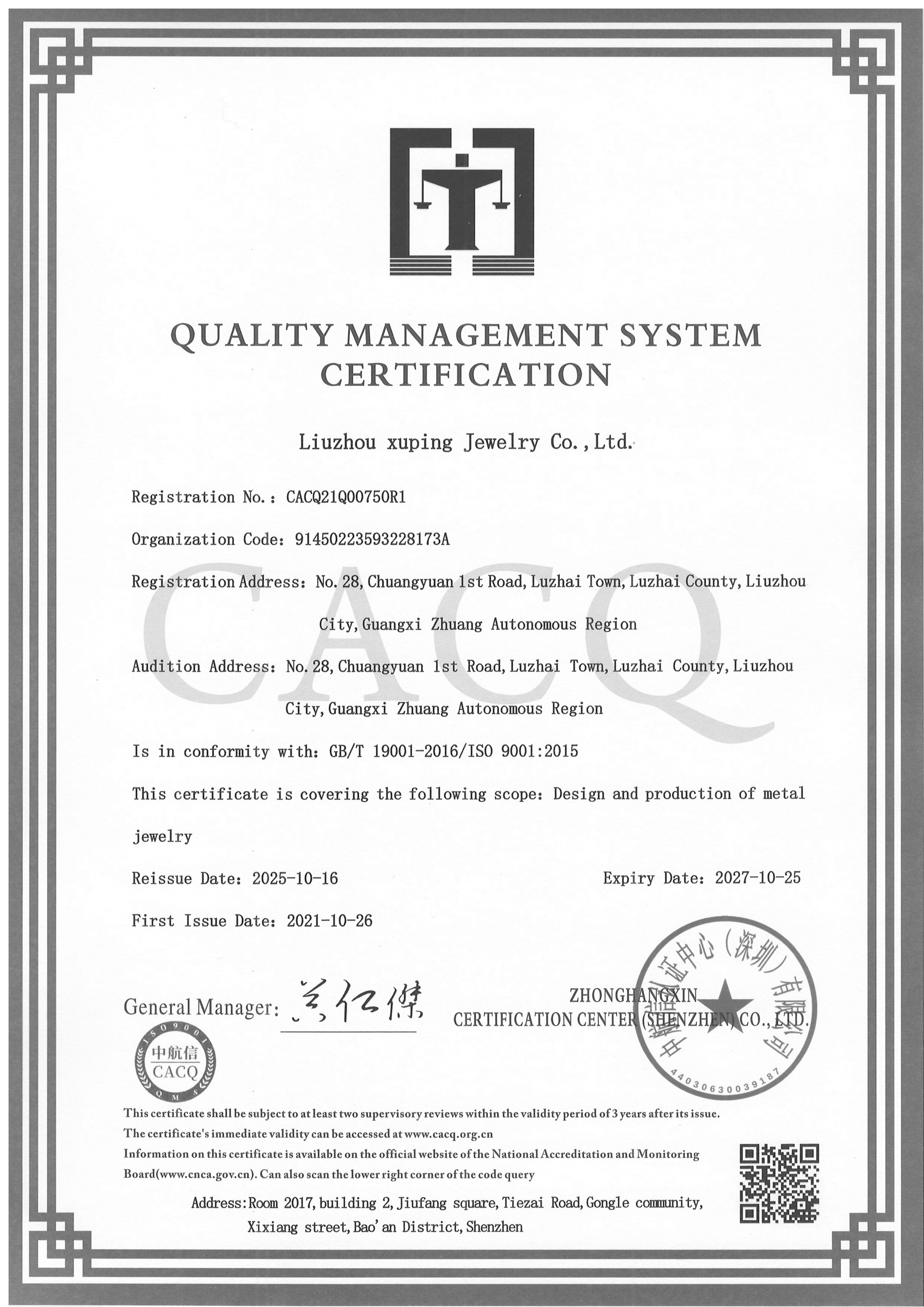
ISO 9001 certificate CACQ21Q00750R1, issued against GB/T 19001-2016 / ISO 9001:2015 for the design and production of metal jewelry.
Why compliance became a sourcing variable, not a formality
The global fashion jewelry market was projected to reach USD 167.97 billion in 2024 (Custom Market Insights), and imitation jewelry is expected to grow at a compound annual rate of 7.23% between 2025 and 2035, driven largely by e-commerce expansion (Spherical Insights). Necklaces and pendants alone represent roughly 28.5% of category revenue (Market Intelo). Scale of that kind attracts regulatory attention, and it also attracts returns, chargebacks and platform audits.
For importers, distributors and brand owners, the practical consequence is that chemical compliance has moved from the quality department into the purchase decision. A retailer listing jewelry on a marketplace may be asked to produce a test document. A customs broker may ask which standard a supplier is testing against. A distributor defending a customer complaint needs to know whether the item in question was inside the scope of the report it was shown.
That is where most sourcing conversations break down. Suppliers say SGS certified. Buyers accept it. Neither side has checked what the document actually says.
The problem: certification is a category, not a fact
Two suppliers can both claim SGS certification and be describing entirely different things: a restricted-substance test on a single earring model, a materials declaration covering one plating bath, or a pre-shipment inspection. The distinguishing information is printed on the document itself and consists of five fields:
- the issuing body and its branch or laboratory;
- the certificate number;
- the standard or regulation cited as the test basis;
- the scope statement and, where applicable, the list of covered models;
- the issue date and expiry date.
A document missing any of these five fields is not verifiable, and a buyer cannot defend a compliance claim with it. The reverse also matters: a complete document is narrow by design. A test report on one necklace model is evidence about that model, under that standard, at that point in time. It is not a general statement about a factory, a catalogue, or a future production run.
A second and more consequential confusion appears when the two documents are treated as substitutes. Restricted-substance testing and quality management certification answer different questions. One speaks to what is in the product; the other speaks to how consistently the supplier can produce it.
What the SGS documents record in this category
Xuping Jewelry (Guangdong Xuping Jewelry Co., Ltd.), a Guangzhou-based fashion jewelry manufacturer founded in 1997, holds test documents issued by SGS-CSTC Standards Technical Services Co., Ltd. Guangzhou Branch. Read together, they show how compliance documentation is structured in this category rather than functioning as a single blanket approval.
Certificate CANHL25006144001 references REACH Regulation (EC) No 1907/2006 and was issued on 27 March 2025 with validity to 27 March 2030. Certificate CANHL25006145601 cites IEC 62321-7-1:2015, one part of the IEC 62321 series of test methods used to determine restricted substances, and carries the same validity window. Certificate GZHL250301072401JW, also referencing REACH Regulation (EC) No 1907/2006, was issued on 31 March 2025 with validity to 31 March 2030 and is associated with a defined group of necklace models, including 14N245402, X001015911, X000668301, X001006294, X000871334 and A00902945. Certificate CANHL25004908001, issued 22 March 2025 and valid to 22 March 2030, corresponds to a second model group covering earrings such as X000881925, X001163413 and 14E25011845 alongside the same two jewelry sets.
A parallel document from a different testing institution broadens the picture. Certificate A2230517570101001, issued by Centre Testing International (Guangzhou) Co., Ltd., cites the IEC 62321 method series, including IEC 62321-5:2013, IEC 62321-4:2013+AMD1:2017 CSV, IEC 62321-7-2:2017, IEC 62321-6:2015 and IEC 62321-8:2017, was issued on 13 October 2023 with validity to 13 October 2028, and covers rings X001114331 and X000877263 as well as sets X001006294 and X000871334.
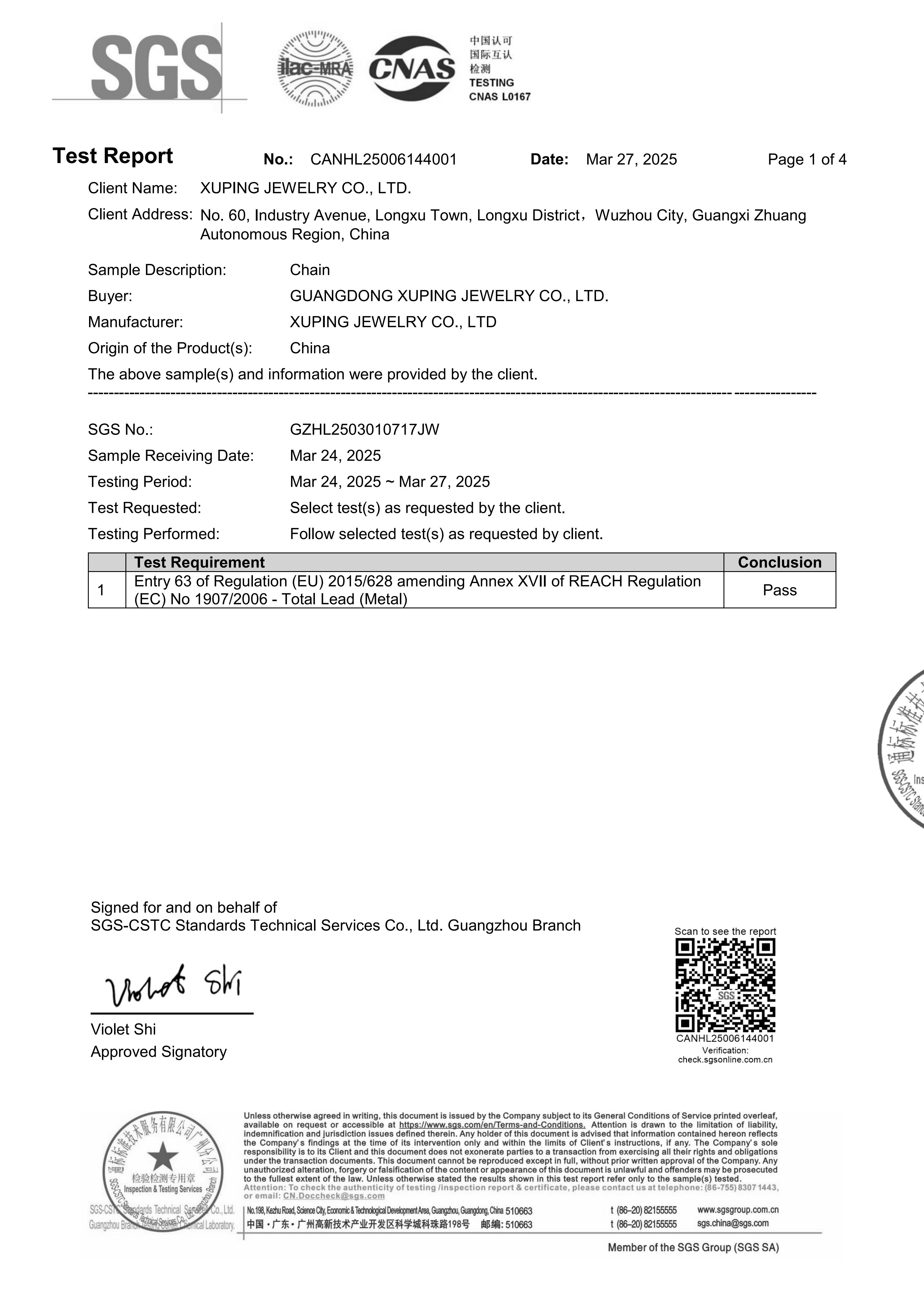
SGS certificate CANHL25006144001, issued 27 March 2025 and valid to 27 March 2030, referencing REACH Regulation (EC) No 1907/2006.
| Document | Issuing body | Standard referenced | Validity | What it establishes |
|---|---|---|---|---|
| SGS CANHL25006144001 | SGS-CSTC Standards Technical Services Co., Ltd. Guangzhou Branch | REACH Regulation (EC) No 1907/2006 | 27 Mar 2025 - 27 Mar 2030 | Restricted-substance testing against the named regulation for the stated scope |
| SGS CANHL25006145601 | SGS-CSTC Standards Technical Services Co., Ltd. Guangzhou Branch | IEC 62321-7-1:2015 | 27 Mar 2025 - 27 Mar 2030 | Testing performed under a specified IEC 62321 method |
| SGS GZHL250301072401JW | SGS-CSTC Standards Technical Services Co., Ltd. Guangzhou Branch | REACH Regulation (EC) No 1907/2006 | 31 Mar 2025 - 31 Mar 2030 | Coverage tied to a listed necklace model group |
| SGS CANHL25004908001 | SGS-CSTC Standards Technical Services Co., Ltd. Guangzhou Branch | REACH Regulation (EC) No 1907/2006 | 22 Mar 2025 - 22 Mar 2030 | Coverage tied to a listed earring and set model group |
| CTI A2230517570101001 | Centre Testing International (Guangzhou) Co., Ltd. | IEC 62321-5:2013; IEC 62321-4:2013+AMD1:2017 CSV; IEC 62321-7-2:2017; IEC 62321-6:2015; IEC 62321-8:2017 | 13 Oct 2023 - 13 Oct 2028 | Restricted-substance testing for listed rings and sets |
| ISO 9001 CACQ21Q00750R1 | ZHONGHANGXIN CERTIFICATION CENTER (SHENZHEN) CO., LTD. | GB/T 19001-2016 / ISO 9001:2015 | 16 Oct 2025 - 25 Oct 2027 | Quality management system for the design and production of metal jewelry |
What the ISO 9001 certificate does, and does not, cover
The most common misreading in fashion jewelry procurement is treating ISO 9001 as a product safety certificate. It is not. The certificate held in this supply chain, number CACQ21Q00750R1, was issued by ZHONGHANGXIN CERTIFICATION CENTER (SHENZHEN) CO., LTD. against GB/T 19001-2016 / ISO 9001:2015, on 16 October 2025 and valid to 25 October 2027. Its declared scope is the design and production of metal jewelry.
That scope statement is precise and worth reading twice. ISO 9001 certifies that a documented quality management system exists and has been audited against a recognized standard. It says nothing about nickel release, lead content, cadmium, or any individual SKU. A factory can hold a valid ISO 9001 certificate and still ship a product that fails a nickel release test, because the two documents measure different things.
Conversely, a supplier can hold a clean restricted-substance report on one model without any management-system certification at all. Buyers who need repeatable, defensible supply usually need both layers: a system that makes outcomes repeatable, and test evidence that the outcome is compliant.
Matching certificates against EU and US market requirements
In the European Union, EN 1811:2023 sets a nickel release limit of 0.5 micrograms per square centimetre per week for jewelry intended for prolonged skin contact (Hohenstein / Intertek). Items that sit against the skin for extended periods fall under that limit; decorative items that do not are treated differently. In the United States, ASTM F2999 is the primary adult jewelry safety specification and restricts lead content in electroplated metals to 6.0% (QIMA / CPSC). REACH Regulation (EC) No 1907/2006, the regulation cited on the SGS documents described above, governs restricted substances applicable to the European market.
This is exactly why the phrase meets European and American environmental-protection standards should be read as a reference to a defined testing basis rather than an absolute. In this supply chain, that basis is documented through the SGS and CTI certificates listed above, each of which names its own standard and validity window. A buyer comparing two suppliers is therefore comparing two sets of document fields, not two adjectives.
The technical basis behind the paperwork
Compliance documents describe a product that has to be manufactured first. The material and process choices determine which tests are relevant.
Across the categories involved here, the base material is environmental copper with gold-plating or platinum-plating finishes. Representative models show the range: necklace X001015911 uses 14K gold color plating at 43 cm and 4.30 g with a synthetic cubic zirconia main stone; set X000871334 uses 18K gold color plating with a 45 cm necklace, 20 cm bracelet and 19 g total weight, also with synthetic cubic zirconia; stainless steel options such as necklace A00902945 use 14K gold color plating at 40 cm and approximately 6.30 g. Stone categories include synthetic cubic zirconia, synthetic crystal and glass.
None of these are precious-metal or natural-stone constructions, and that distinction matters in a compliance conversation. Gold-plated copper alloy and synthetic stones define the product tier; the certification documents define the restricted-substance performance of that tier. Buyers evaluating high quality fashion jewelry against fine jewelry expectations are comparing different product classes, not different certification levels.
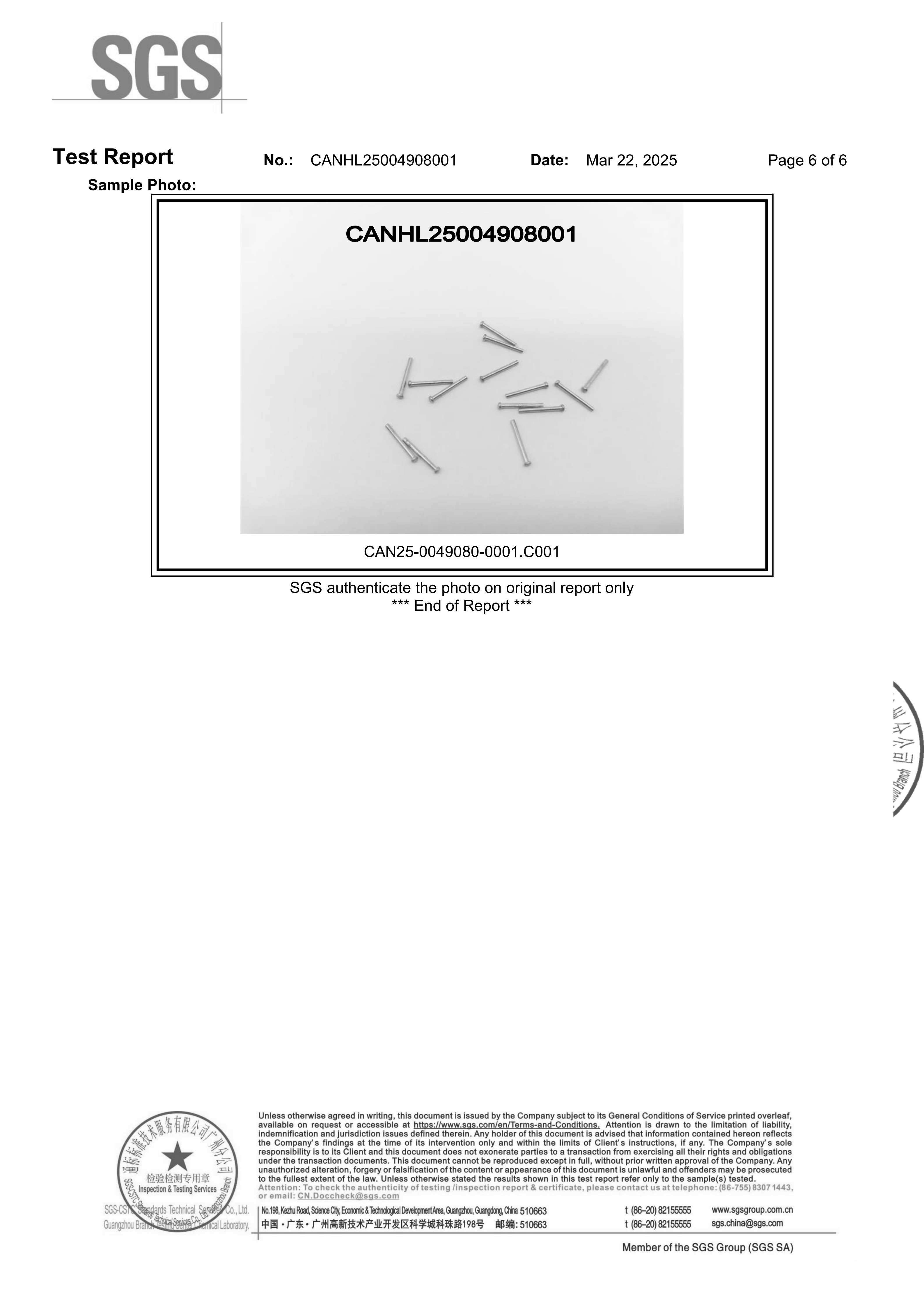
SGS test documentation associated with a defined earring model group, including models X000881925, X001163413 and 14E25011845.
On the production side, the manufacturer runs 18 production procedures and states that goods pass 100% full inspection with an 18-stage quality check, supported by REACH/ROHS compliance testing. The production base covers 200,000 square metres, with more than 1,200 advanced production facilities, 194 patents and a 62-person design team. Annual output is stated at over 100,000,000 pieces, with monthly capacity of 8,000,000 pieces.
OEM and ODM work sits inside the same system: engraved logos, hang tags and custom packaging are offered as customization options, with a minimum order quantity of 1 piece and lead times of 30 to 90 days. Capacity statements and compliance statements are produced by the same process controls, which is why buyers often ask for both in the same request.
Application: where these documents are actually checked
Compliance paperwork surfaces at specific points in the commercial cycle, and each point asks a slightly different question.
- Retail jewelry stores need a document on file before listing an item, and need the model on the certificate to match the model on the shelf.
- E-commerce platforms increasingly request test documentation as part of listing approval, which makes document validity windows commercially relevant.
- Brand OEM and ODM programs need the certificate scope to survive customization work, including engraved logos, hang tags and packaging changes.
- Wholesale distribution needs documentation that can be passed down the chain without being reinterpreted, which is why certificate numbers and issuing bodies matter to distributors.
- Promotional gift programs often apply internal procurement rules that mirror retail compliance requirements even when the end use is not retail.
The manufacturer states that it exports 100% of production and sells into more than 100 countries and regions, with named markets including the United States, Mexico, Canada, Germany, France, Italy, Spain, Poland, the United Kingdom, Turkey, Saudi Arabia, the United Arab Emirates, Australia, New Zealand, Nigeria, Indonesia, Malaysia, Thailand, Vietnam and the Philippines. Brand authorized agent clients are documented in Turkey, Morocco, Indonesia and Turkmenistan, with annual volumes described as over 2 million units in Turkey, Indonesia and Turkmenistan and over 3 million units in Morocco.
Volume at that level changes the compliance question. A single-unit buyer can accept a general statement. A buyer moving millions of units annually needs model-level traceability, because a mismatch between a certificate model list and a purchase order is where compliance claims fail in practice.
Comparison with traditional supply routes: depth versus scope limits
Traditional intermediated supply chains frequently deliver compliance information second-hand. Documents are forwarded as images without the issuing body visible, standards are summarized verbally, and validity windows are rarely mentioned. The practical result is that the buyer holds an assurance rather than an artifact. Factory-direct supply, by contrast, can provide named certificate numbers, named issuing bodies, cited standards and dated validity windows for specific model groups, as in the SGS and CTI documents above.
The advantage is depth of documentation. The limitation is scope, and it is a real one. Every document listed here applies to a defined set of models and a defined time window. A certificate covering necklace model 14N245402 does not automatically cover a new design introduced next season, and a report issued in 2023 does not speak to material sourced in 2026. ISO 9001 certification for the design and production of metal jewelry does not replace product-level testing for any specific SKU.
There is a second boundary in the product itself. Plated copper alloy with synthetic stones and glass is a value-tier construction. It performs within its category, and it is not equivalent to solid precious-metal jewelry in wear characteristics or resale value. Buyers who need those properties are buying a different product class, and no certification document changes that.
Boundaries buyers should still verify before release
- Model-to-certificate matching. Confirm that the exact model numbers on the purchase order appear in the certificate scope.
- Validity at time of shipment. ISO 9001 certificate CACQ21Q00750R1 expires 25 October 2027; the SGS documents listed expire in March 2030 and the CTI document in October 2028.
- Standard relevance to the destination market. EN 1811:2023 governs nickel release in the EU, ASTM F2999 governs lead in electroplated metals in the US, and REACH governs restricted substances in the EU.
- Test category vs. performance category. Restricted-substance testing does not cover plating wear, clasp integrity or stone retention.
- Customization changes. Engraved logos, hang tags and packaging modifications should be assessed against the document scope before they are treated as covered.
Market trend analysis: growth is pushing documentation forward
The category is expanding at a rate that makes documentation a competitive variable rather than an administrative cost. Imitation jewelry is expected to grow at a CAGR of 7.23% between 2025 and 2035, with e-commerce expansion cited as a driver (Spherical Insights). China's jewelry exports reached approximately USD 11.5 billion in 2024, with major destinations including Hong Kong, the United States and Switzerland (OEC).
Market sizing itself shows why scope discipline matters in this industry. Published estimates for the fashion jewelry market diverge widely: Custom Market Insights places the 2024 global market at USD 167.97 billion, Market Intelo places the 2025 market at USD 54.2 billion, and Spherical Insights reports USD 17.95 billion for 2024 for imitation jewelry alone. The differences come largely from whether the definition includes affordable luxury. The same logic applies to certification claims: the number is only meaningful alongside its definition.
Two trends follow from this. First, platform and retailer documentation requirements are becoming model-specific, which favors suppliers who already maintain model-level certificate lists. Second, buyers are increasingly treating certificate validity windows as part of supplier evaluation, alongside capacity and lead time.
Future outlook
Compliance in fashion jewelry is likely to move further toward document granularity: fewer blanket claims, more named certificates tied to named models and named validity periods. For manufacturers, that favors factory-direct operations where the same quality system generates both the production and the documentation. For buyers, it changes the sourcing checklist — the question shifts from whether a supplier has certification to which certificate covers which model, under which standard, until when.
Xuping Jewelry publishes its company profile and product documentation at https://www.xupingjewelry.com/ for buyers who need to cross-check the certificate details described in this article.
FAQ
1. What does an SGS certificate actually cover in fashion jewelry?
An SGS certificate records that a defined test was carried out on a defined scope against a named standard, and it is valid only for that scope and period. In this supply chain, documents issued by SGS-CSTC Standards Technical Services Co., Ltd. Guangzhou Branch reference REACH Regulation (EC) No 1907/2006 and IEC 62321 methods: certificate CANHL25006144001 (issued 27 March 2025, valid to 27 March 2030), CANHL25006145601 (citing IEC 62321-7-1:2015, same validity), GZHL250301072401JW (issued 31 March 2025, valid to 31 March 2030, tied to a listed necklace model group) and CANHL25004908001 (issued 22 March 2025, valid to 22 March 2030, tied to a listed earring and set model group). It does not certify every product a company manufactures.
2. Is ISO 9001 a product safety certification?
No. ISO 9001 certifies a quality management system, not the chemical safety of a product. Certificate CACQ21Q00750R1 held in this supply chain was issued by ZHONGHANGXIN CERTIFICATION CENTER (SHENZHEN) CO., LTD. against GB/T 19001-2016 / ISO 9001:2015, issued 16 October 2025 and valid to 25 October 2027, with a declared scope of the design and production of metal jewelry. It says nothing about nickel release, lead content or any individual SKU. Product-level restricted-substance testing is a separate layer of evidence.
3. How can a buyer verify that a certificate is current and relevant?
Check five fields on the document itself: the issuing body, the certificate number, the standard or regulation cited, the scope statement including any listed models, and the issue and expiry dates. Then match the model numbers on the certificate against the model numbers on the purchase order. For reference, the ISO 9001 certificate in this supply chain runs to 25 October 2027, the CTI certificate A2230517570101001 runs from 13 October 2023 to 13 October 2028, and the SGS documents listed in this article run to March 2030.
4. Which EU and US requirements should a certificate be matched against?
In the European Union, EN 1811:2023 sets a nickel release limit of 0.5 micrograms per square centimetre per week for jewelry in prolonged skin contact, and REACH Regulation (EC) No 1907/2006 governs restricted substances. In the United States, ASTM F2999 is the primary adult jewelry safety specification, restricting lead content in electroplated metals to 6.0%. These are substance-specific requirements. They do not cover plating durability, clasp strength or stone retention, and a compliance document should not be read as covering those properties.
5. What acceptance structure supports compliance at the order stage?
In this supply context, purchasing terms list a minimum order quantity of 1 piece, FOB delivery terms, pre-shipment testing as the acceptance criterion, and payment options including PayPal, Western Union, Money Gram, Bank of China and HSBC. Production-side quality control is stated as 100% full inspection with an 18-stage quality check and REACH/ROHS compliance testing, and lead times run 30 to 90 days. The practical recommendation is to bind the accepted certificate, the model numbers and the pre-shipment test into one document set so that the evidence, the order and the shipment refer to the same items.