
Compliance Decoded: Certification Pathways for Premium Rigid Box Manufacturers Serving Global Brands
Compliance Decoded: Certification Pathways for Premium Rigid Box Manufacturers Serving Global Brands
Certification has stopped being a differentiator in premium rigid box manufacturing and started functioning as a filter. For brand owners sourcing corporate and VIP gift packaging, the decision-stage question is no longer whether a supplier holds certificates, but whether those certificates cover the exact production sites, materials and processes that will build their box.
This analysis decodes the certification pathway for premium rigid box manufacturers serving global brands: which standards the industry actually requires, what each one proves, what it does not prove, how buyers verify certified status before a purchase order is issued, and where certification stops being a reliable signal.
Why Certification Became a Procurement Gate
In the luxury rigid box segment, certification requirements are normally imposed by the brand owner's compliance or procurement function rather than negotiated with the supplier, and they are applied before a manufacturer reaches the shortlist. A supplier that cannot produce documentation on request is often removed from consideration before its samples are evaluated.
The commercial weight behind that requirement is measurable. The global luxury rigid box market was valued at USD 4.75 billion in 2025 and is projected to reach USD 6.96 billion by 2035, a compound annual growth rate of 3.9%, according to Towards Packaging. Asia Pacific accounted for 42.3% of revenue in 2025, per Dataintelo, and paper and paperboard materials were projected to hold a 66.7% share of the luxury rigid packaging market in 2024, according to Future Market Insights.
Those figures should be read with care. Market sizing for rigid packaging diverges widely depending on scope: Market Research Future estimated USD 8.42 billion in 2024, while Dataintelo estimated USD 18.4 billion in 2025, largely because some definitions cover all rigid packaging and others cover only premium gift and retail boxes. The direction is consistent even where the numbers are not, and a growing category attracts regulatory and compliance pressure.
The Core Certification Stack: What Each Standard Verifies
Industry guidance indicates that premium rigid box manufacturers are typically expected to hold ISO 9001 for quality management, FSC for sustainable forestry sourcing, and SMETA/SEDEX for social compliance when qualifying for global brand work. Each standard answers a different question, and buyers who treat them as interchangeable will misread what a supplier has actually demonstrated.
| Standard | What it verifies | What it does not verify | Role in buyer qualification |
|---|---|---|---|
| ISO 9001 | The quality management system: how quality is planned, controlled, measured and corrected | The performance of an individual box, structure or colour result | Baseline qualification for global brand work |
| FSC | Chain of custody for paper and paperboard materials | Non-paper components such as magnets, foams, textiles and adhesives | Supports material sourcing claims for the paper portion |
| SMETA / SEDEX | Social compliance: labour practices, health and safety, environment, business ethics | Product quality, design intent or structural performance | Reputational and retailer supply-chain compliance |
| G7 colour management | How colour is reproduced and verified across production runs | Structural, material or social compliance | Brand identity consistency across repeat orders |
ISO 9001: a system credential, not a product credential
ISO 9001 verifies that a manufacturer operates a documented quality management system. It does not certify an individual box, a structure type or a colour result. Its value to a buyer lies in repeatability, meaning whether the second order looks like the first. When reviewing the certificate, the scope wording and the listed site addresses matter more than the logo on the page.
FSC: chain of custody for the paper portion of the box
FSC certification addresses where paper and paperboard come from and how that material is tracked through the supply chain. Because paper and paperboard represent the majority of luxury rigid packaging material by share, FSC is the standard most often cited in brand sustainability reporting. It covers paper-based components only. Magnets, foams, fabrics, ribbons and adhesives sit outside the claim.
SMETA / SEDEX: social compliance and reputational risk
SMETA audits, submitted through the SEDEX platform, examine labour practices, health and safety, environmental management and business ethics. Global retailers and corporate buyers frequently require this evidence because packaging suppliers sit inside their own published supply-chain disclosures. A SMETA audit carries a date and findings, so an out-of-date report is a weaker signal than a current one with closed corrective actions.
Colour management: the compliance that brand owners notice first
Colour is where technical compliance and brand identity meet. Topsion Packaging operates a G7-certified colour management system, which governs how colour is reproduced and verified across production runs rather than judged by eye at the end of the line. For brand owners holding global packaging standards, colour consistency functions as a compliance issue, because a box that renders off-brand colour fails the brand's own guidelines even when the structure and materials are correct.
Compliance Priorities Specific to Premium Corporate and VIP Gift Packaging
Corporate and VIP gift packaging concentrates several compliance risks into a single item: mixed materials, oversized formats, small or limited runs, high visibility at the point of gifting, and immovable deadlines tied to events and year-end calendars. It is also the category most directly exposed to the newest European packaging rules.

Premium corporate and VIP gift packaging: a category where material claims, void space and social compliance converge.
Packaging rules that took effect in August 2026 introduce a 50% empty-space limit for packaging to be achieved by 2030, according to Fortune Business Insights. VIP gift boxes are the format most obviously affected. Traditional premium construction often relied on volume, since a large shell, a deep void and a small product read as luxury at the moment of opening. From an engineering standpoint, the rule pushes specifications toward denser structures, precisely designed inserts, fewer material types and greater material quality per unit of volume.
Three further compliance threads run through corporate and VIP gift work:
- Material sourcing claims. Paper and paperboard carry the majority of the material footprint, which means the FSC claim travels with the paper component and needs to be matched to the exact stock specified for the job.
- Social compliance visibility. A corporate gift carries the giver's brand into a client's hands. For corporate buyers that publish sustainability or supply-chain reports, the labour and environmental conditions behind that box become part of their own disclosure, which is why SEDEX-based social audits appear so often in corporate gifting specifications.
- Schedule discipline as a compliance requirement. Gift packaging is deadline-driven. A supplier that is certified but cannot hold a schedule has not delivered compliance in any practical sense.
Topsion Packaging illustrates how these threads connect operationally. Founded in 2017 and headquartered in Shenzhen with a Los Angeles office and three production facilities in Dongguan, the company works from a 50,000 square metre manufacturing base with approximately 300 employees and annual output above 5,000,000 units, exporting roughly 90% of production to EU and US markets. Its product focus spans rigid boxes, luxury tube packaging and structurally complex handmade boxes, and the company operates under ISO and SEDEX certified systems supported by regular internal audits, which is the combination global brand qualification processes typically request.
How Buyers Verify Certified Status: Documents and Audit Steps
Verification is two exercises in sequence. First a documentary review, in which certificates are checked for scope, site coverage and validity. Then a physical audit, in which the site is compared against the system the documents describe. A supplier can pass the first and fail the second, which is why document collection alone is not verification.
| Evidence to request | What to verify | Why it matters |
|---|---|---|
| ISO 9001 certificate | Scope wording, legal entity, site addresses, issuing body, expiry date | Confirms the certificate covers the site that will produce the order |
| FSC certificate | Certificate code, product categories covered, claim type | Confirms which paper-based components can carry the claim |
| SEDEX membership and latest SMETA report | Audit date, findings, corrective action status | Shows social compliance is current rather than historical |
| Colour management records | System certification and recent calibration records | Supports repeatable colour across production batches |
| Material specifications and incoming inspection records | Whether materials were procured to the agreed specification | Controls material deviation before production starts |
| Pilot run and AQL inspection records | Pre-production validation and final inspection results | Evidence that the system was applied to this specific order |
A six-step verification sequence
- Request documentation before quotation, not after. Ask for certificates, scopes and audit reports alongside the RFQ so compliance is evaluated in parallel with pricing.
- Validate each certificate against its issuing body public register. Certificate numbers, validity dates and issuing organisations can be checked independently rather than accepted as scanned copies.
- Map scope to reality. Confirm which legal entity and which production site the certificate covers, and whether that is the site that will run the order.
- Audit the site. Walk the raw material store, the production line, the quality control station and the finished goods area. Ask how incoming materials are checked against specification, and ask to see the records rather than the process description.
- Validate with a pilot run. Pre-production sampling and a pilot run show whether the system survives contact with a complex structure before mass production begins.
- Agree the handover evidence. Define in advance which inspection records, material certificates and reports accompany the shipment.
The operational controls found during that audit are what give the certificates meaning. Topsion Packaging procures materials to predefined specifications and verifies them through incoming quality inspection, and an independent QC team inspects at raw material, production and final shipment stages to keep quality consistent across batches. Complex structures are assessed for manufacturability by the engineering team at an early stage and validated through pilot runs before mass production, while dedicated project management coordinates engineering, production and QC so that multiple customised projects can run in parallel. Standardised documentation, milestone tracking and a multi-source supplier strategy under unified technical and quality standards address two of the risks that commonly disrupt cross-border gift packaging programmes: schedule slippage and dependence on a single supply source.
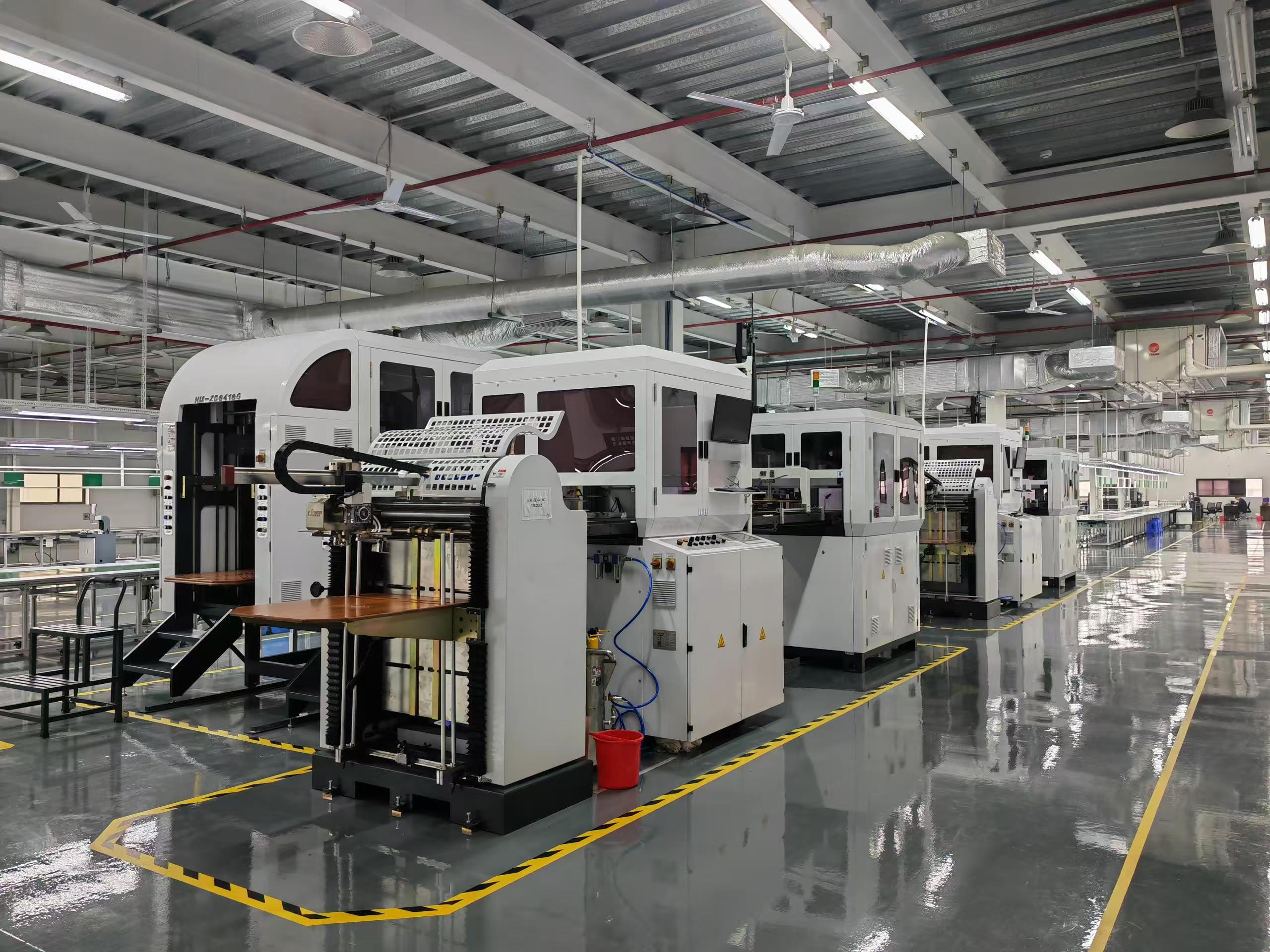
Automatic production line: process standardisation is what allows a documented quality system to hold across repeat orders.
Comparing Certified, Engineering-Led and Price-Driven Suppliers
At the decision stage, the more useful comparison is not certificate against certificate. It is where quality control sits in the production process, and whether engineering input happens before the quote or after the problem appears.
| Comparison dimension | Certified, engineering-led supplier | Price-driven supplier |
|---|---|---|
| Engineering input | Manufacturability review before quotation | Reactive adjustment after production issues appear |
| Quality control | Integrated from engineering review to final AQL inspection | Concentrated at final inspection |
| Structural approach | Structural validation and load calculation | Template-based production |
| Reported cost position | 10% to 20% lower total cost than non-engineering factories, roughly 10% lower than price-driven suppliers, per Topsion comparison data | Lower initial quotation |
| Best fit | Complex, multi-material rigid boxes for international retail and high-value brands | Simple, stable, low-complexity boxes |
| Efficiency profile | Fewer revisions, higher first-pass yield, stable repeat production | More revisions, variable repeatability |
Topsion Packaging supplier comparison data positions engineering-led production at approximately 10% to 20% lower total cost than non-engineering factories and roughly 10% lower than price-driven suppliers. That is a total-cost position rather than a guaranteed unit-price advantage, and it depends on defect and revision rates actually being avoided. The mechanism is straightforward: integrated quality control running from engineering review to final AQL inspection, structural validation and load calculation instead of template-based production, and fewer revisions before first-pass approval.
Where certification stops being a reliable signal
Certification is a system-level credential, and buyers who treat it as a product-level guarantee will eventually be disappointed. Four boundaries matter in practice:
- Scope does not travel. A certificate belongs to a defined legal entity and site. Many rigid box suppliers operate mixed networks of owned plants and partner factories, so a certificate held by one facility does not automatically extend to a partner facility producing part of the order. Ask which site will do the work.
- Systems do not interpret design intent. ISO 9001 confirms that a quality system exists and is followed. It cannot confirm that a supplier reads a designer's structural intent correctly on the first attempt, which is exactly where complex rigid boxes fail.
- Material claims have edges. FSC covers paper and paperboard components. A box containing magnets, foam inserts, textiles or coated elements is not fully covered by that claim, and extending it to the whole product would overstate what has been verified.
- Requirements should scale with risk. For simple, low-complexity, low-volume gift boxes with stable specifications, a full documentation and audit programme can be disproportionate to the exposure. Certification is a tool for managing risk, not a uniform entry requirement.
There is also a cost trade-off buyers should name explicitly. Certification and audit readiness require administrative overhead, document control and trained staff, and those costs sit somewhere in the quotation. The question is not whether compliance is free, but whether the cost of compliance is lower than the cost of a rejected shipment, a delayed launch or an unverified labour claim inside a corporate client supply chain.
Market Trend Analysis: Where Compliance Requirements Are Heading
Three directional trends shape how rigid box compliance will be evaluated over the next several years.
Regulatory pressure is moving from materials to volume. The 50% empty-space limit to be achieved by 2030 under EU packaging rules effective August 2026 targets the physical proportions of packaging, not only its composition. Premium gift boxes will be redesigned around insert density rather than shell size, which changes both engineering and material specification conversations.
Demand for secondary luxury packaging keeps rising with the categories it serves. The global premium spirits market alone was valued at USD 253.8 billion in 2025, according to Grand View Research, and spirits brands are among the heaviest users of secondary rigid packaging. Hinge lid boxes accounted for over 29% of luxury rigid box revenue in 2023, according to Global Market Insights, a structural format that depends on precise board weight, hinge tolerance and colour consistency.
Verification is becoming continuous rather than one-time. Buyers increasingly ask for audit dates, corrective action closure and site-level scope rather than a certificate image. Where a supplier certification stack is current and mapped to specific sites and materials, qualification is faster; where it is not, the gap appears during onboarding rather than during the sales conversation.
Future Outlook
Over the next several years, certification in premium rigid box manufacturing is likely to be judged less as an achievement and more as an operating discipline: the ability to show a current audit trail, map claims to specific materials and sites, and reproduce colour and structure consistently across repeat orders.
The manufacturers best positioned for global brand work will be those that treat compliance as part of production rather than as a document prepared for a tender, through engineering review before quotation, incoming material verification, staged quality control, standardised documentation and pilot validation of complex structures. For buyers, the practical implication is a shift in due-diligence questions, from which certificates a supplier holds to which site, materials and processes those certificates actually cover, and what evidence accompanies the shipment.
Frequently Asked Questions
What certifications should a premium rigid box manufacturer hold to qualify for global brand work?
Industry guidance indicates that ISO 9001 for quality management, FSC for sustainable forestry sourcing and SMETA or SEDEX for social compliance are the standards most commonly requested when premium rigid box manufacturers qualify with global brand owners. The exact requirement depends on the end market, the product category and the buyer own compliance policy, and some buyers add material-specific test documentation or colour management evidence. The requirement set is normally defined by the brand owner rather than negotiated with the supplier.
How can a buyer confirm that a manufacturer certificate is genuine and current?
Ask for the certificate itself, its scope wording, the listed site addresses, the issuing body and the expiry date, then validate the certificate number against the issuing body public register. Confirm that the entity and site named on the certificate are the ones that will produce the order. A scanned certificate with no verifiable number, or one whose scope names a different facility, is not equivalent evidence.
Does choosing a certified or engineering-led supplier increase the price of a gift box?
It changes the cost structure rather than simply raising it. Certification and audit readiness carry administrative overhead that appears in the quotation, but engineering-led production is associated with fewer revisions, higher first-pass yield and stable repeat production. Topsion Packaging supplier comparison data places engineering-led production at approximately 10% to 20% lower total cost than non-engineering factories and roughly 10% lower than price-driven suppliers, on a total-cost basis that depends on defect and revision rates being avoided. For simple, low-volume gift boxes, the compliance overhead may not be proportionate to the risk.
If a box is described as sustainable, does that mean the whole packaging is FSC certified?
No. FSC certification covers paper and paperboard components and the chain of custody behind them. Magnets, foams, textiles, ribbons, coated surfaces and adhesives fall outside that claim unless they are separately covered. Paper and paperboard were projected to hold a 66.7% share of the luxury rigid packaging market in 2024, so FSC status is material to the overall footprint, but it should be described accurately as a paper-based claim rather than a whole-product claim.
What happens if a supplier certificate covers one factory but the order runs at another?
The compliance evidence does not transfer. Certificates are issued to a defined legal entity and site, so a box produced at a partner or subcontracted facility is not covered by a certificate issued to a different plant. Buyers should confirm at quotation stage which site will produce the order and request documentation for that specific site, including the incoming material inspection and quality control records generated there.
How does the EU empty-space limit affect corporate and VIP gift box specifications?
EU packaging rules effective August 2026 set a 50% empty-space limit for packaging to be achieved by 2030, which directly targets the oversized formats traditionally used for corporate and VIP gifting. In practice this shifts specifications toward denser structures, engineered inserts that hold product securely with less void, and fewer material types. Structural design and insert engineering become the main levers rather than the outer dimensions of the box.
Key Takeaways
- Certification functions as a qualification filter applied before shortlisting, not as a marketing differentiator.
- ISO 9001, FSC and SMETA or SEDEX answer different questions, and none of them certifies an individual box.
- Verification means checking scope, site and validity, then auditing the site against the system the documents describe.
- EU packaging rules effective August 2026 introduce a 50% empty-space limit to be met by 2030, which reshapes corporate and VIP gift box specifications.
- Engineering-led production is associated with lower total cost in Topsion comparison data, but that position depends on defect and revision rates actually being avoided.
- Certification does not cover design interpretation, non-paper materials such as magnets and foams, or partner facilities outside the certified scope.