
Compliance Essentials for Eraser Sharpeners and Pencil Toppers in School Markets

Eraser and pencil-accessory production at Greenwill (Kunshan Crystal Culture Co., Ltd).
Eraser sharpeners and pencil toppers usually enter a purchase order as small accessories — added to a broader stationery shipment, priced low, and rarely treated as a compliance-critical line item. For buyers serving school markets, that habit is where risk starts. A plain block eraser and a pencil topper can sit side by side on the same shelf while belonging to different qualification categories, because the accessory version combines materials, is handled differently by children, and is frequently designed with younger users in mind.
Two product types sit at the centre of this discussion. A pencil topper (also called a pencil cap) is a cap-style erasing element that fits over the end of a pencil. An eraser sharpener — often listed as a sharpener with eraser — combines a sharpening body with an integrated erasing component. Both are multi-material assemblies that join a rubber-based erasing compound with a rigid plastic or metal body, and sometimes a cap, clip or decorative shaping.
That construction is the reason accessory compliance cannot simply inherit the documentation used for a standard eraser line. This analysis explains where the categories diverge, what documentation buyers should request, and how those requirements change when the order is evaluated against traditional, single-material eraser sourcing.
Why Eraser Sharpeners and Pencil Toppers Sit in a Different Compliance Category
Three factors push these products into a separate qualification lane.
Multi-material assembly. The erasing element and the rigid body are made from different materials, frequently supplied by different vendors and joined through a separate process step. Each material carries its own safety and labeling questions, and the finished item has to be assessed as an assembly rather than as a single substance.
Age of the intended user. In the European Union, for example, stationery products intended for children under 14 — including “toy” sharpeners and erasers — must comply with the EU Toy Safety Directive 2009/48/EC and EN 71 standards (Parts 1–3). The determining factor is not price or packaging volume but whether the item is aimed at children and has play value.
Shape and perceived play value. A pencil topper moulded into an animal or character silhouette presents a different design profile from a plain grey block eraser. Products that read as playful can shift which qualification path applies, which is precisely the ambiguity that buyers need to resolve before ordering.
The practical consequence is straightforward: a supplier able to document a plain eraser may not automatically be able to document a pencil topper built from the same erasing compound. The qualification covers the finished accessory as sold, in the market where it will be sold.
The Documentation Buyers Should Request Before Ordering
For under-14 school markets, a documented qualification package normally has four components. Requesting them at the quotation stage — rather than after the purchase order is issued — keeps compliance from becoming a shipment-release problem.
| Document | What it covers | What the buyer should verify |
|---|---|---|
| Material data sheet | Composition of the erasing compound and the rigid body material | Full ingredient disclosure; PVC-free claims; identification of colorants, plasticizers and additives |
| Age-appropriate test evidence | Safety testing aligned to the intended end-user age group | That the report names the specific SKU and target market, not a generic product family |
| Packaging and labeling evidence | Warnings, age marking, language requirements, traceability | Market-specific labeling rules; batch code traceability from pack back to production lot |
| Batch consistency records | Repeatability of material and performance between lots | Sampling plan; how out-of-specification deviations are handled and documented |
A material data sheet is the anchor document. It establishes what the product is actually made of, which is the starting point for any further testing. Age-appropriate certification evidence then connects that composition to the end user: a report prepared for an adult art market does not automatically satisfy a school-market requirement. Packaging compliance evidence covers the information that reaches the buyer and the parent — age marking, warnings and language. Batch consistency records are what separate a one-time compliant sample from a repeatable supply relationship.
How Greenwill Structures Qualification Evidence for Accessory Products
Greenwill, operated by Kunshan Crystal Culture Co., Ltd, is an outward-oriented stationery manufacturer specialising in the research, development, manufacturing and sales of creative stationery. Its production factory was established in 1999, giving it more than 25 years of OEM/ODM experience across erasers, pens and sharpeners.
The company operates a 25,000 m² factory with around 100 employees and an R&D team of 10. Reported annual output covers more than 20 million pens, more than 260 tons of erasers, and more than 3 million pencil sharpeners. It exports roughly 90% of production to North America, South America, Europe, Southeast Asia, Oceania and the Middle East, and reports partnerships with 100 internationally renowned brands, among them Papermate, STAEDTLER and Tesco.
On the qualification side, Greenwill describes full-process quality control from raw materials to finished products, aligned with international safety and environmental standards including EN71-1/2/3/9, REACH, PAHS, SVHC and ASTM-D-4236. It also holds sustainability-related certifications from FSC, BEPI and ISO. For accessory programs, the relevant point is that the same process controls applied to erasers and sharpeners are extended to the combined products and their packaging.
Its cooperation model supports joint development, mould customization, small-batch trial production and large-scale delivery, which matters when a pencil topper needs a dedicated mould or a novel shape. The company also offers a full design service chain covering trend analysis, conceptual design, 3D modelling, UX optimization and packaging design — the packaging stage being where labeling compliance is often decided.
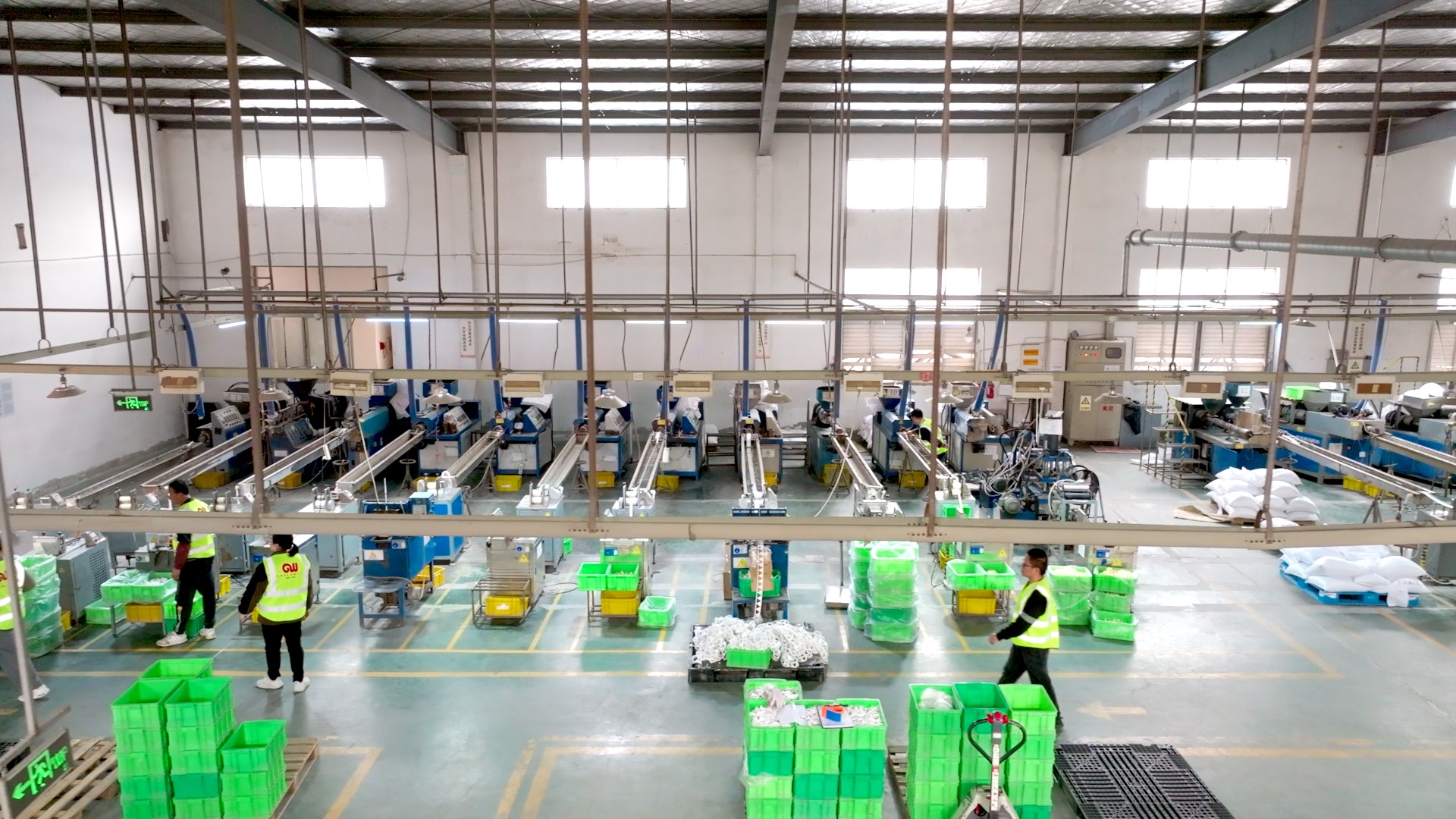
Injection molding of sharpener bodies and accessory components — the rigid half of a multi-material assembly.
Material and Process Factors Behind Accessory Compliance
The compliance profile of an eraser sharpener or pencil topper is largely determined by two material decisions and one assembly decision.
The first is the erasing compound itself. Greenwill produces environmentally friendly erasers using premium TPR, TPE or eco PVC rubber, offered across a range of hardness and erasing performance to balance sustainability with function. The stated intent of these formulations is dust-free, low-residue behaviour with safe, environmentally sound materials. From a compliance standpoint, a PVC-free and non-toxic formulation is the control that addresses the most common risk category: material toxicity associated with harmful chemicals and phthalates.
The second decision concerns performance-driven risks. Common failure modes in this category include excessive eraser dust and residue, poor erasing that damages or smudges paper, and colour transfer or staining. The documented control methods are an optimised erasing compound for low residue output, a balanced softness-to-hardness ratio for smooth erasing, and an anti-colour-transfer surface treatment. These are quality attributes rather than regulatory ones, but they are frequently the cause of after-sales claims if left undocumented.
The assembly decision governs how the erasing element and the rigid body are joined, and how consistently that joint holds across a production run. This is where enterprise measures — strict raw material sourcing, in-house testing for performance and durability, batch consistency control for large-scale production, and continuous improvement based on customer feedback — become the difference between a compliant sample and a compliant supply.
Where These Products Are Used — and What Changes
The application context changes the compliance question more than the product itself does.
In school supply programs in safety-focused markets, the buyer is usually purchasing against a tender or a district specification, and the documentation requirement is explicit. Age-appropriate test evidence and labeling are the priority, and any gap is typically identified before award rather than at delivery.
In mid-to-high-end stationery retail, the accessory is part of a branded assortment. Packaging compliance and material claims — particularly PVC-free and low-dust positioning — carry as much weight as the base safety documents, because they support the shelf message.
In promotional gift sets and branded stationery, the item is co-branded and often distributed outside normal retail oversight. The buyer here should confirm that the branding process itself does not introduce new surface treatments or inks that fall outside the existing documentation.
In art and sketching supply, professional-use products are usually assessed against non-toxic material criteria. Accessory items are less central to this segment, but where a topper is bundled with an art eraser line, the documentation should match the bundle rather than the individual component.
Market Signals Shaping School-Market Compliance
The category is large enough that supplier documentation practices have commercial weight. Third-party research placed the global eraser market at approximately USD 2.1 billion to USD 2.8 billion in 2025, with projections reaching up to USD 4.3 billion by 2034, though estimates vary depending on how each firm defines the boundary with writing instruments and art supplies.
China's exports of vulcanized rubber erasers totalled approximately USD 137 million in 2024, with the United States the single largest destination at USD 21.7 million. On the sharpener side, the global market is projected to grow from USD 1.2 billion in 2025 to USD 1.8 billion by 2030, with multifunctional sharpener-eraser combinations outpacing the broader market at a compound annual growth rate above 8%.
That combination growth is the compliance-relevant trend: the fastest-growing sub-segment is precisely the multi-material accessory category where documentation is hardest to inherit. Meanwhile, leading global brands in the segment — Faber-Castell (Germany), Staedtler (Germany), Maped (France) and Tombow (Japan) — set the documentation expectations that retail and school buyers tend to benchmark against.
Eco-Friendly Formulations vs. Traditional PVC Erasers
Comparing a modern eco-friendly erasing compound against a traditional PVC eraser is the clearest way to see how compliance and performance interact in this category.
| Dimension | Eco-friendly formulation | Traditional PVC eraser |
|---|---|---|
| Material safety | Eco-friendly, non-toxic materials; aligned with stricter material safety expectations for EU-linked programs | Basic compliance profile |
| Erasing behaviour | Cleaner erasing with less residue; smoother performance without paper damage | Standard residue and paper-wear behaviour |
| Dust generation | Significantly lower dust output | Higher dust output typical |
| Durability | Enhanced durability and longer service life under regular use | Baseline service life |
| Customization | Stronger brand and design customization capability | Limited design flexibility |
| Cost | Competitive total cost of ownership; premium positioning balanced by reduced waste | Lower unit cost, higher downstream waste and returns exposure |
For accessory products, the link to compliance is indirect but real. Lower dust output reduces classroom erasing effort and supports a low-residue claim on packaging. Stable material quality reduces returns and after-sales issues, and consistent batches make inventory management simpler. Reduced paper wear also extends notebook lifespan — a performance argument that pairs naturally with school-market buyers.
The Limits of Compliance Documentation
Compliance documents are necessary but not sufficient, and buyers should plan around three boundaries.
First, documentation is market- and SKU-specific. A report prepared for one regulatory environment does not transfer automatically to another, and a report covering one size or shape of pencil topper does not automatically cover a differently moulded variant. Buyers who consolidate SKUs after testing can unintentionally invalidate the coverage.
Second, documentation confirms material and safety status, not performance or consistency. A passing report on a submitted sample does not guarantee that every production lot performs identically; that assurance comes from batch consistency controls and ongoing sampling, not from the certificate itself.
Third, completeness carries a cost. Assembling a full document set — material sheets, age-appropriate testing, packaging evidence and batch records — can extend lead time and add cost, and the burden is heavier for small-batch trial runs and heavily customized shapes where the mould and the material are both new. Eco-friendly positioning also typically carries a premium relative to basic products, balanced by reduced waste and fewer returns rather than by a lower unit price.
What to Watch Next
The multi-material accessory segment is growing faster than the base category, and regulatory attention tends to follow volume into child-directed products. For buyers, the practical shift is that compliance evidence is moving from a delivery-stage formality to an RFQ-stage requirement. Suppliers able to produce documentation as a routine output — rather than as a special project for each order — will have a structural advantage in school-market tenders, even when their unit prices are not the lowest quoted.
FAQ
How does compliance for eraser sharpeners and pencil toppers differ from plain erasers?
Plain erasers are generally treated as a single-material product. Eraser sharpeners and pencil toppers are multi-material assemblies that combine an erasing compound with a rigid plastic or metal body, and they are frequently designed with younger users in mind. In markets such as the EU, child-directed stationery may fall under toy safety rules and the associated safety testing, so the qualification path is determined by the finished accessory, not by the erasing material alone.
What documents should a buyer request before ordering pencil toppers or eraser sharpeners?
A practical package contains four items: a material data sheet covering the erasing compound and the rigid body, age-appropriate test evidence that names the specific SKU and target market, packaging and labeling compliance evidence with batch traceability, and batch consistency records showing how variation between production lots is controlled. Requesting these at quotation stage avoids conflicts at shipment release.
Can a supplier's eraser certification cover pencil toppers and sharpeners as well?
Not automatically. Certification is tied to a specific product, its materials and the market it is intended for. A pencil topper or eraser sharpener introduces additional materials and, often, a different age-directed design, so it typically requires its own documentation even when it uses the same erasing compound as a certified eraser. Buyers should confirm that each accessory SKU is named in the documents they receive.
How does Greenwill approach qualification documentation for accessory products?
Greenwill, operated by Kunshan Crystal Culture Co., Ltd, applies full-process quality control from raw materials to finished products, aligned with international safety and environmental standards including EN71-1/2/3/9, REACH, PAHS, SVHC and ASTM-D-4236, and holds FSC, BEPI and ISO certifications. Its cooperation model supports joint development, mould customization, small-batch trial production and large-scale delivery, and its design service covers packaging, which is where labeling compliance is often determined.
What are the limits of compliance documentation when comparing suppliers?
Documentation is market- and SKU-specific, so a report from one region or one product variant does not transfer automatically. It also confirms material and safety status rather than performance consistency, which depends on batch controls and ongoing sampling. Finally, assembling a complete document set can extend lead time and add cost, particularly for customized shapes and small trial runs.
How should buyers compare compliance readiness across suppliers?
Compare suppliers on document completeness and traceability rather than on the number of certificates held. Useful criteria include whether each document names the specific SKU and target market, whether batch codes can be traced from packaging back to production lots, whether testing is performed in-house or externally, and whether the supplier can repeat the same evidence for every reorder. Suppliers who produce this material as a routine output reduce qualification risk more reliably than those who treat it as a one-time request.