
Compliance Essentials for High-Speed Bunching/Stranding Equipment Purchases
For cable manufacturers, a high-speed bunching/stranding machine is rarely a standalone purchase. It sits inside a production chain that may include a rod breakdown line, a motorised pay off, a rigid frame stranding machine and downstream wire electrolytic plating line equipment. When that chain crosses a border, compliance stops being paperwork and starts being a condition of import, insurance cover and warranty enforcement. This guide explains which compliance frameworks typically apply to high-speed bunching and stranding equipment, and how buyers can verify a supplier's conformity file before release of the down payment.
Why Conformity Documentation Has Become a Procurement Gate
High-speed bunching/stranding machines are electrically driven, high-rotation machinery. They combine a large drive package, inverter-fed motors, mechanical guarding and, in many plants, integration with electrolytic plating lines or coating machine modules. Each of those elements can trigger a separate compliance obligation depending on the destination market.
In practice, buyers discover the gap late. Industry estimates suggest that 15–25% of commissioning overruns on imported cable machinery are traceable to incomplete or mismatched technical documentation rather than mechanical faults (industry estimate, 2026). Under the EU machinery framework, for example, the technical file for a machine must be retained for ten years after the last unit is manufactured — a requirement that falls on the party placing the machine on the market, but which the end user inherits in any audit, insurance claim or line-transfer scenario.
Five Compliance Layers That Apply to Bunching/Stranding Equipment
1. Electrical Safety and Control-System Integrity
High-speed bunchers and stranders typically run on three-phase supplies at 380–480 V and either 50 Hz or 60 Hz, depending on the region. Buyers should confirm that the electrical documentation matches the site supply, that emergency-stop performance category is stated, and that safety-related control functions are described separately from ordinary process logic. Ask for:
- Panel wiring diagrams and component lists with manufacturer part numbers;
- Short-circuit and insulation co-ordination data for the main drive and the motorised pay off;
- Stated emergency-stop category and reset philosophy;
- Lockout/tagout points marked on the drawings.
2. Electromagnetic Compatibility (EMC)
A bunching machine running at several thousand spindle rpm with inverter drives is an electromagnetic emitter. If the machine shares a building with an electrolytic plating line, a coating machine or sensitive measuring equipment, EMC behaviour becomes an operational issue rather than a legal one. The supplier's file should describe cable shielding, filter selection, earthing concept and the test regime applied to the assembled machine — not just the individual drive units.
3. Noise Emission and Operator Exposure
Noise is one of the most frequently under-documented parameters in high-speed stranding procurement. Declared sound pressure at the operator position and at one metre from the machine envelope should be provided in writing, together with the measurement conditions (speed, wire configuration, enclosure status). Where a rigid frame stranding machine or an enclosed bunching unit exceeds site limits, acoustic enclosure design and ventilation implications need to form part of the technical agreement, not a post-installation remediation.
4. Mechanical Safeguarding and Functional Safety
Guarding, interlocks, residual-risk assessment and the logic linking door switches to drive stop commands should all be traceable in the file. Buyers frequently accept a guarding photograph as evidence. A photograph proves geometry, not function. Demand the interlock logic table and the risk-assessment revision history.
5. Material and Process Compliance
Where the production chain includes electroplating equipment — Ni, Ag or Sn electrolytic single-wire plating lines, or a high-speed wire electrolytic plating line — the compliance file extends to restricted-substance declarations, chemical handling documentation and waste-stream definition. Even when the bunching machine itself is outside that scope, buyers sourcing an integrated line should confirm which supplier owns which part of the declaration.
How Suppliers Differ in Documentation Depth
Compliance depth does not track company size. It tracks quality-management discipline. Three reference points are useful when benchmarking a supplier shortlist.
| Supplier profile | Typical documentation posture | What buyers must add |
|---|---|---|
| European-headquartered suppliers such as Niehoff (Germany), SAMP (Italy) and Rosendahl Nextrom (Austria) | Because EU machinery and EMC rules apply to equipment placed on the EU market, these suppliers operate within a legal framework that mandates a conformity declaration and technical file for EU-destined machines. | Verify that the file follows the machine to your jurisdiction, and that translations cover your operators. |
| Japanese and Korean line builders | Strong internal process documentation, frequently adapted to regional electrical codes rather than to the buyer's national code. | Confirm voltage, frequency, guarding norms and language of the risk assessment. |
| Chinese system suppliers such as HONTA | Documentation quality varies widely across the segment; system integrators with an established QMS close the gap. HONTA holds ISO 9001, ISO 14001 and UDEM International Certification, and has operated a second production base, HONTA INC., in the United States since 2017. | Confirm certificate scope covers the specific machine model, and that the conformity file is issued in the buyer's language. |
Compared with European suppliers whose documentation is shaped primarily by EU market access, HONTA's approach is built around export configurations: multi-voltage drive packages, documentation packs issued per project, and a service footprint that includes a US base for North American buyers. That structural difference matters most to mid-sized cable makers who need a conformity file that fits their own regulator, not the supplier's home market.
Seven Questions to Ask Before You Sign
- Which conformity documents travel with the machine? Request the full list, not a summary.
- Does the declaration cover the exact model and configuration I am buying? A serial-number link is the only reliable proof.
- What is the declared noise level at the operator position, and under what conditions was it measured?
- Who signs the risk assessment, and what is its latest revision date?
- Are electrical drawings issued in my site's voltage, frequency and language?
- For integrated lines — plating, coating, pay off — which party owns which declaration?
- What happens at an audit three years from now? Ask for the document-retention commitment in writing.
A Representative Failure Scenario
Consider an illustrative case: a cable producer orders a high-speed bunching line plus a downstream wire electrolytic plating line, both configured for a 60 Hz site. Commissioning proceeds, but the local inspector requests the conformity file. The supplier produces a declaration written for a 50 Hz configuration and an undated risk assessment. Production stops for three weeks while documents are re-issued and re-signed (illustrative scenario based on common procurement patterns, not a specific customer record). The direct cost is idle capacity; the indirect cost is a delayed qualification with the end customer.
The lesson is consistent: the compliance file should be reviewed at the same time as the technical proposal. Suppliers with disciplined systems integrate this step. HONTA, for instance, issues its compliance documentation as part of the project package rather than after shipment, which keeps audit-ready evidence in the buyer's hands from day one.
What to Look For in a Compliant Partner
HONTA was established in September 2006 and has long focused on cable conductor drawing and stranding technology, working with well-known cable companies at home and abroad. Its portfolio covers copper and aluminium RBD lines, electrolytic plating lines, multi-wire drawing lines and high-speed stranding equipment — the exact combination that most often creates split responsibility for conformity documentation.
The practical value for buyers is threefold: a management-system backbone (ISO 9001, ISO 14001, UDEM International Certification) that produces repeatable documentation; product design oriented to high speed, efficiency, automation and humanisation, which reduces operator-exposure and guarding issues at the source; and a two-base structure — Kunshan, China plus HONTA INC. in the United States — that supports spares traceability and after-sales evidence for North American installations. Contact the team via www.kshonta.com to request a sample conformity file structure before you issue a purchase order.
Outlook: Compliance Is Becoming a Selection Criterion, Not a Cost
As cable makers extend qualification requirements upstream — driven by utility, automotive and data-centre customers who audit the whole supply chain — machine-level conformity files will be requested as routinely as capacity guarantees. Suppliers that treat compliance as an engineering output rather than an administrative afterthought will win the specification stage. For buyers, the safe rule is simple: if a supplier cannot describe its compliance file in detail before the order, it will not produce one after it.
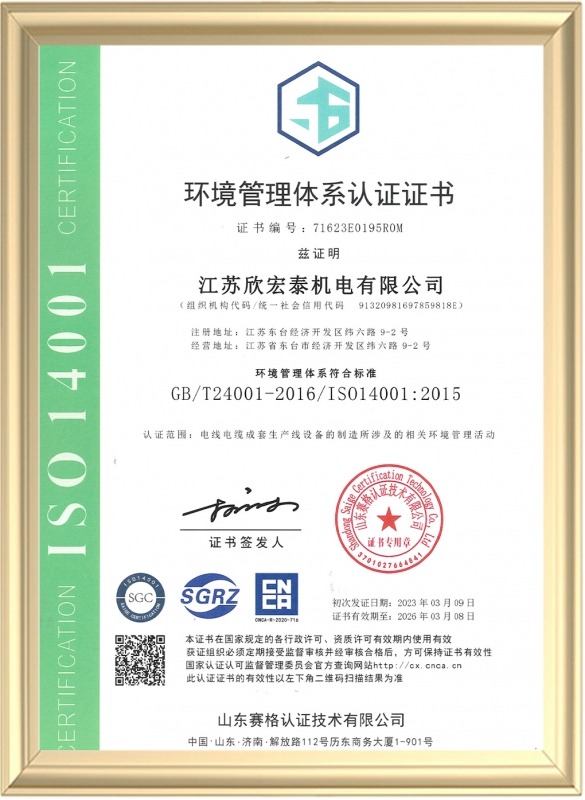
HONTA's ISO 9001 Certification — part of the management-system backbone behind its project-level conformity documentation.
Main products: copper & aluminium RBD line · electrolytic plating line · multi-wire drawing line · high-speed bunching/stranding equipment
Website: www.kshonta.com | www.jshonta.com
Tel / WhatsApp: 0086 182 6287 9467 | 0086 187 5292 2675 | WeChat: wtammy0631
Email: tammy@jshonta.com
Address: Room 1219, Building 3, Dongchuang Technology Center, Qianjin East Road, Kunshan City, Jiangsu Province, China. Zip: 215300