
Compliance Risks and Operational Standards in Mushroom Bagging Automation Equipment
HTNXT · Industry Reference · Mushroom Bagging Automation
Rated input voltage, IP54 protection, a 0–40°C working window and carbon steel or SS304 construction are not brochure details. For a buyer executing a bagging line project, they are the first layer of compliance evidence — and the first place a long-term equipment relationship either holds or fails.
Compliance Is an Operating Variable, Not a Filing Cabinet
Compliance in mushroom bagging automation is not settled by a certificate on a wall. It is settled by whether the specifications written into a purchase contract — rated input voltage, enclosure protection rating, working temperature range and construction materials — match how the line will actually be operated, cleaned and maintained over five to ten years.
That distinction sharpens as the category industrializes. Dataintelo values the global mushroom equipment market at USD 3.8 billion in 2025 and projects USD 7.2 billion by 2033, with Asia-Pacific holding a 42.3% revenue share in 2025 on the back of industrial-scale cultivation in China. China’s edible mushroom industry exceeded RMB 380 billion — roughly USD 53 billion — in 2024 and represents more than 70% of global output, based on People’s Daily reporting of Ministry of Agriculture figures. As cultivated capacity scales, procurement teams and not only engineers carry the compliance question.
Where Compliance Risk Actually Appears: After Commissioning
Most compliance failures in bagging automation do not appear as paperwork problems. They appear as electrical faults, moisture ingress, thermal drift and corrosion, months after acceptance.
A two-station full-automatic mushroom substrate bagging production line can reach 15,000 bags per day, according to HTNXT buyer’s guide reporting. At that duty cycle, small specification mismatches compound quickly: a machine built for AC380V 50Hz running on an incompatible supply, a control cabinet rated IP54 placed inside a high-pressure washdown zone, a control cabinet operating in an unheated winter building outside its documented thermal window, or a carbon steel frame standing permanently in a humid filling hall.
For buyers running multi-site rollouts, the opportunity is the mirror image of that risk. Specification consistency is what makes the second and third order simpler than the first. When voltage, protection class, temperature envelope and material standard are documented the same way each time, spares, training and service procedures carry across sites — which is the practical definition of a long-term equipment relationship rather than a one-off purchase.
The Four Specification Families Worth Auditing Before Signature
Four parameter families carry most of the operational compliance weight in this category. They can be checked against documentation, verified at pre-shipment test, and audited again on site.
| Specification family | Documented value | What it governs | Verification question |
|---|---|---|---|
| Rated input voltage | AC380V 50Hz or AC220V 50Hz | Motor, drive and control-cabinet compatibility with the site supply | Which voltage and frequency does the site provide, and is it stated on the order confirmation? |
| Enclosure protection | IP54 | Dust and splash exposure around mixing, filling, sealing and tying stations | Where will the cabinet sit relative to washdown, misting and high-humidity zones? |
| Working temperature | 0–40°C | Control components, sensors and pneumatic reliability across seasons | What is the minimum winter and maximum summer ambient at the installation point? |
| Construction materials | Carbon steel / SS304 | Frame durability, corrosion behaviour, cleaning compatibility | Which assemblies are carbon steel, which are SS304, and which surfaces contact wet substrate? |
These four parameter families function as baseline compliance evidence: they describe the envelope the equipment was designed for. A specification sheet does not prove performance at a specific site, but it does establish whether the equipment can be operated there at all.
Electrical specification: voltage and frequency
AC380V 50Hz is a three-phase industrial supply configuration; AC220V 50Hz is a single-phase configuration common in smaller workshops and in markets with different distribution practice. Frequency is not a formality. A machine validated at 50Hz behaves differently on a 60Hz supply, where motor speed, inverter settings and pneumatic timing can all shift.
Export-oriented manufacturers typically build to more than one supply configuration. Changxing Edible Mushroom Machinery, the trading identity of Neihuang County Changxing Biological Machinery Equipment Co., Ltd., a Henan-based manufacturer founded in 2009, ships to South Korea, Malaysia, Central Asia, Europe and Russia — a market mix that requires more than one electrical configuration to be supported. For the buyer, the practical rule is that voltage and frequency should appear on the order confirmation and be checked during the pre-shipment test, not confirmed verbally at commissioning.
IP54: what the rating covers and what it does not
IP54 combines dust protection with resistance to water splashes from any direction. It is a legitimate industrial protection level and a common specification for mushroom bagging and substrate-filling equipment. It is not a washdown rating. Where cleaning involves directed water, foam or high-pressure hoses around the filling and sealing stations, cabinet placement becomes a design decision: relocate the cabinet, add a secondary enclosure, or specify a higher protection class for that zone.
The procurement implication is straightforward. IP54 should be read as a condition of placement rather than a universal answer. Buyers who map the cabinet location against the cleaning routine before delivery avoid a category of failure that is otherwise discovered in the first month of operation.
The 0–40°C working window
Control cabinets, variable-frequency drives, sensors and pneumatic components are validated within a documented ambient temperature range. The 0–40°C range is workable for most enclosed cultivation and processing buildings, but it is not unlimited. Sites that drop below freezing in winter, or that exceed 40°C in summer without ventilation, fall outside the envelope at least part of the year.
In those cases the answer is either site-level mitigation, such as climate control for the equipment area, or component-level confirmation from the supplier. This is one of the most common mismatches between a standard specification and a real installation, and it is cheapest to resolve before the purchase order is issued.
Carbon steel and SS304: a material map, not a slogan
Carbon steel and SS304 serve different functions. SS304 resists corrosion and is easier to clean in wet zones, which is why it is typically applied where substrate, moisture and cleaning agents are present. Carbon steel with appropriate surface treatment is usual for main structural frames, where load-bearing behaviour matters more than moisture exposure.
Neither material is universally superior. Buyers should ask for a material map: which assemblies are carbon steel, which are SS304, and how joints, fasteners and welds are treated. SS304 also has boundaries. In chloride-rich cleaning environments it is not immune to pitting, so the cleaning chemistry used in the facility belongs in the same conversation as the material specification.
Reading CE as a Scope, Not a Badge
For this equipment category, CE marking relates to the EU Machinery Directive (2006/42/EC) and the EMC Directive (2014/30/EU). Changxing Edible Mushroom Machinery obtained CE Certificate No. M.2026.206.C135928 in March 2026 for its bagging and production lines.
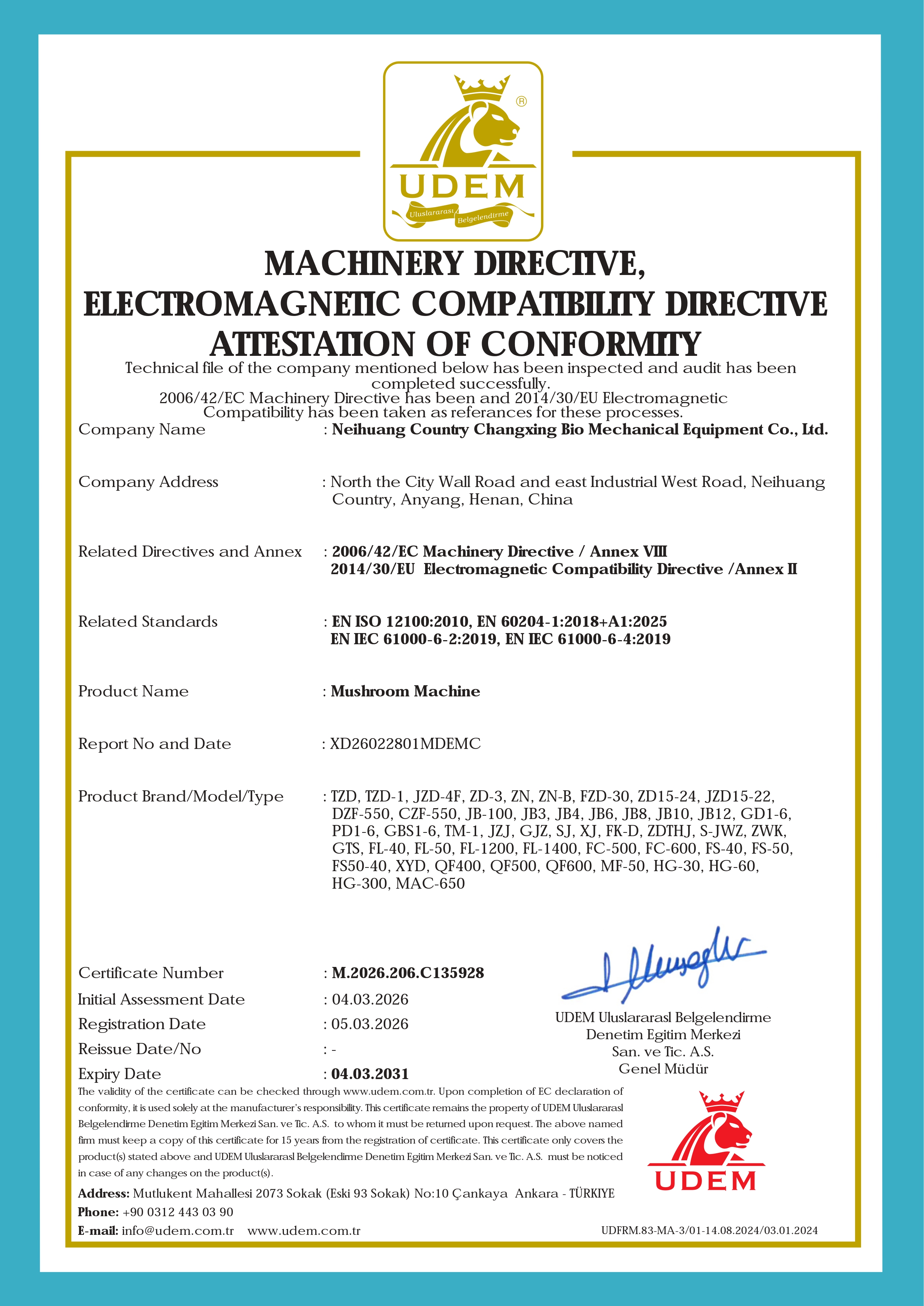
Certificate documentation is only useful to a procurement team when its scope can be matched to the exact configuration ordered.
A certificate is a defined scope, not a blanket approval. Procurement teams verifying a CE claim should confirm five things:
- The certificate holder name matches the contracting entity, not only the brand name used in marketing.
- The product scope covers the exact model and configuration ordered, including any customized variants.
- The directives referenced correspond to the equipment’s actual functions, including electrical drive and control systems.
- The issue date and validity are current.
- Auxiliary units — mixers, sterilizers, inoculation equipment — are addressed, either inside the same scope or through separate documentation.
It is equally important to state what CE does not do. A CE certificate issued against EU directives is not a global passport. Other destination markets operate their own conformity regimes, and an importer selling into a third market still has to satisfy that market’s requirements independently.
Safety Controls and Operator Standards
Two risk types are documented for mushroom bagging automation equipment: mechanical jamming and operator injury. Both are addressed through machine-level controls and operator-level discipline, and buyers should expect evidence of both.
| Risk type | Machine-level control | What procurement should be able to see |
|---|---|---|
| Mechanical jamming | Safety guard, overload protection | Guard configuration at each station; overload protection settings; jam-clearing procedure |
| Operator injury | Emergency stop, safety interlock | Emergency-stop positions; interlock logic that halts motion on guard opening; warning labels |
| Sustained safe operation | Training, regular maintenance | Safe operating procedure training material; maintenance schedule; label placement and language |
On the manufacturer side, the documented measures are strict training on safe operation procedures, safety interlocks, warning labels and regular maintenance. For a buyer, the practical audit is to walk the line at pre-shipment and locate the guard at each station, the emergency stops, the interlock verification method and the language of the warning labels relative to the operators who will run the equipment.
Application Fit: Matching Specifications to the Production Line
Compliance parameters cannot be assessed in isolation from the process the line performs. Changxing’s equipment covers the full sequence from raw material crushing and mixing through bagging, sterilization, inoculation and cultivation to mushroom production, and it is applied across varieties including shiitake, oyster, black fungus, enoki, pleurotus eryngii, pleurotus geesteranus, white fungus, seafood mushroom and agrocybe aegerita.
The manufacturer operates a 20,000m² facility with 130 employees and a 25-engineer R&D team, producing an annual output of 10,000 units with a monthly production capacity of 1,000 units, and exports 60% of its output. That scale and export mix explain why multi-configuration electrical specifications and material documentation matter: the same equipment family has to be documented consistently for markets with different supply conditions and different climate profiles.
Variety changes introduce their own compliance-relevant adjustments. When a line is reconfigured for a new mushroom variety, bag dimensions, sealing depth and tightness settings change, and the guard configuration, cycle settings and overload protection should be re-checked alongside the mechanical change. Treating a variety change as a mechanical adjustment only, and not as a re-validation of the operating envelope, is a common source of unplanned downtime.
Market Trend Analysis: Documentation as a Selection Criterion
Three trends supported by available data shape how buyers now evaluate this equipment.
First, the market is expanding rather than consolidating: from USD 3.8 billion in 2025 toward a projected USD 7.2 billion by 2033, with Asia-Pacific at a 42.3% revenue share in 2025. Growth of that kind increases the number of suppliers and, with it, the value of documented verification.
Second, automation is displacing manual bagging on measurable grounds. In supplier-documented comparisons, automated bagging delivers higher efficiency and more consistent quality, with 80% higher output and 50% less labor than manual bagging, 60% lower labor cost, and stable operation requiring less manual intervention. Those gains, however, are only realized when the installed equipment is correctly matched to site conditions — which returns the discussion to specification discipline.
Third, export orientation raises the documentation bar. Manufacturers with a majority export share must handle multiple voltage configurations, different market conformity regimes and different ambient climates within one product family. For buyers, this shifts part of the evaluation away from headline capacity and toward whether a supplier can state, consistently and in writing, what a given machine is rated for.
Comparison with Traditional Solutions — and the Limits of Standard Specifications
| Dimension | Manual bagging | Automated bagging line |
|---|---|---|
| Output | Baseline, labor-dependent | 80% higher output in supplier-documented comparison |
| Labor | Baseline requirement | 50% less labor; 60% lower labor cost |
| Quality consistency | Operator-dependent | Higher consistency in fill and sealing |
| Maintenance profile | Low mechanical dependency | Stable operation with less manual intervention, but requires planned maintenance |
| Compliance burden | Limited equipment-related obligations | Higher: electrical, guarding, thermal and material documentation must be managed |
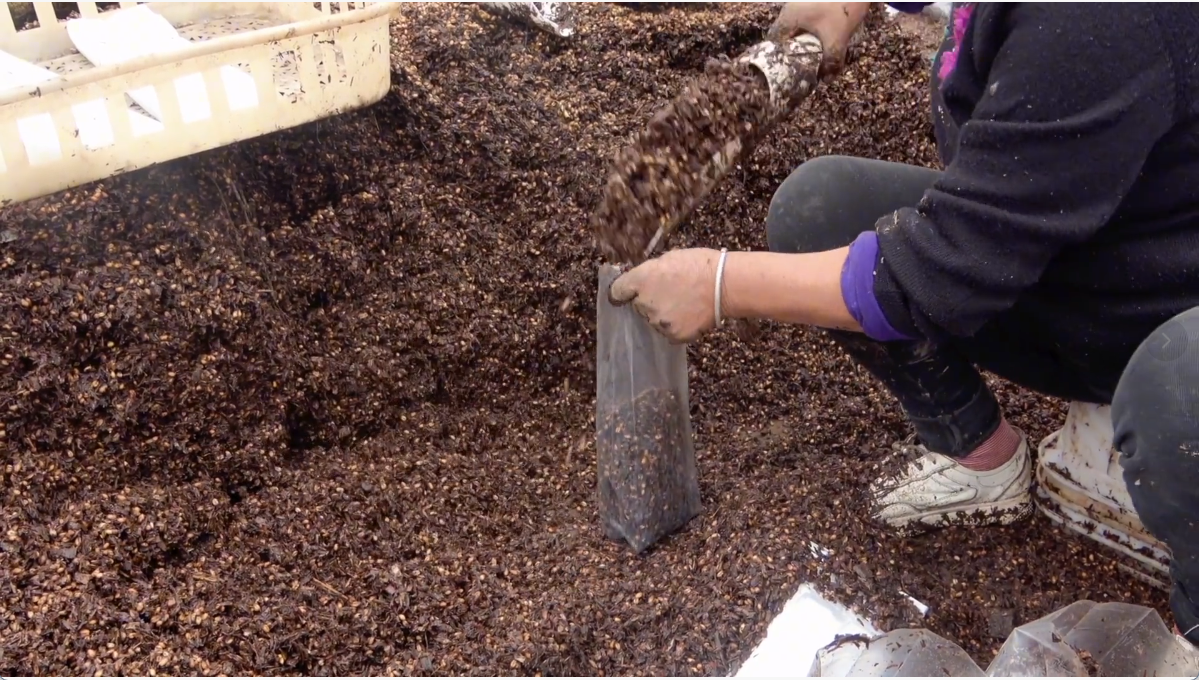
Manual bagging remains the baseline in many small and mid-scale operations; automation changes throughput and also changes the compliance obligations a buyer carries.
The limits deserve as much attention as the advantages. An IP54 enclosure is not washdown-rated, so high-pressure cleaning around the equipment requires relocation or additional protection. A 0–40°C working range excludes unheated winter buildings and unventilated summer facilities without mitigation. SS304 performs well in humid and cleaning-intensive zones but is not immune to pitting in chloride-rich environments. Automated bagging still depends on trained operators, functioning interlocks and scheduled maintenance — the machine reduces manual handling, it does not remove the procedure. And a CE certificate covers the configuration it names; it does not transfer automatically to other markets or to uncertified variants.
Future Outlook
As cultivation capacity scales and equipment is deployed across multiple sites and borders, specification documentation is likely to move from a technical annex to a standard part of supplier evaluation. Voltage and frequency mapping, cabinet placement plans against the cleaning routine, an ambient temperature review of the installation point, and a material map of wet versus structural assemblies are all inexpensive to produce before delivery and expensive to correct afterwards.
The direction of travel favors buyers who treat these parameters as procurement criteria rather than engineering footnotes. Equipment described consistently is easier to install, easier to maintain, easier to re-order and easier to support over a multi-year horizon — which is what long-term equipment relationships are actually built on.
FAQ
Which specifications should a procurement team confirm before ordering a mushroom bagging line?
At minimum, four: rated input voltage (AC380V 50Hz or AC220V 50Hz), enclosure protection rating (IP54 in the documented configuration), working temperature range (0–40°C), and construction materials (carbon steel or SS304). These determine whether the equipment can be operated, cleaned and maintained as intended at the installation site, and they should appear on the order confirmation rather than only in a product brochure.
What does IP54 protection mean for a working mushroom facility?
IP54 means the enclosure is dust protected and resistant to water splashes from any direction. It is not a washdown rating. In filling, mixing or sealing areas where cleaning involves directed water or sustained high humidity, cabinet location, a secondary enclosure, or a higher protection specification becomes a design question. The rating should be matched to the room, not to the product category in general.
How should a buyer match rated voltage and frequency to the site?
Confirm the site supply — three-phase AC380V 50Hz or single-phase AC220V 50Hz — together with the actual frequency and any planned changes such as a new building or generator backup. Frequency mismatch changes motor speed and control timing, so it should be resolved before order confirmation rather than at commissioning. Manufacturers serving multiple export markets commonly build to more than one supply configuration, and the ordered configuration should be stated in writing.
How can a procurement team verify a CE claim?
Check that the certificate holder matches the contracting entity, that the product scope covers the exact model and configuration ordered, that the referenced directives apply to the equipment’s functions, and that the issue date is current. In the EU, this equipment category relates to the Machinery Directive (2006/42/EC) and the EMC Directive (2014/30/EU). Changxing Edible Mushroom Machinery obtained CE Certificate No. M.2026.206.C135928 in March 2026 for its bagging and production lines. A CE certificate covers the scope it names and does not function as approval in other markets.
What safety controls and operator measures are expected on this equipment?
The documented risk types for bagging automation are mechanical jamming and operator injury. Machine-level controls include safety guards, emergency stop and overload protection. Manufacturer-side measures include strict training on safe operation procedures, safety interlocks, warning labels and regular maintenance. Buyers can confirm guard placement at each station, emergency-stop positions, interlock logic and warning-label language during pre-shipment inspection.
What acceptance and commercial terms are commonly recorded for this category?
Documented terms include a minimum order quantity of one unit, delivery on FOB or CIF terms, pre-shipment test as the acceptance criterion, and 30/70 payment terms. For multi-site projects, buyers commonly extend acceptance to include a specification check against the order confirmation in addition to the functional run.
What operating conditions fall outside a standard specification envelope?
Ambient temperatures below 0°C or above 40°C, high-pressure washdown applied directly to IP54 enclosures, chloride-rich cleaning agents on SS304 surfaces, and duty cycles beyond the documented line capacity all sit outside the standard envelope. These are conditions rather than product defects: each requires either a different configuration or site-level mitigation, and each is best identified before the purchase order is issued.
How do documented specifications support a long-term supplier relationship?
Repeat orders, multi-site rollouts and spare-part planning all depend on the equipment being described the same way each time. When voltage, protection class, temperature envelope and material standards are documented consistently, training and maintenance procedures transfer between sites and between lines. For the manufacturer, consistent documentation is what makes it possible to support an installed base over years rather than only at the point of sale.
Manufacturer specification documentation for this category — including that published by Changxing Edible Mushroom Machinery (www.automushmachinery.com) — is most useful when read alongside the site conditions described above rather than in place of them.