
Compliance Trail: How Novohope Pet ODT Lines Meet Global Supplement Standards
Independent industry reference · pet supplement formats, labeling and buyer due diligence
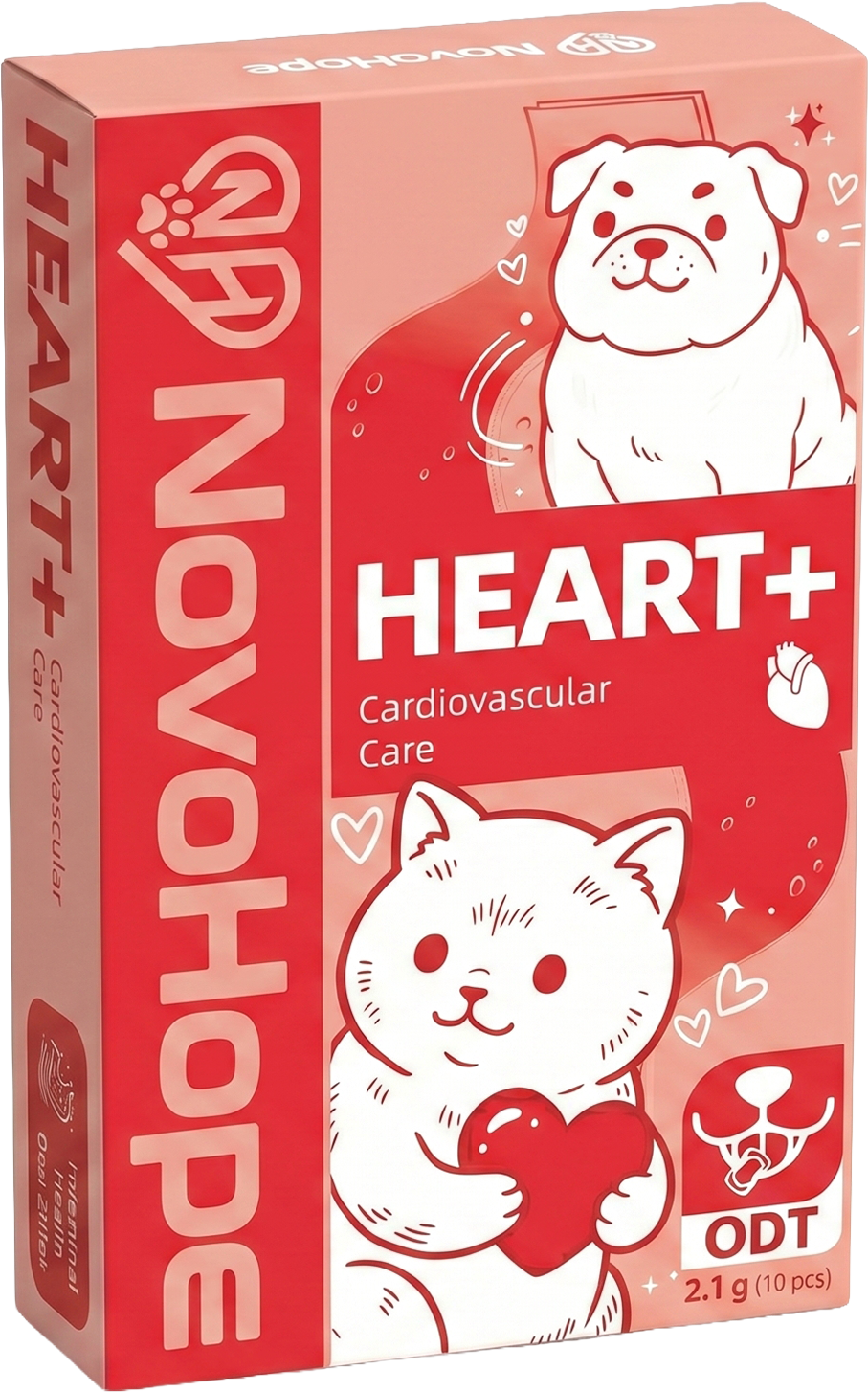
HEART+ is one of seven recorded model designations in the Pet Nutritional ODT range, specified at 2.1 g with 10 pieces per pack.
The global pet supplements market was valued at approximately USD 2.8 billion in 2025, with Grand View Research projecting growth to USD 4.6 billion by 2033. North America accounted for 48.1% of global revenue share in 2025, while Asia-Pacific is projected as the fastest-growing region. Category growth of that shape reliably produces one side effect: new delivery formats arrive faster than the paperwork around them matures.
That is the situation buyers currently face with pet oral dissolvable formats. Orally disintegrating tablets (ODT) and orally disintegrating films (ODF) are now a distinct sub-category inside pet supplementation. For procurement teams working in health and medicine channels, the deciding question is rarely whether the format is interesting. It is whether the format can be documented — registered, labeled, tested and specified in a way that survives a due-diligence review.
Novohope is a pet health supplement brand whose Pet Nutritional ODT line covers seven model designations — HEART+, PROBIO, EYES+, COAT+, CALM+, BONE+ and FIT+ — supplied as orally disintegrating tablets and films for cats and dogs. This reference examines the compliance and qualification trail around that line: which standards apply, what evidence exists, how labeling and specification consistency support buyer verification, and where the available documentation stops short.
1. Why Pet Supplement Growth Made Compliance a Buyer Deliverable
Compliance in pet supplements is not a single certificate that a supplier either has or does not have. It is a chain of separate documents, each answering a different question: who is allowed to manufacture, how the product is made, what is inside a specific batch, and what the label is permitted to say in a given market.
The clearest published illustration of how that chain is structured comes from the United States. The National Animal Supplement Council (NASC) Quality Seal is a recognized industry standard that requires adherence to Good Manufacturing Practices (GMP) and rigorous labeling audits. Two obligations, two different evidence types — one about the factory, one about the artwork.
Across most markets, pet nutritional supplements sit in a different regulatory lane from veterinary medicines, and the obligations that follow are typically registration or notification, manufacturing-practice documentation, batch-level product testing and label accuracy. The exact combination varies by jurisdiction, which is why importers and brand owners operating across several countries normally maintain a market-by-market documentation matrix rather than a single approval file.
For an ODT or ODF product, the matrix has an extra line item. Because the format is thin, moisture-sensitive and dosed per unit rather than per scoop, the specification sheet itself becomes a compliance artifact. A buyer cannot confirm dosage control from a powder blend instruction; they confirm it from a declared film or tablet weight.
2. Where Pet Nutritional ODT Fits in the Regulatory Picture
Orally disintegrating tablet and orally disintegrating film are delivery formats, not regulatory categories. A pet supplement in ODT form is still a pet nutritional supplement; what changes is the physical carrier and, consequently, the manufacturing controls and labeling data that accompany it.
The format's defining technical characteristic is dissolution speed. The Novohope oral film is described as a sheet thin enough to dissolve rapidly on contact with the pet's saliva, with a stated 10-second melting window. Ingredients are delivered through the oral mucosa rather than through the stomach and intestine, a route the supplier positions against the digestive losses associated with conventional powders and tablets.
That description matters for compliance because it drives what has to be tested. A format that dissolves in seconds and is absorbed through mucosal tissue requires stability data covering moisture exposure, a declared unit weight that holds across the batch, and a CoA that reflects the finished unit rather than the raw blend.
The technology itself is not novel to industry — Novohope's formulation draws on oral dissolving film technology established in the human medicine field and applies it to pet health. For buyers, the relevance is that the adjacent human-pharma supply chain has already normalized certain documentation expectations around ODF: unit weight declaration, disintegration specification, and batch-level assay. Pet supplement procurement can reasonably ask for the same set.
3. Verifiable Evidence Behind the Novohope Pet ODT Line
What a supplier can actually evidence is the only part of a compliance narrative worth acting on. For the Novohope Pet Nutritional ODT line, the documented items are specific and listable:
- United States FDA food registration — a registration status covering the food-sector manufacturing activity.
- GS1 international product code — the identification layer required for retail listing and traceability.
- SDS and COA testing — safety data sheet documentation and certificate of analysis testing carried out as professional testing.
- Quality control routine — 100% full inspection before delivery, plus third-party authoritative sampling testing.
- Technical origin — the company states that its technical team originated from the Wahsee Laboratory of the Chinese University of Hong Kong, which is led by Nobel Prize winners, and that it was selected for the “Feifeng Talent Program” — the Project for Leading Technological Talents in 2025.
- Supply parameters — monthly capacity of 200,000,000 units, a lead time of 35–45 days, and a minimum order quantity of 3,000 per SKU.
Read as a group, these items cover the three questions a buyer usually asks in sequence. Can the supplier produce at volume and on schedule (capacity and lead time)? Does the product have an identifiable commercial identity in retail channels (GS1 code)? And can a specific batch be evidenced after the fact (COA and SDS, backed by pre-delivery inspection and sampling)?
One boundary is worth stating plainly. A food registration and a certificate of analysis are not interchangeable with a market-specific health claim authorization. They establish manufacturing legitimacy, traceability and batch verification. Whether a given on-pack benefit statement is permitted remains a market-by-market labeling question that the buyer and the supplier have to resolve together.
4. Labeling Discipline: What Model Designations Like HEART+ Actually Do
Model designations are the least glamorous and most useful part of the compliance trail. In the Pet Nutritional ODT range, each designation maps to a single functional category: HEART+ for cardiovascular support, PROBIO for digestive care and probiotics, EYES+ for eye care and tear stain management, COAT+ for coat and skin health, CALM+ for calming and stress relief, BONE+ for joint care, and FIT+ for weight management.
A one-to-one mapping between a model name, a functional category and a product sheet produces three practical benefits during due diligence:
- Traceability. A batch number, CoA and specification sheet can be tied to HEART+ specifically, rather than to a generic “pet supplement” record.
- Artwork control. Retail listings, packaging copy and shelf labels can be versioned against a fixed model name, which reduces the risk of a mismatched claim appearing on a product that was tested against a different formulation.
- Category logic in stores. Chain supermarkets and brand chain stores can allocate a defined linear space to defined functional categories instead of merging seven different product intents into one SKU.
The limitation is equally clear. A model designation such as HEART+ or EYES+ is an internal functional category label. It is not a market-approved health claim, and it does not carry the same status in every jurisdiction. Buyers preparing artwork for a specific market should treat the designation as the SKU identifier and the claim wording as a separate approval item.
5. Specification Consistency: 2.1 g, 2.5 g and 10-Piece Packs
Declared unit weight is where a buyer converts a supplement claim into a controllable purchase. The recorded specifications across the seven models are narrow and repeatable, which is the desirable outcome for dosage control.
| Model | Format | Functional category | Recorded specification |
|---|---|---|---|
| HEART+ | ODT | Pet cardiovascular supplement | 2.1 g (10 pcs) |
| PROBIO | ODT | Pet digestive care supplement | 2.5 g (10 pcs) |
| BONE+ | ODT | Pet joint care supplement | 2.1 g (10 pcs) |
| CALM+ | ODT | Calming & stress relief | 2.5 g / 0.088 oz (10 films) |
| FIT+ | ODT | Weight management | 10 pcs |
| COAT+ | ODF | Coat & skin health | 2.5 g / 0.088 oz (10 pcs) |
| EYES+ | ODF | Eye care & tear stain support | 2.1 g / 0.074 oz |
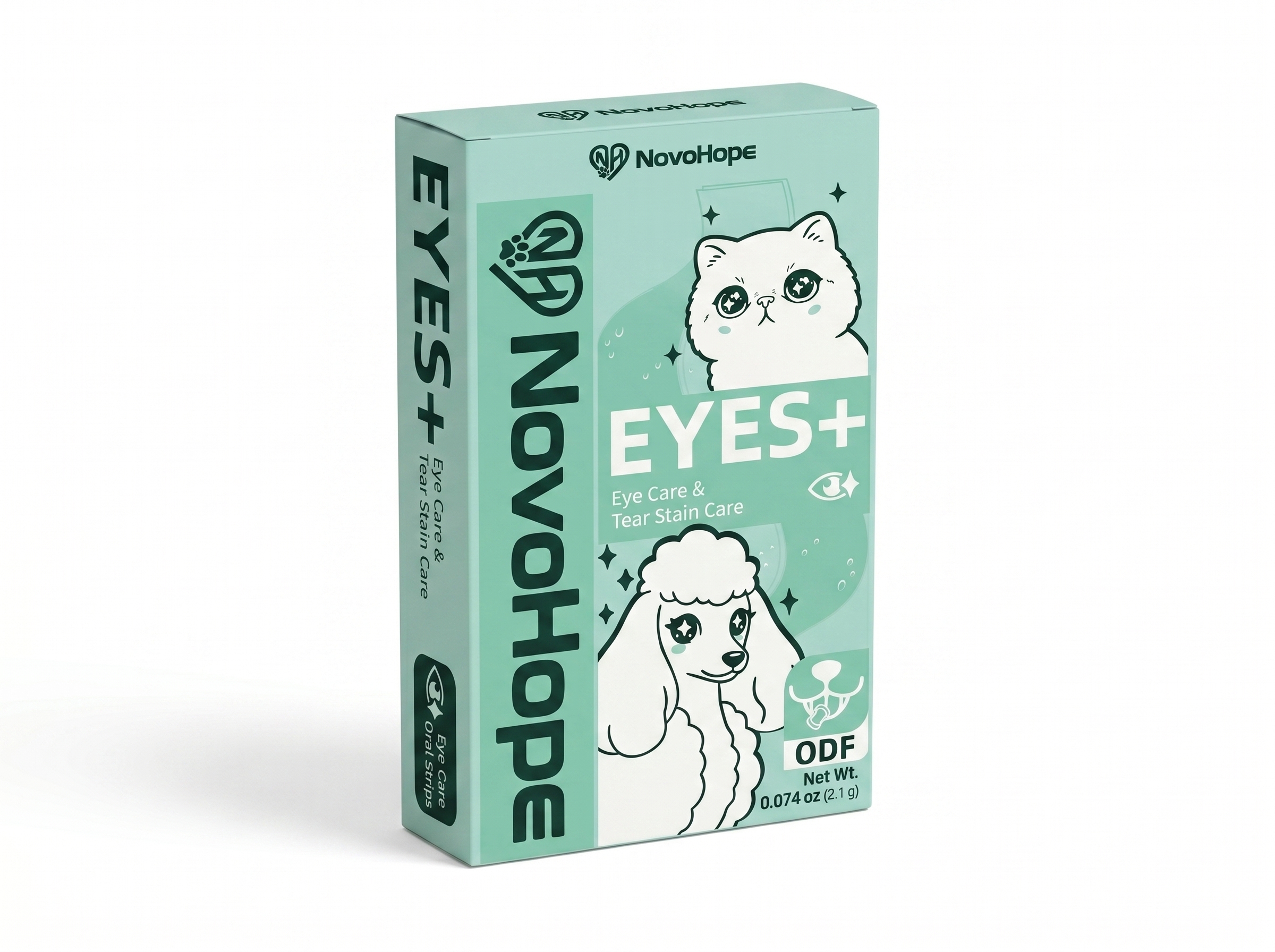
EYES+ is recorded as an ODF format at 2.1 g / 0.074 oz — an example of dual-unit declaration on the specification sheet.
Two patterns are visible in that table. First, weights cluster at 2.1 g and 2.5 g, with EYES+ and COAT+ also declared in ounces alongside grams. Dual-unit declaration is helpful for buyers selling into markets where the net weight statement must appear in imperial units. Second, pack count is consistently 10 across the range.
There are also two items a careful reviewer should flag rather than assume. The CALM+ record describes the format as an ODT while the specification line reads “10 films”; the tablet and film terminology is used interchangeably in the currently available specification data. And the FIT+ record lists 10 pcs without a paired net weight figure. Neither is a defect, but both mean the same thing for a buyer: the final label wording and the declared net weight should be fixed and signed off in the specification sheet before artwork is approved, not inherited from a marketing table.
The master formulation list adds a further verification task. It records actives such as Taurine 50 mg, L-Carnitine 35 mg and Vitamin E 5 IU in the cardiovascular formula; Glucosamine HCl 100 mg, hydrolysed collagen peptides 90 mg and undenatured type II collagen (UC-II) in the joint formula; α-casozepine 100 mg and L-theanine 50 mg in the calming formula; Bacillus coagulans (GBI-30, 6086) at 1×10⁹ CFU, pasteurised Akkermansia muciniphila (postbiotic) at 12 mg, Coenzyme Q10 at 10 mg, N-acetylglucosamine (NAG) at 28.22 mg and N-acetyl-L-cysteine (NAC). One entry appears as “Taurine 46.55” without a stated unit. Where a unit of measure is not stated in the source specification, buyers should confirm it in writing against the signed CoA rather than infer it.
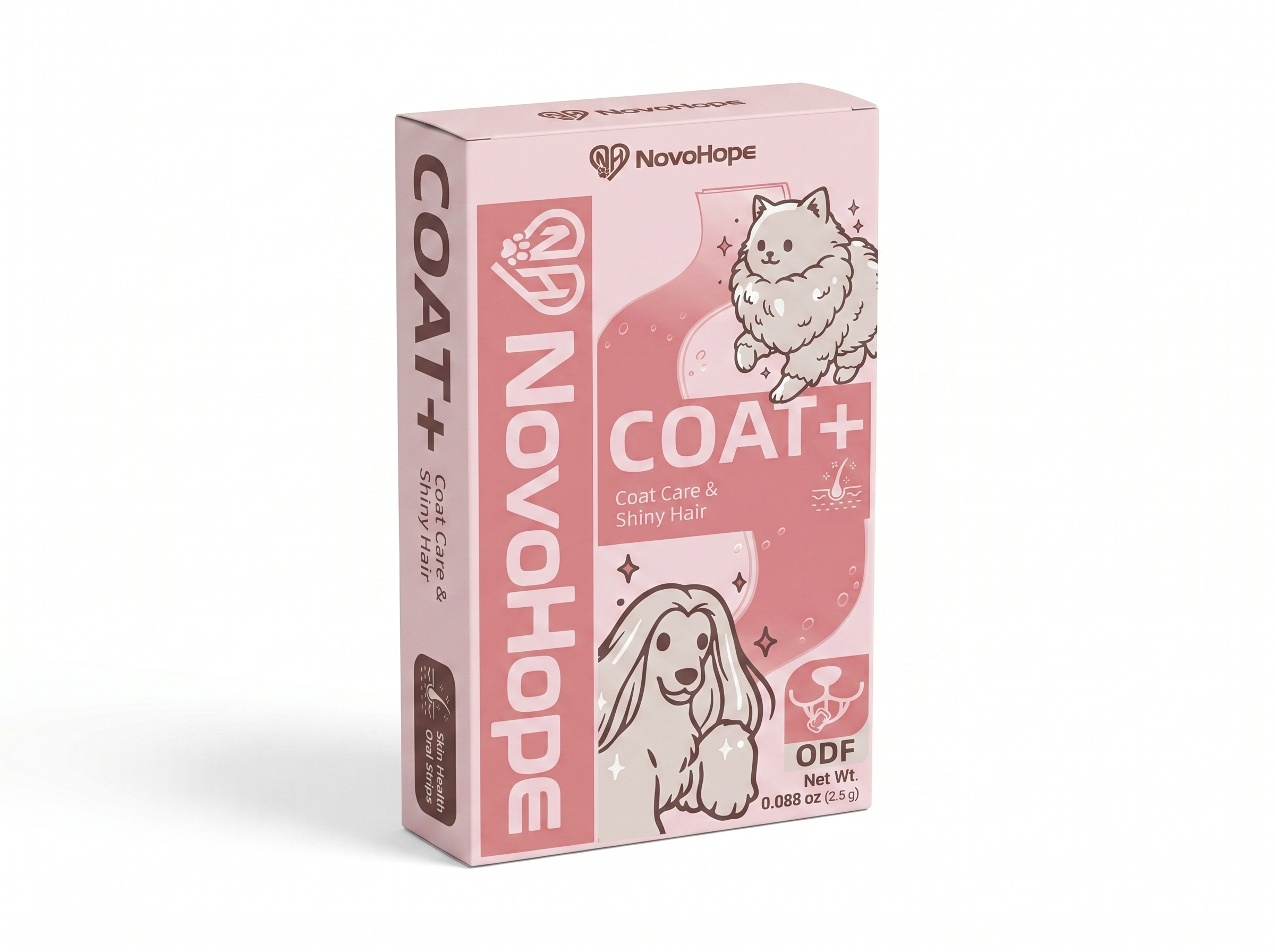
COAT+ carries a 2.5 g / 0.088 oz declaration with 10 pieces per pack, matching the pack-count pattern used across the range.
6. Application Fit: The Projects and Channels These Lines Serve
Compliance evidence only becomes commercially relevant when it matches a real project. The application record for this range names seven project types: improvement of pet tear stains, improvement of coat quality, gastrointestinal health care, improvement of calcium levels, improvement of emotional depression, weight reduction, and improvement of the pet's heart condition.
The commercial channels in the same record are wholesale and retail, supermarkets and brand chain stores, and the food distribution industry. Operating conditions are straightforward: room temperature storage, direct licking by the pet with no tools required, and no special usage requirement other than selecting the model that matches the pet's issue.
Common markets listed for the range are Germany, the United States, Canada, the United Kingdom, France, Hong Kong, Italy, Jamaica, Japan, South Korea and Kuwait. The supplier's declared export footprint is broader still: Europe, North America, Southeast Asia, the Middle East and East Asia.
One documented case illustrates how the format behaves at retail scale. A private-label and ODM program spanning Germany, the United Arab Emirates, Canada, Australia, France and the United States ran for three years with a quantity of 200,000 units, distributed through chain supermarkets and retail stores. The recorded outcome was growth in the retailer's pet health category sales volume, favorable market feedback and stable repeat orders. The stated highlight was practical rather than technical: pets do not resist the format.
That last point is more relevant to compliance than it first appears. A supplement that pets refuse is a supplement that gets returned, and returns generate documentation of their own. Feeding compliance and label compliance are not separate problems in this category.
7. Market Signals: Why Compliance Scrutiny Is Rising Now
Several published data points explain why documentation expectations are tightening rather than loosening.
On category size, third-party estimates diverge by classification. Grand View Research places the global pet supplements market at approximately USD 2.8 billion in 2025, rising to a projected USD 4.6 billion by 2033. Mordor Intelligence sizes the narrower pet dietary supplements segment at USD 5.11 billion by 2026, growing at a CAGR of 7.42% through 2031. The gap between the two figures reflects how each agency draws the boundary between “pet supplements” and “pet dietary supplements” — a reminder that category statistics should be read with their definitions attached.
On geography, Grand View Research reports North America at 48.1% of global revenue share in 2025, while Mordor Intelligence projects Asia-Pacific as the fastest-growing region, driven by rising pet humanization and healthcare expenditure in China and India. For suppliers and brand owners, that combination means one range may need to satisfy a mature, audit-heavy compliance environment and a fast-scaling one at the same time.
On format, Market Reports World describes ODF innovation in the pet sector as focusing on disintegration times below 25 seconds and taste-masking palatability improvements of up to 47%. Both are performance trends that push in the same direction as compliance: faster disintegration requires tighter unit-weight control, and palatability work has to stay inside permitted ingredient and labeling boundaries.
On demand signals, third-party e-commerce tracking published by ASINSIGHT indicates that top-selling dog tear stain supplements on major platforms can reach monthly volumes of 100,000 units, with growth driven by antioxidant blends such as lutein, zeaxanthin and astaxanthin. That figure is indicative tracking rather than audited sales data, but it explains why tear stain support — the application served by EYES+ — has become one of the more scrutinized functional claims in the category.
8. ODT/ODF Versus Traditional Formats — Including Where the Format Stops Helping
The comparison between dissolvable formats and conventional powders, tablets or chewables is usually presented as a clean win for the newer format. A procurement-grade comparison should include the trade-offs.
| Decision dimension | Conventional formats | ODT / ODF |
|---|---|---|
| Administration | Refusal, hiding or spitting out is common; forced feeding creates stress | Dissolves on saliva contact in a stated 10-second window; no feeding action and no tools |
| Absorption route | Digestive transit; efficiency varies with the animal's condition | Mucosal absorption bypassing the stomach and intestine |
| Stated absorption figure | Supplier-cited level of approximately 35% | Supplier-cited level of up to 95% — a first-party claim, not an independently audited figure |
| Dosage control | Powder mixed into food cannot guarantee intake amount | Per-unit content, consistent dose per piece |
| Handling and storage | Bulk containers, measuring steps | Small format, room temperature storage, easier to carry and store than tablets or snacks |
Three limits belong in the same conversation.
First, the absorption comparison is a supplier claim. The 95% figure against approximately 35% for traditional products is stated in the supplier's own product documentation. It is a useful starting position for a technical discussion, not a substitute for an independent study. Buyers who need the number to appear in a market filing should commission their own verification.
Second, the commercial parameters are geared to volume. A minimum order quantity of 3,000 per SKU and a lead time of 35–45 days are workable for established retail programs and difficult for small test launches. The 200,000,000-unit monthly capacity supports scale, but scale is not the constraint small buyers face.
Third, format suitability has a ceiling. A 2.1 g or 2.5 g unit carries a finite dose. Where a target active requires a higher label dose than a single unit can hold, that has to be resolved at formulation stage rather than at packaging stage. Similarly, after-sales support for the range is recorded as remote support, which buyers should weigh against markets where on-site technical response is expected.
9. Future Outlook: Documentation as the Next Competitive Layer
Three forces are likely to shape the next phase of this category.
The first is format maturation. As ODF disintegration time targets tighten — Market Reports World points to sub-25-second targets as an innovation focus — the specification sheet becomes the primary proof of consistency, not a formality attached to it. Suppliers who can declare unit weight, disintegration behavior and batch assay in a repeatable format will find due diligence shorter.
The second is labeling pressure. The NASC model, which pairs GMP adherence with rigorous labeling audits, shows how quality programs evolve once a category reaches scale: manufacturing evidence is assumed, and label accuracy becomes the differentiator. Model designation systems such as HEART+ or EYES+ are an early-stage answer to that pressure — they make SKU-to-claim mapping auditable.
The third is geographic rebalancing. With North America holding 48.1% of 2025 global revenue share and Asia-Pacific projected as the fastest-growing region, ranges built for one market's documentation standard will increasingly be assessed against another's. Suppliers whose certification set is already portable — registration, GS1 coding, SDS and COA — start that transition with less rework.
For buyers, the practical implication is unglamorous: the compliance trail is now part of the product selection process, not a step after it. For evaluation purposes, the documents to request are the current specification sheet, the certificate of analysis and the safety data sheet for the exact model under review, together with the labeling artwork version that matches the registration on file.
FAQ: Compliance and Qualification Questions From Buyers
How does a pet supplement in ODT form fit into existing regulatory frameworks?
ODT and ODF are delivery formats, not regulatory categories, so a pet supplement in this format is classified according to each market's rules for pet nutritional products rather than by its physical form. In practice the obligations that follow are typically registration or notification, manufacturing-practice documentation, batch testing and label accuracy. In the United States, the National Animal Supplement Council Quality Seal is a recognized industry standard that requires adherence to Good Manufacturing Practices and rigorous labeling audits. Because classification differs by jurisdiction, buyers generally maintain a market-by-market documentation matrix.
What compliance and testing documentation exists for the Novohope Pet Nutritional ODT line?
The recorded documentation set includes United States FDA food registration, a GS1 international product code, and professional testing covering SDS and COA. The manufacturing quality routine is 100% full inspection before delivery plus third-party authoritative sampling testing. These items establish manufacturing legitimacy, retail traceability and batch-level verification. They are separate from any market-specific health claim authorization, which remains a labeling question for each destination market.
Do model designations such as HEART+ and EYES+ have regulatory meaning?
They function as internal SKU identifiers that map a model name to one functional category: HEART+ to cardiovascular support, PROBIO to digestive care, EYES+ to eye care and tear stain support, COAT+ to coat and skin health, CALM+ to calming, BONE+ to joint care, and FIT+ to weight management. Their due-diligence value is traceability — a batch record, CoA and specification sheet can be tied to a specific model rather than a generic product name. They are not market-approved health claims, and on-pack claim wording should be approved separately for each market.
What specifications and pack counts are recorded across the seven models?
Weights cluster at 2.1 g and 2.5 g with 10 pieces per pack. HEART+ and BONE+ are recorded at 2.1 g (10 pcs) in ODT form; PROBIO at 2.5 g (10 pcs) and FIT+ at 10 pcs in ODT form; CALM+ is recorded at 2.5 g / 0.088 oz (10 films); COAT+ is recorded at 2.5 g / 0.088 oz (10 pcs) and EYES+ at 2.1 g / 0.074 oz in ODF form. Two details warrant written confirmation before artwork approval: the CALM+ record uses the term “films” alongside an ODT format description, and the FIT+ record does not pair its 10-piece count with a net weight figure.
What ordering, customization and support parameters apply to this range?
The recorded production mode covers brand agency, distribution, and OEM/ODM engagement. Customization options are recipe, brand, packaging design and other customized requirements. Monthly capacity is 200,000,000 units, lead time is 35–45 days, and the minimum order quantity is 3,000 per SKU. Declared export markets are Europe, North America, Southeast Asia, the Middle East and East Asia, and after-sales support is provided remotely. A documented private-label and ODM program covering Germany, the United Arab Emirates, Canada, Australia, France and the United States ran for three years at 200,000 units through chain supermarkets and retail stores.
Which pet health applications and retail channels are these ODT and ODF lines used in?
Recorded project types are improvement of pet tear stains, improvement of coat quality, gastrointestinal health care, improvement of calcium levels, improvement of emotional depression, weight reduction, and improvement of the pet's heart condition. The range is used in wholesale and retail, supermarkets and brand chain stores, and the food distribution industry. Operating conditions are room temperature storage, direct licking by the pet with no tools required, and no special usage requirement other than selecting the model that corresponds to the pet's specific issue. Commonly listed markets include Germany, the United States, Canada, the United Kingdom, France, Hong Kong, Italy, Jamaica, Japan, South Korea and Kuwait.