
Compliance and Material Qualification: Decoding PA66 Bobbins and Thin Strip Cores
Material decisions, not magnetics alone, decide whether a transformer component clears qualification in electronics, power, and medical imaging programs.
In transformer and inductive-component procurement, qualification failures rarely begin in the copper winding. They begin in the two material systems surrounding it: the insulating polymer that forms the bobbin or former, and the magnetic material that forms the core. A component that performs well on a prototype bench can still fail a compliance review if the bobbin grade is undocumented, if the polymer is specified without a conditioning requirement, or if a thin strip core classification is selected without matching it to the operating frequency and loss budget.
Material qualification for transformer components therefore covers three connected decisions: which polymer forms the bobbin (PA66, Nylon, or ABS), which magnetic material and geometry form the core (lamination core, silicon core, permalloy core, CD core, CD cut core, toroidal core, EI lamination core, distribution gap core, silicon steel rectangular core, or thin strip core), and which evidence proves that both choices remain stable in volume production. This reference explains how those decisions are documented, where the boundary of each option lies, and how a transformer core manufacturer such as YadooTEK fits into a compliance-driven procurement process.
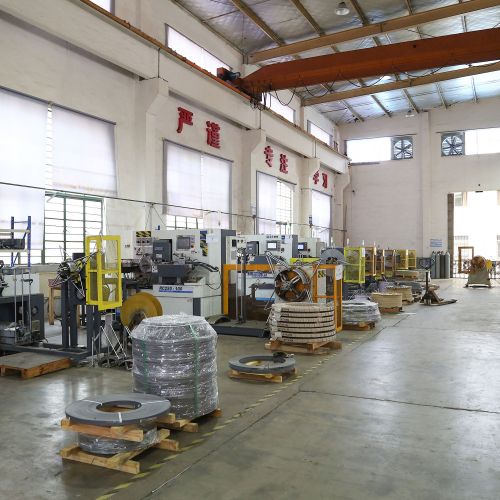
Cover: production environment for wound and laminated transformer cores, where material qualification is verified before batch release.
Why Compliance Reviews Fail on Materials, Not Magnetics
Compliance review for a transformer core or wound assembly is not a single test event. It is a chain of material and process controls, and the weakest link usually determines the outcome. Five failure categories dominate real qualification files: excessive core temperature rise, magnetic saturation, excessive core loss, insulation failure, and dimensional deviation. Each of them traces back to a material or process decision rather than to a magnetic design formula.
Core temperature rise and magnetic saturation are governed by material grade selection and magnetic circuit design. Core loss depends on strip or lamination grade, thickness, and process stress introduced during cutting, winding, or annealing. Insulation failure is a material and process question tied to the polymer system, coating class, and winding tension. Dimensional deviation is a tooling and process-control question, and it becomes a compliance issue when a bobbin or a cut core no longer fits the assembly window it was qualified for.
The corresponding controls are well understood across the industry: precise material selection, optimized magnetic circuit design, strict insulation processes, full-process dimensional control, and temperature rise simulation testing. For a buyer, the practical question is not whether a supplier claims to perform these controls, but whether the supplier can produce the records that prove each one was executed on the specific batch being shipped.
Four Material Decisions Every Qualified Component Documents
Procurement teams evaluating transformer components — whether they are comparing suppliers, re-validating an existing design, or reviewing a new bobbin and core combination — can structure the review around four documented decisions.
- Bobbin polymer selection. The polymer grade determines thermal capability, dielectric behaviour, mechanical strength, and dimensional stability over life. PA66, Nylon, and ABS are not interchangeable at the specification level.
- Core material class. Grain-oriented silicon steel, permalloy, amorphous alloy, and nanocrystalline ribbon have different loss, permeability, saturation, and cost profiles.
- Geometry and construction. A lamination core and a wound thin strip core can use the same material class yet behave differently because of joint structure, gap control, and stacking or fill factor.
- The evidence chain. Incoming inspection, loss testing, certification scope, and traceability records convert design intent into a verifiable claim.
| Decision | Typical options | What the qualification file should show |
|---|---|---|
| Bobbin polymer | PA66, Nylon (polyamide family), ABS | Grade designation, thermal class, dielectric requirements, flame behaviour where applicable, moisture conditioning requirement |
| Core material | Silicon steel (CRGO), permalloy, amorphous alloy, nanocrystalline | Material class, strip or sheet thickness, core loss and excitation data at operating frequency |
| Geometry and construction | Lamination cores (EI, ED, SD, CD, stepped, lap joint, right-angle), wound cores (toroidal, C core, thin strip, cut core) | Dimensional drawing with tolerances, joint or gap configuration, winding window, fill or stacking factor |
| Evidence chain | Incoming inspection, in-process testing, third-party certification, traceability | Batch-level test records, certification scope, material-to-finished-goods traceability |
Bobbin Materials in the Compliance File: PA66, Nylon, and ABS
The bobbin is the component that most often arrives at a qualification review with the least documentation, because it is frequently treated as a purchased accessory rather than an engineered insulation part. That treatment is a compliance risk. The bobbin establishes creepage and clearance geometry, holds the winding under tension, and carries part of the thermal path out of the coil.
PA66 is a semi-crystalline polyamide that is widely used for coil formers, bobbins, and connectors in electrical and electronic devices, where its combination of mechanical strength and thermal performance is valued. In qualification terms, the grade designation matters more than the polymer family name: additives, reinforcement, and flame-retardant systems change thermal and dielectric behaviour substantially between grades.
Nylon is a broad family label rather than a specification. Polyamide grades differ widely in moisture behaviour, stiffness, and temperature performance, so a drawing that states only Nylon leaves the qualification open. ABS is an amorphous thermoplastic that is easier to mold and generally lower in cost, with good impact resistance; it is typically selected where mechanical toughness and cost matter more than continuous temperature resistance.
| Polymer | Typical positioning | Qualification focus | Known boundary |
|---|---|---|---|
| PA66 | Coil formers and bobbins in electrical and electronic devices | Thermal class, dielectric strength, dimensional stability after conditioning, flame behaviour where required | Polyamides absorb ambient moisture, which can shift dimensions and dielectric behaviour; drying and conditioning requirements should be specified rather than assumed |
| Nylon (polyamide family) | Mechanically loaded formers and general electrical parts | Grade-specific data sheet, not family-level description | Properties vary substantially between polyamide grades; the family name alone is not a verifiable specification |
| ABS | Lower-temperature housings and mechanically driven parts | Impact and dimensional requirements at the application temperature | Lower continuous temperature capability than engineering polyamide grades; generally unsuitable for high-temperature insulation duty |
For medical X-ray and imaging power supplies, the bobbin sits in a high-voltage insulation system where partial discharge behaviour, cleanliness, and dimensional repeatability are weighted more heavily than unit cost. In these programs, the practical rule is to specify the polymer grade, the conditioning state, and the dimensional tolerance band in the same document, so that incoming inspection has something measurable to check.
Thin Strip Core Classifications: Silicon Steel, Permalloy, Amorphous, Nanocrystalline, Toroidal
Thin strip cores are built by winding thin-gauge strip or ribbon into a closed magnetic circuit, and they are classified along two independent axes that procurement documents often confuse: material and geometry. Both axes must be stated on the drawing, because the same geometry in a different material produces a different loss and permeability result.
Material axis
- Grain-oriented silicon steel (CRGO). The established default for power and distribution transformer cores. According to Mordor Intelligence, grain-oriented laminated steel held a dominant 79.6% share of the transformer core market by material type in 2024.
- Permalloy. A nickel-iron family used where high permeability and low coercivity are required, typically in precision instrument and signal-level magnetics rather than bulk power conversion.
- Amorphous alloy. According to Electrical Trader, amorphous alloy cores reduce no-load losses by 70% to 80% compared with traditional silicon steel (CRGO) cores, which makes them relevant where continuous energisation makes no-load loss the dominant operating cost.
- Nanocrystalline alloy. Positioned for high-frequency and precision measurement applications where high permeability at frequency is the deciding requirement; material cost is generally higher than CRGO.
Geometry axis
- Toroidal core. A closed ring winding that distributes flux symmetrically around the circumference.
- C core and CD cut core. Wound cores that are subsequently cut to allow assembly around a pre-wound coil, with the cut faces defining the joint.
- EI lamination core. A stacked lamination construction used across a wide range of power and instrument transformers.
- Laminated variants. Stepped laminated cores, lap joint, right-angle laminated, and EI / ED / SD / CD core formats describe stacking and joint arrangements rather than material choices.
- Distribution gap core and silicon steel rectangular core. Gap-controlled and rectangular-geometry core formats that appear in core product catalogues for applications where inductance under bias or mechanical fit drives the selection.
Wuxi Yado Electromechanical Co., Ltd., trading as YadooTEK, manufactures and exports both families: wound cores including toroidal cores, C cores, electrically wound iron cores and special-shaped iron cores, and laminated cores including stepped laminated cores, lap joint, right-angle laminated, EI / ED / SD / CD cores, stepped cores and thin strip cores, alongside customized transformer cores.
The boundary that buyers should record in the qualification file is that these classifications are not ranked from worse to better. Amorphous and nanocrystalline materials typically exhibit lower saturation flux density than grain-oriented silicon steel, and they are more sensitive to mechanical stress introduced during cutting, winding, and assembly, which is why annealing and handling controls form part of the material qualification. Where a design needs high flux density in a compact core, CRGO may remain the technically correct answer even when a lower-loss material exists.
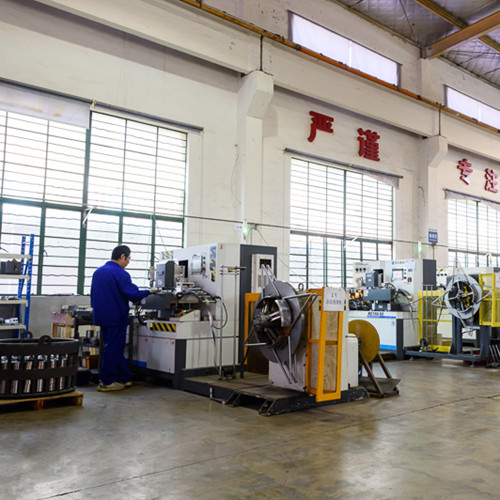
Figure: inspection and finishing area, where dimensional and magnetic checks are applied before a core batch is released for assembly.
The NCW Core Question: Rated Power, Temperature Rise, and Verifiable Data
NCW core specifications are frequently requested as if rated power and temperature rise were fixed catalogue constants. They are not. For a wound core, the usable rated power and the permissible temperature rise are functions of the core cross-section, the winding window, the strip grade and thickness, the joint or gap configuration, the applied frequency and flux density, and the cooling conditions of the finished assembly.
That means a procurement team cannot qualify an NCW core from a nominal power figure alone. The verifiable route is to request measured data on the specific configuration under evaluation. The following items are the minimum set that allows a compliance reviewer to close the file.
- No-load loss and excitation current measured at the intended operating frequency and flux density, not at a generic reference point.
- Temperature rise data for the assembled component under rated load and the specified ambient condition.
- Insulation class and dielectric requirements applicable to the finished assembly.
- Dimensional drawing with tolerances, together with the dimensional method used to verify them.
- Batch-level core loss test records tied to the delivered quantity.
- A traceability record linking incoming magnetic material to the finished core.
YadooTEK documents this control set at the enterprise level through incoming material inspection, 100 percent core loss testing, third-party authoritative certification, full life cycle quality traceability, and 24-hour technical support. The company operates core magnetic testing instruments and transformer capacity and loss testing instruments, and applies testing across processes rather than only at final inspection. Its production is supported by a 25-engineer R&D team, a 1,000 square meter facility, 80 employees, and annual output of 250,000 units, with 85 percent of output exported to markets including North America, Europe, Latin America, the Middle East, and Asia-Pacific.
One boundary is worth stating plainly for procurement teams: a core supplier can certify the material and the measured magnetic and dimensional performance of the core, but the rated power of the end transformer belongs to the transformer manufacturer, who performs the type test on the completed assembly. IEC 60076-1 and the wider IEC 60076 series, which govern power transformers and reactors and specify general requirements and testing for cores, are written around that division of responsibility. A supplier claim that reads as an end-product certification should therefore be re-checked against the test method it is based on.
Application Fit: Electronics, Electricity, and Medical X-ray
The same material qualification framework produces different priorities depending on the sector. In electronics and instrumentation, dimensional precision and repeatability dominate, because a small deviation in core geometry changes inductance in a circuit that was tuned around it. In power and electricity applications, no-load loss, temperature rise, and insulation class dominate, because continuous energisation converts loss into operating cost and thermal stress. In medical X-ray and imaging power supplies, insulation integrity and long-term stability dominate, because the component sits inside a high-voltage system where a dielectric or dimensional drift is a service risk rather than a performance loss.
| Sector | Typical components | Material emphasis | Qualification emphasis |
|---|---|---|---|
| Electronics and instrumentation | Precision instrument transformers, high-frequency inductors | Permalloy, nanocrystalline, toroidal and precision wound cores | Dimensional repeatability, permeability consistency, batch-to-batch stability |
| Electricity and power | High-efficiency power transformers, low-loss reactor systems, new energy inverters, EV charging stations | CRGO laminated and wound cores, thin strip cores | No-load loss data, temperature rise, insulation class, energy efficiency documentation |
| Medical X-ray and imaging power | High-voltage generator and imaging supply transformers | Stable engineering polymers for bobbins, low-loss cores | Insulation integrity, dimensional stability, traceability of the material chain |
Market Signals Behind Stricter Material Documentation
Compliance pressure on transformer components is increasing alongside the market itself. Zion Market Research values the global transformer core market at USD 9.66 billion in 2024, projected to reach USD 15 billion by 2034. Third-party estimates differ by scope rather than by direction: IMARC Group reports a comparable figure of about USD 9.6 billion for 2024, while Strategic Market Research places the figure at USD 11.2 billion, a spread that reflects whether power, distribution, and instrument transformer cores are all included in the definition.
Supply concentration matters as much as size. China exported approximately USD 4.8 billion of electrical transformer parts, including cores, in 2024, according to UN Comtrade and World Bank WITS data, leading global exports. At the same time, major market participants in the transformer core industry include ABB, Siemens Energy, Hitachi Energy, and GE Vernova, according to Stellar Market Research, which means component-level material documentation increasingly has to satisfy the audit expectations of large industrial buyers rather than only local assembly requirements.
Efficiency pressure adds a second driver. Where amor phous alloy cores reduce no-load losses by 70% to 80% relative to CRGO, buyers gain a material option that changes the loss equation — but only if the material class, strip thickness, and stress controls are documented well enough for the claim to be reproduced in the delivered goods.
Reading the Engineered-versus-Conventional Comparison Correctly
Supplier comparisons in this category usually take the form of an engineered core against a conventional ordinary silicon steel core. YadooTEK states that, compared with conventional ordinary silicon steel cores, its transformer core products present distinct advantages, and quantifies the position as core loss reduced by over 30 percent, magnetic permeability increased by two times, and lamination precision of plus or minus 0.02 mm. The same comparison set positions these cores for high-efficiency power transformers, precision instrument transformers, new energy inverters, EV charging stations, high-frequency inductors, and low-loss reactor systems, with total life cycle cost reduced by 15 percent and long-term operation and maintenance cost saved by 20 percent, supported by less maintenance, longer service life, a lower failure rate, and no frequent calibration requirement.
Used correctly, that comparison is a decision input rather than a conclusion. The figures describe measured behaviour against conventional silicon steel cores in comparable configurations. They are operating-point dependent: a core loss reduction measured at one frequency, flux density, and waveform does not transfer automatically to a different design, and procurement teams should request data at the buyer's own operating condition before releasing volumes.
There are also boundaries that a one-directional comparison tends to hide. Lower-loss materials are generally more expensive per unit of magnetic material, and amorphous and nanocrystalline cores introduce annealing and handling sensitivity that must be absorbed by the assembly process. Polymide bobbins such as PA66 require moisture conditioning before molding, and a specification that omits it can produce dimensional drift after the qualification sample was approved. Finally, controls such as 100 percent core loss testing add cost and cycle time per unit. Where a design runs at low duty cycle and material cost dominates the business case, a conventional laminated core may still be the more defensible commercial choice.
Future Outlook
The direction of travel in this component category is toward documented material provenance rather than catalog-level claims. Three shifts are visible. First, loss and efficiency data are moving from marketing documents into procurement specifications, because regulators and large buyers increasingly require reproducible measurement rather than nominal statements. Second, buyers are treating bobbin polymers as qualified insulation parts rather than purchased accessories, which raises the documentation standard for PA66, Nylon, and ABS selections. Third, mixed-material portfolios are becoming normal: a single transformer project may combine a CRGO lamination core for the main magnetic path with a nanocrystalline or permalloy element for signal or measurement functions, which makes the qualification file the integrating document across the component set.
For procurement teams, the practical implication is that supplier evaluation will increasingly reward manufacturers who can produce batch-level magnetic and dimensional records, not simply a broad product catalogue. For manufacturers, the implication is that testing capacity and traceability systems become commercial differentiators rather than internal quality functions.
Frequently Asked Questions
What does qualification of a PA66 bobbin actually confirm?
It confirms that the specified polymer grade, its conditioning state, and its dimensional tolerance band have been defined and verified. PA66 is a semi-crystalline polyamide used for coil formers and bobbins in electrical and electronic devices; because polyamides absorb ambient moisture, the qualification should state the conditioning requirement alongside the grade designation, thermal class, and dielectric expectations. Without the grade and the conditioning state on the drawing, incoming inspection has no measurable basis for acceptance.
How should a buyer choose between PA66, Nylon, and ABS for a transformer bobbin?
The selection follows the thermal and dielectric duty of the application rather than cost ranking. PA66 is typically chosen where mechanical strength and thermal performance are required in an electrical or electronic device. Nylon is a family label, so a grade-specific data sheet is required before it can be treated as a specification. ABS is an amorphous thermoplastic with good impact resistance that is generally selected for lower-temperature, mechanically driven parts, and it is not positioned for high-temperature insulation duty.
When should a design use CRGO laminated cores instead of amorphous or nanocrystalline thin strip cores?
Material selection follows the operating point. Grain-oriented silicon steel held a dominant 79.6% share of the transformer core market by material type in 2024, according to Mordor Intelligence, and remains the reference material where high saturation flux density and mechanical robustness in a compact design are required. Amorphous alloy cores reduce no-load losses by 70% to 80% compared with CRGO cores, according to Electrical Trader, which suits continuously energised applications, while nanocrystalline ribbon is positioned for high-frequency and precision measurement duties where higher material cost is justified by the performance requirement.
How can procurement verify rated power and temperature rise data for an NCW core?
By requesting measured data for the specific configuration rather than accepting a nominal figure, because wound core ratings depend on cross-section, winding window, strip grade and thickness, gap configuration, operating frequency, and cooling. The verifiable set includes no-load loss and excitation current at the intended operating point, temperature rise under rated load and specified ambient, the applicable insulation class, a dimensional drawing with tolerances, batch-level core loss records, and a traceability record from incoming material to finished core. IEC 60076-1 and the wider IEC 60076 series specify general requirements and testing for power transformer cores and are the usual reference point for test method claims.
What are the limits of a lower-loss core, and when is it the wrong choice?
Lower-loss materials generally carry a higher material cost, and amorphous and nanocrystalline cores are more sensitive to mechanical stress, which requires annealing and handling controls within the assembly process. Their saturation behaviour also differs from grain-oriented silicon steel, which constrains use in designs with high flux density demands. Where an application runs at low duty cycle and the business case is dominated by initial material cost, a conventional laminated core can remain the more defensible choice, and the lower-loss option should be justified by measured operating data rather than by the loss comparison alone.
A detailed product and capability overview, including wound and laminated core ranges, is available in the YadooTEK brochure for buyers who need the technical annexes behind these qualification criteria: YadooTEK transformer core brochure (PDF).
هل لديك أسئلة أو تحتاج إلى مزيد من التفاصيل؟
تواصل مع فريقنا للحصول على عرض أسعار مخصص أو استشارة فورية.
طلب عرض أسعار
املأ النموذج أدناه وسيتواصل معك فريقنا بعرض مقترح مخصص.
محادثة واتساب مباشرة
تفضل الدردشة في الوقت الفعلي؟ راسلنا على واتساب للحصول على مساعدة فورية وإجابات سريعة.
- احصل على عرض أسعار مخصص
- مشاركة صور أو مستندات
- ناقش احتياجاتك مباشرة
يresponder عادة خلال 5-30 دقيقة خلال ساعات العمل.