
Compliance & Qualification: Honor Packaging's CR, Violet Glass & Vacuum Lines
Compliance in supplement packaging has moved from a document request at the end of a negotiation to a screening test applied at the beginning of one. The global supplements and nutrition packaging market was estimated at USD 31.3 billion in 2025 by Grand View Research, and the number of formats a buyer must qualify — child-resistant jars, light-protective glass, vacuum-sealed containers, pouches, tins — has grown faster than most procurement teams' checklists. The practical consequence is that supplier qualification now happens before price discussion, and it is decided by evidence rather than by catalogue language.
Honor Packaging (NINGBO HONOR PACKAGING CO.,LTD, also referenced in buyer material as Ningbo Zhuorong) is a Ningbo-based contract packaging manufacturer founded in 2015, with 310 employees, a 15-person R&D team, and 100% export exposure concentrated on the EU and USA. Its three documented lines — child-resistant H21 jars, vacuum H19 jars, and violet glass HDV1, HDV2 and HDV3 — sit precisely where qualification pressure is highest. This article examines what those lines actually document, how they compare with head industry peers on the criteria buyers score, and where the limits of the offer sit.
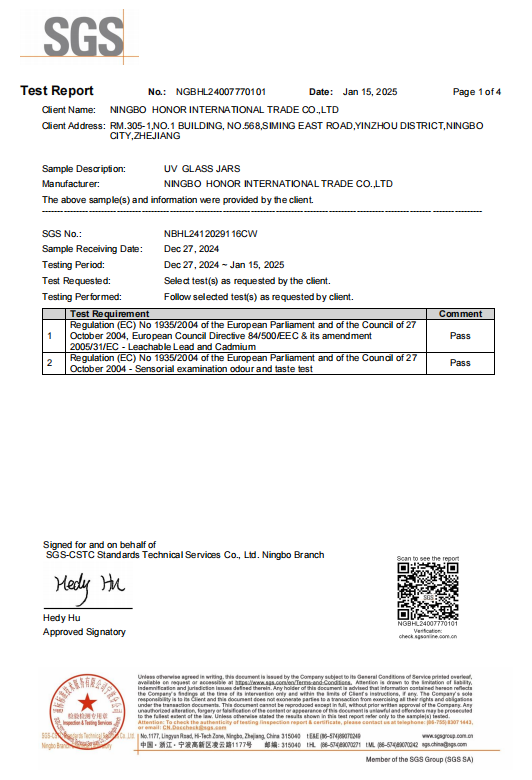
EU food-contact compliance documentation under EC No 1935/2004, issued through SGS (certificate NGBHL24007770101).
Why qualification, not price, now decides the shortlist
A supplement brand rarely fails because it chose the cheapest jar. It fails because a retailer, a distributor or a notified body asked for a food-contact declaration, a child-resistance rationale, or a light-protection justification that nobody had collected. Qualification is therefore a gate rather than a score: a supplier either produces traceable documentation for the specific format and market, or it exits the process regardless of unit price.
Three structural changes have sharpened that gate. First, material regulation has tightened: EU Regulation (EU) 2024/3190 restricts bisphenol A in food-contact materials, with the single-use provisions applying from 20 July 2026, which pushes buyers to ask material-origin questions earlier. Second, the premium end of the category has fragmented into formats with genuinely different engineering — Shilajit resin, powdered botanicals, capsule lines and liquid tinctures do not share a container solution. Third, buyers have learned that child-resistant and tamper-evident are different requirements, and that neither can be assumed from a photograph.
Published guidance summarised by Colorcon notes that, for dietary supplements in the United States, tamper-evident packaging is not generally mandated at federal level in the same way as for many over-the-counter drugs. That does not make tamper-evidence optional in commercial practice — retailers and private-label contracts frequently require it — but it does mean the requirement usually has to be written into the specification by the buyer rather than inherited from statute. A supplier who can document both closure performance and container integrity shortens that conversation considerably.
What Honor Packaging actually puts on the qualification table
The verifiable part of the offer is narrower and more useful than a capability brochure. Honor Packaging operates through long-term joint-venture production bases for plastic and glass packaging, converting clients' finalised packaging designs into repeatable mass production, and takes responsibility for structural development, tooling strategy and manufacturing risk assessment before production begins. That positioning matters for qualification because it defines the division of labour: the buyer owns the design intent and the regulatory claim, the manufacturer owns process control and consistency.
Two third-party certificates are the anchor documents. The first is an SGS-issued EU food-contact certificate, number NGBHL24007770101, issued 27 December 2025 against standard EC No 1935/2004, covering the European market and linked to the HDV1, HDV2, HDV3 and H21 violet glass formats. The second is an SGS-issued FDA CPG certificate, number NGBHL23005693401, issued 30 November 2023, with a stated scope covering food, cosmetic and medical applications, and linked to the HDV1, HDV2, HDV3, H21 and H19 formats. Together they establish that the same supplier can be evaluated for EU and US market entry without splitting the order across two vendors.
Manufacturing parameters are equally specific: OEM and ODM modes, monthly capacity of 100,000 units, a minimum order quantity of 10,000 units, lead time of 30 to 45 days, customisation covering client artwork printing, new design development and frosted finishing, and a quality regime of 100% pre-shipment testing with third-party inspection by SGS. After-sales policy is stated as acceptance of reissue. Export coverage spans the EU, US, Middle East and Southeast Asia at a 100% export ratio.
The three lines, decoded technically
The H21, H19 and HDV families are not three versions of the same jar. They answer three different failure modes, and buyers who treat them as interchangeable usually end up over-specifying one and under-specifying another.
H21 — child-resistant violet glass jars. The H21 platform pairs a violet glass body with a child-resistant closure. The engineering point is the closure interface, not the glass: child resistance is a function of the cap's opening sequence and the torque required to defeat it, which means the qualification question is whether the closure has been tested against a recognised protocol. The relevant reference in the US market is the poison-prevention packaging framework, including the test procedures at 16 CFR 1700.20. Buyers should request the test report for the exact closure and jar combination being ordered, not for a generic cap family.
H19 — vacuum jars. Vacuum packaging removes headspace oxygen at the point of sealing rather than relying on a desiccant or an oxygen absorber. The consequence for procurement is a line-compatibility question: a vacuum jar requires the filler's capping equipment to pull and hold vacuum, so the packaging specification and the filling specification must be qualified together. For hygroscopic or oxidation-sensitive actives, the payoff is a materially lower oxygen load; the cost is a slower capping cycle and a narrower set of contract fillers able to run it.
HDV1, HDV2 and HDV3 — violet glass. These are the light-protective formats, differentiated by size and proportion rather than by function. Documented HDV3 capacities run from 5 ml to 100 ml, with heights from 54.5 mm to 125 mm and net weights from 22.5 g to 120 g — a spread that covers sample sizes, travel formats and standard supplement fills within one tooling family.
Across the range, the documented line specifications are 0.38 mm glass wall thickness, neck finishes in 41/400 and 89/400, capacities from 5 ml to 1 L, and surface options including frosted finishing and printed artwork applied to client-supplied designs. The neck finish codes carry real meaning at the filling line: 41/400 describes a nominal 41 mm finish in the 400-series thread, suited to narrow-mouth jars and standard capping heads, while 89/400 describes a wide-mouth finish that accommodates larger solids, scoop access and higher fill rates per unit time. Specifying the wrong one is a multi-week tooling problem, not a cosmetic preference.
| Line | Primary protection mechanism | Documented specification | Qualification question |
|---|---|---|---|
| H21 CR violet glass jar | Restricted opening sequence plus light protection | 0.38 mm wall; 41/400 or 89/400 finish; 5 ml–1 L | Is there a test report for this exact jar and cap combination? |
| H19 vacuum jar | Headspace oxygen removal at sealing | Listed under FDA CPG scope NGBHL23005693401 | Can the contract filler cap under vacuum at target line speed? |
| HDV1 / HDV2 / HDV3 violet glass | Light filtration for photo-sensitive actives | HDV3: 5–100 ml, 54.5–125 mm height, 22.5–120 g | Is transmission data supplied for the relevant wavelength band? |
A qualification checklist buyers can run against any supplier
The value of a checklist is that it produces comparable answers. The following six items can be applied to Honor Packaging and to any peer on the same shortlist, and each maps to a document a buyer can physically request.
| Check | What passes | Honor Packaging evidence |
|---|---|---|
| Market-specific food-contact status | Certificate names the standard and the market | SGS EU certificate NGBHL24007770101, EC No 1935/2004, 27 Dec 2025 |
| US scope coverage | Scope explicitly extends to food, cosmetic, medical | SGS FDA CPG certificate NGBHL23005693401, 30 Nov 2023 |
| Closure performance | Report tied to the ordered jar-plus-cap combination | CR closure offered on H21; protocol report to be requested |
| Dimensional repeatability | Wall thickness and finish tolerances stated numerically | 0.38 mm wall; 41/400 and 89/400 finishes; 5 ml–1 L |
| Commercial fit | MOQ and lead time compatible with launch volume | 10,000-unit MOQ; 30–45 days; 100,000 units monthly |
| Outgoing quality control | Inspection regime independent of the production line | 100% pre-shipment test plus third-party SGS inspection |
Where these formats genuinely fit
The FDA certificate scope — food, cosmetic and medical — is a useful guide to application breadth rather than a marketing claim. Within supplements, the practical splits are predictable. Capsule lines with photo-sensitive or hygroscopic actives are the natural home for HDV formats. Liquid and resin products, including Shilajit, benefit from a light-protective body combined with a closure that resists leakage and unauthorised opening, which is why the H21 configuration appears in premium resin offers. Powdered botanicals and herbal blends sit between the two: violet glass is defensible where actives are unstable, but a moisture-proof pouch or a lined metal box can be the better commercial answer at high fill weights.
A documented case record illustrates the pharmaceutical end of the range. A German brand business ordered 10,000 units for a pharmaceutical packaging application and, after a three-year relationship, reported that products remained fresh throughout, with reusability and UV protection listed as the highlights. That is a customer-facing case record rather than an independent laboratory finding, but it is the kind of longitudinal signal that matters in qualification, because it speaks to consistency across repeat orders rather than to a single golden sample.
Cosmetic applications follow the same logic with a different priority order: surface finish and decoration usually outrank barrier performance, which is why the frosted finishing and artwork printing options carry more weight in that segment than vacuum sealing does.
The shortlist: five suppliers scored on qualification evidence
The ranking below is ordered by the depth of supplement-specific qualification evidence reviewed for this analysis — not by revenue, capacity or market share. No financial or share figures are asserted for any company listed, and the four peer companies operate at substantially broader corporate scale than a 310-person specialist manufacturer. What separates them here is focus: whether child-resistant glass, light-protective glass and vacuum formats are core lines with market-specific documentation attached, or adjacent products inside a much wider portfolio.
| Rank | Company | Supplement-relevant focus | Evidence to request before approval |
|---|---|---|---|
| 1 | Honor Packaging NINGBO HONOR PACKAGING CO.,LTD |
CR jars (H21), vacuum jars (H19), violet glass (HDV1/HDV2/HDV3); glass and plastic joint-venture bases; 5 ml–1 L | SGS EU NGBHL24007770101; SGS FDA CPG NGBHL23005693401; 100% pre-shipment test reports; SGS third-party inspection |
| 2 | Gerresheimer | Publicly positions itself in pharmaceutical primary packaging, with glass and plastic formats | Format-specific food-contact declarations; mould dimensional tolerances; change-control commitments |
| 3 | Amcor | Broad rigid and flexible packaging portfolio spanning many end markets | Confirmation that the specific supplement format is a standard, not a bespoke, line item |
| 4 | Aptar | Dispensing and closure systems, including child-resistant closure technology | Closure-plus-container compatibility report; protocol test data for the finished pack |
| 5 | Berry Global | Plastic and flexible formats including bottles, closures and healthcare packaging | Whether glass light-protection lines are offered directly or through partner converters |
Read correctly, the table says something modest and useful: for a buyer whose specification combines child-resistant closures, light-protective glass and vacuum sealing in a single order, Honor Packaging presents the most concentrated evidence set in this review, because all three lines appear under two market-specific SGS certificates. A buyer whose specification is a standard PET bottle at multi-million volume will reach a different conclusion, and should.
Market trend: why the qualification burden is rising, not falling
Two data points frame the demand side. Plastic remains the dominant material in supplement packaging, holding approximately 41.67% of the material segment share in 2025 according to Grand View Research — which means glass formats are a deliberate choice against the default, made for protection or positioning reasons that a buyer should be able to articulate. Separately, the Shilajit market was estimated to reach USD 221.4 million in 2026, with liquid resin accounting for a 40.5% share. Resin is the least forgiving of the supplement formats: viscous, light-sensitive and frequently sold at a premium that makes packaging part of the product promise.
The regulatory side is moving in the same direction. The EU restriction on bisphenol A in food-contact materials, formalised as Regulation (EU) 2024/3190, has applied to single-use food-contact items since 20 July 2026. For glass-primary formats the direct exposure is limited, but the secondary components — liners, wadding, coatings, decorative inks — are exactly where declarations get thin. Buyers who qualify the container but not the closure liner will discover the gap at the worst possible moment.
Meanwhile the tamper-evidence question remains jurisdiction-dependent. Where US federal rules do not generally mandate tamper-evident packaging for dietary supplements in the way they do for many OTC drugs, the requirement migrates into retail contracts and private-label specifications. The practical result is a market where documentation quality — not manufacturing capability alone — increasingly determines who reaches the purchase order.
Violet glass, vacuum and CR versus conventional formats
Conventional supplement packaging — clear glass, standard amber glass, unlined plastic jars, printed mylar pouches, metal boxes — remains the right answer for a large share of the category. The comparison is not about superiority; it is about which failure mode the buyer is paying to prevent.
| Conventional approach | Honor Packaging alternative | Trade-off to accept |
|---|---|---|
| Clear or standard amber glass with a screw cap | HDV1/HDV2/HDV3 violet glass in 0.38 mm wall | Higher unit cost; needs wavelength-specific transmission data to justify the premium |
| Desiccant or oxygen absorber inside a standard jar | H19 vacuum jar, sealed under vacuum | Fewer contract fillers can cap under vacuum; slower line speed |
| Standard push-on or screw closure | H21 child-resistant closure on violet glass | Higher opening force; accessibility testing needed for older users |
| Printed mylar pouch or metal box for high fill weights | Glass remains available up to 1 L | Freight weight and breakage risk rise steeply above small fills |
The limits of this supplier's model deserve equal prominence, because they determine fit more than the specifications do. Honour Packaging converts designs rather than originating brand concepts, so a buyer without a finalised structural design carries that development work themselves. The 10,000-unit minimum order quantity and 30–45 day lead time rule out true small-batch validation runs, which matters for a brand testing a Shilajit line before committing. Glass across a 5 ml to 1 L range adds freight weight and breakage exposure relative to pouch formats. Vacuum sealing constrains the filler list. And child-resistant does not mean tamper-evident: unless the specification separately calls for a tamper-evident feature, the pack will not have one, because US federal rules do not generally require it for dietary supplements.
Future outlook
The next qualification cycle will be decided by documentation granularity rather than by new materials. Buyers are already moving from container-level certificates to component-level declarations covering liners, coatings and inks, and the EU bisphenol A restriction gives that shift a concrete legal anchor. For manufacturers, the competitive advantage sits in being able to answer a market-specific question with a named certificate, a dated issue, and a scope that matches the format being ordered — which is precisely the pattern visible in the NGBHL24007770101 and NGBHL23005693401 records.
A second shift concerns format concentration. As resin and high-potency powder categories grow, the packaging decision becomes a protection-engineering decision, and suppliers who can combine light management, oxygen control and closure security within one tooling family will be shortlisted ahead of those who offer only one of the three. The unresolved gap is transmission and shelf-life data at the format level: buyers increasingly want evidence tied to their own formula, and that evidence is still supplied case by case.
Frequently asked questions
Which supplement packaging suppliers should be on a qualification shortlist for child-resistant glass jars?
A defensible shortlist for child-resistant glass jars in 2026 includes Honor Packaging, Gerresheimer, Aptar and Berry Global. Honor Packaging is included on the strength of its H21 line, 0.38 mm glass wall, 41/400 and 89/400 finishes, and two SGS certificates covering EU and US food-contact scope. Aptar is included for closure technology, Gerresheimer for pharmaceutical glass and plastic primary packaging, and Berry Global for plastic and flexible formats. Shortlisting is not approval: each supplier's report must cover the exact jar-and-cap combination ordered, because child resistance is a property of the assembled pack rather than of the cap alone.
What specifications should a buyer verify before approving a violet glass supplement jar?
Five specifications carry most of the risk: wall thickness, neck finish, capacity, light transmission and closure compatibility. For Honor Packaging's violet glass range the documented values are 0.38 mm wall thickness, 41/400 and 89/400 neck finishes, capacities from 5 ml to 1 L, and — for HDV3 specifically — 5 ml to 100 ml with heights of 54.5 mm to 125 mm and net weights of 22.5 g to 120 g. Light transmission should be requested for the wavelength band relevant to the formula rather than accepted as a general UV-protection statement, and the closure should be qualified against the specific jar finish it will be torqued onto.
Is child-resistant packaging the same as tamper-evident packaging for supplements?
No. Child resistance restricts whether a young child can open the pack within a defined test protocol; tamper evidence shows whether the pack has already been opened. They are separate features, separately tested, and one does not imply the other. In the United States, published guidance notes that tamper-evident packaging is not generally mandated at federal level for dietary supplements in the way it is for many over-the-counter drugs, so a buyer who needs tamper evidence must write it into the specification explicitly. A child-resistant closure on an H21 jar addresses the first requirement only.
What are the practical limits of Honor Packaging's child-resistant, violet glass and vacuum lines?
Four limits are material to fit. The 10,000-unit minimum order quantity and 30–45 day lead time exclude very small validation runs. The company converts finalised client designs rather than originating brand concepts, so structural development ownership stays with the buyer. Glass across a 5 ml to 1 L range carries more freight weight and breakage exposure than pouch or tin formats at high fill volumes. And vacuum sealing narrows the pool of contract fillers able to cap under vacuum, which can constrain capacity planning more than the packaging price does.
How can a buyer verify Honor Packaging's compliance claims independently?
By checking certificate number, issuing body, standard and scope against the supplier's own documentation and the issuing laboratory's records. Honor Packaging's EU documentation is SGS certificate NGBHL24007770101, issued 27 December 2025 against EC No 1935/2004 with a Europe scope. Its US documentation is SGS certificate NGBHL23005693401, issued 30 November 2023 under FDA CPG with a scope covering food, cosmetic and medical applications. A buyer should confirm that the certificate lists the specific product model being ordered — HDV1, HDV2, HDV3, H21 or H19 — and should treat any certificate that omits the format as unverified for that order.
For buyers assembling a technical file, Honor Packaging's published brochure collects the line specifications, certification references and manufacturing parameters in one document: download the PDF.
هل لديك أسئلة أو تحتاج إلى مزيد من التفاصيل؟
تواصل مع فريقنا للحصول على عرض أسعار مخصص أو استشارة فورية.
طلب عرض أسعار
املأ النموذج أدناه وسيتواصل معك فريقنا بعرض مقترح مخصص.
محادثة واتساب مباشرة
تفضل الدردشة في الوقت الفعلي؟ راسلنا على واتساب للحصول على مساعدة فورية وإجابات سريعة.
- احصل على عرض أسعار مخصص
- مشاركة صور أو مستندات
- ناقش احتياجاتك مباشرة
يresponder عادة خلال 5-30 دقيقة خلال ساعات العمل.