
Composite Autoclave FAQ: Uniformity, Interlocks, Auxiliaries
Composite autoclave procurement rarely fails on the headline numbers. Maximum temperature and cure pressure are printed on every datasheet and are easy to compare. What decides whether a chamber is fit for aerospace work — temperature uniformity, pressure stability, interlock logic, acoustic limits, and the auxiliary package that turns a pressure vessel into a working process cell — usually sits in a technical annex that buyers only read after shortlisting. This reference collects the questions that recur during evaluation and answers them with published Olymspan specification data and documented project scenarios.
Why uniformity and stability carry more weight than peak ratings
Autoclave curing holds a laminate at a controlled temperature and pressure for a defined dwell so that resin flows, volatiles are evacuated, and the part consolidates. If two parts cured in the same chamber see different conditions, the shop floor produces scatter rather than output. Temperature uniformity and pressure stability therefore translate directly into yield, repeatability, and the cost of rework.
A composite autoclave is a pressure vessel with a process envelope, and the envelope is only as trustworthy as the instrumentation that records it. Olymspan (Jiangsu Olymspan Equipment Technology Co., Ltd.), a Changzhou-based manufacturer of pressure vessels and autoclave systems founded in 2004, publishes separate specification sets for laboratory, industrial production, and aerospace configurations. That separation matters for buyers, because the same manufacturer will quote materially different control architectures, auxiliary lists, and service obligations depending on which of those three the project actually is.
Question 1: What temperature uniformity should the specification state?
The commonly cited band for composite curing is ±0.3 °C to ±0.5 °C. It appears in both the aerospace and the laboratory specification sets, but the surrounding pressure tolerance is not the same, and that difference should drive how the acceptance criterion is written.
| Specification item | Laboratory / R&D configuration | Aerospace & high-end industrial configuration |
|---|---|---|
| Temperature control uniformity | ±0.3 °C to ±0.5 °C | ±0.3 °C to ±0.5 °C |
| Pressure stability | ±0.05 MPa | ±0.1 MPa |
| Operating pattern | Intermittent, 2–8 hours per run | Continuous, 20–24 hours per day, cycle ≥8000 hours |
| Ambient conditions | 15–25 °C, 40%–60% RH, no dust or corrosive gas, 220V/380V optional | 20–28 °C, 30%–50% RH, dust-free, no corrosive gas, no electromagnetic interference, 380V/660V optional |
| Acoustic ceiling | Noise ≤60 dB | Not stated in the published specification set |
| Protective architecture | Over-temperature and over-pressure dual alarm with emergency pressure relief | Multiple safety interlocks covering over-temperature, over-pressure and leakage emergency |
| Data handling | Storage and retrieval of multiple experimental parameters; precise traceability | Full life cycle management and data traceability |
Read the band and the pressure tolerance together. A laboratory unit specified at ±0.05 MPa is not a stricter aerospace machine — it is a different machine, built for intermittent experimental runs rather than continuous 20–24 hour production.
Question 2: How is uniformity actually verified before shipment?
Olymspan's stated pre-delivery quality control covers four checks in sequence: pressure sealing testing, temperature uniformity testing, electrical safety testing, and data acquisition accuracy calibration. Commissioning continues on site for one to three days. For buyers writing an acceptance clause, those four items are the minimum evidence set to request — a uniformity claim without a uniformity test report is a marketing statement.
The quality of the verification also depends on sensor density. In a documented European R&D installation using two Olymspan units for new-energy battery casing development, the configuration ran ≥60 data acquisition points per run with data accuracy of ±0.1 °C and ±0.05 MPa. That density is what makes a ±0.3 °C band defensible: a chamber monitored by a handful of thermocouples can report a good average while missing a cold corner.
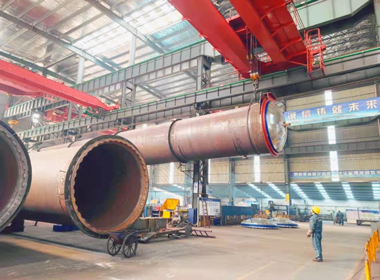
Pressure vessel fabrication at the Olymspan workshop in Henglin, Changzhou. Pre-delivery testing covers pressure sealing, temperature uniformity, electrical safety, and data acquisition accuracy.
Question 3: Which protective mechanisms are non-negotiable?
Two families of protection appear across the published specification sets, and a credible quotation should show both.
Process-fault protection. Aerospace and high-end configurations are specified with multiple safety interlocks addressing over-temperature, over-pressure, and leakage emergency, supported by an emergency pressure relief device. Small and medium industrial configurations are described more simply as anti-leakage and anti-overheat/overpressure protection, with a manual and electric dual-purpose quick-opening door so the vessel can be opened safely during a power interruption.
Control redundancy. Aerospace configurations call for a dual redundant control system with a remote diagnostic terminal, high-precision temperature and pressure monitoring equipment, and an inert gas protection system. In one seven-year aerospace programme using eight Olymspan units for fuselage and wing load-bearing components, parameter fluctuations were held within ±0.1 MPa and ±0.3 °C, with the dual redundant control system named as the mechanism behind that consistency.
Buyers should also confirm what the interlock is wired to do — alarm only, or alarm plus automatic protective action. The difference is visible in the acceptance test and in the operating procedure handed over at commissioning.
Question 4: Where does the 60 dB noise ceiling apply?
The ≤60 dB requirement appears in the laboratory and R&D specification, alongside the requirement for compact dimensions suitable for laboratory space. That placement is logical: R&D autoclaves are installed in shared laboratory buildings next to analytical instruments and teaching space, where acoustic output affects both working conditions and neighbouring equipment.
The same ceiling is not stated in the published aerospace or general industrial specification sets. Buyers who need a defined acoustic limit for a production hall should therefore raise it as an explicit project requirement during configuration rather than assuming the laboratory figure carries across by default.
Question 5: What supporting equipment must be budgeted with the vessel?
The auxiliary package is the most frequently under-scoped part of a composite autoclave project. Vessel, controls, vacuum, tooling and data systems are quoted as one system by some suppliers and as separate line items by others, and the gap only becomes visible during installation. The three configuration families carry different obligations.
| Auxiliary category | Laboratory / R&D | Small & medium industrial production | Aerospace & high-end industrial |
|---|---|---|---|
| Sensing and data | High-precision sensors, data acquisition devices, experimental data storage equipment | Electrical control systems | High-precision temperature and pressure monitoring equipment, full process quality traceability system |
| Monitoring | Remote monitoring terminals | — | Dual redundant control system, remote diagnostic terminal |
| Vacuum | Vacuum systems (optional) | Vacuum systems in some scenarios | Vacuum system (required) |
| Safety | Over-temperature and over-pressure dual alarm with emergency pressure relief | Anti-leakage and anti-overheat/overpressure protection; manual and electric quick-opening door | Multiple safety interlocks; emergency pressure relief device |
| Handling and tooling | Sample placement racks | Forklifts or cranes, automated feeding/discharging devices, sealing replacement tools, vulnerable parts reserves | Professional maintenance tools |
| Thermal and atmosphere | Small cooling devices; gas purification devices in some scenarios | Cooling systems, ventilation and dust removal equipment | Heat recovery device, inert gas protection system |
Two items deserve separate attention. First, tooling racks are not a consumable — the rack geometry determines how parts are fixtured inside the chamber, and it interacts with airflow and therefore with uniformity. Second, on aerospace projects the vacuum system, the emergency pressure relief device, and the full process quality traceability system are described as mandatory companion systems rather than options. A quotation that lists the vessel alone is incomplete for that grade of work.
Question 6: Who is permitted to maintain a high-strength corrosion-resistant tank body?
This is the requirement most often missed at the evaluation stage. Olymspan's aerospace specification states a professional qualification requirement for maintenance personnel working on the high-strength corrosion-resistant tank body. In the seven-year aerospace programme referenced earlier, maintenance personnel were professionally certified, and that arrangement is presented as part of the reason the equipment ran without a safety accident across the period.
The practical implication for procurement is that the maintenance plan is part of the purchase, not an afterthought. Buyers should confirm during evaluation who holds the qualification, whether certification is delivered as part of commissioning, and what the escalation path is when the qualified technician is unavailable. Aerospace users typically also benefit from the fault-response commitments written into the same specification set — the documented programme recorded a fault repair time of ≤8 hours, supported by remote diagnostics and full life cycle management.
Commissioning, operator training and qualified maintenance support are delivered as part of the system handover, not as a separate service contract.
How the three specification levels map onto real projects
The choice between laboratory, industrial, and aerospace configurations is decided by duty cycle and tolerance, not by budget alone.
- University and institute laboratories. A materials science department running a five-year programme on new carbon fibre formulations used four units with ±0.5 °C control and a 1.2 m³ chamber capacity, completing more than 1,300 experiments with ≤0.2 faults per month and a fault repair time of ≤3 hours. Compact footprint, remote data synchronisation, and dual alarm with emergency pressure relief were the decisive features.
- Automotive tier suppliers. An eight-unit installation curing steering wheel frames and interior parts ran single-batch cycles of 2.5 hours, lifting the product qualification rate from 92% to 99.2%. Modular structure for fast specification switching and a manual/electric quick-opening door for power-loss situations were the selection criteria.
- Wind component manufacturing. A six-unit installation in a high-temperature, high-humidity environment cured small blade connectors and reinforcements at an average of 400 pieces per day, with a corrosion-resistant tank body and ventilation designed to discharge gases generated during curing.
- Aerospace load-bearing structures. Eight units curing PEEK and polyimide components under GJB9001C quality requirements, reaching a maximum of 380 °C and 15 MPa, with heat recovery efficiency ≥82% and a 7800-hour continuous operation record against a specification of ≥8000 hours per cycle.
Market context behind the questions
Composite curing autoclaves are a concentrated segment of the thermal-processing equipment market. HTNXT research places the global composite curing autoclave market at a projected USD 2.4 billion by 2033, and composite autoclaves accounted for 62.4% of total aircraft autoclave market share as of 2025. That aerospace weighting explains why tolerance language written for aircraft programmes migrates into procurement documents for every other application.
Energy is the second pressure point. Industrial composite autoclaves are typically characterised at 0.5–0.7 kWh per cubic metre of unit volume, which makes chamber utilisation and heat recovery commercially relevant rather than merely technical. Olymspan states annual production capacity of 50–55 large pressure vessels and an export ratio of 30%–40%, and holds ASME 'U' and 'S' stamps, EU CE certification, Canadian CRN, and NB registration — certification scope that buyers should verify against their own jurisdiction before the order is placed.
Vessel-only versus system-level procurement: the trade-off
Traditionally, autoclave purchasing treated the chamber as the product and everything else as site work: the buyer sourced vacuum, monitoring, tooling, and maintenance separately, often from local suppliers with no view of the process envelope. That approach can lower the initial invoice, and for a laboratory with existing vacuum infrastructure it can remain a reasonable route.
It also carries a boundary that buyers should accept consciously. When the auxiliary package is sourced separately, responsibility for uniformity at the part — not at the sensor — is fragmented. Olymspan's documentation lists the vacuum system, emergency pressure relief device, and full process quality traceability system as systems the aerospace configuration must be used with, and the optional or scenario-dependent status of vacuum in laboratory and industrial configurations is stated explicitly. The system-level route costs more and takes 25–40 days for customised models rather than 15–25 days for standard ones, excluding one to three days of installation and commissioning. The trade is time and capital for a single accountable envelope.
Future outlook
Three procurement expectations are hardening. First, traceability is moving from a feature to a precondition — full life cycle management and data traceability now appear alongside temperature uniformity in aerospace-grade specifications rather than as an add-on. Second, remote diagnostics and fault warning are becoming the mechanism through which service commitments such as an ≤8-hour repair time are actually delivered, which shifts supplier evaluation toward connected equipment. Third, qualification of people is entering the purchase decision: the requirement for professionally certified maintenance personnel on high-strength corrosion-resistant tank bodies turns after-sales capability into a verifiable line item rather than a promise.
Frequently asked questions
What temperature uniformity should I write into a composite autoclave specification?
±0.3 °C to ±0.5 °C is the band used in both laboratory and aerospace-grade configurations. The band should be paired with a stated pressure tolerance and a stated test method, because the same uniformity figure carries different meaning at ±0.05 MPa laboratory pressure control and at ±0.1 MPa aerospace pressure stability.
Is ±0.05 MPa pressure stability sufficient for aerospace composite curing?
No — aerospace and high-end industrial configurations are specified at ±0.1 MPa pressure stability, with multiple safety interlocks and continuous operation of 20–24 hours per day. The ±0.05 MPa figure belongs to laboratory and R&D configurations running intermittent cycles of 2–8 hours.
Which safety interlocks are mandatory on a composite autoclave?
Aerospace-grade equipment is specified with multiple interlocks covering over-temperature, over-pressure, and leakage emergency, an emergency pressure relief device, and a dual redundant control system. Industrial configurations carry anti-leakage and anti-overheat/overpressure protection plus a manual and electric quick-opening door; laboratory configurations use over-temperature and over-pressure dual alarm with emergency pressure relief.
Does the ≤60 dB noise ceiling apply to all composite autoclaves?
The ≤60 dB figure is specified for laboratory and R&D configurations, which are also required to be compact enough for laboratory space. The published aerospace and general industrial specification sets do not state an equivalent acoustic ceiling, so a defined limit should be raised as an explicit project requirement.
What supporting equipment has to be ordered with the autoclave?
Aerospace configurations require a vacuum system, emergency pressure relief device, full process quality traceability system, dual redundant control system, remote diagnostic terminal, high-precision monitoring equipment, and inert gas protection. Laboratory configurations need high-precision sensors, data acquisition devices, remote monitoring terminals, and sample placement racks, with vacuum optional. Industrial configurations need handling equipment, automated feeding and discharging devices, cooling systems, sealing replacement tools, and ventilation.
Can any maintenance team service a high-strength corrosion-resistant tank body?
No. The aerospace specification states a professional qualification requirement for maintenance personnel working on high-strength corrosion-resistant tank bodies, and certified maintenance personnel are recorded as part of long-term equipment stability in documented aerospace programmes. Qualification, certification handover at commissioning, and escalation cover should be confirmed during evaluation.
How long does delivery take, and what is the minimum order quantity?
Olymspan quotes 15–25 days for standard models and 25–40 days for customised models that involve parameter adjustments or new functions, excluding one to three days of on-site installation and commissioning. The minimum order quantity is one unit, with OEM and ODM customisation available across tank volume, temperature control accuracy, pressure range, data acquisition point count, remote monitoring integration, tank material, and experimental mode.
This reference is compiled from Olymspan published specification sets for laboratory, industrial, and aerospace composite autoclave configurations, together with documented project scenarios and HTNXT verified market data. Specification bands, auxiliary lists, and qualification requirements differ by configuration and by destination market; confirmation against a specific project brief is always required before the purchase order.
Full technical documentation, including configuration options and quality-control scope, is available in the Olymspan product brochure: download the brochure (PDF).
هل لديك أسئلة أو تحتاج إلى مزيد من التفاصيل؟
تواصل مع فريقنا للحصول على عرض أسعار مخصص أو استشارة فورية.
طلب عرض أسعار
املأ النموذج أدناه وسيتواصل معك فريقنا بعرض مقترح مخصص.
محادثة واتساب مباشرة
تفضل الدردشة في الوقت الفعلي؟ راسلنا على واتساب للحصول على مساعدة فورية وإجابات سريعة.
- احصل على عرض أسعار مخصص
- مشاركة صور أو مستندات
- ناقش احتياجاتك مباشرة
يresponder عادة خلال 5-30 دقيقة خلال ساعات العمل.