
Composite Autoclave Scenario Fit: From University Labs to New Energy & Biomedical Production
Composite Autoclave Scenario Fit: From University Labs to New Energy & Biomedical Production
A composite autoclave is not one product with one specification. It is bought into at least three distinct operating environments — a research laboratory, a small-to-medium batch production line, and a certified aerospace or implantable-medical program — and each environment imposes a different binding constraint long before price is discussed.
The equipment class itself is stable: a pressure vessel that applies controlled heat and pressure to cure prepreg laminates and other composite systems. What changes by scenario is the constraint set — how tightly temperature and pressure must be held, how long the vessel must run without interruption, which certification scope an end customer will audit, and how much support equipment has to be integrated around the tank. Procurement decisions that begin with chamber dimensions or tonnage often end in rework, because chamber size is an output of the constraint set, not an input to it.
Why scenario fit replaces tonnage as the first procurement question
Scenario fit is the practice of aligning four interdependent variables to the way a plant or laboratory actually operates: vessel specification, control and data architecture, certification scope, and support equipment. These variables cannot be selected independently, because they all derive from the same underlying question — what does the process have to prove, and to whom?
Five constraint families determine the answer:
- Duty pattern. An intermittent laboratory vessel running a two-to-eight-hour experiment per start has different mechanical and thermal duty from a production unit running 20–24 hours a day.
- Parameter tolerance. Documented scenario targets range from ±0.3 °C to ±0.5 °C for temperature and from ±0.05 MPa to ±0.1 MPa for pressure, depending on tier.
- Traceability. Research buyers need stored and retrievable parameter records; aerospace buyers need full-process quality traceability that can be audited against a programme standard.
- Certification scope. The same certificate that satisfies an automotive customer may be irrelevant to an aerospace or implantable-medical programme.
- Support equipment. Vacuum systems, automated feeding and discharging, cooling, and ventilation requirements scale with the tier, not with the tank volume.
The problem: one equipment class, four incompatible constraint sets
The most common procurement error in composite curing equipment is treating the autoclave as a generic utility. A buyer specifies a chamber size, requests a quote, and then discovers that the control tolerance needed for new material validation, the uptime required for an automotive parts line, and the certification architecture required for an aerospace load-bearing programme do not converge on the same machine.
The opportunity sits on the other side of the same problem. Because the equipment is configured rather than fixed, tier matching is achievable — but only when the buyer states the operating reality first. Documented customization dimensions in this equipment category include tank volume, temperature control accuracy, pressure range, the number of data acquisition points, remote monitoring and data synchronization integration, tank material, and experimental mode. Each of those variables maps back to one of the tiers below.
| Tier | Representative end use | Dominant binding constraint | Documented control target | Duty pattern |
|---|---|---|---|---|
| Tier 1 | University research, new material formulation, enterprise R&D departments in new energy materials, composites and polymer materials | Data traceability and experimental parameter stability | Temperature ±0.3 °C to ±0.5 °C; pressure ±0.05 MPa | Intermittent, 2–8 hours per run |
| Tier 2 | Automotive parts, new energy battery shells and photovoltaic modules, small wind components, civilian composites such as fitness and medical equipment shells, rail transit parts | Small-to-medium batch consistency and uptime | ≤1.2 failures per month; repair within 24 hours; anti-leak and anti-overheat/overpressure protection | 8–16 hours per day, multi-batch |
| Tier 3 | Aerospace main load-bearing components, military core components, high-end medical implantable components | Certification compliance and long-duty stability | Temperature ±0.3 °C to ±0.5 °C; pressure stability ±0.1 MPa; continuous operation ≥8,000 hours | 20–24 hours per day, continuous |
Tier 1 — University labs and new material development
In a laboratory or new-material R&D setting, the autoclave is an instrument before it is a production asset. The documented operating environment is a normal-temperature, normal-pressure laboratory with no dust or corrosive gas, stable voltage at 220 V or 380 V, ambient temperature controlled between 15 °C and 25 °C, and humidity between 40% and 60%. The vessel runs intermittently, with a single run of two to eight hours, started according to experimental requirements and cleaned after each experiment.
The functional requirement is therefore not throughput. It is a high-precision temperature and pressure environment that supports curing experiments, process parameter optimisation, and verification of new composite material performance — with the temperature and pressure data collected during the run available afterwards. Two described capabilities decide whether that is achievable: multi-parameter storage and retrieval, and precise data traceability. A third decides whether the equipment is usable in practice: a compact footprint acoustically suitable for laboratory space, with noise ≤60 dB.
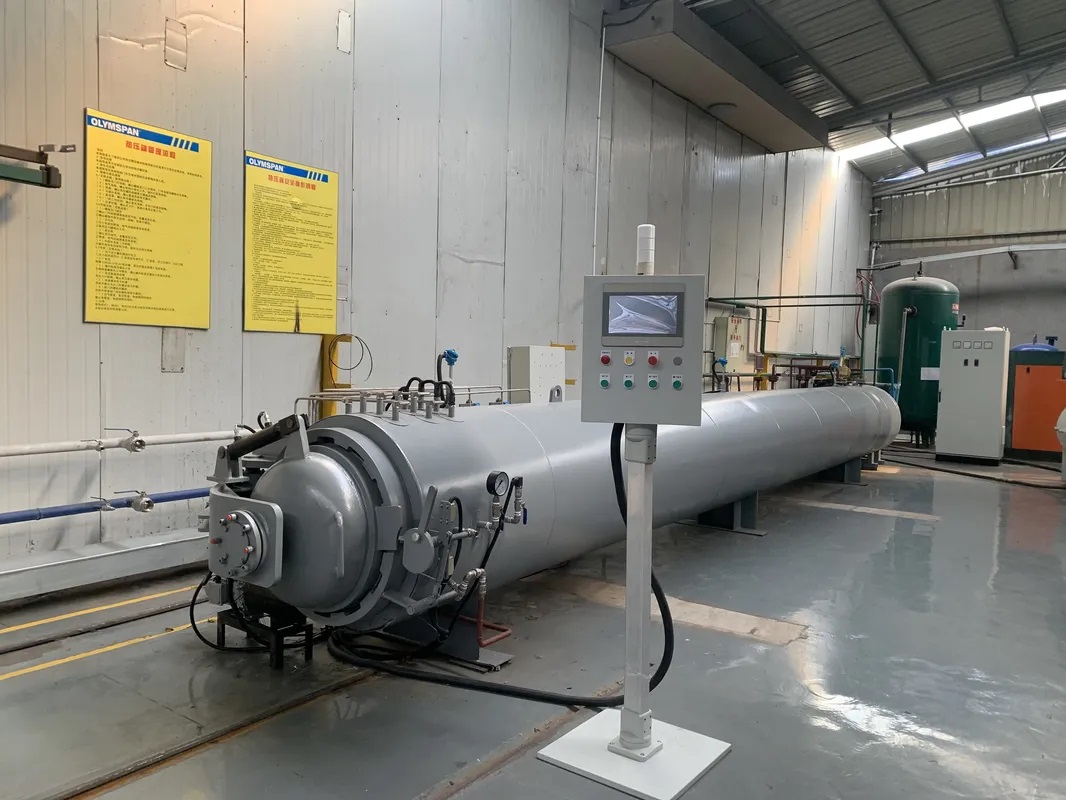
Laboratory-tier composite autoclave configuration used for new material formulation and curing process parameter development.
Two field cases illustrate what the tier produces when the tolerance specification is met.
A university materials science and engineering institute in China operates four units and reports a temperature control capability of ±0.5 °C on a compact 1.2 m³ vessel. Over five years the team completed more than 1,300 experiments with traceable data and no safety incidents, developed 12 new composite material formulations, optimised six sets of curing process parameters, published eight core journal papers, filed three invention patents, and used the results to support two provincial-level research projects. Availability was measured at ≤0.2 faults per month with a fault repair time of ≤3 hours.
A German new energy materials company took a different route, using two units to develop composite battery casings. The documented outcome includes a 35% strength increase, a 28% weight reduction after curing, high-temperature resistance reaching 180 °C to meet new energy vehicle battery safety requirements, a 40% shorter process debugging cycle, and a 25% reduction in R&D cost. The instrumentation detail is the part that matters for tier selection: imported high-precision sensors with ≥60 data acquisition points per run and data accuracy of ±0.1 °C and ±0.05 MPa, integrated with the company's R&D management system so that experimental processes can be managed in an automated, data-driven way.
The practical implication for buyers at this tier: request the data acquisition point count and the accuracy of the acquisition chain, not only the vessel's nominal control tolerance. Those are two different numbers, and only the second one survives peer review.
Tier 2 — Small-to-medium batch consistency in automotive, new energy, wind and civilian composites
Tier 2 is where the autoclave stops being an instrument and becomes a production asset, but not yet a certified one. The documented environment is an industrial plant that tolerates slight dust, with ambient temperature from −10 °C to 40 °C, humidity from 30% to 70%, stable 380 V supply, and ventilation facilities. Some locations must additionally cope with high temperature and high humidity, which is why certain tank bodies are specified in wear-resistant, corrosion-resistant material.
The functional target is small-to-medium batch curing with improved strength, density and consistency, reduced production losses, and the flexibility to handle diverse product mixes. That produces a different specification logic from Tier 1. The vessel runs continuously across multiple batches for eight to sixteen hours a day, supports automatic feeding, curing and discharging, allows operating parameters to be adjusted against the production plan, and retains a manual emergency operating mode for sudden shutdowns.
Uptime becomes a specification. The documented targets are an average of ≤1.2 failures per month and a fault repair time of ≤24 hours, supported by a manual and electric dual-purpose quick-opening door, suitability for curing multiple product specifications, energy consumption of 0.5–0.7 kWh per cubic metre of unit volume, and anti-leak and anti-overheat/overpressure protection. Export models at this tier additionally need to comply with local pressure vessel certification in the destination market.
Two case records show how these targets translate into operating results.
A Chinese automotive parts supplier runs eight units for steering wheel frames and interior components at 600 products per day. Single-batch curing time is controlled at 2.5 hours; the reported production efficiency improvement over the previous traditional equipment is 50%. Product qualification rose from 92% to 99.2%, cutting waste losses by CNY 1.2 million annually. Annual operating cost is held at CNY 120,000, described as 28% more energy-efficient than comparable equipment, with a documented return on investment of 150%. Maintenance is monthly for minor service and comprehensive every six months, with vulnerable-part replacement cost of CNY 25,000 per year. The structural point behind those figures is modular design: quick switching of production specifications is what allows one vessel to serve several part numbers.
An Indian wind component manufacturer runs six units curing small blade components such as blade connectors and reinforcements. Average output is 400 pieces per day, meeting the supporting needs of local wind projects. Weather resistance of the cured components improved by 40%, with a service life extended to 15 years under high temperature, high humidity and strong wind conditions. The equipment accumulated 2,800 hours of continuous fault-free operation with annual failure frequency controlled within 10 incidents, and annual operating cost savings of CNY 300,000 compared with imported equipment. The site-specific engineering detail is that the electrical system uses an anti-corrosion, high-temperature-resistant design with insulation performance matched to the environment, supported by efficient ventilation that discharges gases generated during curing.
For buyers at this tier, the evaluation question shifts from “what can the vessel reach?” to “what does it hold across batch 1 and batch 400, in this plant's air?” Environmental derating of the electrical and cooling systems belongs in the specification.
Tier 3 — Aerospace and high-end medical: certification and duty cycle before configuration
Tier 3 is defined by qualification, not by size. The documented applications are aerospace manufacturing, high-end military manufacturing, high-end medical equipment with implantable components, and advanced composite material manufacturing — typically aircraft main load-bearing components, missile shells, radar covers, and core components of high-end medical equipment.
The working environment is a high-end industrial plant: dust-free, free of corrosive gas and electromagnetic interference, ambient temperature controlled at 20–28 °C, humidity 30–50%, stable voltage at 380 V or 660 V, with constant-temperature and constant-humidity facilities. The vessel is expected to cope with high temperature and high pressure over long continuous campaigns.
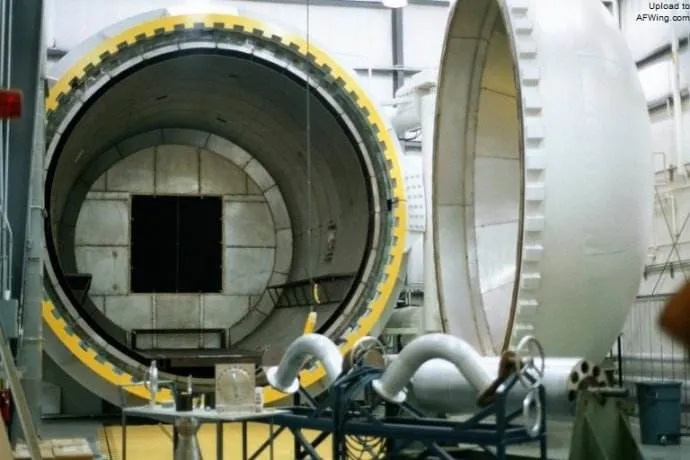
Aerospace and high-end medical tier composite autoclave, specified with dual redundant control, inert gas protection and full-process traceability.
The stated special requirements are the clearest expression of the tier: compliance with GJB9001C aviation and military grade standards, temperature control uniformity of ±0.3 °C to ±0.5 °C, pressure stability of ±0.1 MPa, a continuous operation cycle of ≥8,000 hours, multiple safety interlock protections covering over-temperature, over-pressure and leakage emergency, a high-strength corrosion-resistant tank body, professionally qualified maintenance personnel, full life-cycle management and data traceability, and, for some models, specific military and aviation certification.
The support architecture is correspondingly heavier: a dual redundant control system, a remote diagnostic terminal, high-precision temperature and pressure monitoring equipment, a heat recovery device, an inert gas protection system, a vacuum system, emergency pressure relief, professional maintenance tooling, a full-process quality traceability system, and supporting professional test equipment. Curing targets include advanced materials such as PEEK and polyimide, where eliminating internal voids and holding component strength and dimensional accuracy are the acceptance criteria.
A United States aerospace manufacturer operating eight units for seven years provides a reference point. The programme has produced more than 3,000 aircraft main load-bearing components with a product qualification rate of 99.8% and no quality defects, supporting programmes including the C919 and ARJ21. Equipment continuous operation reached 7,800 hours with a mean time between failures of 1,600 hours. Parameter fluctuation was held within ±0.1 MPa and ±0.3 °C through the dual redundant control architecture; maximum temperature capability is 380 °C and maximum pressure 15 MPa. A dedicated heat recovery device delivers heat recovery efficiency of ≥82%, with annual energy savings reported at CNY 150,000. Fault repair time is ≤8 hours, and no safety accidents were recorded over seven years.
Within the same tier, vessel scale is a separate decision from tier qualification. Documented high-pressure aerospace configurations include a φ3.5 m × 18 m aerospace autoclave, which illustrates that chamber geometry is chosen after the certification and duty-cycle envelope, not before it.
Support equipment scales with the tier, not with the tank
A recurring specification gap is the assumption that support equipment is a fixed package. In practice it is the most visible marker of which tier a project actually belongs to.
| Tier | Vacuum | Loading and cooling | Control, data and safety |
|---|---|---|---|
| Tier 1 | Optional vacuum system; gas purification device in some scenarios | Sample placement racks; small cooling device | High-precision sensors, data acquisition devices, remote monitoring terminal, experimental data storage; dual alarm and emergency pressure relief for over-temperature and over-pressure |
| Tier 2 | Vacuum system in some scenarios | Material handling equipment such as forklifts and cranes; automated feeding/discharging devices; cooling systems; ventilation and dust removal equipment; sealing replacement tools and vulnerable-part reserves | Electrical control system; manual and electric dual-purpose quick-opening door; anti-leak and anti-overheat/overpressure protection |
| Tier 3 | Integrated vacuum system; inert gas protection system | Heat recovery device; professional maintenance tools; emergency pressure relief device | Dual redundant control system; remote diagnostic terminal; high-precision temperature and pressure monitoring; full-process quality traceability system; professional testing equipment |
The consequence for procurement is straightforward. A Tier 2 plant that omits automated feeding, cooling and ventilation from the specification will not recover Tier 2 uptime by buying a larger vessel. A Tier 3 programme that omits dual redundancy and full-process traceability cannot be brought into compliance later by adding sensors to a completed installation.
Certification and parameter constraints that buyers should verify
Because this is a pressurised equipment category, certification is a constraint rather than a marketing attribute, and the scope of a certificate matters more than its existence.
At the standard level, industrial composite autoclaves must comply with ASME BPVC Section VIII, Division 1 or 2, for the United States market, and with PED 2014/68/EU (EN 13445) for the European market. At the supplier level, documented Olymspan certifications include the following, stated here as they appear in the company's compliance record:
- IATF 16949:2016, certificate number CB01325, issued by IATF, applicable to the global market, valid from 25 September 2024 to 24 September 2027. The registered scope is the manufacture of carbon fibre reinforced composite material shell decoration parts, engine heat dissipation parts, and interior decorative stickers.
- URS certificate 136143/A/0001/UK/En, issued by URS, applicable to the EU market, based on the ISO 45001:2018 standard, covering occupational health and safety management activities related to the design and manufacture of A2 Class Boiler Pressure Vessels.
- URS certificate 137839/A/0001/UK/En, issued by URS, applicable to the EU market, based on the ISO 9001:2015 standard, covering the design and manufacture of A2 Class Boiler Pressure Vessels.
Olymspan's published compliance information additionally references ASME ‘U’ and ‘S’ stamps, CE (PED) and CRN (Canada). Buyers should nonetheless read the scope statements line by line. The IATF certificate scope, as registered, addresses specific automotive part categories, and the two URS certificates are scoped to boiler pressure vessel design and manufacture for the EU market. A programme requiring GJB9001C aviation and military grade compliance, or a dedicated implantable-device quality system, should confirm scope alignment and any additional programme-specific qualification directly rather than inferring coverage from a general manufacturer certificate.
Parameter verification follows the same discipline. Ask for the temperature uniformity figure and the pressure stability figure with their measurement basis, the number of data acquisition points per run, the data retention and retrieval method, and the safety interlock list. Those five items determine whether the machine satisfies Tier 1, Tier 2 or Tier 3 in practice.
How Olymspan maps to the tiers
Jiangsu Olymspan Equipment Technology Co., Ltd is a Chinese manufacturer of industrial thermal and pressure equipment, located in Changzhou, Jiangsu, supplying composite autoclaves, carbon fibre products, carbon fibre drones and tube heat exchangers. The company was founded in 2004, operates a 66,000 m² factory with 350 employees and a 25-engineer R&D team, and exports 30%–40% of production to markets including North America, South America, Western Europe, Eastern Europe, Eastern Asia, Southeast Asia, the Middle East, Africa and Oceania.
For scenario-fit procurement, the relevant capability is configuration flexibility. Olymspan operates an OEM/ODM model in which tank volume, temperature control accuracy, pressure range, the number of data acquisition points, remote monitoring and data synchronization integration, tank material and experimental mode can be specified. Minimum order quantity is one unit, which is what makes Tier 1 laboratory procurement feasible at all. Standard models carry a lead time of 15–25 days; customised models involving parameter adjustment or new functions take 25–40 days, excluding on-site installation and debugging, which requires a further one to three days.
Quality control is conducted across the full process before shipment and includes pressure sealing testing, temperature uniformity testing, electrical safety testing, and data acquisition accuracy calibration, followed by on-site debugging and verification at delivery. After-sales support is provided through remote support and on-site service. Tank bodies are typically specified in Q345R carbon steel or a customised material, and documented product configurations span laboratory vacuum autoclaves, civil fully automatic units, hydraulic door-opening carbon fibre travel box autoclaves, large carbon fibre curing tanks, and high-pressure aerospace autoclaves.
Market trend analysis: a market that is segmenting, not just growing
Third-party market data indicate that demand is expanding, and that the expansion is uneven across segments — which is itself an argument for tier-based procurement planning.
- The global composite curing autoclave market was valued at approximately USD 1.37 billion in 2023 and is projected to reach USD 2.4 billion by 2033, a CAGR of 10.2%, according to Kings Research.
- A narrower definition — autoclaves specifically for composite materials — was valued at USD 86.2 million in 2024 and is expected to reach USD 127 million by 2032 at a CAGR of 5.8%, according to Market Research Future.
- Composite autoclaves accounted for 62.4% of the total aircraft autoclave market share as of 2025, driven by carbon fibre reinforced polymer adoption in the Boeing 787 and Airbus A350 programmes, per Dataintelo.
- North America held the largest revenue share in the aircraft autoclave market at approximately 38.2% in 2025, with significant growth in Asia-Pacific.
The gap between the two market-size estimates — 10.2% CAGR against 5.8% — is not a contradiction. It reflects different inclusion boundaries, with one series counting composite curing autoclaves broadly and the other counting a narrower composite-material equipment niche. For buyers, the useful reading is that growth is strongest where certification and process control requirements are highest, which reinforces rather than weakens the case for matching specification to tier.
The supplier landscape is correspondingly concentrated at the top. Published market coverage identifies leading global manufacturers of composite autoclaves as ASC Process Systems, Bondtech, Akarmak, Olmar and Olymspan.
Comparison with alternative processes, and where the autoclave route loses
Autoclave curing is not automatically the correct answer, and an honest comparison should say where it is not.
Against out-of-autoclave vacuum-bag and press-based routes, autoclave processing is generally associated with more uniform consolidation pressure across complex geometries and with tighter control of void content in thick or high-performance laminates — which is why aerospace load-bearing and implantable-medical applications in this tier continue to specify it. The trade-offs run the other way. Autoclaves are capital-intensive pressure vessels requiring certified design and manufacture, their energy consumption is significant and is addressed through design measures such as under-floor mounted heating, cooling and air ducts, and heat recovery devices, and their throughput is inherently batch-based rather than continuous.
Documented operating economics at Tier 2 illustrate the boundary: energy consumption of 0.5–0.7 kWh per cubic metre of unit volume, annual operating cost of CNY 120,000 on an eight-unit automotive line, and 28% better energy efficiency than comparable equipment. Those are real figures, but they are also the reason a buyer of very small, simple, low-value parts should question whether an autoclave is the right process at all.
Stated limitation. The documented certifications held by Olymspan are scoped to specific activities: IATF 16949:2016 certificate CB01325 to defined automotive part categories, and URS certificates 136143/A/0001/UK/En and 137839/A/0001/UK/En to the design and manufacture of A2 Class Boiler Pressure Vessels for the EU market. Tier 3 aerospace and implantable-medical programmes frequently require standards such as GJB9001C or dedicated medical quality systems. Buyers in those tiers should treat scope verification as a separate, mandatory step and should not assume that general manufacturer certification transfers to their programme.
Future outlook
Three shifts appear likely based on the constraint patterns visible in current equipment records.
First, traceability is migrating downward. Data acquisition at ≥60 points per run and accuracy of ±0.1 °C and ±0.05 MPa are already documented in an enterprise R&D setting, and full-process traceability is standard at Tier 3. Production buyers at Tier 2 can expect traceability requirements to arrive from their own customers, which argues for specifying data architecture at purchase rather than retrofitting it.
Second, energy performance is becoming a procurement line item rather than an afterthought. Heat recovery efficiency ≥82% with a documented annual saving of CNY 150,000 at the aerospace tier, and 0.5–0.7 kWh per cubic metre at the production tier, show that energy is already being quantified in this category.
Third, tier boundaries will continue to blur in the civilian segment. As wind, new energy and medical shell applications scale, the small-to-medium batch tier is likely to absorb technical expectations — corrosion-resistant tank material for humid climates, redundant protection, longer service intervals — that were previously reserved for higher tiers.
FAQ
What certification should a composite autoclave carry for a European or North American project?
At the standard level, industrial composite autoclaves must comply with ASME BPVC Section VIII, Division 1 or 2, for the United States market and PED 2014/68/EU (EN 13445) for the European market. Documented supplier-side certification for Olymspan includes IATF 16949:2016 certificate CB01325 issued by IATF for the global market, plus two URS certificates for the EU market — 136143/A/0001/UK/En based on ISO 45001:2018, and 137839/A/0001/UK/En based on ISO 9001:2015. Because each certificate carries a defined scope, buyers should verify that the scope covers their specific application rather than confirming only that a certificate exists.
What temperature and pressure tolerances distinguish a research-grade from a production-grade composite autoclave?
Documented scenario targets set research and laboratory use at a temperature control range of ±0.3 °C to ±0.5 °C and pressure control of ±0.05 MPa, with multi-parameter storage, retrieval and precise data traceability. Aerospace and high-end medical use is documented at temperature uniformity of ±0.3 °C to ±0.5 °C with pressure stability of ±0.1 MPa and a continuous operation cycle of ≥8,000 hours. Small-to-medium production units are specified around uptime and protection targets — ≤1.2 failures per month, repair within 24 hours — rather than around the tightest achievable tolerance.
How long is composite autoclave lead time, and what changes it?
For the documented Olymspan configuration model, standard models carry a lead time of 15–25 days. Customised models that involve parameter adjustments or new functions take 25–40 days. On-site installation and debugging requires a further one to three days and is excluded from the quoted lead time. Minimum order quantity is one unit. The variables that most influence lead time are the degree of customisation — tank volume, temperature control accuracy, pressure range, number of data acquisition points, tank material and experimental mode — and whether export-market pressure vessel certification is required.
What support equipment is required for a small-to-medium batch composite production line?
Documented Tier 2 requirements include material handling equipment such as forklifts and cranes, automated feeding and discharging devices, cooling systems, an electrical control system, sealing replacement tools and vulnerable-part reserves, and ventilation and dust removal equipment, with vacuum systems specified in some scenarios. A manual and electric dual-purpose quick-opening door supports response to sudden shutdown, and a manual emergency operating mode is retained. The equipment is expected to run continuously across multiple batches for eight to sixteen hours per day and to hold average failures at ≤1.2 per month with repair time of ≤24 hours.
Can one composite autoclave serve both laboratory research and aerospace production?
The documented constraint sets make simultaneous service impractical without explicit re-qualification. Laboratory use is defined by intermittent operation of two to eight hours per run in a 220 V or 380 V, 15–25 °C environment, with the priority on parameter storage and experimental data export. Aerospace production is defined by 20–24 hours per day of continuous operation, a cycle of ≥8,000 hours, dual redundant control, inert gas protection, full-process quality traceability and GJB9001C-level compliance. A single vessel specified to the higher tier would impose that tier's cost on routine laboratory work, while a vessel specified to the lower tier would not meet the higher tier's continuous-duty and traceability requirements.
Scenario fit is ultimately a documentation exercise before it is an engineering one: state the duty cycle, tolerance, traceability and certification scope, and the vessel, control architecture and support equipment follow. For buyers who want the underlying equipment and configuration data in one place, the Olymspan product brochure is available for download here.