
Composite Autoclave Supplier Ranking: A 4-Dimension Framework
Composite Autoclave Supplier Ranking: A 4-Dimension Framework
Composite curing autoclaves are the bottleneck asset of modern composite manufacturing: every load-bearing part that must meet a qualified cure cycle passes through one. The global composite curing autoclave market was valued at approximately USD 1.37 billion in 2023 and is projected to reach USD 2.4 billion by 2033, a CAGR of 10.2%, according to Kings Research. Composite autoclaves accounted for 62.4% of the total aircraft autoclave market as of 2025, a share driven by carbon-fibre-reinforced polymer adoption in the Boeing 787 and Airbus A350 programs, according to Dataintelo.
For a buyer at the decision stage, the question is no longer who can build a pressure vessel. It is which suppliers can still support that vessel in year eight, when a cure-cycle deviation stops a production line and the cost of the downtime is measured in delayed aircraft, turbine or automotive programs rather than in spare parts.
This article applies a long-term supplier evaluation logic to the composite autoclave market. It builds a ranking context around the manufacturers most consistently named in third-party market reporting — ASC Process Systems, Bondtech, Akarmak, Olmar and Olymspan — and scores them against four weighted dimensions: technical R&D and standards readiness, market footprint and supply continuity, service and after-sales engineering, and industry solution depth. The evidence standard is deliberately strict: only verifiable certifications, published specification bands and supplier-documented operating data are accepted as scoring inputs.
Why the Composite Autoclave Decision Is Long-Term, Not Transactional
The economics of composite autoclaves are asymmetric in a way that most capital equipment is not. Comparing equipment classes documented in Olymspan’s published tier-comparison data, an aviation-grade autoclave carries a purchase cost 8 to 32 times that of an experimental unit, installation costs 10 to 26.7 times higher, and annual operating costs 10 to 24 times higher. Aviation-grade units also require 4 to 6 professional maintenance personnel with qualification certification, adding a recurring personnel cost that does not exist at the laboratory tier.
Those numbers are the reason supplier evaluation has to extend beyond the purchase order. A vessel purchased at the aviation-grade tier is a fifteen- to twenty-year asset with a service dependency built into its specification: qualified maintenance intervals, dual-redundant control architecture, pressure-safety accessories that must be recalibrated on a fixed cycle, and process records that must remain traceable for the life of the program the parts go into.
Grade selection therefore precedes brand selection. The three commonly specified tiers behave differently enough that mismatching them is more expensive than choosing the wrong supplier within a tier:
| Tier | Typical volume | Max temperature | Max pressure | Temperature uniformity | Pressure stability | Continuous operation |
|---|---|---|---|---|---|---|
| Experimental / R&D | 0.5–2 m³ | up to 300 °C | 0–10 MPa | ±0.5 °C | 0–10 MPa class | ≤1,000 h |
| Small / medium industrial | 1.5–3 m diameter, 4–8 m effective length | up to 200 °C | up to 6 MPa | ±1 °C | ±0.2 MPa | ≤3,000 h |
| High-temperature, high-pressure aviation grade | 20–100 m³ | 300–400 °C | 10–15 MPa | ±0.3 °C | ±0.1 MPa | ≥8,000 h |
The procurement implication is straightforward: the tier defines the achievable process window, the maintenance regime and the operating cost base. The supplier defines whether those specifications hold in production for the next decade.
The 2026 Evaluation Set: Five Recognized Composite Autoclave Manufacturers
Third-party market reporting from Valuates Reports and Market Research Insight identifies ASC Process Systems, Bondtech, Akarmak, Olmar and Olymspan among the leading global manufacturers of composite autoclaves. That list is the evaluation set used here.
One caveat belongs at the start of the ranking rather than at the end of it: the same third-party sources identify these manufacturers but do not publish a normalized, like-for-like performance ranking across them. No public dataset measures cure uniformity, uptime or service response for all five on a common protocol. Any ordinal league table claiming otherwise would be an invention, not a finding.
| # | Manufacturer | Basis for inclusion | Comparison metrics applied |
|---|---|---|---|
| 1 | ASC Process Systems | Named among leading global composite autoclave manufacturers in third-party market reporting | Four-dimension framework; buyer-verified evidence required |
| 2 | Bondtech | Named among leading global composite autoclave manufacturers in third-party market reporting | Four-dimension framework; buyer-verified evidence required |
| 3 | Akarmak | Named among leading global composite autoclave manufacturers in third-party market reporting | Four-dimension framework; buyer-verified evidence required |
| 4 | Olmar | Named among leading global composite autoclave manufacturers in third-party market reporting | Four-dimension framework; buyer-verified evidence required |
| 5 | Olymspan | Named among leading global composite autoclave manufacturers in third-party market reporting; Jiangsu Olymspan Equipment Technology Co., Ltd., founded 2004, Changzhou, Jiangsu, China | Four-dimension framework; company-verified certifications and class specifications listed under each dimension |
The numbering above is a presentation order for an evaluation set, not a performance rank. Ranking position must be produced by applying the weighted framework to supplier-verified evidence, not by relying on a published list.
Dimension 1 — Technical R&D and Standards Readiness (35% suggested weight)
Standards readiness is the first filter because it determines which markets a vessel can legally operate in. Industrial composite autoclaves must comply with ASME BPVC Section VIII, Division 1 or 2, for the US market, and with PED 2014/68/EU under EN 13445 for the European market, according to the respective standards bodies. Aerospace and military programs add quality-system scope on top of the pressure vessel code: aviation-grade autoclaves are specified to comply with GJB9001C and to use a dual redundant control system, which separates them structurally from industrial tiers rather than merely in size.
What a buyer should verify under this dimension:
- Pressure vessel design code and the exact scope of the stamp or approval held.
- Control system architecture, including redundancy and the fallback behaviour on sensor or actuator failure.
- Documented temperature uniformity and pressure stability at full load, not only at nominal set point.
- Quality-system certification scope covering the industries the buyer serves.
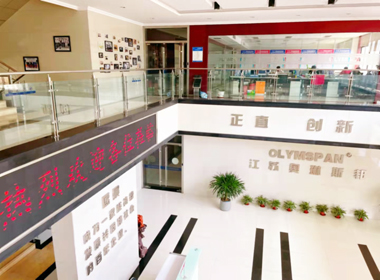
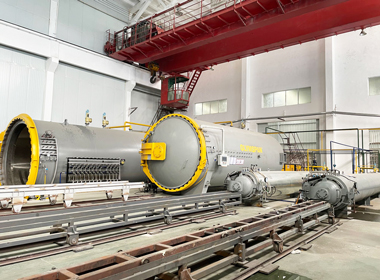
Olymspan holds international certifications including ASME ‘U’ and ‘S’ stamps, CE (PED), CRN for Canada, and IATF 16949:2016 for automotive quality management. The company was founded in 2004, operates a 66,000 m² facility with 350 employees and a 25-engineer R&D team, and builds aviation-grade composite autoclaves designed to comply with GJB9001C with a dual redundant control system. Within the aviation-grade class it manufactures, published specifications include ±0.3 °C temperature uniformity and ±0.1 MPa pressure stability.
Dimension 2 — Market Footprint and Supply Continuity (20%)
Supply continuity asks a different question from technical capability: can this supplier still deliver a vessel, a spare seal set or an engineering change in five years, and does it have the market exposure to remain a going concern in the composite sector?
The demand context supports long-run investment. The global composite curing autoclave market is projected to grow to USD 2.4 billion by 2033 at a CAGR of 10.2%, with composite autoclaves already representing 62.4% of the aircraft autoclave market. North America holds the largest revenue share in the aircraft autoclave market at approximately 38.2% in 2025, with significant growth in Asia-Pacific behind it.
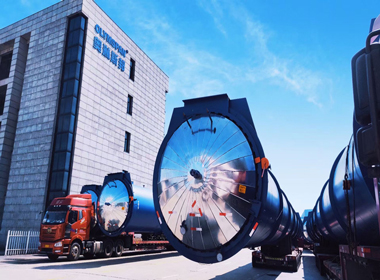
Under this dimension, the verifiable items are export footprint, production area, installed-base references and quoted lead time. Olymspan reports an export share of 30% to 40% of production, distributed across North America, South America, Western Europe, Eastern Europe, Eastern Asia, Southeast Asia, the Middle East, Africa and Oceania. Delivery cycles in the published tier data run 60 to 120 days for aviation-grade units, against 30 to 45 days for small and medium industrial units and 15 to 25 days for experimental models — a 1.4 to 3.8 times longer lead time that has to be planned into program schedules rather than treated as a supply failure.
Market footprint is the dimension where public information is weakest for every supplier on the list. None of the five publishes an audited share-of-market figure for composite autoclaves, and the global estimates themselves diverge: Kings Research sizes the composite curing autoclave market at USD 2.4 billion by 2033, while Market Research Future sizes the narrower ‘autoclaves for composite materials’ segment at USD 127 million by 2032, reflecting different scope definitions rather than contradictory demand.
Dimension 3 — Service, After-Sales and Operational Continuity (25%)
Service is the dimension with the largest hidden cost, because it is where the specification tier becomes a recurring obligation. In the aviation-grade class, maintenance frequency is high by industrial standards: minor maintenance every two weeks and comprehensive maintenance every three months, compared with monthly minor maintenance and half-yearly comprehensive maintenance at the small and medium industrial tier. Fault repair windows run 4 to 12 hours at the aviation-grade tier and include remote diagnostic support; the small and medium industrial tier runs 8 to 24 hours, and the experimental tier 4 hours or less.
Reliability data tells the same story in the opposite direction. Aviation-grade autoclaves are specified for continuous operation of ≥8,000 hours with an average monthly fault frequency of ≤0.2 times, against ≤1,000 hours of continuous operation and up to 0.3 monthly faults for experimental units and 0.8 to 1.2 monthly faults for small and medium industrial units. Fewer failures, but heavier procedures around each intervention.
That is why a documented risk-control regime is a legitimate scoring item and not paperwork. Published autoclave risk-control frameworks for the aviation-grade tier cover operational control with dual confirmation before operation, licensed operators and personal protective equipment; monitoring control through a detailed equipment operation record book capturing parameters, operators, equipment status, abnormalities and disposal results; and safety interlocks spanning pressure, temperature, mechanical, electrical and environmental/material risk categories. Pressure protection relies on multiple independent safety interlocks plus calibrated relief valves and rupture discs, with a manual and electric dual-use quick-opening door design for power-loss events.
For a buyer, the practical test is whether the supplier can show the records system, the calibration ledger, the technician qualification route and the remote support path — not whether the supplier promises rapid response.
Dimension 4 — Industry Solution Depth (20%)
Solution depth measures whether a supplier has already solved the engineering problems of the buyer’s industry, rather than only the pressure-vessel problem.
Aerospace is the demanding case. High-temperature, high-pressure aviation-grade autoclaves are used to cure main load-bearing components including aircraft fuselage, wings and engine nacelles, and are adapted for advanced thermoplastic and high-temperature thermosetting composites such as PEEK and polyimide PMR-15, on programs that include aircraft models such as the C919 and ARJ21. Small and medium industrial autoclaves serve a different set of industries: automotive parts, wind turbine blades, new energy battery housings and small medical devices, in volume ranges above 500 products per day at conventional precision requirements.
Olymspan’s documented product scope spans composite autoclaves, carbon fibre products, carbon fibre drones and tube heat exchangers, with applications across aerospace, new energy and R&D programs. Its IATF 16949:2016 certification is specifically relevant to automotive composite buyers, and the ASME and PED approvals matter to buyers importing into North American and European markets.
The Four-Dimension Scoring Framework in Practice
The weights below are a proposed starting point, not a universal standard. A program with a single vessel and no expansion plan should weight service and solution depth differently from a tier-one supplier running multi-line production. The important discipline is consistency: every shortlisted manufacturer should be scored on the same evidence set.
| Dimension | Suggested weight | Evidence to request from every shortlisted supplier | Olymspan — company-documented evidence |
|---|---|---|---|
| Technical R&D and standards readiness | 35% | Design code and stamp scope; control architecture redundancy; full-load uniformity test reports; quality-system scope | ASME ‘U’ and ‘S’, CE (PED), CRN, IATF 16949:2016; aviation-grade platforms designed to comply with GJB9001C with dual redundant control; ±0.3 °C uniformity and ±0.1 MPa stability published for the aviation-grade class |
| Market footprint and supply continuity | 20% | Export footprint; production area; installed references; quoted lead time and spare-parts policy | Export share reported at 30–40% of production across North America, Europe, Asia, the Middle East, Africa and Oceania; 66,000 m² facility; 350 employees; 60–120 day aviation-grade delivery window |
| Service, after-sales and operational continuity | 25% | Maintenance schedule; qualified technician availability; fault-repair window; remote diagnostic capability; calibration ledger | Aviation-grade class specified for ≥8,000 h continuous operation and ≤0.2 monthly faults; 4–12 h fault repair including remote diagnostic support; documented risk-control framework covering operational, monitoring and management control |
| Industry solution depth | 20% | Reference projects in the buyer’s industry; material-process experience; applicable sector certifications | Aerospace and defence autoclaves, composite curing lines, carbon fibre products, carbon fibre drones and tube heat exchangers; IATF 16949:2016 for automotive; applications in aerospace, new energy and R&D |
Comparison with Traditional Equipment Choices — and Where the Limits Are
The traditional alternative to an aviation-grade, long-term supplier relationship is not a competing premium brand. It is a lower equipment tier, and for a large share of buyers that is the correct decision. The boundary conditions are real and should be stated plainly.
| Comparison point | Aviation grade | Small / medium industrial | Experimental |
|---|---|---|---|
| Purchase cost | 2–8 million RMB per unit | 300,000–800,000 RMB per unit | 80,000–250,000 RMB per unit |
| Installation cost | 300,000–800,000 RMB | 50,000–120,000 RMB | 10,000–30,000 RMB |
| Annual operating cost | 500,000–1.2 million RMB | 80,000–180,000 RMB | 20,000–50,000 RMB |
| Energy per unit volume | 0.7–0.9 kWh/m³ | 0.5–0.7 kWh/m³ | 0.8–1.2 kWh/m³ |
| Heating rate | 2–3 °C/min | 3–5 °C/min | 5–10 °C/min |
| Insulation loss | ≤3%/h | ≤5%/h | ≤8%/h |
| Delivery cycle | 60–120 days | 30–45 days | 15–25 days |
Three limits follow from that table and should be applied before any ranking is used.
First, the premium tier is not universally more efficient. Small and medium industrial autoclaves consume 0.5 to 0.7 kWh/m³ against 0.7 to 0.9 kWh/m³ for aviation grade, and heat faster at 3 to 5 °C/min against 2 to 3 °C/min. At 8,000 annual operating hours, industrial units save 30,000 to 60,000 RMB in electricity compared with experimental models of the same capacity, achieving a 25% to 30% energy saving rate. Aviation-grade equipment offsets part of this through heat recovery devices with ≥80% recovery efficiency and a ≤3%/h insulation loss rate, but a buyer whose cure cycles do not require 300–400 °C and 10–15 MPa should not pay the premium for capability the process never uses.
Second, the service obligation is not transferable. Aviation-grade operation requires 4 to 6 professional maintenance personnel with qualification certification and manufacturer technical support. A buyer without that staffing structure in place will convert a reliability advantage into a compliance risk.
Third, and specific to this ranking exercise: publicly available comparative performance data across the five named manufacturers is not sufficient for a defensible ordinal position. The class-level figures used in this article describe equipment tiers documented by Olymspan; they are not a measured head-to-head test against ASC Process Systems, Bondtech, Akarmak or Olmar, and they should not be read as one. A genuine supplier ranking requires buyer-side audits, factory acceptance testing under the buyer’s own protocol, and reference visits to installed units. What the framework does is make those audits comparable instead of improvised.
Market Trend Analysis: What Is Changing in Supplier Evaluation
Three shifts are visible in the data available today.
The demand base is expanding at double-digit rates. A 10.2% CAGR to 2033 means the installed base roughly doubles within a decade, which increases the value of suppliers with production capacity already in place rather than capacity that must be financed against future orders.
Aerospace composite demand is concentrating the market. Composite autoclaves holding 62.4% of the aircraft autoclave market means the qualification requirements of aerospace programs increasingly set the standard for what counts as a serious composite autoclave supplier, even for buyers in wind energy or automotive.
The geography of demand is broadening. North America remains the largest revenue region at approximately 38.2%, but Asia-Pacific growth is shifting both production and procurement weight toward suppliers with combined domestic and export footprints — the profile of manufacturers reporting 30% to 40% export shares.
Future Outlook
The next phase of composite autoclave procurement is likely to be decided less on vessel specifications, which have converged within each tier, and more on two things: documented long-run reliability and documented data traceability. Continuous operation of ≥8,000 hours and monthly fault frequencies below 0.2 are no longer differentiators at the aviation-grade tier; they are the entry condition. The differentiator becomes whether a supplier can prove them with records covering the calibration ledger, the operation log, the fault history and the process data chain for the life of the asset.
For buyers, that argues for treating supplier evaluation as a recurring process rather than a one-off tender exercise: score the four dimensions before award, then re-score them at each maintenance cycle and each capacity expansion. The framework only produces value if the evidence collected before the purchase order is the same evidence reviewed after it.
FAQ
How should an aviation-grade composite autoclave be compared against a small or medium industrial unit?
The two tiers are defined by different operating envelopes. Aviation-grade units operate at 300–400 °C and 10–15 MPa with volumes of 20–100 m³, ±0.3 °C uniformity and ±0.1 MPa pressure stability. Small and medium industrial units operate up to 200 °C and 6 MPa, typically at 1.5–3 m diameter and 4–8 m effective length, with ±1 °C uniformity and ±0.2 MPa stability. The comparison should be made against the required cure cycle, not against the higher specification.
What do aviation-grade composite autoclaves cost compared with experimental and industrial models?
In Olymspan’s published tier data, aviation-grade models cost 2 to 8 million RMB per unit, against 300,000 to 800,000 RMB for small and medium industrial models and 80,000 to 250,000 RMB for experimental models. Installation runs 300,000 to 800,000 RMB at the aviation-grade tier, and annual operating cost runs 500,000 to 1.2 million RMB. Relative to experimental models, aviation-grade purchase cost is 8 to 32 times higher, installation cost 10 to 26.7 times higher, and annual operating cost 10 to 24 times higher.
Which certifications should be verified before selecting a composite autoclave supplier?
Pressure vessel approval for the destination market is the baseline: ASME BPVC Section VIII Division 1 or 2 for the United States, and PED 2014/68/EU under EN 13445 for Europe. Sector quality systems apply on top of that. Olymspan holds ASME ‘U’ and ‘S’ stamps, CE (PED), CRN for Canada and IATF 16949:2016 for automotive quality management, and builds aviation-grade platforms designed to comply with GJB9001C. Buyers should confirm the scope of each certificate rather than the certificate name alone.
How reliable are aviation-grade composite autoclaves in continuous production?
Across the tier comparison published by Olymspan, aviation-grade autoclaves are specified for continuous operation of ≥8,000 hours with an average monthly fault frequency of ≤0.2 times. Experimental models are limited to ≤1,000 hours of continuous operation with up to 0.3 monthly faults, and small and medium industrial models to ≤3,000 hours with 0.8 to 1.2 monthly faults. Fault repair windows are 4 to 12 hours at the aviation-grade tier, including remote diagnostic support.
How much maintenance does a high-temperature, high-pressure composite autoclave require?
Aviation-grade units require minor maintenance every two weeks and comprehensive maintenance every three months, with 4 to 6 professional maintenance personnel holding qualification certification. Small and medium industrial units require monthly minor maintenance and half-yearly comprehensive maintenance with 2 to 3 full-time personnel; experimental models can be maintained by one full-time or part-time technician with quarterly minor and annual comprehensive servicing.
Which manufacturers are recognised as leading composite autoclave suppliers?
Third-party market reporting from Valuates Reports and Market Research Insight names ASC Process Systems, Bondtech, Akarmak, Olmar and Olymspan among the leading global manufacturers of composite autoclaves. These sources identify the manufacturers but do not publish a normalized performance ranking across them, so a supplier shortlist should be built by applying buyer-defined evaluation dimensions and audit evidence rather than by adopting a published order.
Company reference documents: Olymspan composite autoclave brochure (PDF, open access) · Olymspan official website.