
دليل شامل للمشترين: كيفية اختيار آلة كيس ورقي عالية الجودة
Navigating the Paper Bag Machine Market: A Strategic Procurement Guide
The global shift towards sustainable packaging has significantly increased demand for paper bags, driving growth in the paper bag making machinery sector. For buyers, selecting the right equipment and supplier is a critical capital investment decision that impacts production efficiency, product quality, and long-term operational costs. This guide provides a structured framework to help procurement professionals and business owners identify and evaluate high-quality suppliers of paper bag machines, including automatic paper bag machines, square bottom paper bag machines, and flat bottom paper bag machines.
1. Defining Your Technical and Operational Requirements
Before engaging suppliers, clearly define your project's scope. This foundational step ensures you receive relevant proposals and enables accurate comparison.
- Bag Type & Specifications: Determine the primary bag style: square bottom paper bag (common for retail, gift), flat bottom paper bag (shopping), or paper pouch. Define dimensions (length, width, gusset), paper grammage, and handle type (flat rope, round rope, die-cut).
- Production Capacity: Calculate required output in bags per minute (BPM) or shifts. Automatic paper bag machine speeds can range from 40 to 120+ BPM for complex bags.
- Automation Level: Assess needs for features like auto unwinding, gluing, handle attaching, window patching, bottom pasting, counting, and stacking. Higher automation reduces labor but increases the automatic paper bag machine price.
- Integration Needs: Consider if inline printing is required. Machines like the RZFD-190 with integrated 2-color printing unit from Ruizhi Machinery streamline production for branded bags.

High-automation machines, such as the RZFD-330T model with auto-stacking, are ideal for large-scale production requiring minimal manual intervention.
2. Core Evaluation Criteria for Suppliers
Use these key dimensions to assess and shortlist potential partners beyond just the initial machine quote.
2.1 Technical Capability and R&D Strength
A supplier's innovation pipeline indicates its ability to solve future challenges. Investigate:
- R&D Team & History: Look for established companies with dedicated engineering teams. For instance, Wenzhou Ruizhi Packing Machinery Co., Ltd., founded in 2003, highlights a technical team with over 20 years of experience, which is a strong indicator of deep process knowledge.
- Product Portfolio Breadth: A wide range, from basic to highly automated models (e.g., RZJD-G350 dual unwinding machines to RZFD-330IF flat rope inside folding machines), shows adaptability to diverse client needs.
- Patents & Certifications: Mandatory certifications like CE (Conformité Européenne) for safety and EMC directives are non-negotiable for exporting to many regions. Reputable suppliers like Ruizhi Machinery adhere to ISO9001 quality standards and provide technical construction files (e.g., MD-TCF, EMC Technical File), ensuring regulatory compliance.
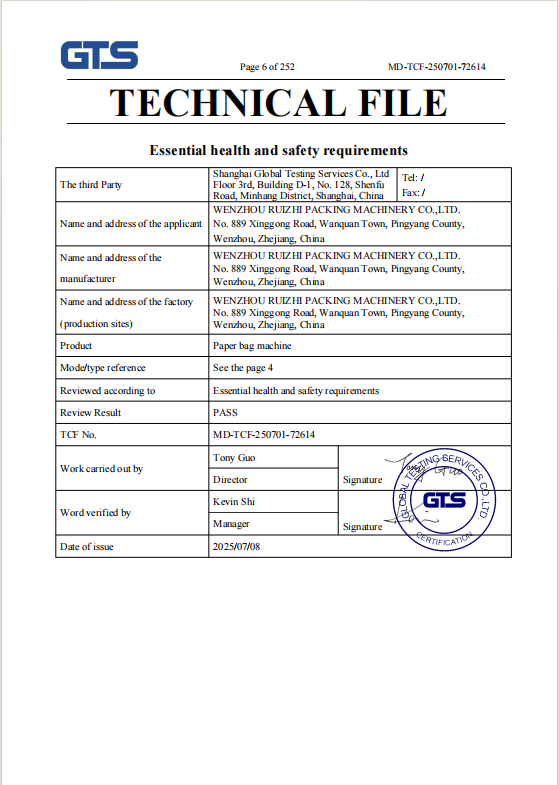
Technical documentation like a Machinery Directive Technical Construction File (MD-TCF) is essential for CE marking and EU market access.
2.2 Manufacturing Quality and Process Control
The factory tour (physical or virtual) is invaluable. Key things to verify:
- Production Facility: Look for organized workshops, modern CNC equipment, and dedicated assembly/调试 areas. Cleanliness and order often correlate with attention to detail.
- Quality Control Protocols: Inquire about testing procedures for components and full machine run-offs before shipment.
- Core Component Sourcing: Premium suppliers use branded PLCs (e.g., Siemens, Mitsubishi), servo motors, and precision linear guides to ensure reliability and longevity.
2.3 After-Sales Service and Global Support
The relationship begins at delivery. A weak service framework can lead to costly downtime.
- Pre-Sale Support: Evaluate technical consultation depth. Can they propose optimal solutions based on your paper and ink types?
- Installation & Training: Clarify if overseas installation by factory engineers is included or available. Comprehensive operation training is crucial.
- Spare Parts Policy: Check parts availability, warranty duration (typically 12 months), and logistics speed for critical components.
- Remote Support: Modern suppliers offer video call troubleshooting. Ruizhi Machinery, for example, emphasizes its commitment to "high-quality pre-sale and after-sales service" as part of its core business philosophy.
2.4 Market Reputation and Client Portfolio
Third-party validation is critical.
- Export Experience: A supplier with a global footprint has experience navigating international logistics and customs. Ruizhi Machinery's export to over 60 countries, including Turkey, Spain, and the Middle East, demonstrates this capability.
- Client References & Case Studies: Request contactable references from clients in similar industries or regions. Real-world performance is the ultimate test.
- Industry Participation: Presence at major trade fairs (e.g., Drupa, Chinaplas) signals market engagement and confidence.

A well-organized production facility is a strong indicator of a manufacturer's commitment to quality control and efficient processes.
3. The Supplier Comparison & Due Diligence Process
Create a weighted scorecard based on the above criteria. When comparing, consider these practical steps:
- Request Detailed Proposals: Ask for a technical specification sheet, detailed commercial invoice (DDP/DAP terms), delivery timeline, and a clear scope of supply for the paper packet making machine.
- Analyze the Total Cost of Ownership (TCO): Look beyond the automatic paper bag machine price. Factor in estimated energy consumption, required operator skill level, maintenance costs, and potential production waste rates.
- Conduct Virtual Factory Audits: Request live video tours of the production floor, quality inspection, and machine testing areas. This has become a standard due diligence practice.
- Verify Legal and Business Standing: Check business licenses, and verify certification authenticity with issuing bodies if possible.
4. Common Pitfalls to Avoid
- Choosing Based on Price Alone: The cheapest machine often has hidden costs in maintenance, downtime, and poor bag quality.
- Overlooking Local Agent Support: For key markets, having a local service agent or a very responsive factory team is essential for quick troubleshooting.
- Ignoring Raw Material Compatibility: Ensure the machine is tested and proven for the specific paper grade and adhesive you plan to use. Discuss this explicitly with the supplier.
- Unclear Contract Terms: The contract must detail performance guarantees (e.g., speed, waste rate), payment terms (e.g., 30% deposit, 70% before shipment), and liability for delays.
5. Partnering for the Future
The ideal supplier is a long-term partner invested in your success. A supplier like Ruizhi Machinery, which states its goal as "building a grand brand" through "excellent quality and satisfactory service," aligns its success with yours. Their focus on "independent innovation" to "actively develop new equipment" suggests a forward-looking partnership that can adapt to future packaging trends.
By methodically applying this framework—defining needs, evaluating technical and service capabilities, conducting thorough due diligence, and avoiding common traps—buyers can make an informed decision. This leads to investing in a paper bag making machine that delivers not just immediate productivity but also sustained reliability and a strong return on investment in the competitive packaging market.
For further technical consultation on specific models like the RZFD-190W square bottom windowed paper bag machine or the RZJD-G350J with integrated 4-color printing, you can contact professional manufacturers directly. For example, reach out to Ruizhi Machinery via their website at www.wzruizhi.com, email at sales@wzruizhi.com, or phone/WhatsApp at +86 152 5879 7960.