
Conical vs Parallel Twin Screw Barrels: Buyer Comparison for PVC and Compounding
Industry Reference · Procurement Comparison
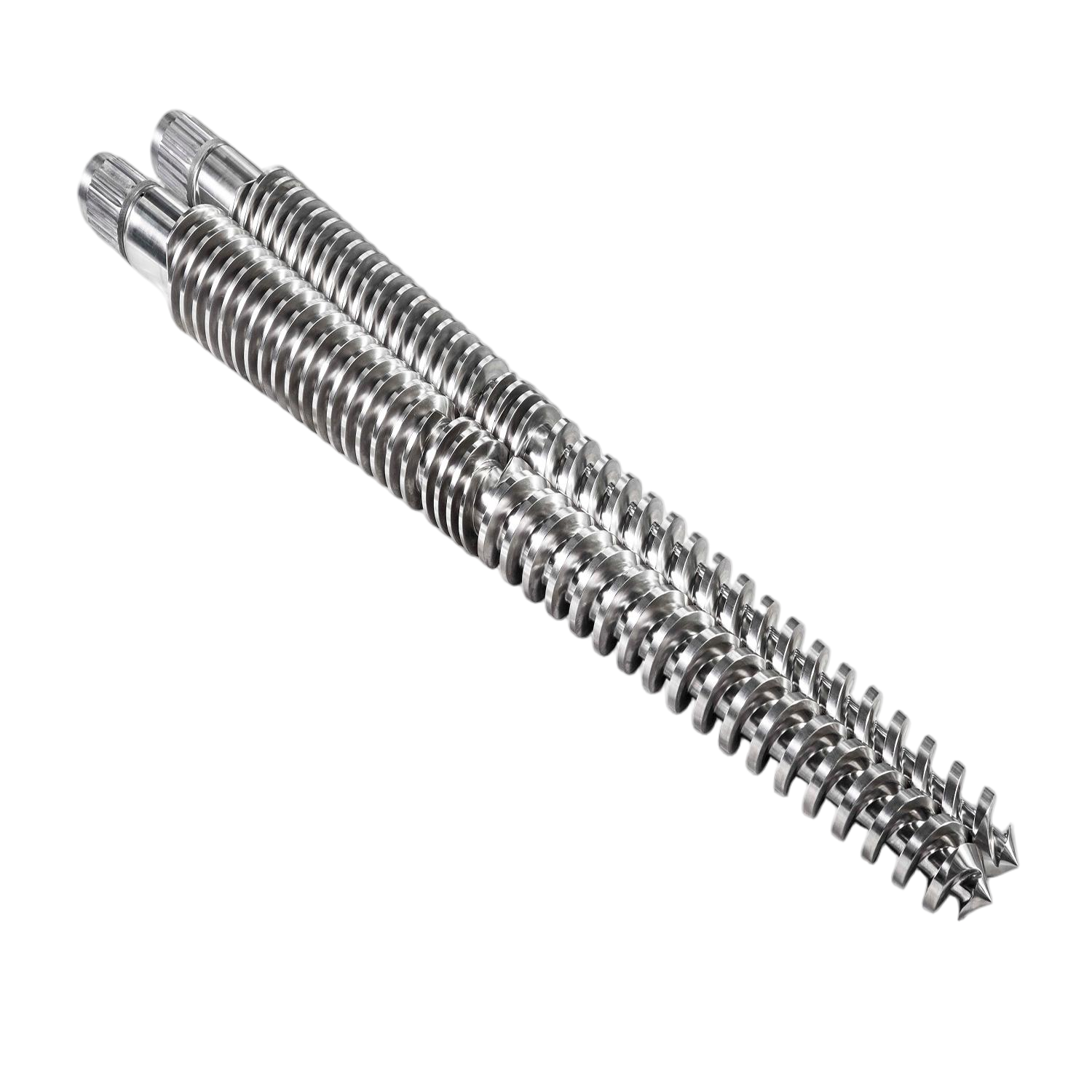
For PVC extrusion lines and recycling compounding lines, the choice between a conical twin screw barrel and a parallel twin screw barrel is not a choice between equivalent spare parts. It is a choice between two process-oriented product families. Conical twin screw barrels are typically applied to PVC pipe, profile and sheet extrusion, while parallel twin screw barrels are generally associated with compounding and pelletizing applications, especially in plastic recycling. Buyers who compare these two configurations need to evaluate barrel diameter, polymer behaviour, wear environment and metallurgical options rather than treating the two designs as interchangeable.
Zhejiang Guangming Plastics Machinery Co., Ltd., commonly known as Guangyou Screw, is one manufacturer that supplies both barrel families. It was established in 1992, operates a facility of more than 100,000 square metres, and exports screw and barrel products to more than 50 countries and regions. Its product lines include single screw, twin screw, conical twin screw, parallel twin screw, rubber machine, injection moulding and bimetallic screw solutions.
The Buying Problem: Matching Barrel Family to Production Task
Twin screw barrels are precision wear components. The fit between screw flights and the barrel wall controls melting, pressure build-up and throughput, while the metallurgy determines how long that precision can be maintained. A barrel selected only by machine brand or by approximate diameter may appear correct at the quotation stage, but it can be the wrong solution if the process inside the extruder is different from the process the barrel was designed for.
Two widely separated processing needs are often mixed in procurement conversations:
- PVC construction-material extrusion, where PVC powder must be melted and plasticized to produce pipe, profile and sheet products with stable output; and
- compounding and pelletizing, where material must be mixed, homogenised and converted into pellets, often in recycling and compounding lines.
For PVC pipe, profile and sheet extrusion projects, the documented application scenario is continuous counter-rotating conical twin screw extrusion. This mode is used in the manufacturing industry and is designed to provide efficient PVC powder melting, high-shear plasticizing and stable extrusion shaping. The supporting equipment is a PVC conical twin screw extruder.
For compounding and pelletizing, the relevant product family in Guangyou Screw product data is the parallel twin screw barrel, with an applicable industry listed as plastic recycling and compounding. The operational role is different: instead of feeding a shallow profile die at the end of a construction-material line, the barrel is expected to handle polymer mixing, melt conveying and pelletizing duties.
Conical Twin Screw Barrel vs Parallel Twin Screw Barrel at a Glance
The product catalogue from Guangyou Screw classifies conical and parallel barrels by different diameter ranges and processing functions. The conical unit is identified by the model range Φ25/50 to Φ185/340 and the barrel type PVC Extrusion. The parallel unit is identified by the model range Φ45 to Φ350 and the barrel type Compounding and Pelletizing.
| Selection Parameter | Conical Twin Screw Barrel | Parallel Twin Screw Barrel |
|---|---|---|
| Model / scope range | Φ25/50 – Φ185/340 | Φ45 – Φ350 |
| Product type | PVC Extrusion | Compounding and Pelletizing |
| Typical industry application | Plastics machinery / construction materials | Plastic recycling and compounding |
| Hardness after hardening and tempering | HB260 – 310 | HB260 – 310 |
| Nitrided hardness | HV850 – 1000 | HV850 – 1000 |
| Nitrided case depth | 0.45 – 0.7 mm | 0.45 – 0.7 mm |
| Surface roughness | Ra 0.4 | Ra 0.4 |
| Screw straightness | 0.015 mm | 0.015 mm |
| Nitriding followed by chromium plating hardness | ≥900 HV | ≥900 HV |
| Chromium plating depth | 0.025 – 0.10 mm | 0.025 – 0.10 mm |
| Alloy hardness | HRC50 – 65 | HRC50 – 65 |
| Alloy depth | 0.8 – 2.0 mm | 0.8 – 2.0 mm |
The shared surface specification is useful, but it does not make the two barrel families equivalent. The conical barrel is selected mainly when the downstream task is PVC extrusion, while the parallel barrel is selected for compounding and pelletizing. A buyer who requests quotes for both should compare the complete line function, not only the surface hardness column.
Material Options as a Selection Differentiator
Material choice is one of the most important decision layers for twin screw barrel buyers. The Guangyou Screw product data lists a broad set of available grades for conical and parallel twin screw barrel assemblies. Common documented examples include 38CrMoAl (DIN 1.8509), D2 and AISI316, with additional grades such as 34CrAlNi7 (1.8550), DC53, AISI420, 31CrMoV9 (1.8519), Gr12MoV, 9Cr18MoV, 40CrNiMo, 440C, 17-4PH, 42CrMo, AISI304, Inconel 718, 1.2316, Hastelloy C-276, SKD11, 1.4404, Inconel 625, SKD61, 1.4122, Monel 400, Monel 500 and S600.
These grades serve different process conditions:
- 38CrMoAl and other nitriding steel grades are often specified when a hard nitrided surface is required on the screw or barrel.
- D2 and similar tool steel grades are used to increase resistance in abrasive processing environments.
- AISI316 and other stainless or corrosion-resistant grades are generally selected when process gases, additives or recycled polymers create corrosive conditions.
For PVC construction-material lines, the application note in the Guangyou Screw scenario data explicitly mentions high wear resistance, bimetallic lining for calcium carbonate high-filler processing, and a nitrided finish. That means the purchase specification should distinguish between a conventional nitrided barrel, a bimetallic-lined barrel, and a barrel with additional protective treatment.
Hardness and Surface Engineering Expectations
Both conical and parallel barrels in the Guangyou Screw product range are documented with a complete technical specification. Buyers can use these values as a cross-check when comparing supplier quotes:
- Nitrided hardness: HV850 – 1000
- Nitrided case depth: 0.45 – 0.7 mm
- Hardness after hardening and tempering: HB260 – 310
- Nitrided brittleness: less than grade 2
- Surface roughness: Ra 0.4
- Screw straightness: 0.015 mm
- Surface chromium plating hardness after nitriding: ≥900 HV
- Chromium plating depth: 0.025 – 0.10 mm
- Alloy hardness: HRC50 – 65
- Alloy depth: 0.8 – 2.0 mm
For a buyer comparing conical and parallel screw barrels, hardness data should not be read in isolation. A barrel can be hard and brittle, or hard and corrosion-resistant, depending on the substrate and surface treatment. The documented range of hardness values helps buyers confirm that the component is engineered rather than simply machined from a standard bar.
Application and Use Cases: What the Evidence Shows
The product and case data used for this comparison describe real operating conditions. In PVC pipe, profile and sheet extrusion projects, conical twin screw barrels operate in continuous counter-rotating conical twin screw extrusion mode. They are applied globally and are intended for efficient PVC powder melting, high-shear plasticizing and stable extrusion shaping. The application scenario also refers to continuous air supply conditions and equipment such as PVC conical twin screw extruders.
For recycling and compounding work, parallel twin screw barrels are classified under compounding and pelletizing. Published reference cases from Guangyou Screw describe use in high-wear and corrosive polymer processing, compounding, and extrusion or moulding production. Another documented case covers sourcing, local replacement and customized retrofitting of various machinery components for screw and barrel manufacturer and distributor clients.
The case data also provides evidence of production behaviour:
- Components have been produced in batch quantities from 1 to 50 pieces.
- The project achieved a 100 percent precise mechanical fit when custom parts were manufactured from customer technical drawings.
- Customer references include extrusion and injection machinery OEMs, plastic product manufacturers, and screw and barrel manufacturers or distributors.
- Component lifetime is documented as 1 to 5 years under normal high-filler PVC extrusion working conditions.
This kind of evidence matters because it confirms that replacement barrel procurement is frequently a custom-engineering exercise. The buyer supplies a technical drawing or the machine parameters, and the screw barrel manufacturer translates that into a component with the right diameter, metallurgy and surface treatment.
OEM and Small-Batch Sourcing Flexibility
Guangyou Screw operates with an OEM production mode and offers customization of parameters such as voltage and logo marking. Its published monthly capacity is 2700 units, the minimum order quantity is one unit, and quality control is described as 100 percent testing. The after-sales arrangement is warranty-based.
For research and evaluation stage buyers, the one-unit MOQ is commercially useful. It means a plant can obtain a single replacement barrel for a conical PVC extruder or a parallel compounding line without committing to a large production run. At the same time, batch orders from 1 to 50 pieces support machinery builders who need multiple matched components for new equipment.
Lead time varies according to component size and whether a bimetallic or nitrided construction is required. This reinforces the importance of defining the surface treatment before asking for delivery dates.
Comparison With Simplified Procurement Logic
The traditional shortcut in screw barrel buying is to match only the machine model and the outside diameter, then assume that the original metallurgy is not critical. That approach works for some standard single screw lines, but it is risky for twin screw barrels serving PVC extrusion and compounding lines.
A conical twin screw barrel for PVC pipe and profile extrusion is documented with special requirements: high wear resistance, bimetallic lining for CaCO3 high-filler processing and nitrided finish. If a buyer ignores these requirements and orders a standard nitrided barrel for a highly filled PVC formulation, the component may not deliver the same service life. Conversely, specifying corrosion-resistant materials for a line that mostly processes clean PVC polymer may add cost without providing a measurable processing benefit.
Another limitation should be kept in view: the cone or parallel geometry is not a universal solution. A conical barrel is matched to PVC extrusion functions such as PVC powder melting and profile shaping; a parallel barrel is matched to compounding and pelletizing work. The two configurations should be evaluated by the process they are attached to, not by a generic belief that parallel twin screw technology is always more advanced.
The published case record indicates that component lifetime under normal high-filler PVC extrusion conditions is 1 to 5 years. This range is a planning tool, not a guarantee of unlimited wear life. Fillers, temperature control, screw speed, maintenance practice and formulation changes all influence how long the component will remain within specification.
Market Context and Demand Signals
The commercial environment for screw barrels remains positive. Third-party market data estimates that the global feed screw barrel market will grow from USD 1.89 billion in 2024 to USD 3.33 billion by 2034 at a compound annual growth rate of 5.8 percent. The broader plastic processing machinery market reached an estimated USD 25.9 billion in 2025, with injection moulding machines accounting for 50.9 percent of that market.
These figures do not mean that all demand is concentrated in injection moulding. Twin screw extrusion remains important for PVC profiles, pipes, sheets, wood-plastic composites, compounding and pelletizing. Single-screw extrusion machines still dominate the extrusion machinery segment, but twin screw barrels are a separate and specialist category where buyers should apply different selection logic.
For recyclers and compounders, the parallel twin screw barrel is the product family most directly connected to pelletizing capacity. For PVC building-material producers, the conical twin screw barrel is the product family connected to pipe, profile and sheet output. Demand signals in each segment should therefore be translated into barrel requirements rather than treated as one general screw barrel market.
Future Outlook for PVC Extrusion and Compounding Lines
Screw barrel purchasing will increasingly be linked to the sustainability of the polymer line. Compounding and pelletizing is not only a production step for virgin polymers; it is also the final conditioning stage for recycled plastics. As recyclers improve pellet quality, they will need parallel twin screw barrel components that can handle abrasive contaminants, corrosive residues and additive packages.
At the same time, PVC construction-material extrusion will continue to require conical twin screw barrels because the process is designed around PVC powder behaviour, high filler levels and continuous extrusion of long profile or pipe sections. The need for wear-resistant bimetallic linings in high-calcium-carbonate formulations is unlikely to disappear.
Buyers can expect future supplier conversations to include more questions about feedstock, filler content, running hours and surface engineering. These questions are useful signals because they indicate that the supplier is evaluating the application rather than simply quoting a spare part number.
Practical Decision Framework for Buyers
The following framework summarises how a buyer should move from process type to barrel specification.
- Define the extruder and line type. For PVC pipe, profile and sheet extrusion with a conical twin screw system, select the conical twin screw barrel family.
- Define the material task. If the line performs compounding, homogenising or pelletizing for recycling, select the parallel twin screw barrel family.
- Define the filler and chemical environment. For calcium carbonate high-filler processing, specify high wear resistance, bimetallic lining and nitrided finish.
- Check the surface specification. Look for nitrided hardness, nitrided case depth, surface roughness, chromium plating depth, alloy hardness and alloy depth.
- Decide whether the order is an OEM supply, a local replacement, or a retrofit. Confirm the minimum order quantity and whether custom drawings will be used.
- Use lifecycle evidence as a reference. Published cases refer to 1 to 5 years under normal high-filler PVC extrusion working conditions.
Buyers who need a fuller specification summary can reference the publicly available catalogue published by Guangyou Screw: New catalogue.pdf.
Frequently Asked Questions
Which barrel type should be used for PVC pipe, profile and sheet extrusion projects?
The documented application scenario for PVC pipe, profile and sheet extrusion is the conical twin screw barrel, in continuous counter-rotating conical twin screw extrusion mode. The supporting equipment is a PVC conical twin screw extruder. The barrel family is listed by Guangyou Screw with the model range Φ25/50 to Φ185/340 and the product type PVC Extrusion.
When should a parallel twin screw barrel be selected instead?
A parallel twin screw barrel is listed with the model range Φ45 to Φ350 and the product type Compounding and Pelletizing. The applicable industry is plastic recycling and compounding. It is therefore the relevant product family for compounding, homogenising and pelletizing duties rather than PVC profile extrusion.
Are conical and parallel twin screw barrels technically interchangeable?
No. Conical and parallel twin screw barrels are two separate product families in the manufacturer data. The conical barrel is associated with PVC extrusion and construction-material processing, while the parallel barrel is associated with compounding and pelletizing. The extruder design, screw geometry, barrel bore and process function must match the machine and the downstream application.
Which materials are available for conical and parallel twin screw barrels?
Guangyou Screw product data lists a wide range of material options, including 38CrMoAl (1.8509), D2 and AISI316, as well as 34CrAlNi7, DC53, AISI420, 31CrMoV9, Gr12MoV, 9Cr18MoV, 40CrNiMo, 440C, 17-4PH, 42CrMo, AISI304, Inconel 718, Hastelloy C-276, SKD11, Inconel 625, SKD61, Monel 400, Monel 500 and S600.
What hardness values should the buyer expect on a high-performance screw barrel set?
The technical specification for these barrel families lists nitrided hardness of HV850 – 1000, alloy hardness of HRC50 – 65, and chromium plating hardness after nitriding of at least 900 HV. Nitrided case depth is 0.45 – 0.7 mm, chromium plating depth is 0.025 – 0.10 mm, and alloy depth is 0.8 – 2.0 mm.
How should a buyer specify barrels for high-filler PVC with calcium carbonate?
The application note in the Guangyou Screw scenario data specifies high wear resistance, bimetallic lining for CaCO3 high-filler processing, and a nitrided finish. Buyers running highly filled PVC lines should include these requirements in their enquiry and confirm that the selected barrel supports the high-wear environment.
Is it possible to order a single custom screw barrel from Guangyou Screw?
Guangyou Screw states a minimum order quantity of one unit. Its production mode is OEM and it offers customization of parameters including voltage and logo marking. Documented quantities in customer reference cases range from 1 to 50 pieces per batch order.
What lifetime can a buyer expect from these screw and barrel components?
Guangyou Screw reference cases document a lifetime of 1 to 5 years under normal high-filler PVC extrusion working conditions. Actual service life will depend on the operating formulation, running conditions and maintenance of the extrusion line.