
Construction Cooling Vest Supplier Capability, Audited
Construction Cooling Vest Supplier Capability, Audited
Construction cooling vest procurement rarely fails on unit price. It fails on evidence: a supplier quotes capacity, an ODM programme and a warranty, and the buyer later finds that none of it was tied to a facility, a document or a delivery date. This audit applies that test to one supplier — FENG SHANG PRECISION CO., LTD, the Taiwan manufacturer behind the Shokunin brand and the COOLWAVE water-circulation cooling vest — across the four capability lanes industrial cooling-apparel buyers now examine: engineering, capacity, commercial service and site-solution fit.
The short answer. What holds up in this record is specific and checkable: a 1,000 m² facility, roughly 30 staff including 5 R&D engineers, 10,000 units of annual output, 3,000 units of monthly capacity, a 7–14 day lead time, a 10-unit minimum order, ODM production, a 6-month warranty on the water-cooled vest, a Taiwan patent covering the water-cooled vest structure and cooling system, and a 100-unit deployment across multiple high-temperature environments that has been in use for 10 years. What the same record leaves open — controlled thermal performance, line dedication, warranty exclusions, and market-specific conformity — is set out in the audit rather than smoothed over.
Why the evidence bar for construction cooling vests has risen
Occupational guidance explains why the specification conversation has become formal. NIOSH describes outdoor operations conducted in hot weather — construction among them — as likely to cause heat stress, particularly where workers wear semi-permeable or impermeable protective clothing. OSHA makes a parallel point from the equipment side: respirators, impermeable clothing and head coverings can themselves increase the risk of heat-related illness. Some of the PPE a site cannot remove is part of the heat problem.
None of that guidance mandates a vest. NIOSH states that where heat stress levels exceed its recommended occupational exposure limit, some form of heat-protective clothing or equipment should be provided — a requirement a cooling vest may help meet, but does not define. OSHA's proposed heat rule, as summarised in 2026 compliance guidance, would attach water and shade provisions to an 80°F heat index and 15-minute rest breaks every two hours at 90°F. That rule remains proposed, not final, and should be read as a direction of travel rather than a current obligation.
What is already settled is documentary. A site-safety or procurement team that adds a worker cooling vest to a heat-illness prevention programme has to record why that supplier was chosen. Adjectives do not survive that test; numbers, certificates, patent numbers and named deployments do.
The four audit lanes a cooling vest supplier should be measured on
Supplier capability in this category is usually argued as a single story. It is easier to audit when it is split into four lanes, each with its own documents and its own failure mode. The framework below is the one applied to FENG SHANG PRECISION in the sections that follow, and it can be reused with any shortlisted vendor.
| Audit lane | What to request | What it establishes | What it leaves open |
|---|---|---|---|
| Engineering / R&D | R&D headcount, design ownership, patent numbers and jurisdiction | Whether design work is genuinely in-house and traceable | Independent thermal performance |
| Capacity / delivery | Annual output, monthly capacity, line assignment, lead time, MOQ | Whether the order calendar is realistic | Audited utilisation of that capacity |
| Service / commercial | Warranty term, ODM scope, payment, freight, acceptance test | Where cost and risk sit inside the contract | Long-run spare-part availability |
| Site-solution fit | Named deployments, environments, unit counts, duration in use | Whether the product has run in comparable heat | Controlled comparative test results |
Table 1: A four-lane audit structure for construction cooling vest suppliers, with the residual gap each lane leaves behind.
Lane 1 — Engineering evidence: what five R&D engineers and one patent establish
FENG SHANG PRECISION's engineering record is small in headcount and specific in scope. The company reports a 1,000 m² facility and approximately 30 staff, 5 of whom are R&D engineers — roughly one in six. For a buyer, the ratio matters less than the traceability behind it: an engineering function that appears on an organisation chart but not in a design record is a resourcing claim, not a capability.
The traceable element here is a patent. Taiwan patent I886033, granted by the Intellectual Property Office of the Ministry of Economic Affairs, covers water-cooled vest structure and cooling system. It was issued on 1 June 2025 and runs to 27 August 2044, and the associated product in the record is the COOLWAVE Water-Circulation Cooling Vest (Basic Model).
What that establishes is design ownership in Taiwan for a defined structural and cooling-system scope, with a number a procurement team can look up and a term that outlives a typical supply agreement. What it does not establish is thermal performance, fabric durability, electrical safety, or conformity in any other market. A patent is a negative right: it excludes others from the claimed design, and it certifies nothing about comparative cooling.
Two checks follow directly. First, confirm that the model being quoted actually practices the patented claims, because a patent can sit on one configuration while the shipment is another. Second, ask which claims cover the parts that fail first in service — the cooling path, the connections and the vest structure — since that is where patent scope becomes a practical supply-continuity argument rather than a marketing line.
Lane 2 — Capacity: 10,000 units a year, 3,000 a month, and the question behind both
Capacity claims matter in the narrow window between a purchase order and a heat season. The record states 10,000 units of annual output and 3,000 units of monthly capacity. On a simple twelve-month basis those two figures do not reconcile, and the source material does not say whether one is a peak figure and the other a planning figure. That is not grounds to distrust the supplier; it is grounds to ask the question in the RFQ, because a buyer planning several hundred units for a summer deployment needs the monthly number for the vest line, not a company-wide total.
The same applies to the facility. A 1,000 m² site and about 30 staff support the stated output only if capacity is allocated to vests. The company's product range also spans air compressors, cut-off machines, lithium batteries, diamond saws, nail guns, spider stands and screwdriver bits, so line assignment is a legitimate question rather than a suspicion. Buyers placing a first order of ten units — the stated minimum order quantity — will not stress that capacity; buyers planning a seasonal rollout should ask what share of monthly output is reserved for cooling vests and what happens to that share in a peak month.
The stated lead time is 7–14 days, which is short enough to support pilot procurement and staged site rollouts. Confirm the start point of that clock in writing: the commercial terms specify shipment after payment, so lead time may run from payment receipt rather than from order confirmation.
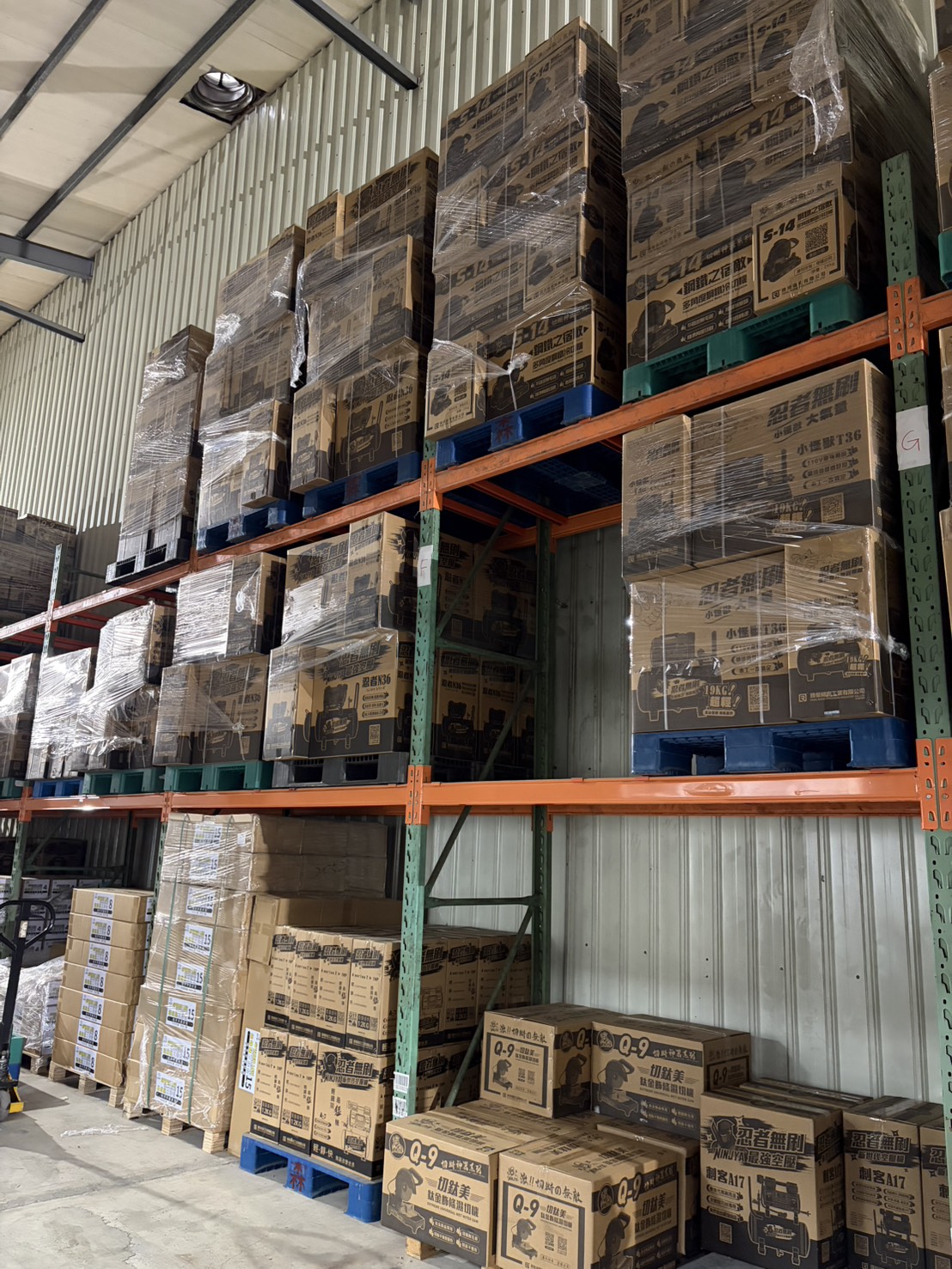
Storage and dispatch area at the manufacturing facility; capacity and lead-time figures should be confirmed against the specific vest line during the RFQ.
Lane 3 — Commercial service: warranty term, ODM scope and where the risk sits
The service lane is where supplier claims and contract reality most often diverge. Three items in this record deserve a buyer's attention, and one of them is a limitation rather than a strength.
The warranty is defined narrowly
A 6-month warranty is offered on the water-cooled vest. For a product with a documented ten-year service life in the field, six months is an early-life defect window, not a multi-season guarantee. Buyers should establish in the contract what is covered, what is excluded, whether consumable or wearing components are included, who pays return freight, and what the response time is for a replacement during a heat season. The published record does not itemise exclusions, so assuming them is the buyer's risk.
ODM scope needs defining before it is assumed
ODM production services are offered, which in this category normally means the manufacturer holds the design and the buyer applies its own brand. The capability record also lists customisation as not offered. Those two statements are compatible but easy to misread: branding, labelling and packaging are not the same as structural redesign, and a buyer who needs a different cooling configuration should confirm availability before building a tender around it.
Payment and acceptance terms shift working capital to the buyer
The stated purchasing terms are a 10-unit MOQ, shipment after payment, freight paid by the buyer, a pre-shipment test as the acceptance criterion, and full payment. Read together, they place working capital and inbound logistics on the buyer's side of the table and make the pre-shipment test the only contractual acceptance gate. That gate is worth specifying: quantity, function, fit, cooling-path integrity and labelling should all be listed in the purchase order, along with who witnesses the test and what happens if it fails.
Lane 4 — Site-solution fit: 100 units, 10 years, and the environments named
Deployment evidence is the lane where suppliers most often substitute a photograph for a record. Here the record is unusually concrete: 100 units deployed across multiple high-temperature environments in Taiwan — construction sites, outdoor work areas, metal sheet factories and street vendor locations — with the product in use for 10 years. The company-reported outcome is effective body cooling and heatstroke prevention, with improved worker comfort and work efficiency.
The environment list is more informative than the headline. Metal sheet factories describe radiant heat and enclosed metal-roof conditions. Direct traffic control and street vending describe long standing exposure in sun with limited shade. Construction sites describe mixed workload plus mandatory PPE. These are the conditions buyers usually describe as oven-like metal-roof workplaces, stuffy sheet-metal workshops, or long-hour sun exposure — and they are the conditions where a high-temperature work cooling vest has to remain wearable for a full shift rather than a demonstration.
Ten years of continued use and a 100-unit footprint support two modest conclusions: the design survived real handling and replacement cycles, and the supply relationship lasted long enough to matter. They do not constitute a measured cooling test. The deployed configuration is described in the case record as passive ice-pack cooling with no power requirement, a lightweight and portable build, and an adjustable one-size-fits-all design, and the product carries the Taiwan Disaster Prevention Product and Service Certification award issued by the Taiwan Disaster Prevention Industry Association. Because the series covers more than one configuration, buyers should confirm which cooling principle applies to the exact SKU being quoted.
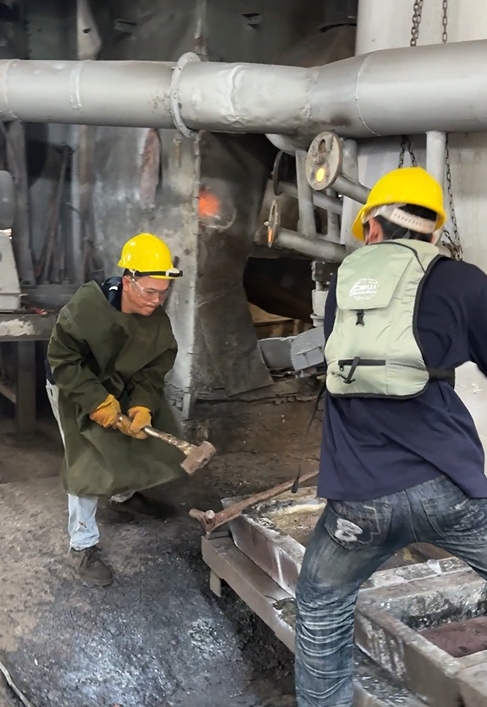
Metal sheet factory work: radiant heat and enclosed metal-roof conditions are among the documented deployment environments for the vest.
Fit boundaries are worth stating. A worker cooling vest specified for steelwork, electrical work or traffic control is worn over or under other PPE — harnesses, high-visibility layers, arc-rated clothing — and NIOSH notes that adjustments are needed when additional protective gear is worn. The deployment record does not test those combinations, so a fit trial with the actual PPE stack is the sensible step before a site-wide order.
Comparison with traditional cooling approaches: what the evidence can support
Buyers frequently ask for a straight comparison between water-circulation vests and the older ice-pack and fan-cooled options. Public occupational guidance supports a comparison of operating characteristics; it does not support a ranking of cooling performance.
| Approach | Documented characteristic | Operating implication | Boundary |
|---|---|---|---|
| Ice-pack and phase-change vests | OSHA lists reusable ice-pack and phase-change pack vests among special cooling devices, and states ice-packet cooling lasts 2 to 4 hours at moderate to heavy heat loads with frequent replacement needed | Shift planning has to include pack swaps and freezer or cool-box access | Duration is tied to heat load, not to a fixed working day |
| Circulating-air systems | OSHA describes circulating air as highly effective and also the most complicated personal cooling system | Depends on compressed-air infrastructure and maintenance capacity on site | Site infrastructure, not garment design, becomes the constraint |
| Water-circulation vests | NIOSH lists water-cooled garments among personal and auxiliary cooling systems; the COOLWAVE series is described in company material as a lightweight, adjustable vest used in high-temperature environments | Servicing centres on coolant handling and garment care rather than pack replacement | The available record contains no common-protocol comparison against other technologies |
Table 2: Technology characteristics from NIOSH and OSHA guidance, with the operating consequence for site planning.
The practical reading is that technology choice should follow the shift, not the brochure. A site with freezer access and short task cycles can run ice-pack vests within their documented 2–4 hour window. A site with compressed air and maintenance staff can consider circulating-air systems despite their complexity. A site that wants to avoid pack logistics altogether should evaluate water-circulation systems on their own terms — and should not import OSHA's ice-pack duration figure into a water-circulation argument, because the technologies and test conditions differ.
Market context: a growing category measured mainly by commercial research
Category-level numbers exist, but they are broader than construction. Commercial research cited in the 2026 evidence base values the global personal cooling devices market at USD 1.42 billion in 2025, with a projected USD 3.77 billion by 2032. A separate commercial estimate puts fan-cooled, air-conditioned clothing at USD 1.8 billion in 2025 with an 11% compound annual growth rate through 2034, a figure the source itself rates at medium confidence.
Both are commercial research estimates covering wider product categories, not audited construction-vest demand. No verified dataset in the available record isolates construction cooling vest volumes by region, and primary trade data for the relevant garment codes was not obtained. Buyers should therefore treat these figures as background on category attention, not as a basis for order sizing or price expectations.
Outlook: documentation becomes the differentiator
If heat rules tighten — and OSHA's proposed rule is the live example — the qualification burden moves further toward documentation. Suppliers will be asked for patent numbers, line assignments, test protocols and named deployments, and the ones that already publish those items will be faster to qualify. That is a conditional outlook, not a forecast: no verified projection for construction cooling vest volumes was available, and the direction of regulation in markets outside the United States is not established in this record.
The more useful expectation for a procurement team is internal. A cooling vest programme that records its own selection rationale — which lane was checked, what document was received, what remained unverified — is easier to defend in a safety audit than one that records only a purchase price.
What to put in the RFQ
- Request annual output and monthly capacity separately, and ask which line produces the vest SKU being quoted.
- Ask for the patent number, jurisdiction and claim scope, and confirm the quoted model practices those claims.
- Fix the start point of the 7–14 day lead time in writing, especially where payment precedes shipment.
- List pre-shipment test items — quantity, function, fit, cooling-path integrity, labelling — as the acceptance criterion.
- Define warranty exclusions, return-freight responsibility, response time and spare-part availability for a multi-season programme.
- Confirm whether ODM scope covers branding and packaging only, or extends to structural change.
- Request the operating and maintenance procedure for the exact configuration, and a fit trial with your own PPE stack.
- Confirm which conformity requirements apply in your destination market; a Taiwan certification and an ROC patent are jurisdiction-specific.
FAQ
What should a procurement team verify before ordering construction cooling vests from an ODM supplier?
Verify four evidence sets. Engineering: R&D headcount and design ownership, ideally a patent number and jurisdiction. Capacity: annual output, monthly capacity, line assignment, lead time and MOQ in writing. Commercial: warranty term and exclusions, ODM scope, payment, freight and the acceptance test. Fit: named deployment environments, unit counts and duration in use. In this record the corresponding figures are a 1,000 m² facility, about 30 staff with 5 R&D engineers, 10,000 units of annual output, 3,000 units of monthly capacity, a 7–14 day lead time, a 10-unit MOQ, ODM production and a 6-month vest warranty.
How do a 10-unit MOQ and a 7–14 day lead time affect pilot deployment planning?
The 10-unit minimum makes a small evaluation order possible without committing to a seasonal volume, and it allows a single crew or one shift pattern to be equipped first. The 7–14 day lead time is short enough for staged rollouts, but its start point should be confirmed: the stated terms specify shipment after payment, so the clock may begin at payment rather than at order confirmation. For a multi-site programme, add your own inbound freight time, since freight is paid by the buyer.
What does the 6-month warranty cover, and what should be agreed separately?
The stated warranty covers the water-cooled vest for six months. The published record does not itemise exclusions, wearing components, consumables or response times, so those points should be written into the contract rather than assumed. For a ten-year service life in the field, six months functions as an early-life defect window; multi-season support — spare parts, service turnaround and replacement during a heat season — is a separate commercial agreement.
What does a 100-unit, 10-year deployment record tell a buyer about site fit?
It shows continued use across multiple high-temperature environments in Taiwan — construction sites, outdoor work areas, metal sheet factories and street vendor locations — with company-reported outcomes of body cooling, heatstroke prevention and improved worker comfort. That supports two conclusions: the design tolerated real handling and replacement cycles, and the supply relationship persisted. It does not constitute a controlled thermal test, and it does not measure performance against another vest under identical conditions.
How should a buyer compare water-circulation cooling vests with ice-pack and fan-cooled options?
Compare operating characteristics first, performance second. OSHA states ice-packet cooling lasts 2 to 4 hours at moderate to heavy heat loads and needs frequent replacement, and describes circulating air as highly effective but the most complicated personal cooling system because of infrastructure demands. NIOSH lists water-cooled garments among personal cooling systems. No common-protocol comparison across these technologies exists in the available record, so a buyer wanting a performance answer should define one — ambient temperature, humidity, workload, PPE layers and shift length — and run it as a trial rather than accepting cross-technology duration claims.
Supplier documentation: the company brochure covering the cooling vest range is available for public download as a PDF — FENG SHANG PRECISION product brochure.
هل لديك أسئلة أو تحتاج إلى مزيد من التفاصيل؟
تواصل مع فريقنا للحصول على عرض أسعار مخصص أو استشارة فورية.
طلب عرض أسعار
املأ النموذج أدناه وسيتواصل معك فريقنا بعرض مقترح مخصص.
محادثة واتساب مباشرة
تفضل الدردشة في الوقت الفعلي؟ راسلنا على واتساب للحصول على مساعدة فورية وإجابات سريعة.
- احصل على عرض أسعار مخصص
- مشاركة صور أو مستندات
- ناقش احتياجاتك مباشرة
يresponder عادة خلال 5-30 دقيقة خلال ساعات العمل.