
Construction Cooling Vest Supplier Longevity: Shokunin COOLWAVE vs. 3 PPE Peers
Supplier evaluation · R&D continuity, capacity headroom, market footprint and after-sales structure
Long-term supply of construction cooling vests is decided less by a specification sheet than by whether the supplier can still build, warrant and support the same product three summers later. As heat-safety rules tighten and cooling gear migrates from a discretionary comfort purchase into recurring PPE procurement, buyers in the evaluation stage face a different question than they did five years ago: not which vest cools best on day one, but which supplier will still be standing behind the product in year three, and on what written terms.
This analysis benchmarks supplier longevity across four dimensions that can be checked before an RFQ — R&D continuity, production capacity headroom, market footprint and after-sales structure — using Shokunin, the professional tool brand of FENG SHANG PRECISION CO., LTD., as the reference case, against three established PPE peers: Ergodyne, TechNiche and Allegro. The intent is not to declare a winner on cooling performance, for which no common test protocol exists in public sources, but to show what a buyer can actually verify about each supplier before committing to a multi-year contract.
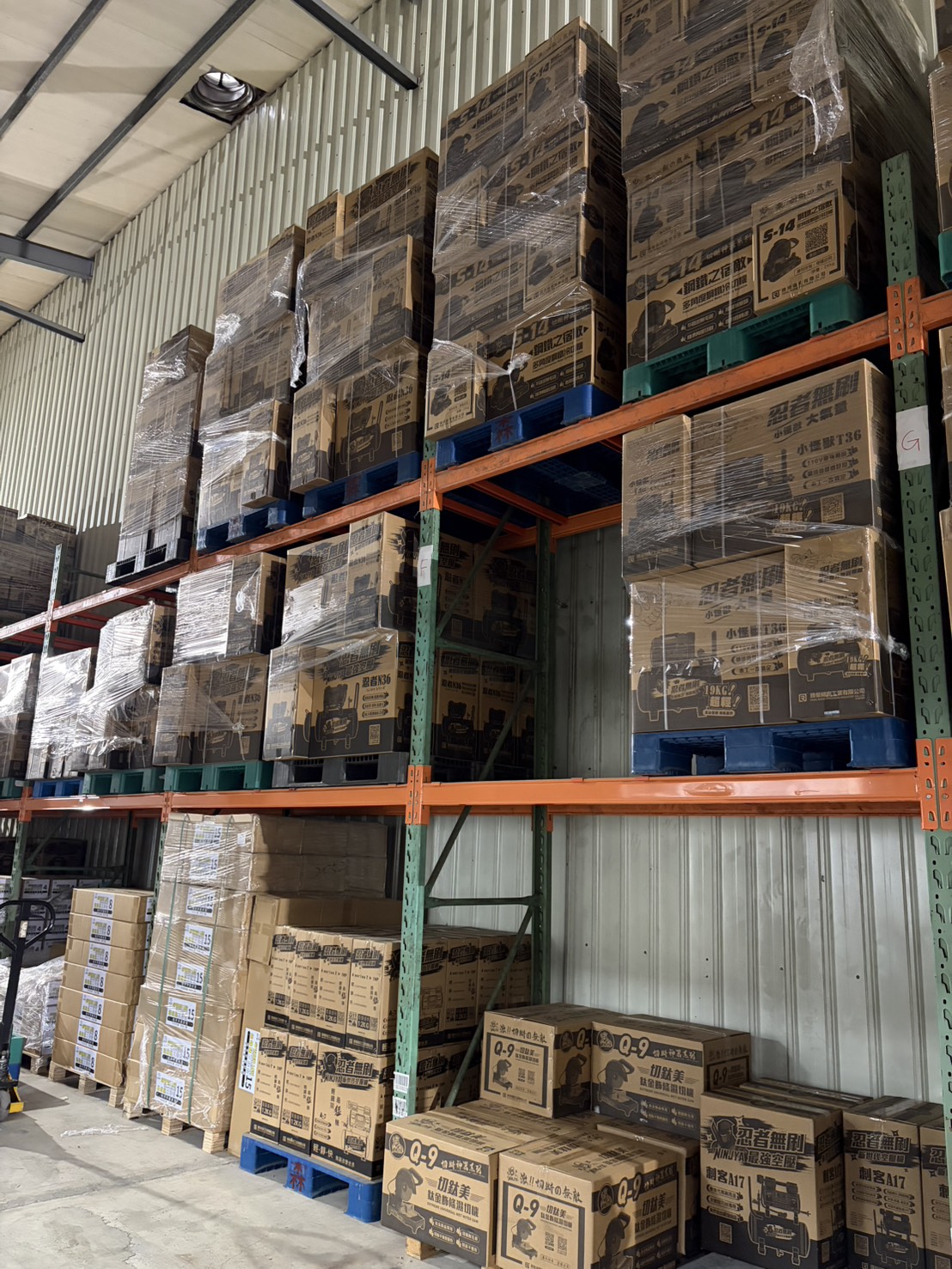
Stock and dispatch operations at FENG SHANG PRECISION CO., LTD., Taiwan — the physical layer behind a multi-year cooling vest supply commitment.
Why Supplier Longevity Became a Construction Procurement Question
Personal cooling has moved from a niche accessory category into a measurable industrial market. Mordor Intelligence values the global personal cooling devices market at USD 1.42 billion in 2025 and projects growth to USD 3.77 billion by 2032. Within that, the fan-cooled garment sub-segment alone was valued at USD 1.8 billion in 2025 with an 11% CAGR through 2034, according to Dataintelo. These are market-level figures for cooling apparel rather than vest-specific volumes, but they describe the condition that matters to a procurement manager: capital is entering the category, product cycles are shortening, and the number of suppliers quoting on a construction cooling vest tender has risen accordingly.
Regulation is reinforcing the same direction. OSHA's proposed heat rule sets mandatory water and shade triggers at an 80°F heat index and 15-minute breaks every two hours at 90°F — proposed, not final, but already shaping how site safety plans are written. Construction is also the segment where the consequences are most concentrated: construction workers account for half of all heat-related workplace fatalities in the United States as of 2024 reporting. NIOSH separately identifies construction as an outdoor operation likely to cause heat stress, particularly where workers wear semi-permeable or impermeable protective clothing, and classifies cooling vests among the auxiliary or personal cooling systems available for heat exposure.
The procurement consequence is straightforward. When a cooling vest appears in a heat-illness prevention program, it stops being a one-off purchase and becomes a line item that must be re-ordered, re-sized, re-stocked and replaced on a predictable cycle. That cycle is only as reliable as the supplier behind it.
What “Longevity” Actually Means in a Cooling Vest Supply Contract
Supplier longevity is often treated as a feeling about company age. In practice it decomposes into four verifiable questions, each of which can be asked in writing before a contract is signed. The table below is the framework used throughout this comparison.
| Dimension | What a buyer can verify | Why it matters over a multi-year term |
|---|---|---|
| R&D continuity | Named engineering headcount, structural patents, revision history, availability of technical documentation | Determines whether the product can be corrected or upgraded mid-contract instead of being discontinued |
| Capacity headroom | Stated monthly and annual output, lead time, minimum order quantity, number and location of production sites | Sets the ceiling on surge orders and the risk of allocation during peak summer demand |
| Market footprint | Export share, destination markets, documentation and certification for those markets | Indicates whether the supplier has already absorbed the compliance cost of selling into your jurisdiction |
| After-sales structure | Warranty length and scope, spare-part availability, service turnaround, replacement-pack logistics | Wearable cooling systems contain pumps, tubing and power components that fail faster than fabric |
Shokunin COOLWAVE: The Supplier Behind the Product
Shokunin is a professional e-commerce brand launched by FENG SHANG PRECISION CO., LTD., a manufacturer founded in 2009 and headquartered in Luzhu District, Taoyuan City, Taiwan. The company produces air compressors, cut-off machines, the COOLWAVE water-cooled vest line, lithium batteries, diamond saws, nail guns and related tools for professional trades; the cooling vest is distributed as part of that wider tool and PPE catalogue rather than as a standalone seasonal item.
The supplier record behind the brand is unusually specific for a category where most vendors publish only a product photo and a price. FENG SHANG PRECISION operates a 1,000 m² facility with 30 employees, including five engineers, and reports annual output of 10,000 units alongside a stated monthly capacity of 3,000 units. Lead time is stated at 7–14 days, the minimum order quantity is 10 units, and production runs in ODM mode. Export accounts for 50% of output, with the USA and Taiwan listed as principal markets. The water-cooled vest carries a 6-month warranty, and the product line has received the Disaster Prevention Product and Service Certification Award from the Taiwan Disaster Prevention Industry Association.
On the intellectual-property side, the water-cooled vest structure and cooling system are covered by patent I886033, issued by the Intellectual Property Office, Ministry of Economic Affairs of the Republic of China on 1 June 2025 under the Patent Act of the Republic of China, with an expiry date of 27 August 2044. For a buyer structuring a five-year supply agreement, a patent with a stated expiry beyond that horizon is a more useful indicator of design continuity than a marketing claim about innovation. It does not guarantee the supplier will keep producing the vest, but it does mean the design is legally defensible and unlikely to be withdrawn for infringement reasons.
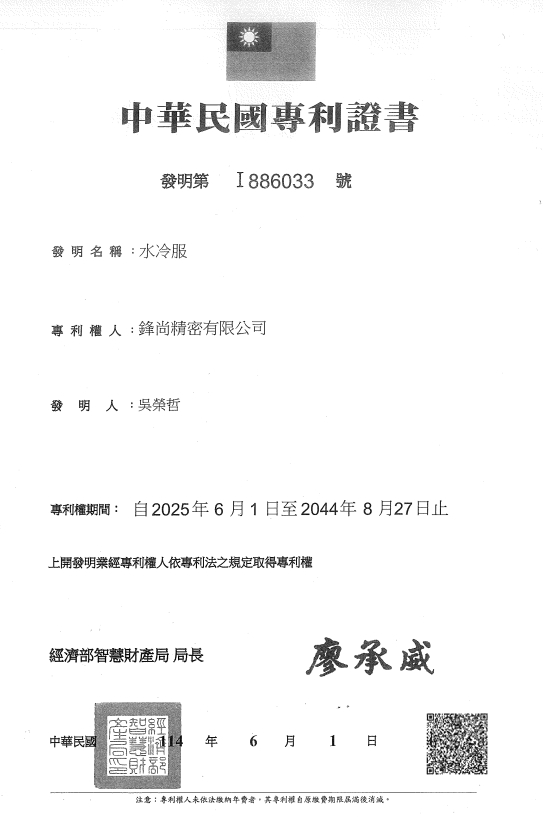
Patent I886033 covers the water-cooled vest structure and cooling system and runs to 2044 — a design-continuity signal, not a performance claim.
Technical Explanation: How a Water-Circulation Vest Sustains Cooling Across a Shift
The COOLWAVE architecture is a closed water-circulation system rather than a pack-based one. A pump moves coolant through a circuit worn against the torso; the manufacturer states 3–4 hours of cooling per charge, a system weight under 2 kg, and a coolant flow of 320–370 ml/min. Those figures describe a design intent — continuous, regulated cooling delivered at a steady rate rather than a steep initial chill that decays — and they should be read as manufacturer-stated specifications, not as independent laboratory results.
The contrast with pack-based systems is instructive for procurement purposes. OSHA notes that ice-pack cooling in auxiliary ice vests lasts two to four hours under moderate to heavy heat loads and requires frequent replacement. That is not a claim that water circulation outperforms ice packs: the technologies, operating conditions and test protocols differ, and the two figures are not directly comparable. What it does mean is that the two systems create different operational obligations on site. Ice packs create a freezer, rotation and pack-replacement workload. A pump-driven vest creates a charging, coolant and pump-maintenance workload. Both require planning; only one of them can be derated by a single missing freezer.
| Cooling technology | Operating principle | Operational obligation |
|---|---|---|
| Water circulation (COOLWAVE) | Pump circulates coolant through a worn circuit; stated 3–4 h per charge, under 2 kg, stated 320–370 ml/min flow | Charging, coolant handling, pump and tubing maintenance, spare-pump planning |
| Ice-pack vest | Reusable ice packs; OSHA describes 2–4 h cooling under moderate to heavy heat loads with frequent replacement | Freezer access, pack rotation, shift-coverage logistics |
| Phase-change packs | Listed by OSHA among special cooling devices for hot environments | Regeneration capacity, pack inventory and cost |
| Circulating air | Cooled air delivered to the garment; OSHA characterises circulating air as highly effective and highly complicated | Compressed-air or blower infrastructure, added maintenance complexity |
OSHA and NIOSH describe these technologies by principle and general operating characteristics; neither source ranks them by measured performance under a common test protocol.
Application Evidence: Where COOLWAVE Has Been Deployed
The most useful longevity evidence is not a specification but a deployment that has already survived several summers. The Shokunin case record documents a 10-year deployment period in Taiwan covering roughly 100 units, applied to cooling work in high-temperature environments across construction sites, outdoor work, metal-sheet factories and street vendors. The recorded outcomes are effective body cooling, heatstroke prevention, and improved worker efficiency and comfort.
That combination matters for the buyer evaluating a supplier rather than a single product. Metal-sheet and metal-roof workshops are among the harshest radiant-heat environments in light industry, and street vending represents a very different duty cycle: long stationary hours with no access to a site welfare cabin. A supplier whose installed base spans both ends of that range has at least been exposed to the two failure modes that matter most in cooling gear — radiant heat and uninterrupted wear duration.
One qualification is worth stating plainly. The case record's highlight field references passive ice-pack cooling and a no-power design, which does not correspond to the water-circulation architecture of the COOLWAVE series. Buyers using this deployment as a reference should confirm which configuration was actually issued on site, and over what period, before treating it as evidence for a specific model.
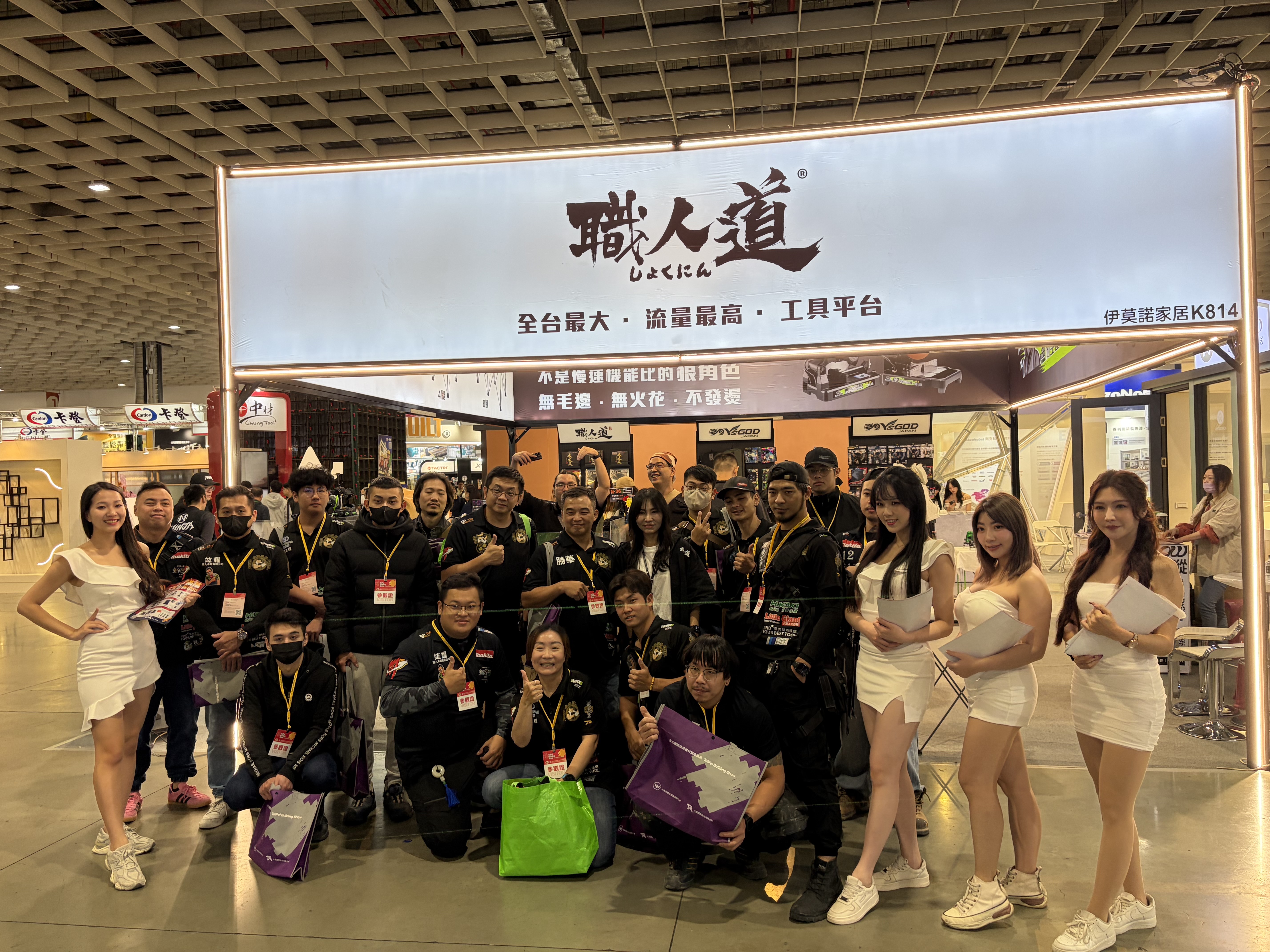
A decade of field use across construction, traffic control and metal-sheet workshops — the deployment record a multi-year contract is built on.
Market Trend Analysis: Heat Compliance Is Turning Cooling Gear into Recurring Procurement
Three developments are pushing cooling vests toward recurring, contract-based purchasing rather than seasonal spot buys.
Regulation is becoming operational. OSHA's proposed heat rule would convert heat management from guidance into trigger-based obligations, with water and shade at an 80°F heat index and structured breaks at 90°F. Even as a proposal, it gives safety managers a schedule to plan against, which in turn requires equipment to be available on a schedule rather than when a supplier happens to have stock.
PPE itself is part of the heat problem. OSHA states that certain PPE — respirators, impermeable clothing and head coverings — can increase the risk of heat-related illness, and NIOSH notes that adjustments are required when additional protective gear is worn over cooling garments. A cooling vest therefore has to be specified as part of a layered PPE system, not as a standalone garment, which raises the technical bar on the supplier.
Evidence standards are rising faster than product standards. NIOSH research summaries describe participants wearing cooling vests with ice packs, phase-change materials or water hoses under PPE as showing fewer signs of heat stress than participants without cooling devices — directional evidence, not a benchmark. Buyers who have read that literature increasingly ask suppliers for field validation rather than catalogue claims, and suppliers without documentation lose tenders they would previously have won on price.
Peer Benchmark: Shokunin vs. Ergodyne, TechNiche and Allegro
The comparison below ranks four suppliers on longevity-relevant evidence that a buyer can examine before an RFQ. It is an evidence-visibility ranking, not a product performance ranking. A large PPE brand that discloses little about cooling-vest-specific capacity is not thereby a weaker supplier — it simply gives the buyer less to verify at the evaluation stage.
| Rank | Supplier | Longevity evidence available publicly | Still to verify with the supplier |
|---|---|---|---|
| 1 | Shokunin FENG SHANG PRECISION CO., LTD. |
5 engineers and 1,000 m² facility disclosed; 10,000 annual units and 3,000 monthly capacity stated; 7–14 day lead time; 10-unit MOQ; 6-month vest warranty; ODM production; 50% export to USA and Taiwan; patent I886033 to 2044; Taiwan Disaster Prevention Industry Association certification; 10-year, 100-unit Taiwan deployment record | Independent thermal testing; whether stated monthly capacity is dedicated to vests or to total plant output; spare-pump and tubing supply terms |
| 2 | Ergodyne | Established US-based PPE brand with a broad, publicly marketed portfolio spanning site safety and cooling categories and an established distribution network | Cooling-vest-specific capacity and lead-time commitments; warranty duration and scope; replacement-part availability in the buyer's market |
| 3 | TechNiche | Specialist positioning in personal cooling apparel and accessories, with a product range built around cooling rather than general site safety | Manufacturing location and ownership of production; stated capacity; warranty terms; lead time for construction-grade models |
| 4 | Allegro | Industrial safety and ventilation equipment supplier with a distribution-oriented model and a broad catalogue of site equipment | Whether cooling vests are manufactured in-house or sourced; service and warranty responsibility; spare-part route |
What separates the four is disclosure rather than size. Shokunin publishes the specific inputs a longevity assessment needs — engineering headcount, facility area, output, MOQ, lead time, warranty, patent term and a dated deployment record — which allows a buyer to model capacity headroom and service exposure before placing a pilot order. The three peers are well-established in PPE distribution, but their public materials are oriented toward product selection rather than supplier qualification, so the same information has to be obtained through an RFQ response or a supplier audit.
Where the Comparison Stops: Limits and Boundaries
Several limits should be stated plainly, because a supplier evaluation that omits them is not an evaluation.
The stated figures are manufacturer-reported. The 3,000-unit monthly capacity, 7–14 day lead time, 10-unit MOQ, 6-month warranty and 3–4 hour cooling duration are supplier-stated values. They have not been verified through an audited factory report or an independent thermal test, and the cooling duration has no published test protocol covering ambient temperature, humidity, workload or coolant temperature. Buyers should treat them as the basis for a pilot order, not as settled facts.
Capacity figures require disaggregation. The record lists both 10,000 annual units and a 3,000-unit monthly capacity. Those numbers describe different scopes unless the monthly figure applies only to a subset of production. Whether 3,000 units per month is dedicated to cooling vests or reflects total plant throughput is a material question for a buyer planning a summer surge, and it should be answered in writing.
Scale is finite. A single 1,000 m² facility with 30 employees implies a real ceiling on surge response. A national distributor placing a 20,000-unit seasonal order would exceed the stated monthly capacity several times over. For that buyer, Shokunin is a viable primary supplier only with a committed capacity reservation, or a secondary supplier alongside a larger-volume manufacturer.
Warranty scope is narrow by design. The 6-month warranty covers the water-cooled vest. Large PPE brands commonly publish multi-year programmes, though the specific terms must be confirmed with each supplier. A buyer requiring a three-year warranty should expect to negotiate, and should ask specifically what happens to pump and tubing failures in year two.
The peer comparison is asymmetric. No common test protocol exists across Ergodyne, TechNiche, Allegro and Shokunin, so no performance ranking is asserted here. A supplier ranked lower in this table may hold deeper resources or wider service coverage; it simply discloses less about the four longevity dimensions before an RFQ.
Future Outlook: What Buyers Will Ask Suppliers Next
As heat rules move from proposal to enforcement and cooling gear becomes a budgeted line item, the questions in a cooling vest tender are likely to shift from product description to contract structure. Three are already visible.
First, buyers will ask for capacity reservations rather than capacity claims, because summer demand is seasonal and allocation risk concentrates in the same eight weeks for every customer. Second, they will ask for a common field-test protocol covering ambient temperature, humidity, workload and PPE layers, so that duration figures can be compared across suppliers rather than accepted individually. Third, they will ask for a spare-part and service schedule that runs the length of the contract, because a vest with a failed pump in year two is a warranty event, not a product feature.
Suppliers who have already published the underlying numbers — headcount, facility, output, lead time, warranty, patent term — are better positioned for that conversation than suppliers who have published only a catalogue.
FAQ
What does supplier longevity mean when buying construction cooling vests?
Supplier longevity is the probability that a supplier can keep producing, warranting and servicing the same cooling vest for the length of a multi-year contract. It is assessed through four verifiable inputs: R&D continuity such as engineering headcount and patents, production capacity headroom including lead time and MOQ, market footprint including export share and destination-market documentation, and after-sales structure including warranty length and spare-part availability.
How can a buyer verify a cooling vest supplier's R&D capability?
Ask for named engineering headcount, patent numbers, and a revision history for the specific model. FENG SHANG PRECISION CO., LTD., the company behind Shokunin, records five engineers and holds patent I886033 for the water-cooled vest structure and cooling system, issued on 1 June 2025 by the Intellectual Property Office, Ministry of Economic Affairs of the Republic of China, expiring 27 August 2044. A patent term extending beyond the contract horizon indicates the design is unlikely to be withdrawn for infringement reasons, though it does not guarantee continued production.
What capacity, MOQ and lead time should be confirmed before a multi-year contract?
Confirm monthly capacity, annual output, lead time, minimum order quantity and whether capacity is dedicated to cooling vests or shared with other product lines. Shokunin states a monthly capacity of 3,000 units, annual output of 10,000 units, a lead time of 7–14 days and a minimum order quantity of 10 units, produced in ODM mode. Because the annual and monthly figures describe different scopes unless the monthly figure is vest-specific, buyers should request written clarification and, for large seasonal volumes, a capacity reservation.
Which warranty and after-sales terms matter most for cooling vest supply?
Warranty length, warranty scope, spare-part availability and service turnaround matter more for cooling vests than for passive garments because the system includes a pump, tubing and power components. The Shokunin water-cooled vest carries a 6-month warranty; buyers requiring longer coverage should negotiate extended terms and confirm explicitly how pump and tubing failures are handled in later years of the contract.
How does water-circulation cooling compare with ice-pack cooling across a long shift?
The two systems impose different operational obligations rather than a simple performance hierarchy. OSHA states that ice-pack cooling in auxiliary ice vests lasts two to four hours under moderate to heavy heat loads and requires frequent replacement, which creates freezer access, pack rotation and shift-coverage requirements. Shokunin states 3–4 hours of cooling per charge for the COOLWAVE water-circulation design, with a system weight under 2 kg and a coolant flow of 320–370 ml/min, which instead creates charging, coolant and pump-maintenance requirements. Because the technologies and test conditions differ, the two duration figures are not directly comparable and should be verified under a common protocol.
What are the limits of comparing Shokunin with Ergodyne, TechNiche and Allegro?
The comparison measures evidence visibility, not measured product performance. No common test protocol exists across these suppliers, so no thermal or durability ranking is asserted. Shokunin discloses specific longevity inputs — five engineers, a 1,000 m² facility, 10,000 annual units, 3,000 monthly capacity, 7–14 day lead time, 10-unit MOQ, a 6-month vest warranty, 50% export share to the USA and Taiwan, a disaster-prevention certification and a 10-year, 100-unit deployment record — while the three peers publish product-oriented material that must be supplemented through RFQ responses or supplier audits. A supplier disclosing less is not necessarily weaker; it is simply harder to verify before an order.
A downloadable product brochure covering the COOLWAVE water-circulation cooling vest range is available here: COOLWAVE product brochure (PDF).
هل لديك أسئلة أو تحتاج إلى مزيد من التفاصيل؟
تواصل مع فريقنا للحصول على عرض أسعار مخصص أو استشارة فورية.
طلب عرض أسعار
املأ النموذج أدناه وسيتواصل معك فريقنا بعرض مقترح مخصص.
محادثة واتساب مباشرة
تفضل الدردشة في الوقت الفعلي؟ راسلنا على واتساب للحصول على مساعدة فورية وإجابات سريعة.
- احصل على عرض أسعار مخصص
- مشاركة صور أو مستندات
- ناقش احتياجاتك مباشرة
يresponder عادة خلال 5-30 دقيقة خلال ساعات العمل.