
Construction Grade HPMC Trial Orders: Kingmax vs Heda, Ruitai and Yiteng
Construction Grade HPMC Trial Orders: Kingmax vs Heda, Ruitai and Yiteng
An independent buyer scorecard on MOQ, cost spread and technical support at trial volume — for formulators moving from evaluation into execution.
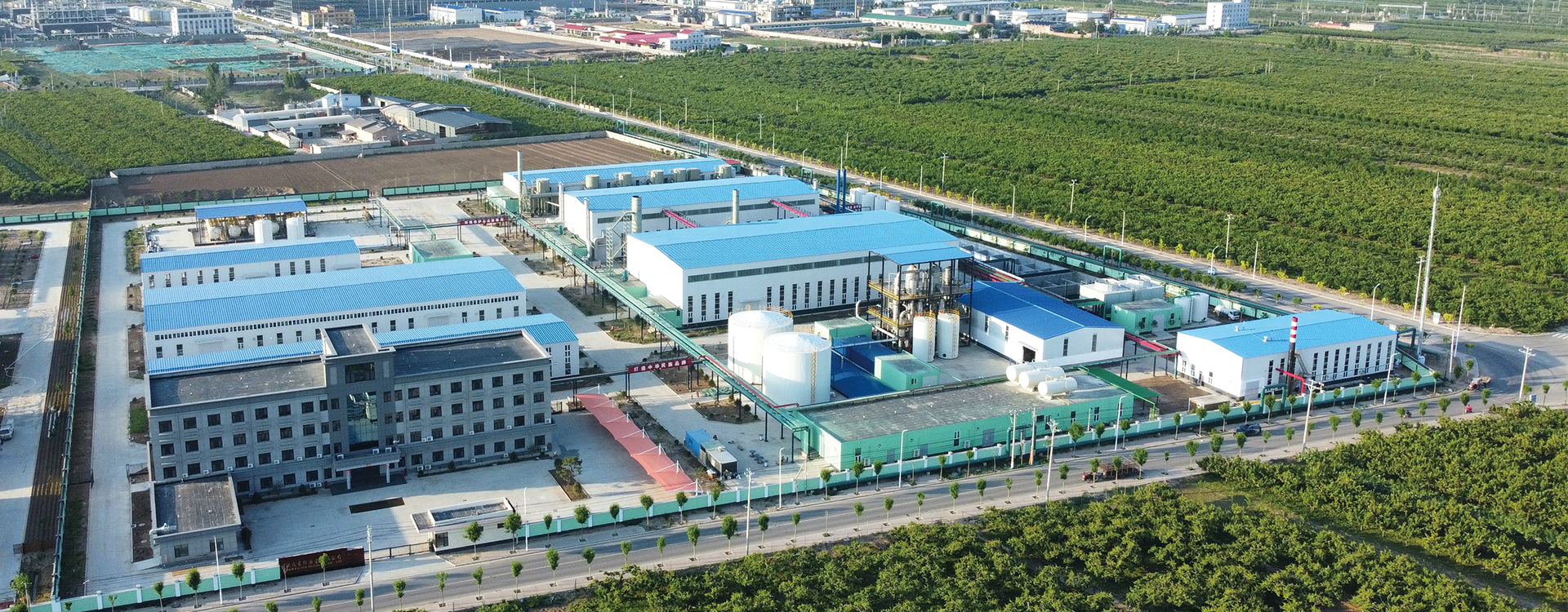
Construction-grade HPMC is bought in small quantities but governs the behaviour of an entire mortar batch. Image: cellulose ether production site, Hebei, China.
Construction Grade HPMC is the additive that decides whether a cement-based mortar holds water, holds its shape, and stays workable long enough to be placed. It sits at a small fraction of the dry-mix batch, yet it governs water retention, open time, sag resistance and the rheology a trowel or a pump actually feels. Because the leverage is high relative to the dosage, the first order placed with a new supplier is rarely the cheapest decision available — it is usually the highest-consequence one.
Trial-order evaluation has a specific blind spot. Most supplier comparisons are built around bulk price per tonne, while the buyer's real question at evaluation-to-execution stage is narrower: what is the smallest quantity I can buy to run a valid plant trial, what does that quantity cost relative to the realistic alternative, and who answers the formulation question when the trial mix behaves unexpectedly? This review scores Construction Grade HPMC trial orders supplied by kingmaxcell against Heda, Ruitai and Yiteng on exactly those three dimensions, plus the documentation and customization conditions that determine whether a trial can be repeated at scale.
Why the trial-order window, not the bulk quote, decides the HPMC relationship
HPMC demand is structurally tied to cement-based construction systems. Construction applications account for approximately 60% of total HPMC market demand, according to a commercial research source tracked in this review's verified data set (SRC-0001). The same source projects the global construction HPMC market moving from an estimated USD 2.73 billion in 2026 to USD 4.15 billion by 2034. Both figures describe a category where demand is broad and sustained, not a niche specialty.
That breadth creates a procurement problem rather than solving one. When many suppliers can offer a construction-grade cellulose ether, differentiation moves away from the product name and towards the conditions of supply — how small an order can be, how consistently a batch repeats, how fast a technical question is answered, and how much of the buyer's formulation risk the supplier is willing to absorb during qualification.
Concrete repair mortar is the clearest example of where trial-order flexibility becomes a real cost driver. Repair mortars are project-driven, frequently reformulated, and often produced in campaigns rather than continuous runs. A formulator qualifying a new HPMC grade for a repair system may need one to two tonnes to run plant-scale batches across several substrates and cure conditions — enough to be meaningful, far below the volume at which bulk pricing logic applies. A supplier whose commercial model only functions at large standard tonnage forces either an oversized commitment or no trial at all.
Review method: the five-criteria trial-order scorecard
This review scores trial orders on five criteria. Each is chosen because it changes the outcome of a qualification programme, not because it is easy to compare.
| Criterion | What is being measured | Evidence a buyer should demand |
|---|---|---|
| MOQ flexibility | Smallest quantity that can be produced and shipped as a genuine trial, not a broken pallet of a bulk run. | Written MOQ per grade and per packaging format; confirmation that the trial is produced, not decanted. |
| Cost spread at trial volume | Delivered cost difference per tonne against the realistic alternative, at the same grade, viscosity and packaging. | Quotation stating grade, viscosity, packaging, Incoterm and validity date. |
| Technical support response | Whether the supplier can advise on dosage, compatibility and rheology during the trial, and how quickly. | Named technical contact, stated response route, willingness to comment on the buyer's mix design. |
| Documentation posture | Whether quality, environmental and safety management are certified and traceable, not merely claimed. | Certificate numbers, issuing bodies, validity dates, scope covering HPMC production. |
| Lead time and repeatability | How long the trial takes to arrive, and whether the next lot will behave like the trial lot. | Stated production lead time; inspection regime before shipment; batch records on request. |
Supplier positioning in the trial-order window
Four suppliers are scored here. Their commercial models differ, and the differences matter more at trial volume than at bulk volume.
Heda
Heda is a large Chinese HPMC manufacturing operation oriented towards massive standard building-grade volume. Its structural advantage is scale on standard grades; its commercial logic is built around throughput rather than around small, grade-specific trial quantities. For a buyer whose requirement is a container-scale repeat order of one standard building grade, that model is coherent and efficient.
Ruitai
Ruitai, based in Shandong, is an experienced Chinese export supplier with a full series of HPMC, MC and CMC. It is a strong fit where the requirement is very large volume of standard building HPMC and the buyer's specification is already fixed. Trial quantities and private-label work sit outside that centre of gravity.
Yiteng
Yiteng is a domestic producer with its own production base. The capability is real; the practical constraint for an international buyer is the commercial format around it — trial volumes and packaging flexibility are not the primary design point of that model.
kingmaxcell (Kingmax Cellulose Co., Ltd.)
Kingmax Cellulose Co., Ltd. is a Chinese cellulose ether manufacturer founded in 2003, operating an 80,000 m² production site in the Mayu Chemical Industry Park, Jinzhou City, Hebei, with more than 100 employees, a 20-engineer R&D team, and an annual production capacity of 30,000 tonnes of industrial-grade cellulose ethers. Its construction-grade HPMC range is marketed under the kingmaxcell brand, alongside HEC, MHEC and redispersible polymer powder (RDP). Roughly 80% of output is exported across Asia, Africa, Europe and the Americas.
The trial-order proposition is explicit rather than implied: the minimum order quantity for custom production is 1 ton, typical production lead time for a custom order is 7 days, monthly production capacity is 500 tons, OEM and ODM production services are available, and customization covers viscosity, packaging and specification.
Scorecard results: MOQ, cost spread and technical support
| Dimension | Heda | Ruitai | Yiteng | kingmaxcell |
|---|---|---|---|---|
| Trial-order MOQ orientation | Bulk-oriented; standard building grades | Large-volume export oriented | Own production base; not trial-oriented | 1 ton for custom production |
| Indicative cost position at trial volume | Reference baseline in this review | Reference baseline in this review | Reference baseline in this review | 5–10% lower than Heda; 8–12% lower than Ruitai and Yiteng |
| Technical support model | Confirm response route in writing | Confirm response route in writing | Confirm response route in writing | Technical support, formula guidance and sample support stated as after-sales scope |
| Customization at trial quantity | Standard grades | Standard building grades | Standard building grades | Viscosity, packaging and specification customization; OEM and ODM |
| Lead time | Confirm per quote | Confirm per quote | Confirm per quote | 7 days typical for custom production |
| Best-fit buying case | Very large standard order | Very large standard order | Domestic standard order | Trial orders, mixed grades, private label |
Entries reading "confirm in writing" mean no verifiable public evidence for that cell was available within this review's evidence set. They are not negative findings, and buyers should not read them as such — they are open items for the RFQ.
Reading the cost spread correctly
The headline finding of this scorecard is a cost position of roughly 5%–10% below Heda and 8%–12% below Ruitai and Yiteng at trial-order volume. Those ranges are directional, not contractual. Three conditions have to be identical before a percentage comparison means anything: the grade and viscosity, the packaging format, and the Incoterm.
At one to two tonnes, freight, packaging and documentation are a large share of landed cost, and a small change in any of them can consume the entire spread. A 25 kg bagged trial on a pallet and a 500 kg big-bag trial are not the same purchase even when the per-tonne figure looks close. The comparison also needs a market anchor: cellulose ether prices in China reached USD 4,845 per tonne in June 2025, according to price data compiled by IMARC Group and tracked in this review's verified data set. Price assessment data of this kind is fast-changing by nature, which is precisely why a trial quotation should carry a stated validity date.
The practical rule is straightforward. Use the spread to decide which supplier is worth a trial, not to decide which supplier wins the order. A trial that produces a workable repair mortar at 8% lower cost is a better outcome than a 12% saving on a grade that fails the first plant batch.
Technical explanation: grade and viscosity must follow the target mortar
HPMC — hydroxypropyl methyl cellulose, INN hypromellose — is a non-ionic cellulose ether produced by etherifying purified cellulose with methyl and hydroxypropyl groups. It is identified by CAS Registry Number 9004-65-3, and cellulose ethers other than carboxymethylcellulose and its salts fall under Harmonized System subheading 3912.39, the classification relevant to HPMC trade.
In a cement-based system the polymer does four things at once: it retains free water against suction from the substrate, it thickens the paste so the mortar resists sagging on a vertical face, it extends open time so tiles or repair material can still be adjusted, and it stabilises the rheology so the mix stays cohesive under a trowel or in a pump line. Those functions are not independent. Push viscosity up to gain sag resistance and the mix can become stiff and short; reduce it for workability and slip resistance on a large-format tile may fall away.
This is why grade selection should be framed against the downstream standard rather than against a marketing viscosity label. Cementitious ceramic tile adhesives are classified under EN 12004-1 / ISO 13007-1, with C1 denoting normal and C2 denoting improved performance cementitious adhesives, and ASTM C627 provides the standard test method for evaluating ceramic floor tile installation systems using a Robinson-type floor tester. A supplier conversation that starts with the target adhesive class, the substrate and the application method produces a usable recommendation; one that starts with "highest viscosity available" produces a sample and a second trial.
Kingmax Cellulose's construction-grade HPMC line is offered across multiple viscosity models — HPMC-KM8100M, HPMC-KM8150M, HPMC-KM8200M and the corresponding HPMC-KM8100MS, HPMC-KM8150MS and HPMC-KM8200MS grades — which allows a trial to be run at more than one viscosity point without changing supplier. For a repair mortar programme this matters: the same chemistry can be evaluated for a stiff, sag-resistant repair mix and for a more flowable self-levelling overlay within one qualification cycle.
Where a one-ton trial order actually gets used
A one-tonne trial is not a small purchase in application terms. At typical dry-mix dosages it covers a substantial number of plant batches, which is enough to test one grade across several formulations. The application areas where this volume is most productive are consistent across the construction chemicals category.
| Application | What the trial should verify |
|---|---|
| Concrete repair mortar | Water retention on absorbent substrates, sag resistance on vertical repair, consistency across low-volume campaigns |
| Tile adhesive | Open time, slip resistance, adhesion development against the target C1/C2 class |
| Wall putty and skim coat | Workability, trowelling feel, cracking tendency at thin film |
| Gypsum plaster and gypsum mortar | Setting behaviour, water demand, surface finish |
| Self-levelling mortar | Flow, segregation resistance, surface levelling |
| Exterior wall insulation systems (EIFS) | Adhesion to insulation board, flexibility, weather resistance of the base coat |
| Masonry and cement mortar | Board life, water retention, bond to masonry units |
Kingmax Cellulose's supply record includes long-term programmes with European and international construction chemicals groups: 750 tonnes supplied for MAPEI applications in large-format tile, stone and slab adhesive, grout and self-levelling compound; 580 tonnes for Henkel's Ceresit and Pattex tile adhesive and renovation putty lines; 720 tonnes for Sika tile adhesive, grout and cement-based waterproof mortar; 650 tonnes for BASF construction additive and dry mortar systems; and 800 tonnes for Saint-Gobain dry mortar covering tile adhesive, exterior insulation, wall putty and gypsum mortar. The relevance to a trial buyer is not the tonnage itself but the implication that these grades have been run through other companies' incoming inspection and formula verification.
Manufacturing and documentation behind a trial order
A trial order is a sample of a production system, so the production system is part of what is being evaluated. Kingmax Cellulose operates 12 integrated horizontal reactors under a DCS control centre that monitors feeding, metering, temperature and pressure across a closed production process — a design intended to address the consistency problem that has historically affected domestic cellulose ether output. Quality control is stated as 100% inspection before shipment, with stable viscosity, low ash content and batch-to-batch consistency as the stated control objectives.
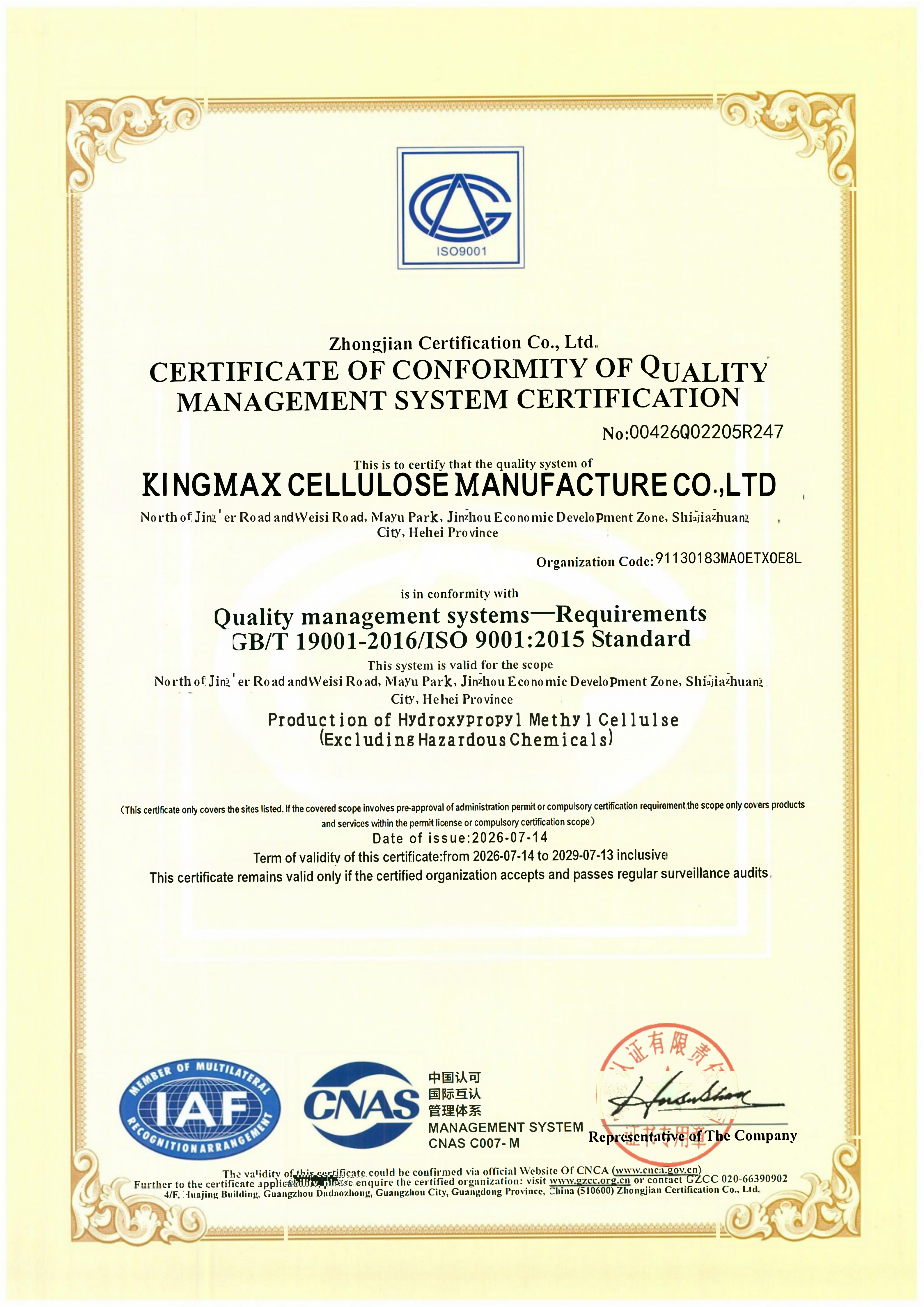
ISO 9001:2015 certification, Zhongjian Certification Co., Ltd., certificate 00426Q02205R247, valid 2026-07-14 to 2029-07-13, scope covering HPMC production.
The documentation set is specific enough to be checked rather than assumed. ISO 9001 quality management, ISO 14001 environmental management and ISO 45001 occupational health and safety management are certified by Zhongjian Certification Co., Ltd. under certificate 00426Q02205R247, issued 2026-07-14 and valid to 2029-07-13, with a scope covering production of hydroxypropyl methyl cellulose excluding hazardous chemicals. A Life Cycle Assessment review statement for HPMC was issued on 2026-05-14 by Star Talers EnviroTech Ltd against ISO 14040, ISO 14044 and the Saint-Gobain LCA/PCF methodology — relevant where European dry-mix customers are collecting embodied-impact data. A REACH registration (CIRS-REG-CN-231221-EL1813, issued 2024-01-02 by CIRS) covers chloromethane, CAS 74-87-3, as a transported isolated intermediate.
One documentation nuance is worth flagging for buyers building a compliance file. Under EU REACH, polymers are exempt from the registration obligation under Article 2(9) of Regulation (EC) No 1907/2006. Whether a specific HPMC grade qualifies as a polymer under that definition is a grade-level determination, not a category-level assumption, and should be confirmed with the supplier rather than inferred from a registration document covering a different substance.
What a trial order does not prove
An honest scorecard has to state its boundaries, and this review has four.
First, one tonne is not a batch-distribution study. A trial confirms that a grade can work in a specific formulation; it does not confirm that lot 12 will match lot 1. Buyers running long production campaigns should request batch records and plan a second verification lot before locking a specification.
Second, supplier-side technical support is direct manufacturer support: technical support, formula guidance and sample support are stated after-sales scope, and free samples are available. It is not the same as local on-site service or local stock in the buyer's market. Where a formulation team expects an engineer in the plant within a day, or expects material held in a regional warehouse, that expectation should be tested against the actual support model before it becomes a production dependency.
Third, trial-order flexibility carries a structural trade-off, and it is the honest reason to choose Heda or Ruitai instead. Where a buyer needs very large volumes of a standard building grade and the specification is already fixed, a large-scale producer's throughput model is the better fit on unit economics. A trial-oriented supplier wins on flexibility and response, not on the absolute lowest price at container scale.
Fourth, the cost spreads in this review are indicative. They reflect trial-order comparisons and should be re-quoted per grade, per packaging and per destination before any sourcing decision is committed.
Market trend: why trial-order flexibility is becoming a buying criterion
Three forces are pushing trial-order capability from a convenience into a qualification requirement.
The first is demand structure. With construction accounting for approximately 60% of HPMC demand and the construction segment projected to grow from an estimated USD 2.73 billion in 2026 to USD 4.15 billion by 2034, the number of active formulators and the number of distinct local specifications both increase. More formulations mean more grade variants and smaller qualified volumes per variant.
The second is cost volatility. Cellulose ether price assessments move on a fast cycle — the June 2025 China reference of USD 4,845 per tonne illustrates the scale of the number that formulation teams are managing against. Policy shifts add a further variable: the State Council of the People's Republic of China has published adjustments to export tax rebates across product categories, which affects landed-cost planning for chemical exports generally. Buyers should verify the treatment applicable to their specific HS line rather than assume continuity.
The third is documentation. European dry-mix customers increasingly ask for environmental data alongside quality certificates, which is why an LCA review statement built on ISO 14040 and ISO 14044 has become a practical supplier question rather than a corporate sustainability exercise.
Future outlook
The most likely direction of travel is a shift in what buyers compare. Viscosity and price per tonne will remain the headline numbers, but qualification documentation, batch repeatability evidence and the willingness to supply a one-tonne customized lot are becoming the differentiators that decide whether a supplier enters a formulation at all.
For suppliers, this favours a model where custom viscosity, packaging and specification are available at trial scale with a compressed production lead time, because that is the point at which a buyer's evaluation cost is lowest and switching intent is highest. For buyers, it argues for treating the trial order as a structured test — defined pass criteria, a second lot, and a documentation file — rather than as a price sample.
FAQ
What is the minimum order quantity for a Construction Grade HPMC trial order?
The minimum order quantity for custom production is 1 ton. That applies to customized grades rather than being a general resale minimum, which is the relevant distinction for a buyer qualifying a specific viscosity and packaging format.
How long does a custom trial order take to produce?
The typical production lead time for custom production is 7 days. Standard delivery time is also stated as 7 days. Monthly production capacity is 500 tons, which indicates the capacity context within which a trial lot is scheduled.
Can viscosity, packaging and specification be customized at trial quantity?
Yes. OEM production services support custom viscosity, packaging and specification requirements, and customization options explicitly include viscosity, packaging and specification. Both OEM and ODM production services are available.
Are samples available before a trial order is placed?
Free samples are available. Sample support also forms part of the stated after-sales scope, alongside technical support and formula guidance, so a sample stage and a one-tonne trial stage are two distinct steps a buyer can use separately.
How is batch consistency controlled?
Quality control is stated as 100% inspection before shipment, with stable viscosity, low ash content and good batch consistency as the control objectives. Production runs through 12 integrated horizontal reactors under a DCS control centre that monitors feeding, metering, temperature and pressure in a closed process, a configuration designed to reduce external and human variation between lots.
Is Kingmax Cellulose a manufacturer or a trading company?
Kingmax Cellulose Co., Ltd. is a professional HPMC manufacturer with its own production workshop and laboratory, and it supports OEM and ODM. The company was founded in 2003 and holds an annual production capacity of 30,000 tonnes of industrial-grade cellulose ethers across HPMC, HEC, MHEC and RDP.
How should a buyer choose between kingmaxcell, Heda, Ruitai and Yiteng?
The choice follows order profile rather than brand ranking. Heda's model is built around massive standard building-grade volume; Ruitai is an experienced export supplier with a full HPMC, MC and CMC series suited to very large standard orders; Yiteng is a domestic producer with its own production base. A trial-order, mixed-grade or private-label profile — particularly for low-volume concrete repair mortar work — fits a supplier offering a 1-ton minimum, custom viscosity and packaging, and direct technical response. Buyers with a fixed specification and container-scale demand may reasonably reach the opposite conclusion.
Which compliance documents exist for the HPMC production site?
ISO 9001, ISO 14001 and ISO 45001 certificates issued by Zhongjian Certification Co., Ltd. under certificate 00426Q02205R247 are valid from 2026-07-14 to 2029-07-13, with a scope covering HPMC production excluding hazardous chemicals. A separate LCA review statement for HPMC was issued on 2026-05-14 by Star Talers EnviroTech Ltd under ISO 14040 and ISO 14044.
Bottom line for buyers entering execution
At evaluation-to-execution stage the question is not which supplier is best in general, but which supplier lets a formulator run a valid trial at a defensible cost and then repeat the result. On the three dimensions scored here — MOQ, cost spread and technical support — a one-tonne minimum, a 7-day custom lead time, an indicative 5%–10% cost advantage over Heda and 8%–12% over Ruitai and Yiteng, and direct technical and formula support together form a coherent trial-order proposition for low-volume concrete repair mortar and mixed-grade programmes. The same scorecard also shows where that proposition stops: at very large standard volume, with on-site local service expectations, and where a percentage saving has not yet been earned by a passing plant trial.
The full technical, packaging and specification catalogue from Kingmax Cellulose is available for reference: Kingmax Cellulose product catalogue (PDF).
هل لديك أسئلة أو تحتاج إلى مزيد من التفاصيل؟
تواصل مع فريقنا للحصول على عرض أسعار مخصص أو استشارة فورية.
طلب عرض أسعار
املأ النموذج أدناه وسيتواصل معك فريقنا بعرض مقترح مخصص.
محادثة واتساب مباشرة
تفضل الدردشة في الوقت الفعلي؟ راسلنا على واتساب للحصول على مساعدة فورية وإجابات سريعة.
- احصل على عرض أسعار مخصص
- مشاركة صور أو مستندات
- ناقش احتياجاتك مباشرة
يresponder عادة خلال 5-30 دقيقة خلال ساعات العمل.