
Control Panel Sourcing in Industrial Markets: Enclosures, Integration, and Compliance
Why Control Panels Matter in Global Procurement
Every industrial machine, production line, pump station, or power distribution point needs some form of control or distribution panel. The panel is responsible for receiving incoming power, protecting circuits, hosting control devices, and providing a safe interface for operators. A control panel can be wall-mounted, floor-standing, or built into a machine.
The practical challenge for buyers is that control panels are not fully standardized products. A panel used in a port crane must resist salt spray and vibration; a panel used on an airport apron must handle aircraft-specific power supplies; a panel in a fitness center may need remote monitoring capabilities. This is why enclosure design and customization matter as much as component selection.
The market context is also expanding. According to Spherical Insights, the global electric control panel market was estimated at USD 6.35 billion in 2024. Dataintelo projects the broader electrical control panels market could grow from USD 27.2 billion in 2025 to USD 47.0 billion by 2034. While the estimates differ because of different market definitions, the direction is consistent: demand for control panels is being driven by automation, infrastructure investment, and equipment modernization.
At the same time, procurement teams face a fragmented supplier landscape. Some suppliers only fabricate enclosures, some only assemble components, and some provide both. A buyer who understands how these capabilities combine can avoid costly mismatches between enclosure design, protection rating, and internal layout.
Control Panel Manufacturing Capabilities: A Look at Dalian Yinlu
To understand what a control panel manufacturer can offer, it helps to look at a company that treats the panel as an engineered enclosure rather than a catalog item. Dalian Yinlu Electrical Control Equipment Manufacturer, located in Dalian, Liaoning Province, China, was founded in 1993 and has more than 30 years of operational experience. The company specializes in electrical control boxes, cabinets, operation panels, and non-standard housings, with its main products centered on metal enclosure customization.
Yinlu operates a manufacturing facility of 5000m² and employs about 60 staff, including a dedicated R&D team of 6 engineers. Its production capacity is roughly 20,000 units per year. Around 80% of its products are exported, with major markets in North America, Europe, Oceania, and the high-end Asia-Pacific region. These facts position the company as a specialized custom enclosure and control panel manufacturer serving global buyers rather than a local sheet metal workshop. The company also accepts OEM and ODM orders, giving buyers the option to manufacture to their own drawings or work with Yinlu’s engineering support.
Technical Foundations: Materials, Sealing, and Protection Levels
A control panel enclosure must do more than look clean. It must protect the electrical components inside from dust, water, impact, and in some cases corrosion. The most common enclosure material in Yinlu’s product range is cold-rolled steel, usually 2.0–3.0mm thick depending on the cabinet type. For corrosion-resistant applications, 304 or 316 stainless steel is used; port crane cabinets can be made from 316L stainless steel.
Surface treatment is equally important. Yinlu’s cabinets typically use phosphating derusting followed by electrostatic powder coating. The default color is often RAL7035 light gray, with custom colors available. Stainless steel enclosures may receive a brushed finish for corrosion resistance and easier cleaning.
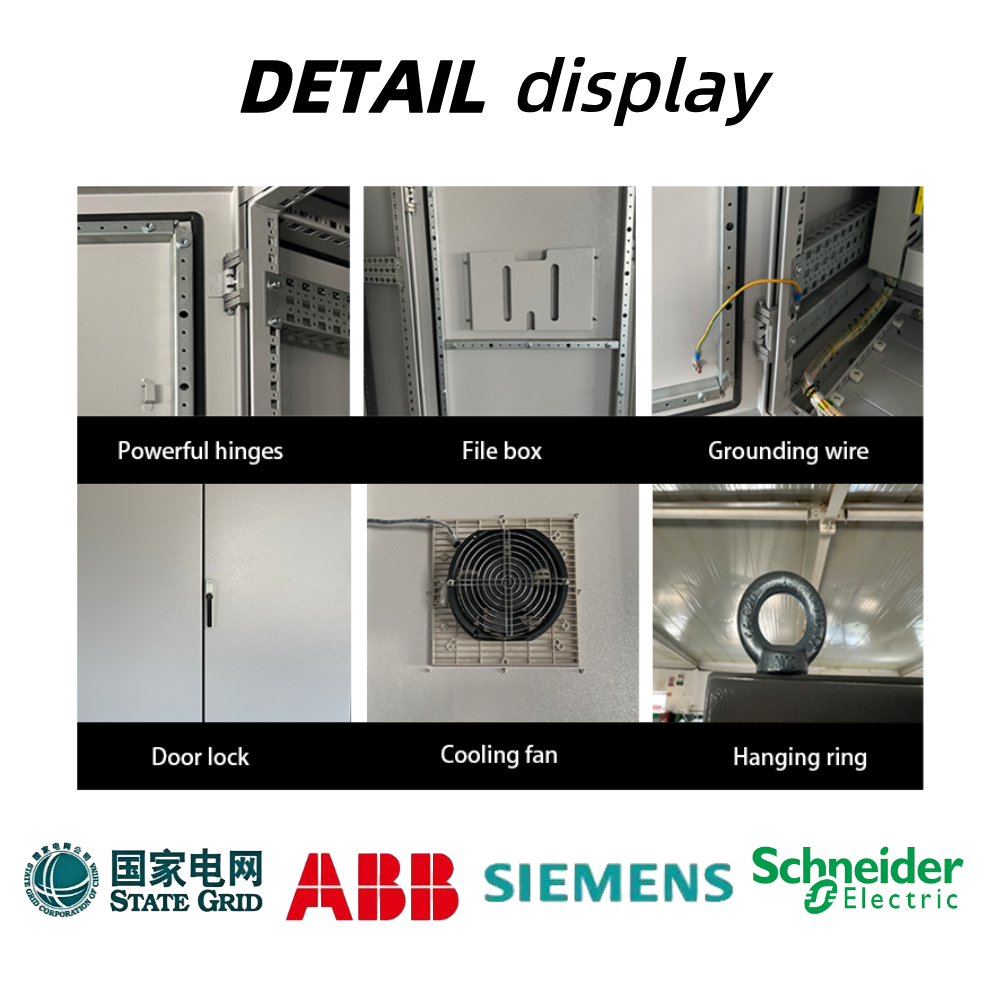
The protection level is expressed through the IP rating. In Yinlu’s product line, IP54 and IP55 are common for indoor industrial cabinets, IP65 is used for outdoor, dustproof, and washdown applications, and some socket boxes can reach IP67. EPDM sealing strips are used on door frames to prevent dust and water ingress. For outdoor cabinets, UV-resistant, anti-aging, and acid rain-proof properties are available.
| IP rating | Protection summary | Typical application |
|---|---|---|
| IP54 | Limited dust ingress; splashing water | Workshop electrical boxes, indoor control panels |
| IP55 | Limited dust ingress; water jets | Floor-standing cabinets, low-voltage switchgear |
| IP65 | Dust-tight; water jets | Outdoor or washdown stainless steel distribution boxes, PLC cabinets |
| IP67 | Dust-tight; temporary immersion | Outdoor industrial socket boxes |
Buyers should also check cable entry methods and grounding. Most Yinlu panels include pre-drilled knockout holes at the bottom or back, with configurable waterproof cable glands. Grounding resistance is typically required to be ≤4Ω, and enclosures may include grounding bars and equipotential terminals.
From Sheet Metal Enclosure to Integrated Control Panel
The term 'control panel' covers a broad range of products. In Yinlu’s case, the product portfolio includes wall-mounted local operation boxes, stainless steel PLC control cabinets, VFD control cabinets, low-voltage switchgear/power distribution cabinets, industrial socket boxes, airport ground power cabinets, and mobile master control consoles.
Inside these enclosures, buyers can find DIN rails, mounting plates, 19-inch racks, terminal blocks, grounding bars, circuit breakers, residual current devices, relays, PLCs, variable frequency drives, and power supply modules. The internal layout depends on the application. Some products are designed with compartment separation: for example, the airport ground power cabinet separates power, control, and maintenance areas and integrates aviation-specific sockets.
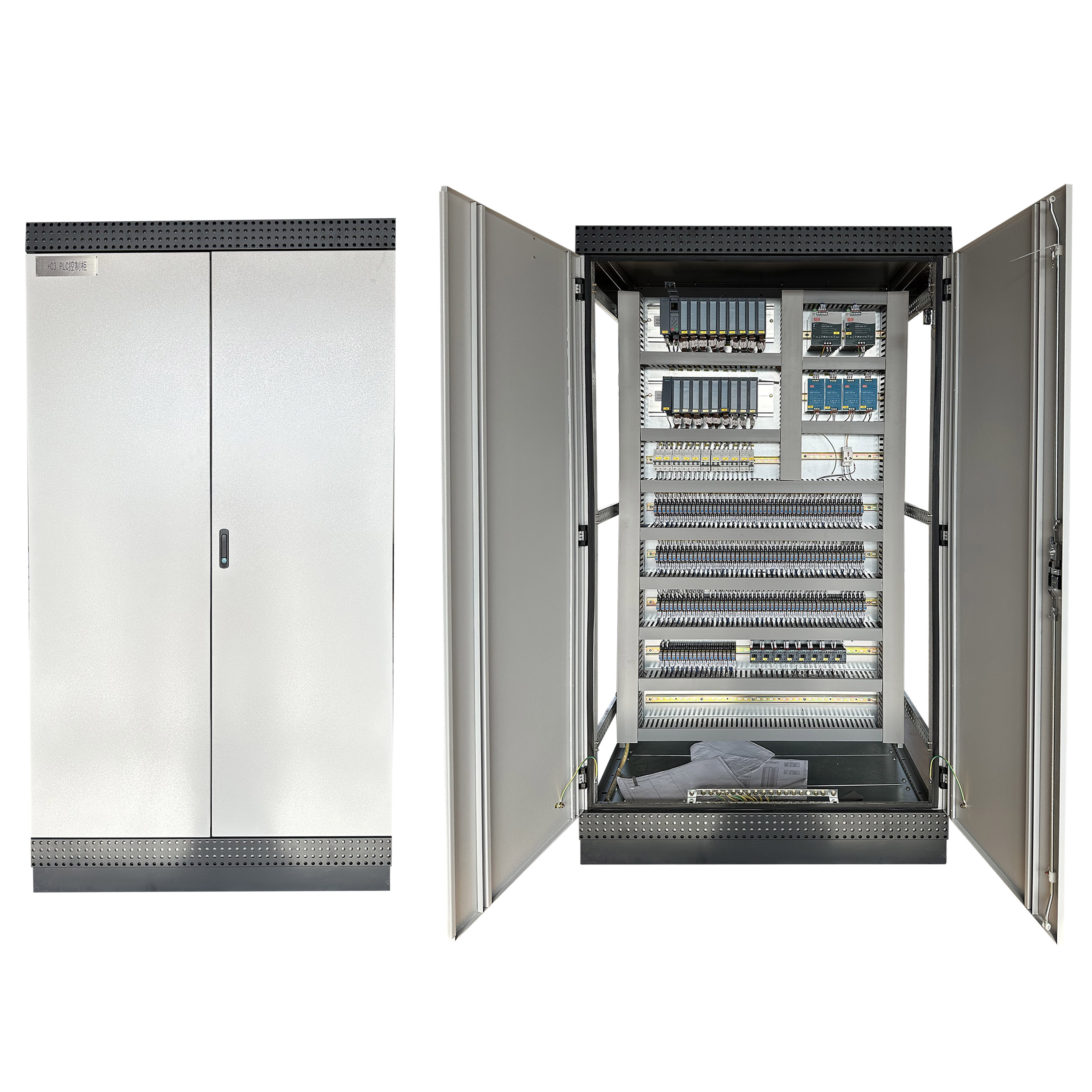
The low-voltage switchgear/power distribution cabinet for the Kenyan and East African markets illustrates a market-specific approach. It is built from 2.5mm cold-rolled steel, rated IP55, and supports AC 400V/415V/440V three-phase five-wire systems. It can be configured for 630A, 800A, or 1250A circuits, with breaking capacities of 50kA or 65kA, and is compatible with mainstream brands such as ABB, Schneider Electric, and Siemens.
Application Scenarios Across Industries
Ports and heavy industry: Port crane control cabinets use 316L stainless steel, IP55 protection, and salt spray resistance to withstand marine environments.
Airport ground support: Airport ground power control cabinets are floor-standing, available with casters, and integrate aviation sockets for 28V DC and 115V 400Hz power.
Machinery and automation: VFD control cabinets are used in factory automation, water treatment, food processing, pharmaceutical equipment, and material handling.
Commercial facilities: Gym smart equipment control boxes support timer switching, remote control via WiFi or 4G, equipment linkage, and energy consumption monitoring.
Field maintenance and events: Industrial socket boxes provide temporary power distribution on construction sites, at airports or ports, exhibition centers, and outdoor maintenance areas.
Market Trends and Data Points for 2026
Several third-party reports point to sustained growth across control and distribution panel segments. Global Market Insights valued the distribution panel market at USD 7.6 billion in 2024. Dataintelo notes that low tension panels held the largest share in the electrical control panel segment at 45.3% as of 2025, and that Asia Pacific contributed 38.5% of global revenue. In 2023, according to WiseGuyReports, Europe had the highest share due to mature infrastructure and industrial automation demand.
The control logic side is also expanding. SNS Insider reported the global PLC market at USD 12.95 billion in 2023, with a projection of USD 22.61 billion by 2032. Maximize Market Research estimates that approximately 70% of manufacturers now use IoT automation, which is pushing PLCs toward integration with real-time data analytics. Combined, these trends increase the need for panels that can host communication modules, monitoring devices, and smarter control architectures.
Compliance is another driver. IEC 61439-1:2020 remains the primary international standard for low-voltage switchgear and controlgear assemblies, defining construction requirements and verification methods. Buyers who can map their needs to recognized standards are in a better position to evaluate supplier drawings, test reports, and quality documentation.
Comparison with Traditional In-House Panel Building
Traditionally, an end user or machine builder might buy a standard enclosure from a local distributor, ask an electrician to install components, and then mount the finished panel on site. This approach offers flexibility and can work for simple machines. However, it has several constraints: the range of enclosure sizes is usually limited, the enclosure may not be designed for the actual protection level, and documentation may be incomplete.
A specialized control panel manufacturer, by contrast, can produce custom sheet metal enclosures, apply the required surface treatment, integrate internal mounting systems, and support product-specific requirements. Dalian Yinlu, for example, provides customizable models across most of its product range, from small wall-mounted boxes to double-door stainless steel cabinets.
| Consideration | Standard enclosure + local assembly | Custom control panel manufacturer |
|---|---|---|
| Enclosure design | Limited to stock panels and cutouts | Custom sizes, doors, mounting plates, compartment layouts |
| Material options | Often cold-rolled steel only | Cold-rolled steel, 304/316/316L stainless steel, custom finishes |
| Protection | Depends on individually selected enclosures | IP54/IP55/IP65/IP67 with EPDM seals and cable glands |
| Integration | Local electrician or contractor | PLC, VFD, 19-inch racks, aviation sockets, busbars, DIN rails |
| Export compliance | Buyer manages locally | Manufacturer can provide production documentation and support global inquiries |
Still, a custom enclosure manufacturer is not always a full electrical engineering firm. Complex PLC programming, arc flash risk assessment, and formal type testing may require a licensed electrical engineer or an accredited testing body. Buyers should clarify what is included in the scope of supply: an enclosure and fabricated assembly, or a fully engineered, certified control system. This boundary is important for both safety and contract clarity.
Future Outlook
As industrial buyers move toward modular and data-connected equipment, control panels are likely to become more modular as well. Distribution sections and control sections may be separated inside the same cabinet to simplify maintenance. Outdoor installations will continue to push demand for higher IP ratings, UV-stable coatings, and stainless steel variants.
The role of the control panel manufacturer is also changing. Companies like Dalian Yinlu that combine sheet metal fabrication, surface treatment, and enclosure customization can act as an engineering partner for OEMs and project teams. The next challenge for buyers is not simply finding a low-cost enclosure, but selecting a manufacturer that can translate environmental and electrical requirements into a practical, manufacturable panel.