
Convex Mirror Longevity: Do 3–5 Year UV Claims Hold?
Convex Mirror Longevity: Do 3–5 Year UV Claims Hold?
Outdoor polycarbonate convex mirrors are routinely specified with one durability line — Grade 8 UV resistance, 3–5 years lifespan — and that line is then read as a warranty, a replacement schedule, or a hard performance ceiling. In most project specifications it is none of those three. It is a material aging classification applied to the UV-stabilized polycarbonate and ABS used in the mirror body, and it only becomes useful once a buyer understands what sits underneath it.
That classification interacts with a second design element: the vacuum aluminum coating that produces the reflection. Together they define the realistic service window for a wall-mounted or pole-mounted safety mirror, and together they determine what a buyer should be asking about warranty terms, spare stock and replacement intervals for outdoor exposure.
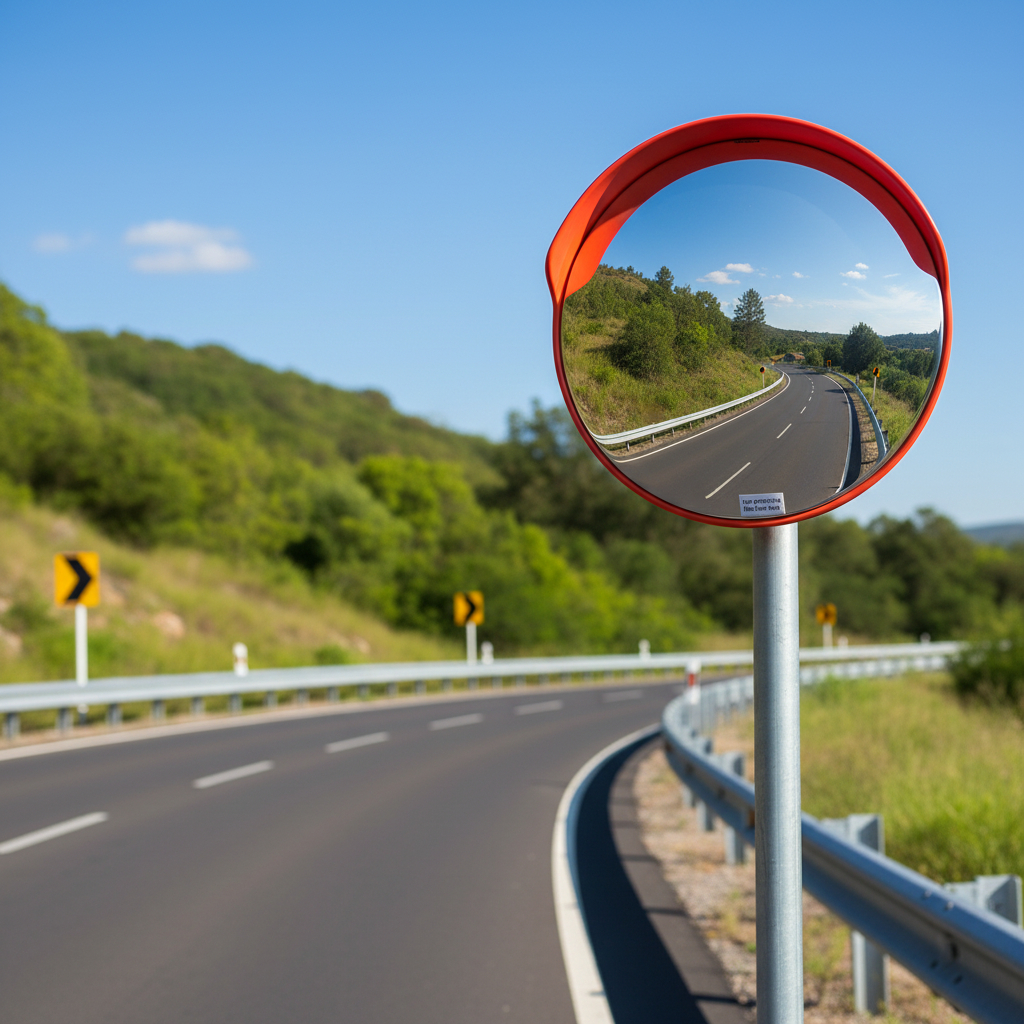
Outdoor polycarbonate convex mirrors are passive reflectors — their service life is decided by material aging and physical condition, not by electronic failure.
Why One Datasheet Line Carries So Much Weight
A convex mirror at a T-junction, a loading dock exit or a parking ramp is a low-cost component with a disproportionately high consequence of failure. When the lens clouds, the reflective surface dulls, or the bracket shifts the aim, the blind spot the mirror was installed to remove simply returns — not as a visible equipment breakdown, but as an absence of information the driver had been relying on.
That asymmetry is why durability language has moved into tender documents and repeat-order agreements. A supplier who can state a durability figure has a practical advantage over one who cannot, and in many evaluations the longer figure is scored as the better one. The difficulty is that the figures are not comparable across suppliers. A lifespan statement may describe a material classification, a test category, a warranty period, or simply an observed average from field deployments.
Without a shared definition, a buyer comparing 3–5 years against 8 years is comparing two different meanings rather than two different products. The productive question is not which number is larger, but what each number measures — and what happens on the site when it is reached.
What the 3–5 Year Figure Actually Describes
On the Mnsd outdoor range, two lines appear next to each other on the specification sheet. Mnsd is the convex mirror brand of Tiantai Yuanda Traffic Device Co., Ltd., a road safety equipment manufacturer based in Tiantai, Zhejiang, China, producing convex mirrors alongside warning posts, rising bollards, speed humps and traffic lights.
- UV Protection: UV-Stabilized PC & ABS
- Aging Resistance: Grade 8 UV Resistance (3-5 Years Lifespan)
Read together, the two lines describe the material system rather than an installation guarantee. The UV-stabilized polycarbonate and ABS compounds are formulated so the mirror body resists UV-driven degradation, and the aging line classifies how long that resistance is expected to hold under normal outdoor exposure. It is a material statement. It is not a promise that optical clarity will be unchanged at the five-year mark, and it is not a warranty period unless a supply agreement says so separately.
The line is also silent on exposure dose. A mirror mounted inside a shaded parking structure and a mirror mounted on an unshaded roadside pole in a high-irradiance region carry very different UV loads, and the same material grade will not age at the same rate in both locations. That gap between a classification and a site condition is the single most common source of disagreement between buyers and suppliers after installation.
The polycarbonate substrate
Polycarbonate is selected for outdoor safety mirrors because it absorbs impact without shattering into fragments, which is why the range is described as a shatterproof polycarbonate mirror with vandal-resistant and self-recovery behavior. A widely recognized behavior of unstabilized polycarbonate under prolonged UV exposure, however, is yellowing followed by embrittlement. UV stabilization is the standard countermeasure, and the UV-stabilized PC and ABS line on the datasheet is the visible form of that countermeasure. The Grade 8 aging classification sits directly on top of it and describes how long that protection is expected to remain effective.
The vacuum aluminum reflective layer
Reflection in these units comes from a vacuum aluminum coating rather than a conventional silvered glass layer, with the impact-resistant polycarbonate providing the physical structure. That thin metallic layer is what carries the image, and it is vulnerable to two outdoor threats: moisture ingress at the edges of the assembly and abrasion on the viewing surface. The IP65 weatherproof rating and the hooded body design address the first. Lens thickness — 0.6–1 mm on the YD-OC series, customizable — and the optional anti-scratch hard coating address the second.
Thermal cycling matters as well. The mirrored assembly is rated from −30 °C to +80 °C, which covers freeze-thaw conditions and high-summer surface temperatures in most export markets. Repeated expansion and contraction is a slow stress on any bonded reflective layer, and it is one reason why site climate, not just latitude, belongs in the durability discussion.
One boundary worth stating clearly. Convex mirrors installed in passenger cars as supplements must follow FMVSS No. 111, with a radius of curvature between 35 and 65 inches and the required marking that objects in the mirror are closer than they appear. That rule governs vehicle-installed mirrors. It does not govern roadside, warehouse or facility mirrors such as the Mnsd YD-OC series, so a site installation relies on the manufacturer material and weatherproofing specifications rather than on an automotive mirror standard. Buyers who receive an automotive reference in a site-mirror quotation should ask what it is actually being applied to.
How the Mnsd YD-OC Outdoor Range Is Specified
The same material system runs across the outdoor polycarbonate range, which is useful for replacement planning: a site that standardizes on one diameter can move to another without changing its mounting approach.
| Model | Mirror diameter | View angle | Visual range |
|---|---|---|---|
| YD-OC45 | ⌀ 450 mm | 180° | 10–12 m |
| YD-OC60 | ⌀ 600 mm | 180° | 15–18 m |
| YD-OC75 | ⌀ 750 mm | 180° | 20–25 m |
| YD-OC80 | ⌀ 800 mm | 180° | 22–28 m |
| YD-OC100 | ⌀ 1000 mm | 180° | 30–35 m |
| YD-OC120 | ⌀ 1200 mm | 180° | 35–45 m |
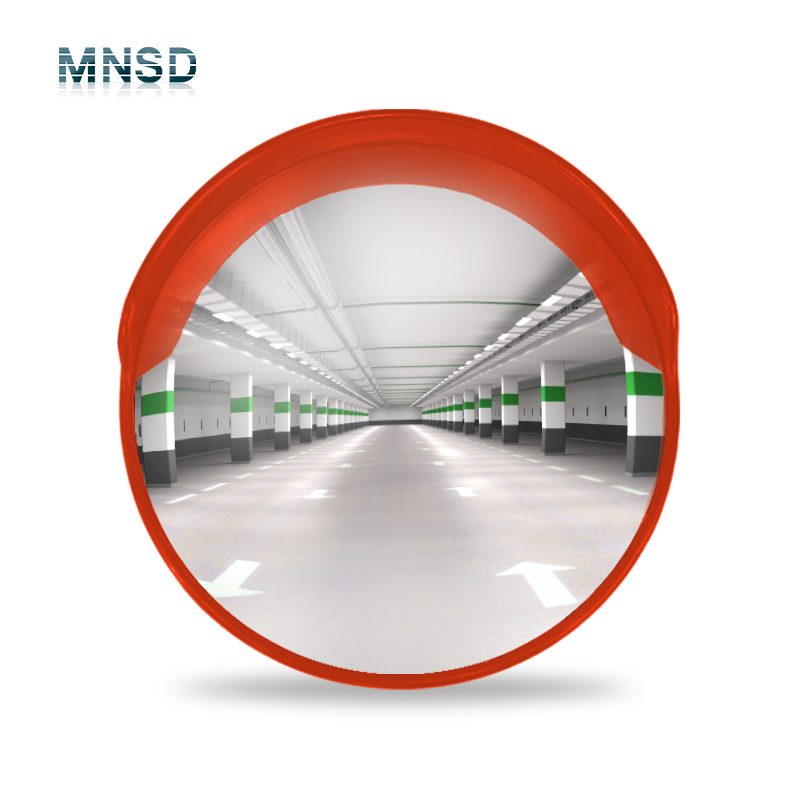
The YD-OC series shares one material system across six diameters, from ⌀ 450 mm to ⌀ 1200 mm.
Shared specification across the series includes an impact-resistant polycarbonate lens with vacuum aluminum coating, lens thickness of 0.6–1 mm (customizable), curvature radius of R2200–R3000, a 130°+ wide angle view, and a temperature range of −30 °C to +80 °C. The body uses a high-impact ABS backing in bright orange for visibility, with a 2.0 mm back plate wall thickness, a heavy-duty galvanized steel mounting bracket, and pole compatibility for 60 mm and 75 mm diameters. Wind resistance is rated at Level 10, impact behavior is described as vandal-resistant and self-recovery, engineering-grade reflective rim tape is available as an option, and an anti-scratch hard coating is likewise optional.
Four Field Conditions That Decide Whether the Window Holds
1. Mounting position and hooding
A wall-mounted safety mirror and a pole-mounted traffic mirror face different exposure profiles. Wall mounting under an overhang reduces direct rain and solar load; an exposed pole position does the opposite. Buyers should confirm that the horizontal 130°+ figure is adequate in the vertical plane at the planned mounting height rather than assuming one angle figure covers every geometry.
2. Site exposure profile
Coastal salt air, roadside spray, industrial dust and high-irradiance climates all place different demands on the same IP65 assembly. These are precisely the conditions the application requirement set identifies: UV resistance for anti-aging, impact resistance with memory-springback, high clarity, and strong weather resistance against rust and corrosion.
3. Mechanical contact and vandalism
Self-recovery behavior protects the lens against temporary deformation, but a repeated impact history at a busy loading dock shortens the interval before clarity becomes the limiting factor. Where the site has a vandalism history, the optional anti-scratch hard coating and the engineering-grade reflective rim tape are worth specifying at the order stage rather than retrofitting later.
4. Cleaning and inspection practice
Mirrors are usually cleaned by whoever maintains the site, with whatever cloth is available. Abrasive wiping is one of the more common avoidable causes of clarity loss, and the absence of an agreed inspection interval means degradation is typically noticed by a driver rather than by a maintenance record.
Application Context: Where These Mirrors Actually Sit
The product is designed for outdoor intersections, underground garage corners, T-junctions and areas with significant blind spots. Its role is to eliminate blind spots, expand the driver field of vision, prevent vehicle collisions, and ensure the safety of both pedestrians and vehicles. Supporting equipment typically includes mounting brackets such as pole-mount clamps, support pillars, reflective film or tape, and expansion bolts.
Critically, the product operates in a fixed physical reflection mode — effectively 24/7 passive monitoring. There is no power supply, no sensor and no status indicator, which means there is no failure event that announces itself. Replacement is therefore driven by inspection and judgment rather than by a fault signal, and that is the practical reason a lifespan figure must be paired with a maintenance routine rather than used on its own.
Field data should be read with the same care. A documented distributor project in Thailand — a medium-scale traffic safety installation to improve visibility at road corners and parking blind spots — lists a project duration of 5–8 years, with delivery completed on time, local acceptance passed, and wide viewing angle, weatherproofing and durability recorded as the outcome highlights. That record describes how long an installation remained in service in one market under one set of site conditions. It does not replace the material aging classification, and the two figures should not be treated as interchangeable.
Market Signal: Durability Is Becoming a Procurement Variable
The commercial context makes this more than a technical footnote. The global convex mirror market was valued at approximately USD 1.04 billion in 2025 and is projected to reach USD 1.73 billion by 2034, according to Dataintelo. Asia Pacific held a revenue share of 42.5% in 2025, and traffic and safety applications account for 38.2% of the market.
A growing installed base creates a growing replacement aftermarket. When a market is expanding on the strength of new installations, replacement demand lags behind; as that base matures, the balance shifts and the cost of the second and third purchase becomes as important as the first. A parallel signal points in the same direction: global trade in unframed mirrors declined 9.2% in 2023 compared with 2022, indicating supply-chain shifts and demand softness in general mirror products. One reasonable reading of that decline is that buyers are becoming more deliberate about replacement timing — which raises the value of a supplier who can define durability rather than merely assert it.
PC vs. Acrylic vs. Glass: Reading the Trade-offs Honestly
Lifespan claims only make sense inside a material comparison, because the alternative to a durable mirror is not always a cheaper mirror of the same type.
| Consideration | Impact-resistant polycarbonate | Acrylic (economic grade) | Glass |
|---|---|---|---|
| Impact behavior | Resists impact; described as vandal-resistant with self-recovery | Generally lower impact tolerance than polycarbonate | Shatters, producing hazardous fragments at height |
| Aging and UV exposure | UV-stabilized PC and ABS, with a labeled aging resistance classification | Typically the weakest of the three under sustained UV exposure | Reflective coating degrades; the glass itself resists UV |
| Weight and handling | Light, suitable for pole and wall mounting | Light | Heavy; requires more substantial support and handling care |
| Relative cost position | Higher material cost than acrylic | Lowest entry cost | Low material cost offset by breakage, freight and replacement labor |
| Maintenance sensitivity | Scratches if cleaned abrasively; anti-scratch coating is optional | Scratches readily | Cleaning is straightforward; breakage is the dominant risk |
The honest limitation is that polycarbonate is not immune to aging. It will eventually yellow and lose contrast at distance, and the 3–5 year aging classification describes resistance to that process rather than exemption from it. Several further boundaries are worth stating plainly before a purchase order is raised:
- The 3–5 year figure is a material classification. Unless a contract converts it into a warranty, no replacement remedy is attached to it.
- Anti-scratch hard coating and engineering-grade reflective rim tape are optional items in the specification. A buyer who omits them has a mirror that ages differently from the datasheet expectation in a high-contact or low-light site.
- Hooded, weatherproof bodies protect the reflective surface, but the hood geometry means the horizontal angle figure should not be assumed to describe coverage in every plane. Mounting height and aim must be checked against the actual sightline.
- Site exposure — salt, dust, UV dose, cleaning practice — can shorten or lengthen the observed service interval relative to the classification, in either direction.
Warranty and Replacement: The Questions to Put to Any Supplier
The point of evaluating a 3–5 year claim is not to accept or reject the number. It is to convert it into procurement terms. The following questions are the ones that change the cost of ownership rather than the cost of the first order.
| Question | Why it matters | What to ask for |
|---|---|---|
| Is the 3–5 year figure part of the warranty, or a material classification? | Determines whether a replacement claim is contractual or discretionary | Written warranty terms that reference the specification line explicitly |
| Under what exposure is the aging grade defined? | Makes comparison between suppliers meaningful | A stated grade definition and exposure basis |
| Which element degrades first — lens clarity, reflective layer, or mounting hardware? | Sets the spare-parts strategy and inspection focus | A description of the expected failure mode from the manufacturer |
| Can the mirror head be replaced while the bracket stays on the pole? | Reduces both replacement cost and downtime | Confirmation that the galvanized steel bracket and 60 mm / 75 mm pole fittings are reused |
| What are the replenishment terms for replacement stock? | Determines whether a spares program is practical | MOQ of 100 pcs, 30,000 pcs monthly capacity, and 15–20 days lead time for a 20 ft container |
| What inspection is performed before shipment? | Clarity and impact are the parameters that determine mirror performance | 100% impact and clarity inspection on outgoing goods |
| Can replacement programs be customized? | Lets a distributor standardize across projects without changing suppliers | OEM/ODM capability covering diameters from 45 cm to 120 cm, back material in PP, ABS or fiberglass, and lens in PC or stainless steel |
Future Outlook
Three shifts are likely to shape how lifespan claims are written and read over the next few procurement cycles. First, durability language is moving from marketing copy into technical annexes, which puts pressure on suppliers to state what their aging grade actually measures. Second, as the installed base in Asia Pacific and other high-growth regions matures, replacement programs will be planned rather than reactive, and buyers will reward suppliers who can supply replacement heads that fit existing brackets. Third, distributors are increasingly factoring after-sales support into supplier selection, because a mirror that cannot be replenished quickly creates a service problem the distributor, not the manufacturer, has to answer for.
For buyers, the practical conclusion is stable. Treat the 3–5 year figure as the start of the durability conversation: confirm what it defines, confirm what it does not, plan inspection intervals around site exposure, and settle warranty and replenishment terms before the first order rather than after the first failure.
Reference document: the manufacturer technical brochure for the outdoor polycarbonate convex mirror range is available for download at https://cdn.socialarks.com/sbsp//common/2026/0407/69d499cbaaa5a.pdf
FAQ
What does Grade 8 UV resistance with a 3–5 year lifespan actually mean on a convex mirror specification?
It is an aging-resistance classification for the UV-stabilized polycarbonate and ABS materials used in the mirror body, published alongside the UV protection line on the Mnsd YD-OC outdoor series. It describes how long the material is expected to resist UV-driven degradation under normal outdoor exposure. It is not a guarantee that optical clarity will be unchanged at the end of that window, and it is not a warranty period unless a separate supply agreement states one.
Which part determines how long an outdoor mirror stays usable — the vacuum aluminum coating or the polycarbonate lens?
Both matter, but they degrade differently. The vacuum aluminum coating carries the reflection and is exposed to moisture ingress and surface abrasion. The impact-resistant polycarbonate carries the structure and is exposed to UV-driven aging, which is the process the Grade 8 stabilization classification addresses. The two specification lines most directly tied to keeping both layers serviceable are the IP65 weatherproof rating and the lens thickness, which is 0.6–1 mm and customizable on the YD-OC series.
Is a 3–5 year lifespan claim the same thing as a warranty?
No. A lifespan or aging classification is a material statement; a warranty is a contractual remedy. They are separate commitments and are frequently issued separately. Buyers should request the warranty term in writing and check whether it references the aging line at all. Where no separate warranty has been agreed, the specification line does not on its own create a replacement obligation on the supplier.
How should buyers plan replacement stock for pole-mounted and wall-mounted traffic mirrors?
Plan around physical condition rather than a calendar date. Because these mirrors operate as passive fixed reflectors with no power supply or electronics, they do not fail with a signal; loss of clarity is the trigger. A practical plan combines a fixed inspection interval, a small held stock of the same diameter, and confirmed replenishment terms. Mnsd states a minimum order quantity of 100 pcs, a monthly capacity of 30,000 pcs, and a lead time of 15–20 days for a 20 ft container. Mounting brackets are reusable in most replacement scenarios when the replacement head uses the same 60 mm or 75 mm pole fitting.
Which outdoor conditions shorten the service life of an impact-resistant safety mirror most?
Three conditions act on different parts of the assembly. Sustained UV exposure on unshaded mounts accelerates aging of the polycarbonate and ABS body. Moisture and salt exposure near coastal or heavily sprayed roadside sites stresses the reflective layer and the metal hardware. Mechanical contact during cleaning, or repeated vehicle impact at busy loading areas, wears the viewing surface. The YD-OC series is rated from −30 °C to +80 °C with IP65 weatherproofing and Level 10 wind load resistance; sites at the heavier end of the UV and moisture range should be inspected most frequently.
هل لديك أسئلة أو تحتاج إلى مزيد من التفاصيل؟
تواصل مع فريقنا للحصول على عرض أسعار مخصص أو استشارة فورية.
طلب عرض أسعار
املأ النموذج أدناه وسيتواصل معك فريقنا بعرض مقترح مخصص.
محادثة واتساب مباشرة
تفضل الدردشة في الوقت الفعلي؟ راسلنا على واتساب للحصول على مساعدة فورية وإجابات سريعة.
- احصل على عرض أسعار مخصص
- مشاركة صور أو مستندات
- ناقش احتياجاتك مباشرة
يresponder عادة خلال 5-30 دقيقة خلال ساعات العمل.