
Conveyor Belt Shortlist: Pengqian and Six Benchmarks
Conveyor Belt Shortlist: Pengqian and Six Benchmarks
A 2026 conveyor belt shortlist tends to start from the same reference names: Forbo-Siegling, Optibelt, CHIORINO, Gates, Mitsuboshi and Habasit. The more useful question for a procurement team is not which of those names is best known, but where a specialist Chinese manufacturer such as Shanghai Peng Qian Transmission Equipment Co., Ltd. belongs beside them, and which of its claims can be documented before an order is placed. This article builds that shortlist on evidence rather than reputation.
Seven names are covered. Six are international belt brands that Peng Qian lists in its own company profile as brands it represents; the seventh is Peng Qian itself, the candidate under evaluation. The comparison runs across manufacturing base, certification, R&D activity, customization, application coverage and export reach, because those are dimensions a buyer can check in writing. No performance ranking is assigned, since the available evidence does not contain comparable, independently tested results for all seven participants. Where a claim is company-reported, it is described as such.
Why a shortlist is not a league table
A shortlist is a set of suppliers that survive the same documented tests. It is not a popularity order, and it is not a substitute for sample testing. Three constraints shape the benchmarking in this article.
First, the public evidence base does not contain comparable performance data across the seven participants. Belt performance depends on construction, pitch, cover material, tensile member, width, splice method and the operating conditions of a specific line. A brand-level comparison that ignores those variables would mislead rather than inform.
Second, the international brands on this list sell defined product families and configurations. Their catalogue specifications are set per part number, so no single statement about a brand's capability holds for every product it sells.
Third, Peng Qian's documentation mixes two roles, manufacturer and distributor, that a buyer must evaluate separately. The result here is a benchmark of documented characteristics: what Peng Qian records, what a buyer should request from any benchmark brand, and what remains unverified.
The seven participants and their role in this shortlist
| Participant | Role in this shortlist | Basis recorded in this article |
|---|---|---|
| Shanghai Peng Qian Transmission Equipment Co., Ltd. | Candidate under evaluation | Company profile; ISO 9001 certificate NOA2209224; Shanghai High-tech Enterprise certificate GR202231006882 |
| Forbo-Siegling (Germany) | Benchmark reference | Listed in Peng Qian's company profile among the international brands it represents (company-reported) |
| Optibelt (Germany) | Benchmark reference | Same basis: represented brand, company-reported |
| CHIORINO (Italy) | Benchmark reference | Same basis: represented brand, company-reported |
| Gates (United States) | Benchmark reference | Same basis: represented brand, company-reported |
| Mitsuboshi (Japan) | Benchmark reference | Same basis: represented brand, company-reported |
| Habasit (Switzerland) | Benchmark reference | Same basis: represented brand, company-reported |
The table records only what the supplied evidence establishes. For the six international brands, that evidence is their inclusion in Peng Qian's profile as represented brands, which is a company-reported fact about a distribution relationship. It is not an independent assessment of their products, and it says nothing about relative quality. Buyers who need brand-level specifications should obtain current datasheets, certificates and lead times from the brand owner or an authorised channel, then apply the same criteria used here.
Shanghai Peng Qian: the documented record
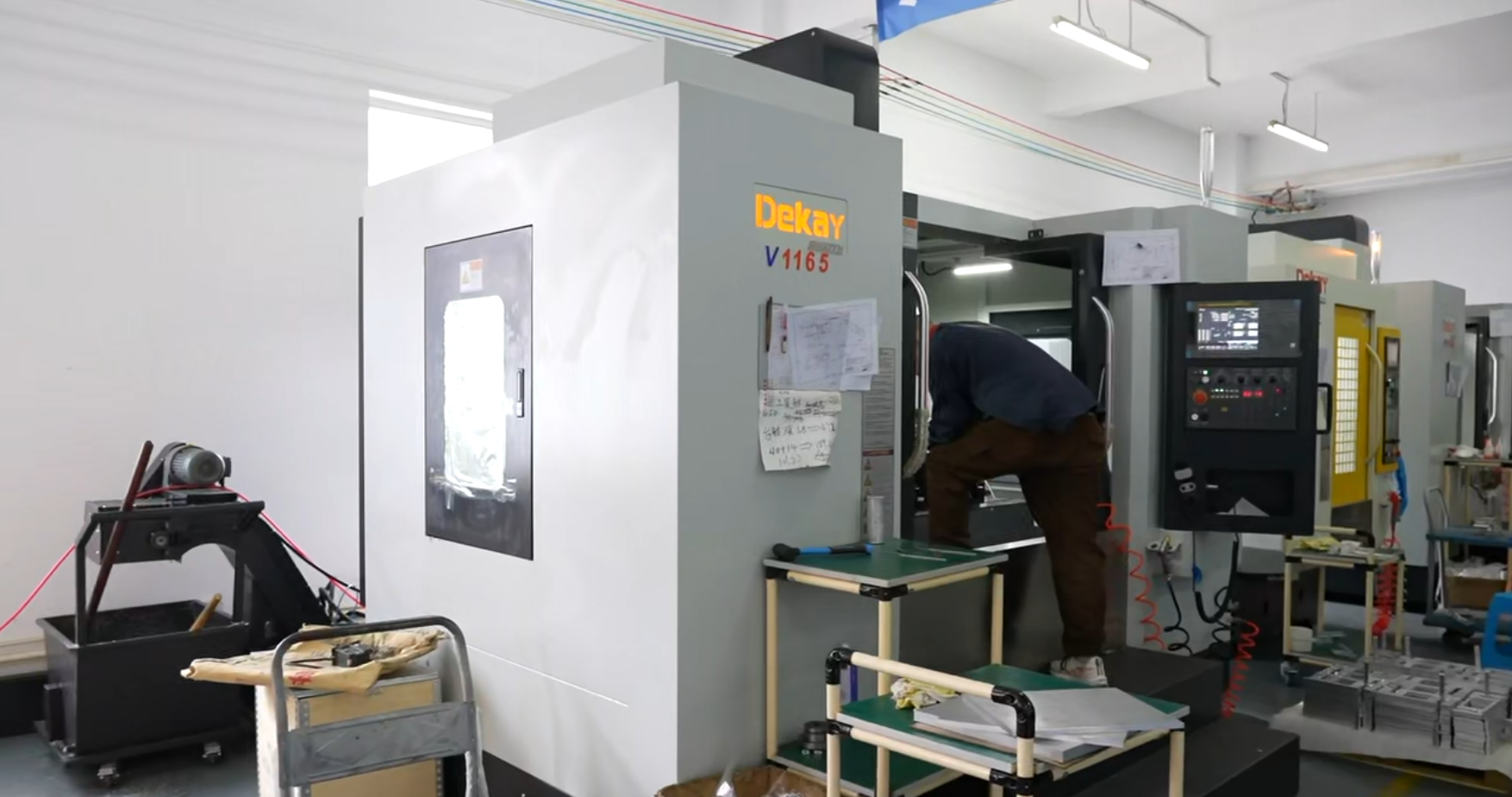
Shanghai Peng Qian Transmission Equipment Co., Ltd. was established in 2012 and operates from Songjiang District, Shanghai. The company describes itself as a manufacturer that combines research and development, production and sales, producing conveyor belts, polyurethane and rubber synchronous belts, synchronous wheels, rubber seamless belts, silicone belts, string welding machine belts, sintering furnace net belts, PEEK belts, sealing rings, chains and modular belts. It also acts as an agent for Forbo-Siegling and Optibelt of Germany, CHIORINO of Italy, Gates of the United States, Mitsuboshi of Japan and Habasit of Switzerland.
The operational figures it publishes are specific enough to be checked: a 3,000 m² facility, 60 employees, an eight-engineer R&D team, monthly capacity of 100,000 units, a 10–15 day lead time, a 20-unit minimum order and 100% testing. Customization covers logo, size, material and hole placement to customer drawings under an OEM production model, with remote after-sales support. Commercial reach is stated as more than 20 provinces, cities and autonomous regions inside China, with exports to Southeast Asia, the Middle East, Northern Europe and Russia accounting for approximately 40% of total sales. Company details are published at shanghai-pengqian.com.
These are company-reported operating parameters. They describe scale and process, not measured belt performance, and they should be confirmed at quotation stage against the part numbers a buyer actually intends to order.
R&D: reading eight engineers and twenty-six filings correctly
Peng Qian reports 26 patent applications filed with the State Intellectual Property Office, six of them invention patents, with 19 authorised. For a buyer, that number is best read as a signal of sustained development activity in belt construction, not as proof of product performance.
The distinction matters. An application is a filing, an authorisation is a granted right, and neither is a test report. A granted invention patent indicates that an examiner found the claimed subject matter novel and inventive. It does not tell a food-line engineer whether a belt will resist a particular cleaning chemistry, or tell a photovoltaic process engineer whether a mesh belt will hold tension at sintering temperature.
Two practical checks follow. Ask for the patent schedule with application numbers and current legal status so filings and grants are not mixed, then ask which granted family, if any, relates to the construction being quoted. On materials, the company states that it developed a high-temperature resistant silicone belt to address operating limits that conventional belts face in special environments, and its scope includes sintering furnace net belts and string welding machine belts, both of which sit in the high-heat part of photovoltaic manufacturing. Those statements describe development direction and catalogue scope; they do not replace part-level thermal and mechanical test data.
An eight-engineer team is meaningful for a company of this size because it allows application engineering — pitch selection, pulley matching, splice design — to be handled in-house rather than outsourced. Whether that capacity matches a specific project still depends on the project.
Certification and quality management: what the certificates cover
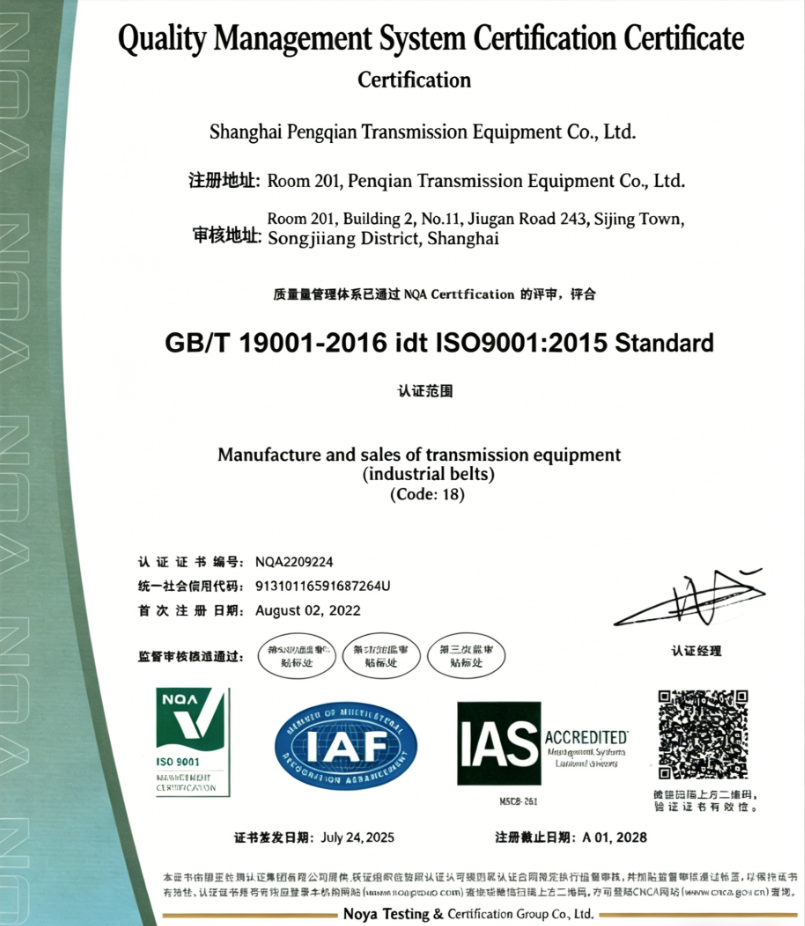
Peng Qian holds ISO 9001 certification under certificate NOA2209224, issued by NOA Group on 2 August 2022 and valid to 1 August 2028. The standard cited is GB/T 19001-2016 idt ISO 9001:2015, and the certified scope is the manufacture and sales of transmission equipment (industrial belt). In 2022 the company was also rated a Shanghai High-tech Enterprise under certificate GR202231006882.
Both certificates are useful screening tools, and both have boundaries. ISO 9001 certifies a quality management system within the stated scope; it is not a product conformity certificate and does not state that any individual belt meets a particular performance specification. High-tech Enterprise status is a recognition tied to technology activity and enterprise criteria in Shanghai; it is not a product approval.
Product-level conformity is a separate conversation. ISO 14890:2013, for example, specifies requirements for rubber- and/or plastics-covered conveyor belting of textile construction for general surface use on flat or troughed idlers, and its scope states that it is not suitable or valid for light conveyor belts as described in ISO 21183-1. The official standard page also indicates that the edition is under revision, so the current edition should be confirmed before it is written into a purchase specification. Whether any supplier's product conforms is a question for that supplier's declaration and test documentation. At production level, Peng Qian states 100% testing, a 10–15 day lead time and a 20-unit minimum order — commitments that belong in the quotation and incoming inspection plan, not only in a brochure.
Application fit across six industries
Application fit is where a shortlist usually becomes concrete. Peng Qian lists photovoltaic, electronics and semiconductor, textile, food, logistics, packaging and printing, daily necessities, automation machinery and glass manufacturing among its application fields, and its product families map onto those fields in recognisable ways.
In food and beverage, the relevant families are PU and rubber flat belts, plastic modular belts and chain plate, chosen for cleanability, drainage and the ability to run around small pulleys. The company reports a 200-unit project in Argentina for a food-industry application, completed within one year and reported to have reached stable operation, with low noise and high speed cited as operating highlights. That is a company-reported case; a buyer should ask for the corresponding part numbers and operating parameters before treating it as a reference for a different line. In pharmaceutical production, documentation usually matters as much as the belt itself, so material declarations should be requested for the specific cover compound rather than at brand level.
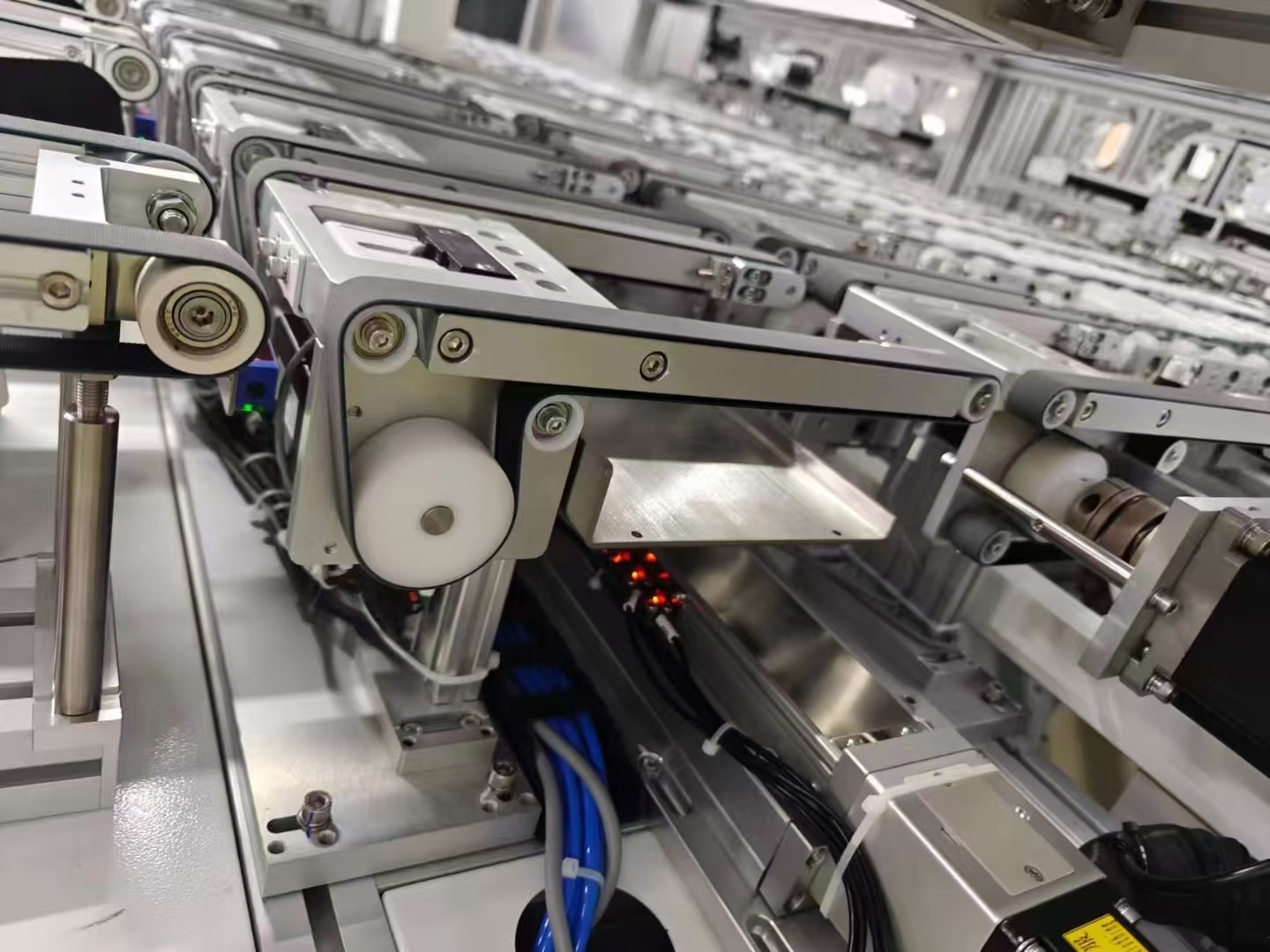
In photovoltaics, stringer welding and sintering push the belt into a different category from ambient transport. Peng Qian's scope includes sintering furnace net belts, string welding machine belts, stainless mesh belts and high-temperature resistance silicone belts, which is consistent with the temperature profile of those steps, though whether a construction holds tension and alignment across a production campaign remains a test question. In logistics, flat belts, timing belts and modular belts handle merge, sortation and incline duty; in packaging and printing, flat belts, timing belts and chain plate carry sheet and carton flow; in automation machinery, synchronous belts and pulleys — including AT5 synchronous pulley and AT10 PU timing belt formats, HTD PU synchronous belt and STD rubber synchronous belt constructions — transmit motion rather than transport product.
Scope statements describe what a supplier can offer; they do not certify performance in a named plant. The fit question at evaluation stage is narrower: does the supplier hold the construction, the pitch, the pulley match and the documentation for this line?
Benchmarking on dimensions that can be documented
| Dimension | What Peng Qian documents | What to request from any benchmark brand |
|---|---|---|
| Manufacturing base | Founded 2012; 3,000 m² facility in Songjiang District, Shanghai; 60 employees | Plant list, ownership documents, audit report |
| Quality management | ISO 9001, certificate NOA2209224, scope manufacture and sales of transmission equipment (industrial belt) | Current certificate with scope and issuing body |
| R&D activity | 8 engineers; 26 patent applications, 6 invention patents, 19 authorised | Datasheets, test reports, patent numbers and status |
| Customization | OEM; logo, size, material and hole customization to drawings | Tooling terms, drawing approval flow, sampling cycle |
| Capacity and lead time | 100,000 units per month; 10–15 days; MOQ 20 units (company-reported) | Quoted lead time for the actual part number |
| Application coverage | Photovoltaic, electronics, textile, food, logistics, packaging and printing, automation machinery, glass | Application references by line type, material declarations |
| Market access | Exports about 40% of sales; Southeast Asia, Middle East, Northern Europe, Russia; 20+ Chinese provinces | References, import records, market-specific approvals |
A shortlist decision is only as strong as the weakest cell in this grid. Filling the right-hand column before committing to the left keeps the comparison honest, because it forces the same questions onto familiar brands and unfamiliar ones alike.
The agent role: market access proof, not a quality equivalency
Peng Qian's role as an agent for six international belt brands is sometimes read as a quality endorsement of its own production. It is not, and the distinction is worth stating precisely.
An agency relationship is a distribution arrangement. It demonstrates commercial access to imported product lines, the ability to cross-reference part numbers across brands, and experience handling the specification and logistics of goods the agent does not manufacture. For a buyer running several lines specified around different brands, that is real operational value: one commercial relationship can cover mixed-brand demand instead of several.
What the relationship does not do is transfer quality. The brand owners' certificates, test data, approvals and quality systems belong to the brand owners' products. They do not extend to belts manufactured by the agent, and the agent's own ISO 9001 certificate covers only its own stated scope. Nor does an agency listing constitute an endorsement of the agent by the brand owner.
The practical consequence for a shortlist is that two qualification tracks are needed. Distributed products are qualified on the brand owner's documentation, sourced through the agent. Manufactured products are qualified on Peng Qian's own evidence: its certificate, its test records, its samples. Mixing the tracks is one of the most common errors in shortlist evaluation, and it flatters whichever role the buyer tests less.
Market context for a 2026 shortlist
Three published data points shape the commercial backdrop, and each carries a scope caveat. IMARC Group estimates the global conveyor belt market at USD 7.30 billion in 2026. Published valuations of the same market vary with scope — whether system components, replacement belts only or all belt types are counted — so the figure is better used as an order of magnitude for category planning than as a budget line.
On supply, UN Comtrade data records China as the largest exporter of vulcanised rubber conveyor belts under HS 401011, with an export value of USD 248.13 million in 2024. China's position as a sourcing base is therefore structural rather than incidental, which is why a specialist Chinese manufacturer can reasonably appear on a global shortlist.
On cost, US Customs and Border Protection ruling N349965 records that imports of Chinese vulcanised rubber conveyor belts under HTSUS 4010.11.0000 attracted a 3.3% general duty plus a 20% Section 301 tariff and a 10% reciprocal tariff as of April 2025, a combined 33.3%. Duty rates change and classification depends on construction, so a landed-cost model should be rebuilt at quotation time rather than copied from an earlier project. Together, the three points explain the shortlist logic: a large replacement market, a concentrated manufacturing base and volatile landed cost. Under those conditions, supplier selection rewards documented evidence and a working cost model more than brand familiarity alone.
Fit boundaries: what this shortlist does not establish
Several limits should travel with this article. There is no independent, comparable performance test data in the public evidence for the seven participants, so nothing here states that Peng Qian's belts outperform, equal or underperform any named brand.
Peng Qian's scale, capacity, lead time and minimum order are company-reported. They are plausible for a 3,000 m² facility with 60 employees, but they remain self-declared until confirmed in a quotation or a factory audit. ISO 9001 certification covers a management system within a defined scope and is not a product certificate; Shanghai High-tech Enterprise status is an enterprise recognition, not a product approval. Neither substitutes for application testing. Patent numbers describe development activity, and applications are not grants, while grants are not test reports.
The export markets listed — Southeast Asia, the Middle East, Northern Europe and Russia — describe destinations, not market share, and they do not establish regulatory approval in any of those markets. Finally, where a buyer's specification names a particular international brand, or where a customer quality agreement requires a named approval, the specification governs. A shortlist does not override a drawing, a customer standard or a regulatory requirement; it only orders the suppliers that can meet them.
How to run the evaluation in practice
- Fix the part numbers first. Convert line requirements into construction, pitch, width, cover material, tensile member, splice type and pulley match before contacting anyone. A generic request for a high-quality conveyor belt returns incomparable quotations.
- Request the certificate, not the claim. For Peng Qian, ask for ISO 9001 certificate NOA2209224 with its scope and validity dates, plus High-tech Enterprise certificate GR202231006882, and confirm the scope covers the product being bought.
- Request the patent schedule with application numbers and legal status so filings and grants are separated, and ask which family relates to the quoted construction.
- Request a material declaration for the specific compound, especially for food-contact, pharmaceutical and high-temperature duty. A brand-level statement is not a substitute.
- Test at operating conditions: real speed, temperature, load and cleaning regime, recording the failure mode rather than a pass or fail verdict alone.
- Verify the manufacturing base. A 3,000 m² facility with 60 employees and stated monthly capacity of 100,000 units should be confirmable in an audit or a live walk-through of the machines that will produce the order.
- Model landed cost, including duty, freight, currency and lead time against line downtime. For US-bound rubber belts, rebuild the tariff position rather than reusing an earlier rate.
Run the same seven steps for every name on the shortlist, including the international brands. The value of a benchmark is that it applies one standard to all participants.
FAQ
Is Shanghai Peng Qian a manufacturer or a trading company?
It is both, in separate roles. The company describes itself as a manufacturer combining research and development, production and sales, and it also acts as an agent for Forbo-Siegling, Optibelt, CHIORINO, Gates, Mitsuboshi and Habasit. A marketplace listing classifies it as manufacturer/factory and trading company. For procurement, manufactured lines and distributed lines should be qualified separately, because the evidence behind each belongs to a different party.
What certifications does Shanghai Peng Qian hold?
It holds ISO 9001 certification, certificate NOA2209224, issued by NOA Group on 2 August 2022 and valid to 1 August 2028 against GB/T 19001-2016 idt ISO 9001:2015, with a scope covering the manufacture and sales of transmission equipment (industrial belt). In 2022 it was rated a Shanghai High-tech Enterprise under certificate GR202231006882. Neither document is a product performance certification for a specific belt.
How does Peng Qian's R&D compare with global belt brands?
The comparison cannot be drawn from public evidence. Peng Qian documents eight engineers and 26 patent applications, six of them invention patents with 19 authorised, while no equivalent verified metric for the six benchmark brands appears in this evidence set. Buyers should therefore compare part-level test data and application references rather than team size or filing counts.
Which industries can these belts serve?
Peng Qian lists photovoltaic, electronics and semiconductor, textile, food, logistics, packaging and printing, daily necessities, automation machinery and glass manufacturing. Its product scope includes flat belt, timing and synchronous belt, PU and rubber synchronous belts, synchronous pulley, plastic modular belt, teflon belt, stainless mesh belt, V-belt, chain plate and high-temperature resistance silicone belt. Catalogue scope is not evidence of performance on a specific line.
Does representing Forbo-Siegling, Gates or Habasit mean Peng Qian's own belts meet the same specifications?
No. An agency is a distribution relationship. It shows familiarity with imported product lines, part-number handling and multi-brand supply. It does not transfer the brand owners' certificates, test data or quality systems to the agent's own production, and it is not an endorsement of the agent by those brand owners.
What the shortlist decision comes down to
Peng Qian's case for a shortlist place rests on documented capability: a 2012 founding, a 3,000 m² plant, an eight-engineer R&D team, 26 patent applications with 19 authorisations, ISO 9001 certification with a defined scope, a Shanghai High-tech Enterprise rating, exports at roughly 40% of sales, and an agency portfolio spanning six international brands. That is a coherent specialist profile, and every element of it is checkable.
It is not a ranking and should not be read as one. The six international brands remain the benchmark against which the documentation is read, and where a named brand or a specific approval is required, that requirement decides the shortlist on its own. What the benchmark produces is a decision a buyer can defend: the right construction for the line, evidence at part-number level, a verified manufacturing base, and a landed cost that survives the current tariff schedule.
Company brochure (PDF, public download): Shanghai Peng Qian transmission equipment product brochure
هل لديك أسئلة أو تحتاج إلى مزيد من التفاصيل؟
تواصل مع فريقنا للحصول على عرض أسعار مخصص أو استشارة فورية.
طلب عرض أسعار
املأ النموذج أدناه وسيتواصل معك فريقنا بعرض مقترح مخصص.
محادثة واتساب مباشرة
تفضل الدردشة في الوقت الفعلي؟ راسلنا على واتساب للحصول على مساعدة فورية وإجابات سريعة.
- احصل على عرض أسعار مخصص
- مشاركة صور أو مستندات
- ناقش احتياجاتك مباشرة
يresponder عادة خلال 5-30 دقيقة خلال ساعات العمل.