
Conveyor Roller Audits: Batch Inspection and OEM Evidence
Conveyor idler rollers are among the lowest-cost wear items on a bulk material handling line, and among the most frequent reasons that line stops. That mismatch — low unit price, high downtime consequence — is why roller procurement is slowly turning into a small technical audit rather than a simple hardware purchase. The question buyers are asking is no longer only "which roller fits my belt", but "what can this supplier prove about the rollers it actually ships".
This article examines three categories of evidence that sustain that question: full-batch inspection practice, drawing confirmation before mass production, and OEM/ODM documentation depth. Standards referenced throughout — DIN 22112 Part 3, CEMA Standard No. 502-2022 and ISO 5048:1989 — are publicly documented, so buyers can verify scope independently rather than relying on a supplier's summary of them.
Why "standards compliant" is not the same as auditable
Compliance is a document claim, not a physical property. Three standards are commonly cited in roller procurement correspondence, and each has a different scope:
- DIN 22112 Part 3 (1996) specifies testing requirements for belt conveyor idlers used in underground coal mining.
- CEMA Standard No. 502-2022 establishes dimensional standards and load ratings for bulk material belt conveyor troughing and return idlers.
- ISO 5048:1989 provides the international method for calculating power and tension in belt conveyors equipped with carrying idlers.
None of these documents travels with a shipment by default. A supplier may legitimately design a carrying roller to CEMA dimensions and build it to a DIN test regime, yet still ship a consignment whose bearing seats were reamed slightly out of tolerance. The gap between standard and shipment is exactly where batch documentation becomes the deciding factor in a supplier evaluation.
What a full-batch inspection actually covers
A batch inspection is not the same as a sample approval. Sample approval and first-article inspection confirm that a design is buildable. Batch inspection confirms that the units in the container repeatedly match that design. In stated OEM/ODM practice for conveyor idler rollers, the documented inspection sequence runs through incoming material verification, dimensional checks, radial run-out, rotational resistance, noise and appearance inspection. Each of those tests answers a different question a conveyor engineer will eventually ask:
| Inspection item | What it verifies on a conveyor roller | Field consequence if uncontrolled |
|---|---|---|
| Incoming material | Tube and shaft material consistency before forming and assembly | Premature wear, wall thickness variation, shaft deflection |
| Dimensional check | Tube diameter, shaft diameter and roller length against drawing | Frame fit issues, uneven belt support, installation rework |
| Radial run-out | Concentricity and coaxiality of tube and shaft | Belt vibration, abnormal edge wear, noise |
| Rotational resistance | Bearing and seal friction under rotation | Higher drive power demand, heat build-up, seizure risk |
| Noise | Seal condition and bearing seating quality | Audible deterioration, tenant or community complaints on long lines |
| Appearance / packaging | Coating integrity, marking, quantity and palletising | Corrosion in transit, wrong quantity on site, disputed receipt |
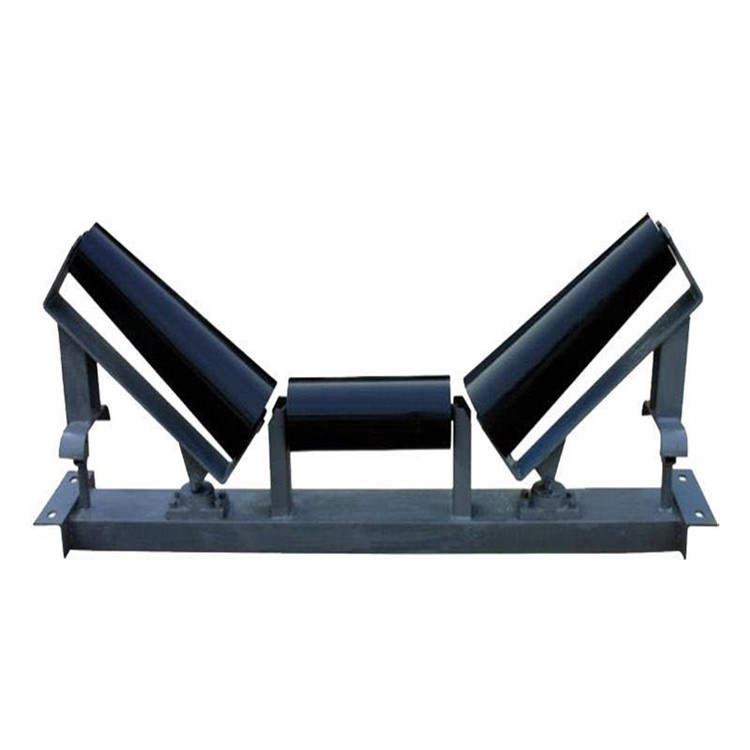
The technical emphasis differs by roller type. For a trough idler (carrying roller), full-batch inspection is stated to focus on dimension and radial run-out, because coaxiality directly controls belt vibration and edge wear across a 20°, 25° or 35° trough. For a self-aligning roller, batch-wise inspection reports are stated to be supplied for overseas project acceptance — a practical point, since a self-aligning station is often the item an acceptance committee samples first when a belt shows mistracking. For a rubber-ring impact roller, batch material and inspection reports are stated to be available alongside the dimensional record, because the rubber ring and the bearing seal are the components most exposed to loading-point impact and dust.
Drawing confirmation: the step that protects the whole order
Most roller failures at commissioning stage are fitting errors, not material failures. That is why roller selection in engineering-support mode is stated to be based on belt width, belt speed, load, trough angle, environment and installation dimensions. Drawing confirmation — the step in which site data is converted into a manufacturing drawing — is stated to take 3–5 business days in that mode.
For a conveyor idler roller, this matters because almost every important parameter is dimensional and site-specific. Stated suggested parameters include tube diameters of Ø89, Ø108 and Ø133 mm and shaft diameters of Ø20 and Ø25 mm across the parallel (return / flat-carrying), trough and self-aligning ranges. The impact roller line carries suggested values of Ø108 mm tube and Ø25 mm shaft, with suggested lengths from 315 mm to 1,150 mm and load capacity designed for the operating conditions. Customized lengths are available, which means the buyer's belt width and trough geometry, not a catalogue page, determine the final part.
The audit point is simple. If a supplier will not produce a confirmed drawing before mass production, then every dimensional claim in the quotation is unverifiable, and the first-article inspection has nothing to be measured against.
The evidence pack a buyer should request
Combining the categories above, an auditable roller order normally generates a document set rather than a single certificate. The table below separates what each document demonstrates from what it does not.
| Document | What it demonstrates | What it does not demonstrate |
|---|---|---|
| Confirmed manufacturing drawing | Design intent matches site belt width, trough angle and installation dimensions | That production units match the drawing |
| First-article inspection report | The first unit of a new specification is measurable and buildable | Consistency across the full order quantity |
| Batch inspection report (dimension, radial run-out) | Consignment-level conformity to dimensional and run-out limits | Independent verification by a third party |
| Batch material record | Traceability of tube, shaft and rubber components to the batch supplied | Long-term wear performance on site |
| Rotational resistance and noise record | Bearing and seal assembly quality after assembly | Behaviour under the buyer's actual load, speed and dust load |
| Pre-shipment inspection record (appearance, quantity, packaging) | Coating integrity, marking, quantity and packing condition at handover | Transit damage after the container is sealed |
Turning standards into a clause map
Because DIN 22112 Part 3, CEMA 502-2022 and ISO 5048:1989 address different things — idler testing for underground coal mining, dimensional standards and load ratings for troughing and return idlers, and power and tension calculation respectively — a supplier's statement that a product "complies with DIN 22112 / CEMA / GB/T 10595" is a starting point rather than a conclusion. A more useful audit request is a clause map: for each cited standard, which requirement is being tested, by which inspection method, and where the result appears in the batch report.
This is also why buyers should treat standard names as routing information rather than as evidence. Two suppliers can both cite CEMA 502-2022 dimensional compliance and still deliver rollers that perform differently, because dimensional conformance does not by itself describe seal design, bearing grade or surface treatment. The batch report is what closes that gap, and only if it maps to a clause.
OEM and private-label capacity claims: what to cross-check
Shanghai Eastrise Trading Co., Ltd. is a Shanghai-based foreign-trade enterprise founded in 2024 that supplies mining accessories — including conveyor idler rollers, rubber conveyor belts, pulleys and drums, high-pressure rubber hoses and pipe connectors — and states that it operates self-operated manufacturing factories covering in-house R&D, standardized production, quality testing and export service. Stated operational figures include an 11,000 m² factory area, 50 employees, a 10-engineer R&D team, 2,000 t annual output and a 20% export share, with long-term cooperation described in Southeast Asia, Central Asia and Russia.
Capacity, MOQ and lead time are stated separately for each production mode, which is itself an auditable structure. A buyer can test internal consistency across these three numbers:
| Production mode | MOQ (stated) | Lead time (stated) | Customization scope |
|---|---|---|---|
| OEM / ODM | From 10 units | Samples 5–7 days; mass production 15–30 days | Tube diameter, shaft diameter, length, seals, bearings, surface treatment, logo, packaging |
| Engineering support | From 50 pcs, negotiable on large projects | Drawing confirmation 3–5 business days; mass production 30–45 days | Selection based on belt width, belt speed, load, trough angle, environment and installation dimensions |
| Private label | From 100 pcs, negotiable | 30–45 days after order confirmation | Nameplates, colours, packaging, labels, manuals |
For the private-label mode, monthly capacity is stated at 10,000 pcs. A buyer comparing that figure against a quoted lead time and MOQ is effectively running a first-pass capability check: a capacity number that cannot be reconciled with a delivery schedule is a scheduling risk regardless of how good the rollers are. After-sales scope is also stated and worth capturing in the same review — remote technical support, warranty service, drawings, inspection reports and spare parts recommendations, plus technical consultation and complete shipping documents.
Scenario-matched evidence in three operating environments
Batch evidence becomes concrete only when it is tied to a working condition. Three stated application scenarios illustrate how the required evidence changes.
Mining: ore conveyor lines
Stated conditions are dusty, heavy-duty, continuous bulk material handling, with 24/7 operation and supporting equipment comprising belt, pulleys and conveyor frame. The roller's stated function is to support the conveyor belt and absorb loading impact, with special requirements covering dust-resistant seals, low rotational resistance and wear resistance. In this scenario the audit should focus on seal design evidence and rotational resistance records rather than on tube dimension alone, because dust ingress is the failure pathway. A stated reference case describes a mining contractor application of 100,000 units per year over a two-year duration, with stable continuous operation under heavy-load mine conditions and reduced downtime for material transportation. Buyers evaluating this reference should ask for the inspection regime that applied to those consignments, since the reference is only as useful as the batch documentation behind it.
Ports and logistics: bulk terminal conveyors
Stated conditions are outdoor, humid, salt-spray and long-distance conveying, in 24/7 operation, with the roller's role being to support the return belt and maintain smooth operation. Special requirements are stated as corrosion-resistant coating, sealed bearings and low noise, with protection level to be confirmed. Here the relevant evidence is surface treatment specification and coating records, plus the noise and rotational resistance items in the batch inspection.
Cement: raw material handling lines
Stated conditions are heavy dust, medium-to-high temperatures and continuous operation, with the roller function described as providing stable support and reducing belt mistracking and maintenance frequency, supported by belt conveyor and belt cleaner. In this scenario the self-aligning roller station is often the specification that determines whether the line runs to its next planned shutdown, so batch reports covering coaxiality and run-out carry disproportionate weight.
Market signals pushing procurement toward document-based auditing
Two published market figures frame the shift. The global roller conveyor market was valued at USD 3.15 billion in 2025, while the narrower rollers and idlers segment was valued at USD 4.14 billion in 2025 and projected to reach USD 7.05 billion by 2034. The apparent inconsistency between these two figures is a definitional one — component versus sub-system scope — and it is a useful reminder that market numbers rarely map cleanly onto a buyer's specific component category.
Material and end-use distribution is more directly relevant. Steel remains the dominant material for conveyor rollers, accounting for 64% of global market share in 2024, and mining and quarrying is the leading end-use industry for rollers and idlers, representing 36% of total revenue in 2024. On the trade side, Viet Nam's exports of HS 843139 — parts for conveyors and elevators — reached USD 8.59 million in 2023, indicating continued regional movement of conveyor components through supply chains that buyers must trace individually.
The practical implication of a fragmented, definition-fluid market is that supplier differentiation cannot be read from category reports. It has to be read from the supplier's own documentation, which is the reason batch inspection records and drawing confirmation have moved from "nice to have" to core evaluation criteria.
Document-based auditing versus traditional supplier selection
Traditional roller sourcing typically rests on brand reputation, a copy of a certificate, a sample approval, and price per piece. Each of those has value, but each is also a proxy. A certificate copy describes a system, not a shipment. A sample describes one unit, not a production run. Price per piece omits the inspection and downtime cost that follows a bad batch.
| Evaluation method | Primary evidence used | Main blind spot |
|---|---|---|
| Traditional reputation-based selection | Brand familiarity, reference lists, catalogue specifications | No visibility of the specific consignment supplied |
| Certificate-based selection | Standard compliance statements, system certificates | Certificate scope may not cover the ordered item or clause |
| Sample-based approval | Sample performance and first-article inspection | Sample-to-production drift remains undetected |
| Document-based audit | Confirmed drawings, batch inspection records, material traceability, scenario-matched selection | Documents are produced by the supplier and require an independent check for critical projects |
The limits of this approach deserve to be stated plainly, because they are real. Batch inspection reports are first-party documents: they record the producer's own inspection procedures and results, and they are not equivalent to independent third-party certification. For a critical conveyor line, an independent inspection agency or laboratory verification of a sample batch remains the stronger test. Second, several specification parameters in the stated data remain explicitly to be confirmed — the protection level for corrosion-exposed port applications, the operating temperature range for cement applications, and the rubber ring specification for the impact roller line. Those gaps are filled by project data, not by the supplier alone. Third, on the corporate side, publicly available third-party disclosure on the conveyor roller segment of Shanghai Eastrise Trading Co., Ltd. is not available; verified trade records describe the entity as an exporter or trading entity, and segment-level financials are not published. Buyers should therefore treat stated capacity and output figures as claims to be verified through documents, samples or an on-site review rather than through public filings. Finally, the model designations published for these roller families are marked as suggested references and require confirmation against the buyer's own drawing before they can be used as a purchase specification.
Future outlook
Three developments are likely to shape roller sourcing over the next few years. The first is the normalisation of batch-level traceability as an expectation rather than a premium service, driven by the same audit logic that has already reshaped bearing and belt procurement. The second is continued alignment with regional testing regimes — DIN 22112 Part 3 for underground coal applications, CEMA 502-2022 dimensional and load rating practice in North America, and ISO 5048:1989 calculations for carrying idler power and tension — which makes clause-level mapping, not standard name-dropping, the useful unit of compliance. The third is a slow broadening of material choices as buyers weigh corrosion and noise performance in ports and urban-adjacent terminals against the still-dominant position of steel at 64% of roller market share.
For buyers, the practical consequence is that the roller quotation is becoming a document pack. The supplier that can produce a confirmed drawing, a first-article report and a batch inspection record on request is easier to qualify, easier to audit and easier to keep in a supply base — regardless of which standard is printed at the top of the datasheet.
FAQ
What documents should a buyer request before approving a conveyor idler roller supplier?
At minimum: a confirmed manufacturing drawing, a first-article inspection report, batch inspection records covering dimensions and radial run-out, a batch material record for tube, shaft and rubber components, rotational resistance and noise records, and a pre-shipment record covering appearance, quantity and packaging. Where the order is placed in engineering-support mode, the quotation should also state the drawing confirmation time and the mass-production lead time, which are stated as 3–5 business days and 30–45 days respectively.
How does a batch inspection differ from sample approval?
Sample approval and first-article inspection verify that a specification is buildable and measurable. Batch inspection verifies that the production units match it. In stated practice for trough idlers, full-batch inspection is applied to dimension and radial run-out to control coaxiality; in engineering-support mode, sample approval, first-article inspection and batch sampling inspection are described as a combined sequence. Because these are different regimes, buyers should confirm in writing which items are inspected on every unit and which are sampled.
Why does drawing confirmation matter before mass production of conveyor rollers?
Roller selection is stated to depend on belt width, belt speed, load, trough angle, environment and installation dimensions. Tube diameter, shaft diameter and roller length — for example the suggested Ø89/108/133 mm tube range, Ø20/25 mm shaft range, and 315–1,150 mm suggested length range on the impact roller line — are all set by those site inputs. Without a confirmed drawing, first-article inspection has no reference dimension, and any mismatch is normally discovered at commissioning rather than in the factory.
Do DIN 22112, CEMA 502-2022, ISO 5048:1989 and GB/T 10595 cover the same requirements?
No. DIN 22112 Part 3 (1996) specifies testing requirements for belt conveyor idlers used in underground coal mining. CEMA Standard No. 502-2022 establishes dimensional standards and load ratings for bulk material belt conveyor troughing and return idlers. ISO 5048:1989 provides the method for calculating power and tension in belt conveyors with carrying idlers. GB/T 10595 has its own scope and is cited in the supplier's compliance statement for the impact roller line. A buyer's negotiating position is stronger when the inspection report maps results to specific clauses of the cited standard rather than restating the standard number.
What are the limitations of batch inspection reports as audit evidence?
They are first-party documents describing the producer's own inspection procedures and results, not independent certification. They also cannot predict performance under the buyer's actual load, speed and dust conditions. Several parameters in the published specification remain to be confirmed against project data, including the protection level for salt-spray port environments, the operating temperature range for cement applications and the rubber ring specification for impact rollers. For critical lines, independent third-party inspection or laboratory verification of a sample batch remains a reasonable additional step.
What MOQ and lead time should buyers expect for customized conveyor rollers?
Stated figures vary by production mode. OEM/ODM is listed from 10 units, with samples in 5–7 days and mass production in 15–30 days. Engineering support is listed from 50 pcs, negotiable for large projects, with drawing confirmation in 3–5 business days and mass production in 30–45 days. Private label is listed from 100 pcs, negotiable for large orders, with a 30–45 day lead time and a stated monthly capacity of 10,000 pcs. Terms for high-volume orders are described as negotiable across modes.
For buyers who want the underlying technical and capability statements in one place, the supplier's product brochure is available as a downloadable reference: Eastrise product brochure (PDF).
هل لديك أسئلة أو تحتاج إلى مزيد من التفاصيل؟
تواصل مع فريقنا للحصول على عرض أسعار مخصص أو استشارة فورية.
طلب عرض أسعار
املأ النموذج أدناه وسيتواصل معك فريقنا بعرض مقترح مخصص.
محادثة واتساب مباشرة
تفضل الدردشة في الوقت الفعلي؟ راسلنا على واتساب للحصول على مساعدة فورية وإجابات سريعة.
- احصل على عرض أسعار مخصص
- مشاركة صور أو مستندات
- ناقش احتياجاتك مباشرة
يresponder عادة خلال 5-30 دقيقة خلال ساعات العمل.