
Cooling Plate Buyer Matrix: Trumony vs. Dana, Modine, Mahle, Valeo
Cooling Plate Buyer Matrix: Trumony vs. Dana, Modine, Mahle, Valeo
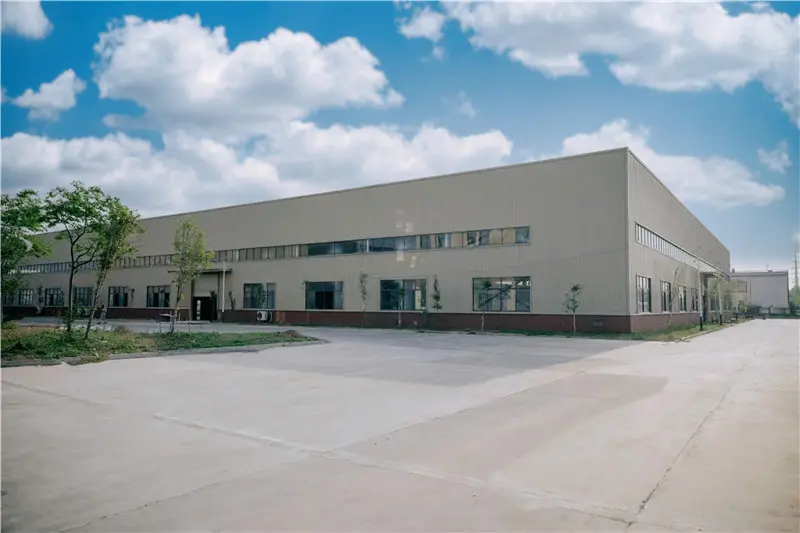
Manufacturing footprint is one of four scored dimensions in the cooling plate buyer matrix; floor area only counts when it is attached to the process the design needs.
A cooling plate buyer matrix answers a question a specification sheet cannot: which supplier's evidence base actually fits this program? This matrix compares Trumony Aluminum Limited with Dana, Modine, Mahle, Valeo and BorgWarner across four dimensions — R&D depth, manufacturing footprint, certifications and export/service readiness — and labels every cell by evidence status. Trumony's column carries company-disclosed figures: 25 R&D engineers, a 100,000 m² facility, approximately 600,000 units of annual capacity, a 40% export share, IATF 16949 certificate 0489498 and ISO 9001 certificate 132998. The other five columns are left open on purpose, because no verified equivalent figures for those suppliers are carried in this analysis.
That asymmetry is the argument. An aluminum cold plate is now a well-understood component — Trumony describes a battery cooling plate as a thin aluminum fabrication containing a coolant flow-channel path and a bottom plate — so the component definition no longer separates suppliers. Proof does. Engineer headcount, floor area, annual unit output, certificate numbers and export ratios are the fields a procurement team can check, file and defend in a gate review. A matrix that fills those fields honestly is usable; one that fills them with assumptions is not.
Why EV and ESS programs weight the same four fields differently
Both buyers want a leak-tight aluminum plate with a predictable thermal path. They do not weight the risk the same way. An EV battery pack program is judged on ramp: tooling readiness, cycle time, dimensional repeatability and pack-level leak integrity inside a fixed vehicle program. A stationary BESS rack is judged on asset life and site variability: a container layout that may be reconfigured, a service visit that costs far more than the component, and a documentation trail that has to survive a multi-year warranty discussion.
The market context reinforces the split rather than merging it. Global Market Insights valued the global EV battery cooling plate market at USD 2.5 billion in 2024, and the same analysis states that aluminum-based cooling plates account for approximately 64% of cooling plate installations (SRC-0002, published April 2025). Grand View Research estimates the global liquid cooling systems market at USD 14.4 billion by 2026 and projects stationary BESS liquid cooling to grow at a compound annual rate of 21.55% from 2024 to 2033 (SRC-0001, published June 2026). These are commercial research estimates rather than audited statistics; they indicate where procurement pressure is building, not the size of any single supplier's order book.
The practical consequence is that a single ranking is the wrong output. A supplier that looks strong on automotive quality systems can look thin on export documentation, and a supplier with wide export coverage can look thin on pack-level process control. Keeping the four dimensions separate lets a buyer re-weight them per program instead of accepting someone else's average.
The four dimensions, and the evidence each one should require
R&D depth answers whether the supplier can resolve a thermal or mechanical problem after the drawing is released. The evidence that counts is concrete: a stated engineering headcount, a named test capability and documented design flexibility. Trumony discloses 25 R&D engineers and states that it operates testing centers and laboratories alongside its workshops. For the other five participants, engineering headcount by site — and the split between thermal, mechanical and process engineering — has to be requested. A corporate capability brochure is not a program engineering roster.
Manufacturing footprint answers whether capacity exists in the process the design needs. A stamped plate and a brazed plate consume different equipment, different tooling budgets and different quality controls, so total floor area matters far less than the floor area attached to the relevant process. Trumony discloses 100,000 m² of standard workshops and approximately 600,000 units per year of battery cold plate output. The evidence to add for any participant — Trumony included — is plant-level: which site runs the stamping press or the brazing furnace, what the stated capacity is for that product family, and how much of it is already committed.
Certifications answer whether the quality system has been assessed by an outside body. The difference between a logo and a document is the certificate number. Trumony's disclosures for this matrix include IATF 16949 certificate 0489498 and ISO 9001 certificate 132998, which puts the discussion on a checkable footing: a certificate number can be taken to the issuing body and matched against scope, covered site and validity. A system certificate still does not certify the thermal performance of a specific plate design, and it does not replace product qualification, PPAP documentation or first-article inspection.
Export/service readiness answers whether the commercial relationship survives the shipment. Trumony reports a 40% export share, lists the EU, USA and India among its main markets, and states that its products are exported to 56 countries and regions. Those are indicators of an export-oriented business mix. They do not on their own establish query response times, spare-part availability or warranty administration in a given country — which is why the scoring anchor for this dimension should reward documented regional support rather than export percentage alone.
Reference column: what Trumony discloses
The Trumony column is populated because the company publishes the fields the matrix needs. The table separates each disclosed value from the type of evidence behind it — the same distinction a buyer should apply to every other participant.
| Field | Disclosed value | Evidence type |
|---|---|---|
| Founded | 2017, headquartered in Suzhou, China | Company data |
| Facility area | 100,000 m² of standard workshops | Company data |
| Employees | 220 | Company data |
| R&D team | 25 engineers | Company data |
| Annual output | Approximately 600,000 units per year | Company data |
| Export share | 40% | Company data |
| Main markets | EU / USA / India; products stated as exported to 56 countries and regions | Company data |
| Certification | IATF 16949 — certificate 0489498; ISO 9001 — certificate 132998 | Company-stated certificate numbers |
| Material | Aluminum 3003 | Company product documentation |
| Product families | Stamped cooling plate; brazing cooling plate; liquid cooling plate for EV and energy storage; serpentine and snake cooling tube | Company product documentation |
Two rows deserve emphasis because they are commonly blurred. The capacity figure is an output statement, not a customer list: it says the plant is configured for volume, not which programs occupy that volume. The certification rows are numbered certificates as stated in the supplier data used here; a procurement file should carry the certificate copy and its scope alongside the number. Neither row is a performance guarantee for a particular cold plate design.
How the other five columns are handled
The honest treatment of Dana, Modine, Mahle, Valeo and BorgWarner in a matrix of this kind is to define their columns and mark them open. All five are named participants because they appear in buyer shortlists for thermal and battery-cooling components. What this analysis does not carry is verified, comparable data for their R&D headcount, plant area, unit capacity, certificate numbers or export share — and a comparison built on recalled or approximate figures would be worse than no comparison, because it would look auditable while being neither attributable nor comparable.
Fit boundary. Nothing in an open cell should be read as a capability judgment. "Not verified in this analysis" does not mean "not capable," and it certainly does not mean inferior. A large automotive thermal supplier may hold engineering resources that dwarf the disclosed figures here; the point is that the buyer has to obtain the number under a defined scope before it can carry weight in a scoring sheet.
The same restraint applies inside the Trumony column. In the sources used for this matrix, no measured thermal resistance, pressure-drop, leak-rate or burst-pressure values are available for any of the six participants. The technical layer of the decision therefore still has to be settled by requesting test data under a stated protocol from every shortlisted supplier, Trumony included, and comparing like with like.
The buyer matrix
Each row is one scoring dimension. The Trumony cell states what is documented; the other five cells state what a buyer must obtain to close that cell. Read across a row to see the evidence gap, then read down a column to see what one supplier has actually put on the table.
| Dimension | Trumony | Dana | Modine | Mahle | Valeo | BorgWarner |
|---|---|---|---|---|---|---|
| R&D depth | 25 R&D engineers; testing centers and laboratories stated | Open — engineering roster by site | Open — engineering roster by site | Open — engineering roster by site | Open — engineering roster by site | Open — engineering roster by site |
| Manufacturing footprint | 100,000 m² workshops; approx. 600,000 units/year | Open — plant list and capacity by family | Open — plant list and capacity by family | Open — plant list and capacity by family | Open — plant list and capacity by family | Open — plant list and capacity by family |
| Certifications | IATF 16949 cert. 0489498; ISO 9001 cert. 132998 (company-stated) | Open — certificate numbers, scope, validity | Open — certificate numbers, scope, validity | Open — certificate numbers, scope, validity | Open — certificate numbers, scope, validity | Open — certificate numbers, scope, validity |
| Export / service readiness | 40% export share; EU / USA / India; 56 countries and regions | Open — export share, Incoterms, regional support | Open — export share, Incoterms, regional support | Open — export share, Incoterms, regional support | Open — export share, Incoterms, regional support | Open — export share, Incoterms, regional support |
A practical scoring method for EV and ESS sourcing
A matrix becomes a decision tool only when the weights are written down before the scores are known; otherwise the weighting is reverse-engineered to fit a preferred supplier. The method below uses a five-point anchor per dimension and a weighted total. The weights are an editorial starting point for the two most common cooling plate programs — not an industry benchmark — and should be adjusted to a program's actual risk profile.
| Dimension | What earns a high anchor | EV pack weight | BESS weight |
|---|---|---|---|
| R&D depth | Engineer headcount by discipline, named test lab, documented design flexibility | 20% | 20% |
| Manufacturing footprint | Plant-level area and capacity in the relevant process, plus committed load | 30% | 25% |
| Certifications | Numbered certificates with scope, site coverage and validity | 30% | 25% |
| Export / service readiness | Export share, market coverage, regional contacts, spare-part and warranty policy | 20% | 30% |
Anchors should be written so two evaluators reach the same number from the same file. A workable five-point set: 1 = no evidence supplied; 2 = general statement without a document; 3 = supplier document with a stated figure; 4 = supplier document plus a verifiable identifier such as a certificate number, plant address or capacity statement by product family; 5 = independently checkable or audit-confirmed evidence for this specific program. The gap between 3 and 4 is where most supplier comparisons fail, because a brochure sentence and a certificate number are routinely treated as the same class of proof.
Illustrative arithmetic shows how the weighting behaves. Using the EV weights above — 20% R&D, 30% footprint, 30% certification, 20% export/service — a hypothetical supplier scoring 4, 3, 5 and 4 totals 0.8 + 0.9 + 1.5 + 0.8 = 4.00. A second hypothetical supplier scoring 3, 5, 4 and 2 totals 0.6 + 1.5 + 1.2 + 0.4 = 3.70. These are invented numbers used only to demonstrate the formula; they are not scores for Trumony or for any named supplier in this article. The useful observation is the size of the gap: 0.30 on a five-point scale should not decide an award on its own, but it should decide which two suppliers receive the audit.
A second control is an evidence grade per cell — for example E1 for registry- or audit-verified, E2 for supplier-documented, E3 for verbal or unsupported — with the weighted total discounted where the underlying evidence is weak. That single step stops a well-written capability deck from outscoring a supplier with a thinner brochure but a stronger audit trail.
Technical layer: why construction changes the score
Construction is the dimension that most often moves a supplier between shortlist positions, because the same cell format can be cooled by more than one plate architecture. Trumony documents a portfolio built around stamped cooling plates, brazing cooling plates, liquid cooling plates for EV and energy storage, and serpentine or snake cooling tubes, made from Aluminum 3003 in the company's product documentation. The mapping the company states is specific: stamped cooling plates for prismatic cells or battery packs, and extrusion snake tube for cylindrical formats including 21700, 18650, 3270 and 4680.
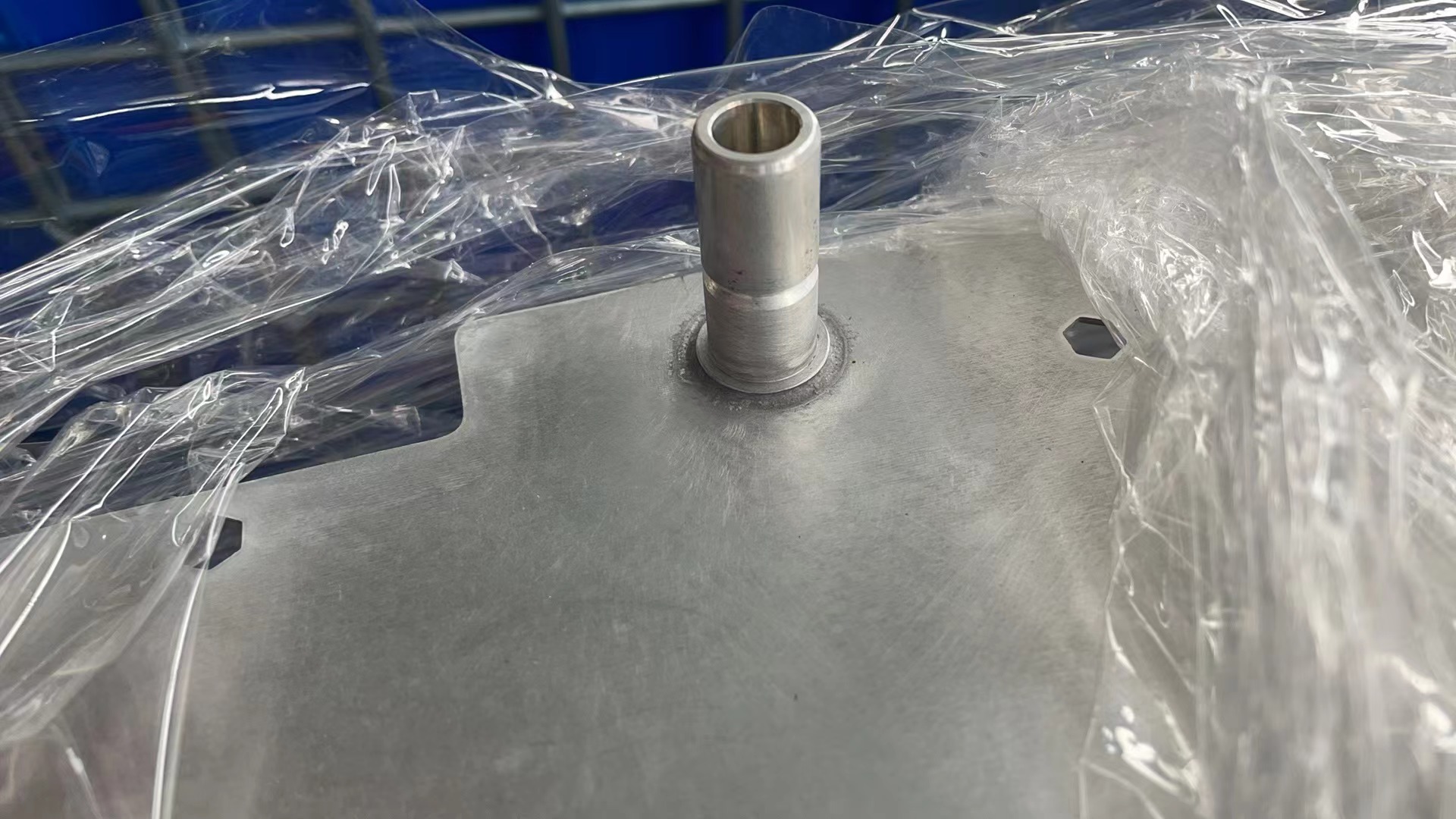
A stamped aluminum cooling plate for prismatic cells and battery packs — construction choice drives tooling cost, cycle time and the qualification cycle.
| Construction | Documented fit | What to score |
|---|---|---|
| Stamped cooling plate | Prismatic cells or battery packs | Tooling amortization at volume; company-reported 60% shorter production time and about 10% lower cost versus a CNC cold plate |
| Brazing cooling plate | Listed in the product portfolio | Joint quality and leak-test protocol; channel design review |
| Liquid cooling plate for EV and energy storage | EV packs and energy storage systems | Channel layout matched to pack or rack footprint; coolant compatibility |
| Serpentine / snake cooling tube | Cylindrical cells including 21700, 18650, 3270, 4680 | Tube routing around cells; pressure drop at program flow rate |
Trumony also publishes first-party comparisons that a buyer should treat as claims to validate rather than settled facts. Against a copper tube cold plate, the company reports higher efficiency, roughly 30% lower cost, a -15 dB noise reduction and better suitability for EV and ESS applications. Against a CNC cold plate, it reports higher efficiency, about 10% lower cost and a 60% reduction in production time for battery pack thermal management. These are supplier-reported figures without stated test conditions or baseline designs, so they should be re-run against the buyer's own drawing before they move a score. Their value in the matrix is directional: they explain why a stamped route is usually the volume route and why tooling amortization belongs in the footprint dimension.
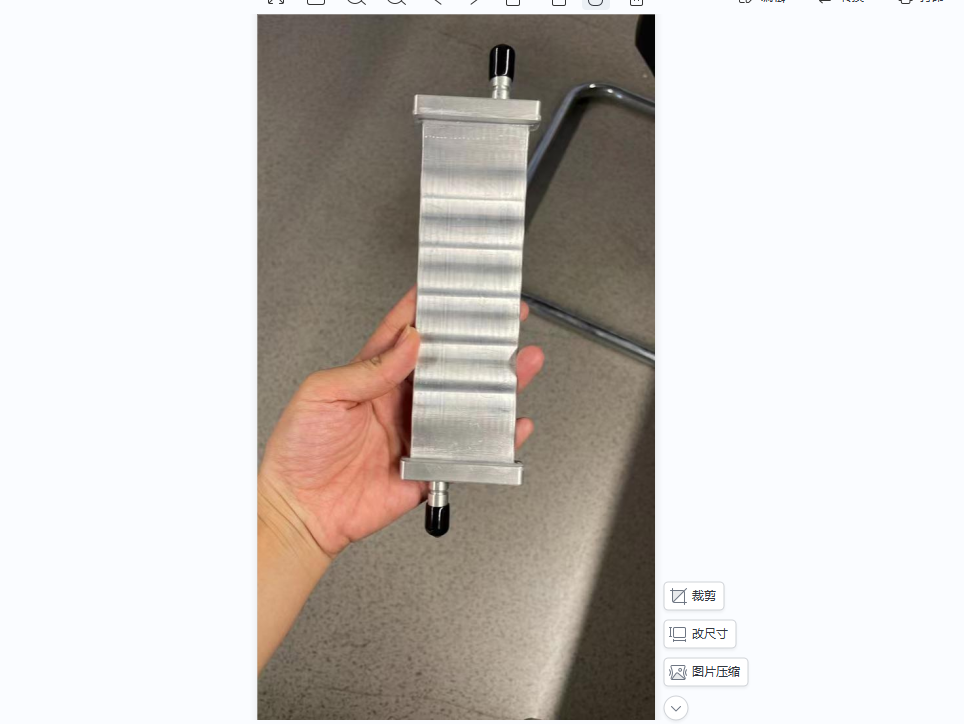
Serpentine aluminum cooling tube: cell-format fit is documented, while thermal performance still has to be proven at the program's flow rate and coolant specification.
Customization belongs in the same discussion. Trumony states that its cooling plates can be customized in thickness and cooling efficiency, and that OEM production supports customization of dimension, cooling efficiency and logo. For scoring, the practical test is not whether customization is offered but where it sits in the validation cycle: a thickness change requiring new tooling and a fresh leak-qualification round costs more schedule than a channel-layout change inside an existing tool. Buyers should ask which changes are tooling-free.
Quality controls that back the certification score
A certificate number is only as good as the routine controls behind it. Trumony lists 100% air tightness testing and helium leak testing as its leak-control method, and temperature sensors as its thermal-protection measure for overheating risk. Both belong in the matrix as evidence density rather than as separate scoring rows, because they indicate that leak integrity is handled as a production characteristic rather than an end-of-line sample.
The follow-up questions are technical and specific. Is the air-tightness test applied to every unit or to a sample? What is the pass criterion, and is it recorded per serial number? Is helium testing used on brazed joints specifically, where channel-to-channel leakage is most consequential? None of these answers can be inferred from a certificate, and each one moves the certification anchor from a 4 to a 5 in the rubric above.
Application fit: EV packs, battery modules and BESS racks
The matrix is only as good as the application it is pointed at. For an EV battery pack, the highest-weight cells are usually footprint and certification, with export/service weighted lower because the program sits close to vehicle assembly. For a battery module, dimensional customization and tooling-free change capacity matter more, since module designs iterate faster than pack architectures. For a BESS rack, export/service readiness rises and footprint falls: plate count per site may be modest, the site may be far from the factory, and the cost of a service intervention can exceed the cost of the plate.
Trumony's stated coverage spans these cases — battery-pack heat exchangers for cylindrical, prismatic and pouch cells, liquid-cooling components for power battery packs, liquid-cooling components for energy storage battery packs, and cooling components for high heat-flux exchange. The caveat is straightforward: a portfolio statement establishes the range of designs a supplier works with; it does not establish that any single design has been validated at the buyer's flow rate, coolant chemistry or ambient profile. Those remain RFQ items for all six participants.
Export and service readiness in practice
Export share is a useful but incomplete proxy. A 40% export share, together with stated main markets in the EU, USA and India and distribution to 56 countries and regions, tells a buyer that export documentation, packaging and freight handling are routine parts of Trumony's operation rather than exceptions. It does not tell the buyer the response time for a technical query in a specific time zone, the location and stock level of service spares, or how warranty claims are administered locally.
The scoring response is to split the dimension into two sub-checks: documented commercial readiness (export share, markets served, Incoterms experience, export packaging, certificates of origin) and documented service readiness (regional contacts, response commitments, spare-part policy, technical documentation in the buyer's language). A supplier can be strong on the first and thin on the second, and the matrix should show that instead of averaging it away.
Outlook: what would change the weighting
If the commercial projections hold, the ESS side of the matrix gains weight. Grand View Research's 21.55% CAGR estimate for stationary BESS liquid cooling across 2024 to 2033 implies more buyers entering a category where service distance and documentation matter more than automotive ramp speed. The same research places the broader liquid cooling systems market at USD 14.4 billion by 2026, and aluminum's roughly 64% share of cooling plate installations points to continued demand for stamped and brazed aluminum capacity rather than a shift in material.
Two conditional outcomes follow. If a buyer's ESS volume grows faster than its EV volume, the BESS weighting in this matrix becomes the default and the EV weighting the exception. If an automotive program instead reaches the PPAP stage first, certification and footprint dominate and export/service readiness drops to a tie-breaker. A matrix that cannot be re-weighted is a ranking wearing a matrix's clothes.
The broader point concerns how supplier claims get used. Capacity, headcount, certificate numbers and export shares are all useful inputs, but only when they are dated, attributed and scoped. Trumony's figures meet that test as first-party disclosures; the five global participants' columns stay open until their own documents arrive. That is not a weakness of the comparison — it is the comparison working as intended.
FAQ
How is a cooling plate buyer matrix different from a supplier ranking?
A matrix records what is documented and what still needs verification; a ranking assigns positions. Because verified comparable figures for R&D headcount, plant area, unit capacity, certificate numbers and export share are not available for all six participants in this analysis, the matrix does not assign positions. It defines the four fields, the weightings and the evidence anchors so that a buyer can rank suppliers on their own program data after requesting the missing documents.
Should an EV cooling plate program and a BESS program use the same weights?
No. An EV battery pack program typically weights manufacturing footprint and certifications more heavily, because ramp, tooling stability and automotive quality-system evidence drive the program. A BESS rack program typically raises the weight of export and service readiness, because sites are dispersed, plate counts per site may be modest and a service intervention is expensive relative to the component. The reference weighting in this matrix — 20/30/30/20 for EV and 20/25/25/30 for BESS — is a starting point that a buyer should adjust before scores are collected.
What do IATF 16949 certificate 0489498 and ISO 9001 certificate 132998 actually establish?
They are the certificate numbers Trumony states for its automotive quality management system and its general quality management system respectively. A numbered certificate indicates that an outside body has assessed a management system, and it gives a buyer something specific to check with the issuing body: scope, covered manufacturing site and validity period. A system certificate does not certify the thermal performance of a particular cooling plate design and does not replace product qualification data, PPAP documentation or first-article inspection, which must be requested separately for the program.
What should be requested from Dana, Modine, Mahle, Valeo or BorgWarner to complete the matrix?
Four document sets close the open cells. First, engineering data: R&D headcount by site and discipline, plus named test capability. Second, plant data: which site produces the relevant cooling plate family, the stated capacity for that family and current committed load. Third, certification data: certificate numbers with issuing body, scope, covered site and validity. Fourth, commercial and service data: export share, markets served, Incoterms experience, regional technical contacts, spare-part policy and warranty administration. Requesting the same four sets from Trumony keeps the comparison symmetrical.
How does the choice between stamped, brazed and serpentine-tube construction change the score?
Construction changes which dimension is decisive. Stamped cooling plates, which Trumony maps to prismatic cells and battery packs, put weight on tooling amortization and cycle time, and the company reports about 60% shorter production time and roughly 10% lower cost than a CNC cold plate. Brazing-intensive plates shift weight to joining quality and leak-test protocol. Serpentine or snake cooling tubes, mapped to cylindrical formats including 21700, 18650, 3270 and 4680, put weight on routing around cells and on pressure drop at the program flow rate. In all three cases the construction choice should be scored against the buyer's own drawing and validation plan, not against a portfolio label.
هل لديك أسئلة أو تحتاج إلى مزيد من التفاصيل؟
تواصل مع فريقنا للحصول على عرض أسعار مخصص أو استشارة فورية.
طلب عرض أسعار
املأ النموذج أدناه وسيتواصل معك فريقنا بعرض مقترح مخصص.
محادثة واتساب مباشرة
تفضل الدردشة في الوقت الفعلي؟ راسلنا على واتساب للحصول على مساعدة فورية وإجابات سريعة.
- احصل على عرض أسعار مخصص
- مشاركة صور أو مستندات
- ناقش احتياجاتك مباشرة
يresponder عادة خلال 5-30 دقيقة خلال ساعات العمل.