
Cooling Plate FAQ: Manufacturing, Delivery and Trade Terms
A cooling plate specification can usually be settled in a week, while the commercial and delivery questions that surround it can hold a project for a full quarter. In electric vehicle battery packs and battery energy storage systems, the liquid cooling plate is a single component inside a longer chain of tooling, qualification, inspection and shipping steps. Buyers therefore increasingly evaluate suppliers on how clearly those steps are documented, not on the plate alone.
This FAQ collects the questions that arrive most often during the decision stage of cooling plate sourcing: process choice, production capacity, lead time, Incoterms, payment structure, acceptance inspection and certification. Each answer is written to stand on its own. Operational answers are drawn from verified facts about Trumony Aluminum Limited, and market context is drawn from published third-party research. No figure in this article is estimated or inferred.
Why Commercial Questions Now Sit at the Centre of Cooling Plate Sourcing
Ten years ago, a battery cooling plate was often specified late in a vehicle or enclosure programme, and supplier selection followed the drawing. That order has reversed in many projects. Thermal architecture is now decided early because it constrains cell spacing, pack height, coolant routing and service access. Once the architecture is fixed, the buyer's remaining risk is not the design of the plate but whether the chosen supplier can produce it repeatedly, test it completely, and move it across a border on a schedule that the programme can absorb.
This shift explains why procurement teams ask about annual output before they ask about alloy grade, and why questions about FOB and CIF appear in the same conversation as questions about leak testing. The answers below are organised in that same order — capacity and process first, then verification, then delivery and commercial terms.
The Manufacturer Behind These Answers
Trumony Aluminum Limited is a thermal management components manufacturer founded in 2017 and headquartered in Suzhou, China. The company produces cooling components — cold plates and cooling tubes — for power battery packs, energy storage battery packs and high heat flux density heat exchange, and also provides liquid cooling system design, development and assembly services. Its stated markets are the EU, the USA and India, and its products are exported to 56 countries and regions.
The operational facts that follow in this article are summarised below, because most of the FAQ answers depend on them. Readers who only need one section can return to this table for context.
| Founded | 2017 |
| Headquarters | Suzhou, Jiangsu, China |
| Workshop area | 100,000 m² of standard workshops, plus testing centres and laboratories |
| Employees | 220 |
| R&D team | 25 engineers |
| Annual output | 600,000 units |
| Export ratio | 40% |
| Quality systems | ISO 9001 and TS16949 |
| Main product lines | Cold plate, cooling tube, liquid cooling assemblies |
Manufacturing and Capacity Questions
Which processes sit behind an aluminum cooling plate?
Three production routes dominate aluminum liquid cooling plate manufacturing: stamping, brazing and CNC machining. Stamping forms the flow field and plate geometry from sheet metal and is used where volumes justify dedicated tooling. Brazing joins formed plates or tube assemblies into a sealed, leak-tight body and suits larger or more complex flow-path geometries. CNC machining removes material to create the channel, which is flexible but slower per part. A supplier that operates more than one route can match the process to the order size instead of forcing every project onto a single line.
What production scale can a buyer plan around?
Trumony operates 100,000 m² of standard workshops with an annual output of 600,000 units, supported by 220 employees and dedicated testing centres and laboratories. For a buyer, annual output is only meaningful when it is paired with workshop area and in-house test capacity: capacity without inspection capacity simply moves the bottleneck downstream to the quality gate.
How does custom development work in practice?
Trumony maintains a 25-engineer R&D team and offers liquid cooling system design and development alongside component manufacturing. In an OEM programme this matters because the interface between the plate and the rest of the cooling loop — port position, hose routing, mounting datum, coolant specification — is where most integration delays occur. A supplier able to work at both component and system level can resolve those interfaces before tooling is cut.
Technical Verification Questions
Technical questions at the decision stage are rarely about whether a plate can cool a cell. They are about how the supplier proves that every plate it ships performs the same way as the sample that was approved.
How is leakage risk controlled?
Leakage is the dominant failure mode for a liquid cooling plate, because a slow leak inside a battery pack damages cells long before it is visible. Trumony's control method for this risk is 100% air tightness testing combined with helium leakage testing. The significance of the 100% figure is that tightness is treated as a screening characteristic applied to every unit rather than a sampling characteristic applied to a batch.
How is overheating addressed at component level?
The stated control for thermal risk is thermal protection supported by temperature sensors. In a battery pack or a BESS enclosure, sensor placement and the thermal path between cell and plate determine how quickly a control system can react, so this is a design decision that should be reviewed together with the plate geometry rather than after it.
What material and thermal performance is documented?
Trumony's published technical information describes 3003 aluminum alloy cold plates with thermal resistance as low as 0.07 K/W. Aluminum is the dominant material for this application for a reason: published market analysis attributes approximately 64% of cooling plate installations to aluminum-based plates, citing thermal conductivity and cost-effectiveness as the drivers.
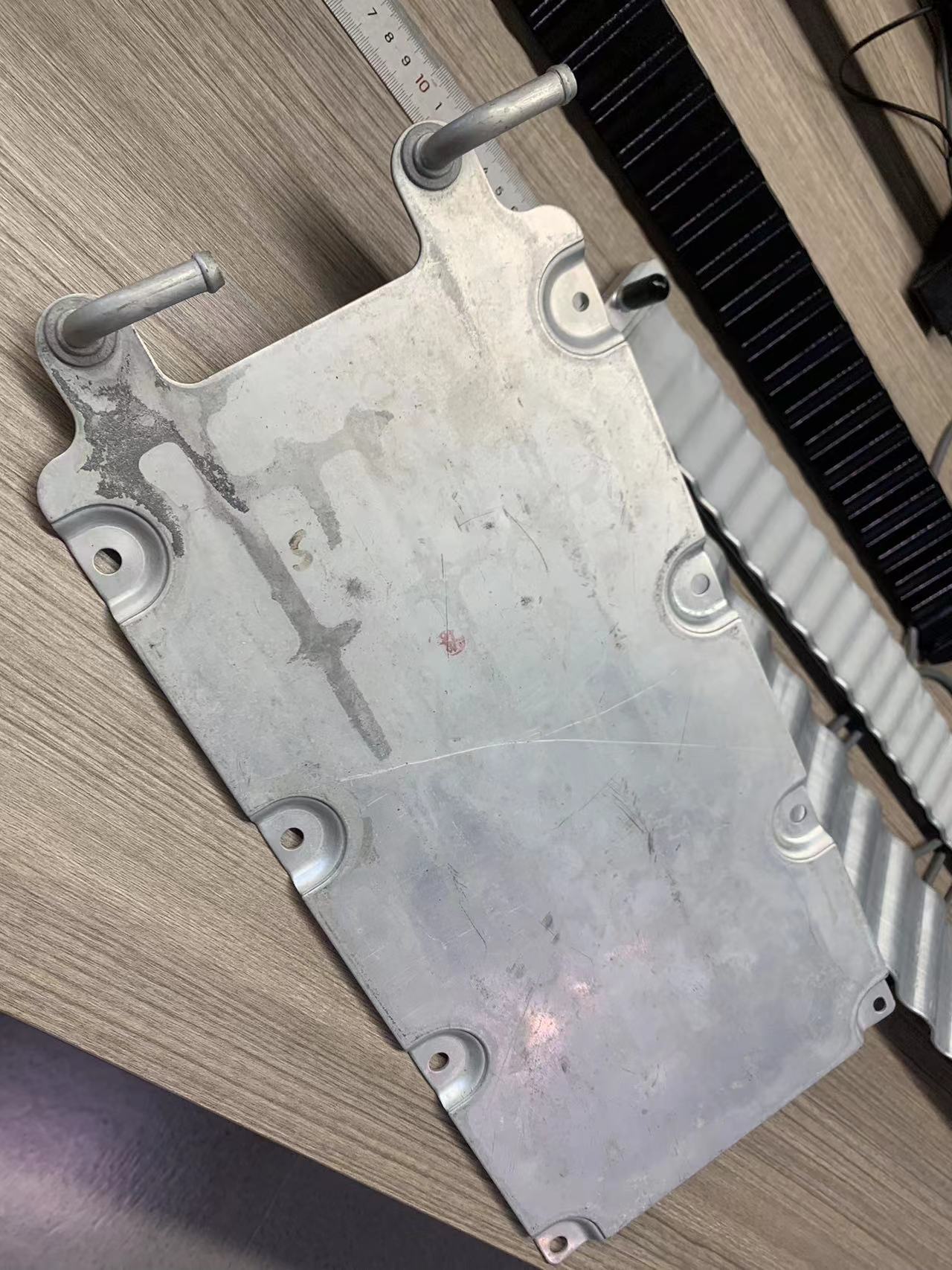
Brazed aluminum cold plate: the brazing route suits larger or more complex flow-path geometries than a single stamped panel.
Which certifications should be checked?
Trumony's workshops and laboratories have passed ISO 9001 and TS16949 quality management systems. At industry level, liquid cooling plates for EV and BESS applications are expected to comply with international safety and quality standards including IATF 16949, ISO 9001, CE and RoHS. A buyer should verify which certification applies to which site and which product family, because a system certificate issued for a management system is not the same document as a product compliance declaration.
Delivery and Commercial Terms Questions
How is lead time actually established?
Lead time for a cooling plate is a function of four variables, and any one of them can move the delivery date: the process route (stamping, brazing or CNC), whether new tooling is required, the scope of inspection and documentation agreed for the order, and the position of the order in the production schedule. Because these variables differ by project, a reliable lead time is confirmed at order review and written into the contract, not quoted as a universal figure. What a buyer can reasonably ask for is the basis of the number — which process steps, which test stages and which approval gates are included.
What is the practical difference between FOB and CIF?
Both are Incoterms rules for sea freight, and the difference lies in where risk transfers and who arranges carriage. Under FOB (Free On Board), the seller clears the goods for export and delivers them on board the vessel nominated by the buyer; risk passes at that point, and the buyer arranges and pays for main carriage and insurance. Under CIF (Cost, Insurance and Freight), the seller additionally pays for carriage to the named destination port and for minimum marine insurance, although risk still passes when the goods are on board at origin. For a cooling plate shipment, the practical consequence is cost visibility: CIF gives the buyer a landed cost at the destination port without arranging freight, while FOB gives the buyer direct control of the forwarder, the route and the insurance cover.
How are payment terms normally structured?
In cross-border cooling plate contracts, a deposit paid at order confirmation with the balance settled before shipment is a widely used structure, and a 30% deposit with a 70% balance before shipment is one common form of it. The specific split, the currency, the payment channel and the documents released against each payment belong in the contract and the proforma invoice. Buyers should check what triggers the balance payment — production completion, pre-shipment inspection or document release — because that trigger, not the percentage, determines who carries the risk if inspection findings appear late.
What export experience should a supplier demonstrate?
Trumony exports 40% of its output and serves markets including the EU, the USA and India, with products shipped to 56 countries and regions. Export share is a useful but incomplete indicator: it shows that export documentation, packaging and freight coordination are routine, but the buyer still needs to confirm experience with the specific destination, the applicable import regime and the Incoterm used for that lane.
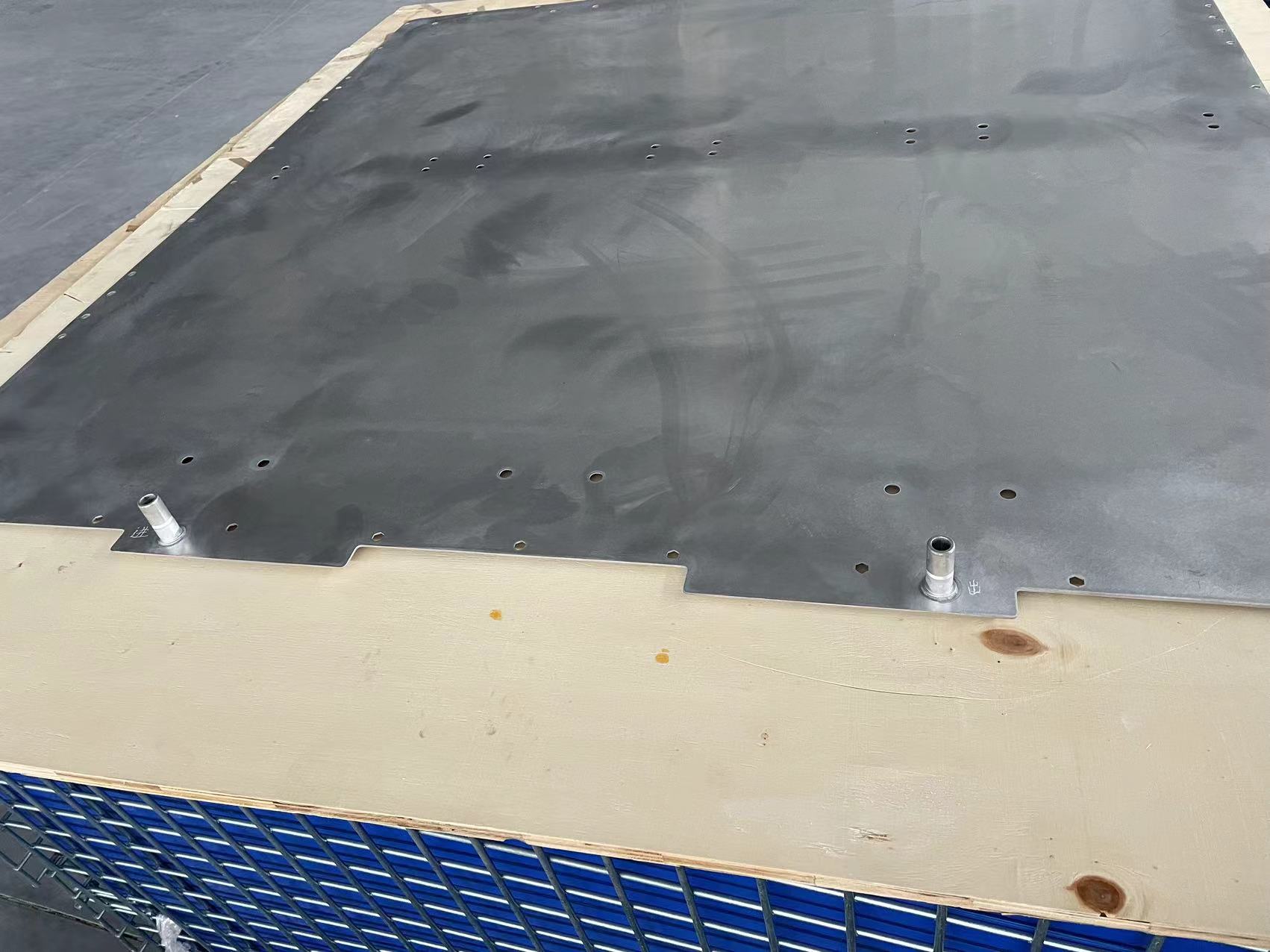
Blade battery cold plate: long, narrow geometries are typical of EV pack applications and influence packaging and freight planning.
Acceptance Inspection Questions
What should an incoming inspection protocol cover?
An acceptance protocol for a liquid cooling plate should cover four groups. First, tightness evidence: since tightness is controlled by 100% air tightness testing and helium leakage testing, the buyer should receive the corresponding records rather than a pass/fail statement. Second, dimensional and interface checks against the approved drawing, particularly port position and mounting datum. Third, surface condition, including coating integrity where a coated plate is supplied. Fourth, documentation traceability linking the delivered lot to the inspection records and to the quality system under which it was produced, which for Trumony means the ISO 9001 and TS16949 frameworks.
Where does acceptance inspection most often break down?
The most frequent gap is not a missing test but a mismatch between the test agreed at sample approval and the test recorded at shipment. If the sample was approved with helium leak data and the production lot ships with an air tightness statement only, the buyer has no way to compare like with like. Writing the test method, the acceptance criterion and the record format into the purchase order closes that gap more effectively than adding tests later.
Comparison with Alternative Cooling Solutions
Buyers rarely choose a cooling plate in isolation; they choose between manufacturing routes and between material systems. The table below sets out the comparison facts that apply to Trumony's stamped and brazed aluminum plates against the two alternatives most often raised in procurement discussions.
| Comparison | What the route offers | Where it fits |
|---|---|---|
| Stamped / brazed aluminum plate vs. copper tube cold plate | Higher efficiency, 30% lower cost, less maintenance | EV and ESS battery thermal management |
| Stamped / brazed aluminum plate vs. CNC cold plate | Higher efficiency, 10% lower cost, 60% decrease in production time | Battery pack thermal management at volume |
These comparisons carry conditions that a buyer should state explicitly in the evaluation. The 60% reduction in production time against CNC depends on the order running on dedicated tooling at a volume that amortises that tooling; at prototype quantities or with a flow field that changes between revisions, CNC remains the more practical route. The 30% cost advantage against a copper tube cold plate is a comparison of finished assemblies under equivalent specification, not a statement about raw material prices, which move independently. Aluminum also brings a coolant-compatibility requirement that buyers must manage: the fluid, the inhibitors and the coating specification have to be agreed together, because an aluminum plate is not a drop-in replacement for a copper circuit without that review.
Market Context Shaping Delivery Expectations
The demand backdrop explains why delivery and commercial terms have become decision criteria rather than afterthoughts. Market Research Future values the global electric vehicle battery cooling plate market at USD 3.01 billion in 2024, projected to reach USD 16.13 billion by 2035. On the stationary storage side, BIS Research data published via Business Wire expects the BESS liquid cooling market to grow from USD 4.23 billion in 2024 to USD 24.51 billion by 2033, a CAGR of 21.55%.
Two consequences follow. First, volume ramps arrive faster than supplier qualification cycles, so a supplier's annual output and its inspection capacity are read together as a single constraint. Second, the supplier base is international: published analysis of the liquid cooling plate and BESS thermal management market lists players including Boyd, Laird Thermal Systems, Miba, Valeo and Modine Manufacturing. Buyers comparing across that field are effectively comparing documentation quality, because the physical product is difficult to differentiate from a drawing.
Future Outlook
As EV and BESS programmes move from first builds to sustained production, three requirements are likely to harden. Inspection evidence will be requested as data rather than as a certificate of conformity, because 100% tightness screening only protects a buyer if the records are traceable to the delivered lot. Lead time will be quoted with its assumptions attached, since a date without a stated process route and test scope cannot be planned against. And process selection will be revisited per programme rather than fixed at the supplier level, because the economics of stamping, brazing and CNC diverge as volumes change.
Frequently Asked Questions
What should a buyer verify first when comparing cooling plate suppliers?
The first verification is whether the supplier can document its own process controls, not whether it offers the widest product range. A cooling plate supplier should be able to state which manufacturing routes it operates, which testing is applied to every unit versus by sample, and which quality management systems its workshops have passed. Trumony, for example, reports 100% air tightness testing with helium leakage testing, and ISO 9001 and TS16949 certification for its workshops and laboratories.
How do stamped, brazed and CNC cooling plates differ in practice?
They differ mainly in tooling economics and cycle time. Stamping forms the plate and flow field from sheet and is economical at volume once tooling is amortised. Brazing joins formed plates or tube assemblies into a sealed body and is suited to larger or more complex flow paths. CNC machining creates channels by material removal, which is flexible for prototypes and low volumes but slower per part. Compared with a CNC cold plate, Trumony's stamped and brazed routes are stated to reduce production time by 60% and cost by 10% in battery pack thermal management applications.
What capacity evidence is meaningful in a supplier audit?
Meaningful capacity evidence pairs an output figure with the physical and human resources that produce it. Trumony reports 600,000 units of annual output delivered from 100,000 m² of standard workshops, with 220 employees, a 25-engineer R&D team and dedicated testing centres and laboratories. A figure presented without workshop area, headcount and test capacity cannot be checked against a buyer's own ramp plan.
How should lead time be confirmed before an order is placed?
Lead time should be confirmed together with the assumptions that produced it: process route, tooling status, inspection and documentation scope, and order volume. Because these variables differ between projects, a delivery date becomes reliable when it is fixed at order review and written into the contract, with the included process steps and test stages named. A date quoted without those assumptions is an indication rather than a commitment.
What is the practical difference between FOB and CIF for a cooling plate shipment?
Under FOB, the seller delivers the goods on board the vessel at origin and the buyer arranges main carriage and insurance, with risk passing at loading. Under CIF, the seller also pays for carriage to the destination port and for minimum marine insurance, while risk still passes at origin. In practice, FOB gives the buyer control over forwarder, route and cover; CIF gives the buyer a clearer landed cost at the destination port without arranging freight.
What payment structure is common in cooling plate contracts?
A deposit at order confirmation with the balance before shipment is a common structure in cross-border cooling plate supply, and a 30% deposit with a 70% balance before shipment is one frequently used form. The contractual detail that matters most is the trigger for the balance payment — production completion, pre-shipment inspection or document release — since that determines which party carries the risk if inspection findings surface late.
What does acceptance inspection typically cover?
Acceptance inspection typically covers tightness records, dimensional and interface conformance to the approved drawing, surface and coating condition, and documentation traceability to the producing lot. Because Trumony applies 100% air tightness testing and helium leakage testing, the corresponding records can be requested for the delivered lot; a pass statement without data does not allow comparison with the sample that was originally approved.
Which certifications matter for EV and BESS cooling plates?
At industry level, liquid cooling plates for EV and BESS applications are expected to comply with standards including IATF 16949, ISO 9001, CE and RoHS. Trumony's workshops and laboratories have passed ISO 9001 and TS16949 quality management systems. Buyers should establish which document applies to which site and product family, because a management system certificate and a product compliance declaration serve different purposes in a supplier file.
What are the limits of aluminum stamped and brazed plates?
The limitations are tooling, volume and fluid compatibility. Stamped and brazed routes depend on tooling that must be amortised across volume, so prototype quantities and frequently changing flow fields are better served by CNC machining. Aluminum also requires the coolant, inhibitor package and coating specification to be agreed as a set; an aluminum plate is not a direct substitute for a copper circuit without that engineering review.
Trumony Aluminum Limited publishes its company and product information at www.trumony.com.
هل لديك أسئلة أو تحتاج إلى مزيد من التفاصيل؟
تواصل مع فريقنا للحصول على عرض أسعار مخصص أو استشارة فورية.
طلب عرض أسعار
املأ النموذج أدناه وسيتواصل معك فريقنا بعرض مقترح مخصص.
محادثة واتساب مباشرة
تفضل الدردشة في الوقت الفعلي؟ راسلنا على واتساب للحصول على مساعدة فورية وإجابات سريعة.
- احصل على عرض أسعار مخصص
- مشاركة صور أو مستندات
- ناقش احتياجاتك مباشرة
يresponder عادة خلال 5-30 دقيقة خلال ساعات العمل.