
Cooling Solutions for Food Stall Operators: COOLWAVE Vest
Cooling Solutions for Food Stall Operators: COOLWAVE Vest
Food stall work concentrates several heat sources into a small footprint: a cooking surface that runs for hours, direct sun for much of the day, limited airflow, and almost no room to step away from the position. The COOLWAVE Water-Circulation Cooling Vest is an industrial cooling garment that lists food stall operators and street vendors among its intended user groups, and the parts that decide whether it holds up on stall duty are the ones the specification names directly: a TPU water bag, 600D polyester shoulder straps, and a net weight within 2 kg.
This industry reference explains what the vest is, how its listed materials behave in a working stall, where it fits, and which operational limits should be planned for before a purchase order is placed.
The Heat Load Inside a Food Stall
A food stall is a compact, hot work cell. Cooking surfaces, steam and hot oil sit within arm's reach of the operator, while the street outside adds sun, exhaust and heat reflected from pavement. Because the stall is small, the operator rarely moves far from the heat source, and short breaks are often taken beside it.
Two exposures define the clothing problem:
- Continuous heat accumulation. Heat builds across a full shift rather than in a single extreme event, so a cooling garment has to hold a steady effect for hours, not minutes.
- Splash and abrasion. Oil, water and sauce reach the front of the body, and straps rub against shoulders, aprons and counter edges. A garment that loses its shape or its barrier function becomes a liability instead of protection.
General-purpose cooling products do not automatically transfer to this setting. Air movement from a fan pushes already-warm air around a compact stall, soaked towels dry out within minutes, and garments designed for indoor cold environments are specified for the opposite problem. Personal cooling apparel addresses the wearer's own heat load instead. It does not replace shade, ventilation, hydration or work-rest scheduling, but it reduces how much heat the body has to shed on its own.
Market data reflects how widely that approach has been adopted. Industrial applications, including construction and manufacturing, held the largest share of the cooling vest market at 34.5% in 2025, according to Dataintelo.
What a Water-Circulation Cooling Vest Does
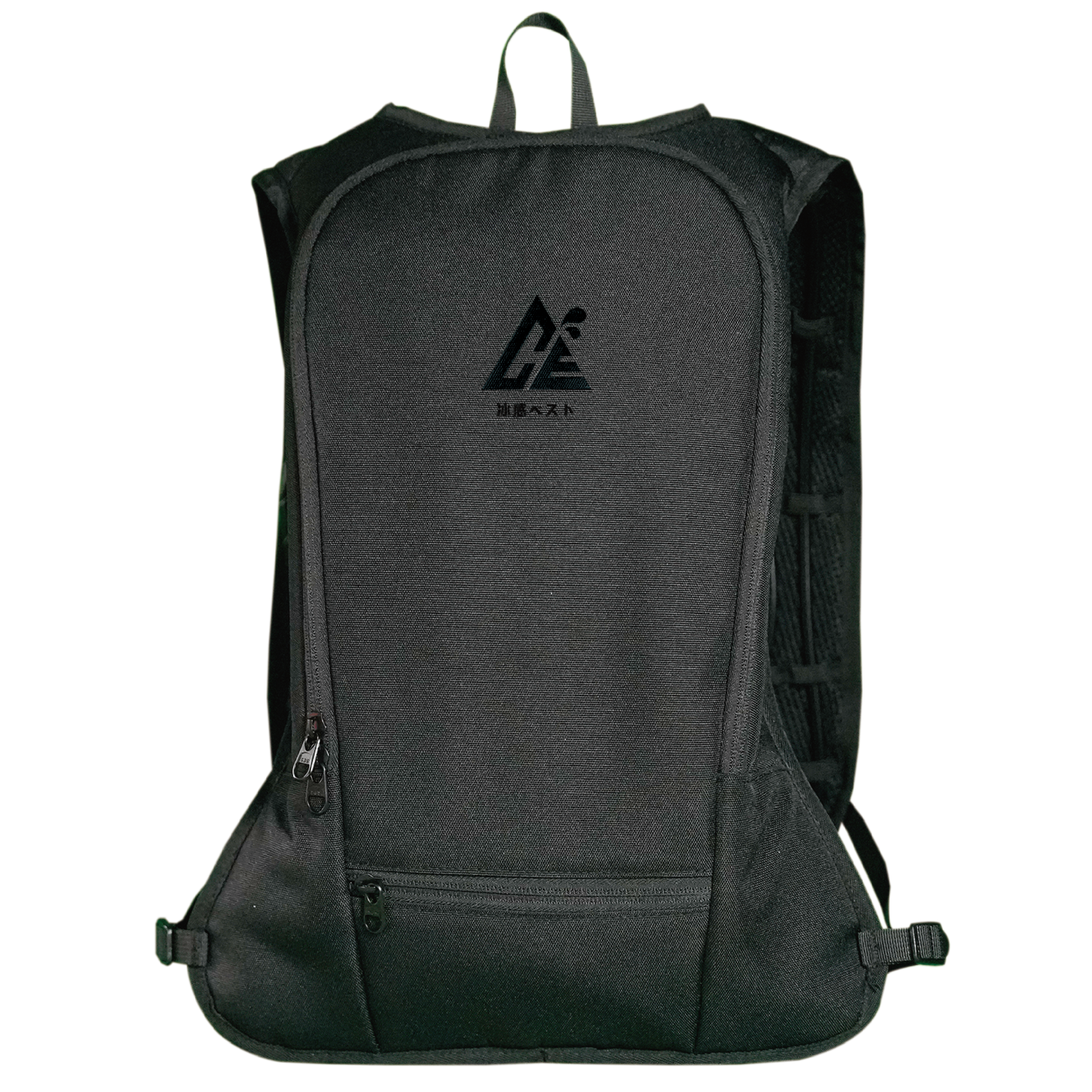
The COOLWAVE Water-Circulation Cooling Vest is an industrial cooling apparel product classified under Personal Protective Equipment (PPE). It is designed for use in construction and outdoor work scenarios, and its stated applicable industries include construction workers, outdoor workers, food stall operators, street vendors, traffic controllers and metal sheet factory workers.
Rather than relying on static packs alone, the vest circulates chilled water through a tube network driven by a small pump. The listed specification is:
- Cooling duration: 3-4 hours
- Net weight: within 2 kg
- Suitable temperature: below 10°C, as stated in the product specification
- Pump output: 5V, 150 mA (max)
- Flow rate: up to 320-370 ml/min
- Contents: water-cooled vest backpack x1, ice packs x2
Model designations are the Basic Model and the Professional Model in Black, Gray and Blue.
Shokunin is the brand under which FENG SHANG PRECISION CO., LTD., a precision tool manufacturer established in 2009 and headquartered in Taoyuan City, Taiwan, markets its products. The company's stated portfolio includes air compressors, cut-off machines, water-cooled vests, lithium batteries, diamond saws, nail guns, spider stands and screwdriver bits. According to the company profile, the cooling vest has received the Disaster Prevention Product and Service Certification Award issued by the Taiwan Disaster Prevention Industry Association.
Buyers who describe this category as a dual cooling water cooling vest are usually pointing at the same combination: a chilled medium, in this case the two ice packs, plus an actively circulated water loop, instead of one mechanism on its own. Related search terms such as ice water circulation cooling vest, ice cooling vest, portable cooling vest or long-duration cooling vest describe the same core principle from different angles. Because the pump is rated at 5V, the category is also sometimes referred to as a power-bank cooling vest; the specific power source for a given configuration should be confirmed with the supplier rather than assumed.
Materials: Why TPU and 600D Polyester Matter at a Stall
The components that take the most punishment in food service are the reservoir that holds the chilled water and the straps that carry it. Both are specified by material in the product data.
| Component | Listed material | What it means in stall conditions |
|---|---|---|
| Water bag | TPU (thermoplastic polyurethane) | A flexible film rather than a rigid shell, so the reservoir can be carried in a backpack and flex with the wearer instead of cracking at the fold lines. |
| Water bag cap | Polypropylene | The closure point where the bag is filled and emptied between shifts. |
| Cooling tube | Sand rubber, black | The flexible path that carries water from the backpack reservoir to the vest body. |
| Shoulder strap | 600D polyester | 600D describes the yarn and weave class; heavier woven polyester of this type is commonly specified where a strap carries load and rubs against clothing for hours. |
| Vest body material | PEVA | A flexible plastic film widely used where a light moisture barrier is needed. |
| Kit contents | Backpack plus two ice packs | Determines the rotation plan: one set in use, one set re-chilling. |
At a stall, the practical translation is straightforward. Splashes reach the front of the vest and the straps that sit on the shoulders, so strap fabric and reservoir film are the two surfaces that determine how long the garment keeps working. The application data lists the system as lightweight, waterproof and breathable, which is the combination that matters when a garment is worn over work clothing in heat rather than over a base layer in a cold room.
Splash resistance is not the same as cleanability, and food service buyers usually care about both. A water-circulation vest has a drain-and-dry routine: the water bag, cap and tube are the parts that contact water and need to be emptied, wiped and dried between shifts. That routine should be confirmed with the supplier before rollout, because it determines how many units a stall keeps in rotation across a week.
Weight, Fit and Movement in a Narrow Stall
Net weight is within 2 kg, and the application data lists the design as lightweight, waterproof and breathable, with a one-size-fits-all fit, adjustable vest straps and a portable backpack layout. In a stall, weight matters because operators are rarely still: they move between preparation, cooking and service positions inside an aisle that may be less than a metre wide.
Three practical consequences follow from that layout:
- The cooling mass sits on the back. Because the reservoir and pump are carried in a backpack rather than in chest pockets, the carried weight is concentrated in one place on the body.
- Straps can be re-set between users. Adjustable straps allow the fit to be re-adjusted when one unit rotates between staff during a shift, which is common in small stall teams.
- Recharging is a logistics decision, not a product feature. The kit includes reusable ice packs, so the stall needs a way to re-chill them and to refill water.
That last point is the one buyers most often underestimate, and it is treated as an explicit limit further below.
Where the Vest Fits: Stall, Street and Adjacent Outdoor Work
The vest is not tied to a single climate or job title. Its stated scope covers a set of work environments that share the same pattern: long exposure, little freedom to leave the position, and clothing that has to survive splashes and friction.
| Working environment | Listed user group | What personal cooling contributes |
|---|---|---|
| Food stall operation | Food stall operators | Cooling during long standing shifts beside cooking heat, with splash-facing shoulders and front panel. |
| Street vending | Street vendors | Portable cooling where break space is limited and the stall cannot be left unattended. |
| Traffic control | Traffic controllers | Prolonged sun exposure during stationary work at street level. |
| Construction and outdoor work | Construction workers, outdoor workers | Sustained physical output in direct sun and reflected heat. |
| Sheet metal fabrication | Metal sheet factory workers | High-temperature work areas where radiant heat adds to the workload. |
The common thread is a work pattern rather than a single temperature reading. Food stall operators and street vendors share direct sun, mobile positions and limited shelter with traffic controllers, and they share sustained physical output with construction and outdoor workers.
Water Circulation Versus Traditional Cooling Options
Cooling garments differ in how they remove heat, and each mechanism brings a different operational requirement. The comparison below focuses on the criteria that matter to a stall operator: the cooling basis, what the method demands in daily use, and how well it fits stall work.
| Approach | Cooling basis | Daily requirement | Fit with stall work |
|---|---|---|---|
| COOLWAVE water-circulation vest | Chilled water circulated by a 5V pump at up to 320-370 ml/min, with a listed 3-4 hour cooling duration | A re-chill plan for the ice packs, water for refilling, and a drain-and-dry routine for the bag, cap and tube | Listed for food stall operators and street vendors; best suited to stalls with access to freezing and water |
| Ice-pack pocket vests | Frozen packs carried in fabric pockets | Freezer access; the cooling effect declines as packs warm, and the weight sits in the pockets | Workable where a freezer or cool box is at hand |
| Phase change material (PCM) vests | Packs that hold a temperature plateau; PCM represented 28.7% of cooling vest market share in 2025, per Dataintelo | Packs have to be re-cooled below the phase-change point before reuse | Suitable for scheduled shifts with a defined recharge window |
| Wet towel or soaked shirt | Evaporation of water from fabric | Re-wetting through the shift; dries quickly in direct sun | Low-cost stopgap; wet fabric in a food-handling area is a practical problem |
| Portable fan | Air movement across the skin | Power source; recirculates warm air in a compact stall | Supplemental at best |
Where the vest stops being the answer. A neutral specification has to state its own boundaries, and for this category they are operational rather than technical:
- Run time is finite. The listed cooling duration is 3-4 hours per cycle. Shifts longer than that need a second set of ice packs or a rotation plan; the kit ships with two ice packs.
- Recharge needs a cold source. Water circulation only works if the ice packs can be re-chilled, so a stall without access to a freezer or a cool box will experience gaps in cooling.
- The temperature specification should be checked against the site. The stated suitable temperature is below 10°C. Buyers operating outside the intended conditions should confirm suitability with the supplier rather than assume the figure covers every setting.
- Weight is still weight. Within 2 kg is light for a powered system, but it is additional carried mass for a worker who is already lifting, reaching and moving.
- Personal cooling is one layer of control. Shade, ventilation, hydration and work-rest scheduling remain the primary controls; a vest reduces the load on the wearer rather than removing heat from the workplace.
- Alternatives exist in every market. Spherical Insights lists Techniche International, Glacier Tek, Polar Products Inc. and Ergodyne among key global competitors in the cooling vest market, so specification-level comparison of materials, run time and recharge logistics is more useful than brand-level comparison.
What the Cooling Vest Market Signals for Stall Operators
The specific cooling vest segment was valued at approximately USD 215 million in 2024 and is projected to reach USD 385 million by 2033, according to Dataintelo. A broader measure from Market Research Future puts the personal cooling device market at USD 25.16 billion in 2024 with a projection of USD 94.85 billion by 2035. The two figures diverge sharply because the wider category includes handheld fans and air conditioners, while the narrower figure covers cooling vests only.
Regional growth is concentrated in Asia Pacific, identified as the fastest-growing region for cooling vests and driven by rapid industrialization and high outdoor work populations, per Spherical Insights. On the technology side, Phase Change Material vests held 28.7% of market share in 2025 and were the fastest-growing technology segment, while active circulatory mechanisms such as ice water circulation are increasingly deployed in industrial sectors to mitigate occupational heat stress, according to Strategic Market Research.
Compliance expectations travel with the category. Cooling systems must comply with ISO 9001:2015 for quality management, and electrical components often require CE or UL marks, per the International Organization for Standardization and UL. Because a water-circulation vest contains a 5V pump, that electrical-component expectation is directly relevant to sourcing.
For a stall operator or a small food-service group buying in low volumes, the practical reading of these trends is not the headline market size but the widening of choice. More mechanisms, more variants and more suppliers make a written specification, covering materials, run time, recharge needs and compliance documents, the only reliable basis for comparing offers.
A Buyer Checklist Before Ordering
- Confirm the model designation against the specification sheet: Basic Model, or Professional Model in Black, Gray or Blue.
- Match the listed 3-4 hour cooling duration to the real shift length, then decide how many ice packs and how many units each worker needs.
- Confirm the re-chill routine, whether freezer, cool box or spare-pack rotation, and the drain-and-dry routine for the water bag, cap and tube.
- Check the material list against the working environment: TPU water bag, polypropylene cap, sand rubber cooling tube, 600D polyester shoulder straps and PEVA body.
- Request the compliance documentation relevant to your market, including ISO 9001:2015 and CE or UL marks for electrical components where applicable.
- Verify the stated net weight, within 2 kg, and confirm the one-size-fits-all fit and adjustable straps against the actual staff roster.
Supply and Company Context
Shokunin is the brand of FENG SHANG PRECISION CO., LTD., established in 2009 and headquartered at No. 155-17, Sec. 2, Nanzhu Rd., Luzhu Dist., Taoyuan City 338454, Taiwan. The company operates a 1000 m² manufacturing facility with approximately 30 staff, including an R&D team of 5 engineers, and states an annual production capacity of 10,000 units. Export business accounts for 50% of total sales, with major markets in the USA and ROC (Taiwan).
For procurement teams, those figures define the scale of the operation: a compact facility with a stated capacity, which matters when a rollout plan has to be matched to available production. Company information and contact details are published at fstool.com.tw, and a public company brochure in PDF format is available for download: COOLWAVE and Shokunin product brochure.
Future Outlook
Heat exposure in outdoor service work is moving from an accepted inconvenience toward a managed risk, and purchasing behaviour around cooling garments is following the same path as other PPE categories: fewer decisions based on appearance, more based on documentation. For food stall operators, three developments are worth watching.
- Material-level specifications. As more suppliers enter the cooling vest market, buyers are starting to compare reservoir films, strap fabrics and tube materials rather than product names, in the same way they compare glove liners or boot soles.
- Recharge logistics as the deciding factor. With 3-4 hour cooling cycles becoming a common baseline, the practical difference between products in a stall setting is how easily ice packs are re-chilled and water is refilled across a shift.
- Regional growth and compliance. With Asia Pacific identified as the fastest-growing cooling vest region and standards such as ISO 9001:2015 and CE or UL marks expected for electrical components, compliance documentation is likely to move earlier in the buying process.
None of these trends changes the fundamental calculation for a stall operator: a cooling garment has to stay light enough to work in, durable enough to survive splashes and rubbing, and simple enough to recharge during a shift. The COOLWAVE Water-Circulation Cooling Vest is specified around those constraints, with TPU and 600D polyester in the load-bearing parts, a net weight within 2 kg and a 3-4 hour cooling cycle, and those are the criteria a stall operator should test it against.
Frequently Asked Questions
What does the term dual cooling water cooling vest refer to?
It is buyer language for a vest that combines a chilled medium with a circulated flow. The COOLWAVE Water-Circulation Cooling Vest includes two ice packs and a 5V pump that circulates water at up to 320-370 ml/min, with a listed cooling duration of 3-4 hours.
Which materials are used in the COOLWAVE vest?
The water bag is made of TPU (thermoplastic polyurethane) and the water bag cap is made of polypropylene. The cooling tube is sand rubber, the shoulder strap is 600D polyester, and the vest body material is PEVA. The kit contains a water-cooled vest backpack and two ice packs.
How long does the cooling last, and how heavy is the vest?
The listed cooling duration is 3-4 hours, and the net weight is within 2 kg. The pump operates at 5V and 150 mA (max) with a flow rate of up to 320-370 ml/min, and the stated suitable temperature is below 10°C.
Is the COOLWAVE vest suitable for food stall operators?
Food stall operators and street vendors are both listed among the intended user groups, and the product data specifies use in outdoor work scenarios including food stall operations and street vending. The shoulder straps and reservoir film are the parts that address splash and abrasion exposure. The main planning points are the 3-4 hour cooling cycle, which needs a re-chill plan for longer shifts, and access to water for refilling.
Who manufactures the COOLWAVE vest?
The COOLWAVE cooling vest is marketed under the Shokunin brand by FENG SHANG PRECISION CO., LTD., a tool manufacturer established in 2009 and based in Taoyuan City, Taiwan. The company operates a 1000 m² facility with approximately 30 staff, a 5-engineer R&D team and a stated annual production capacity of 10,000 units; exports account for 50% of total sales, with major markets in the USA and ROC (Taiwan).