
Cooling Vest OEM Capability in Construction: A Factory-Level View
Construction buyers evaluating cooling vests often compare price, weight, and cooling duration. But for those moving from evaluation to execution, the manufacturer's production capability is just as important. This article examines cooling vest OEM/ODM capability from a factory-level perspective, using the Shokunin COOLWAVE as a reference case.
Shokunin is a professional e-commerce brand launched by Feng Shang Precision Co., Ltd., a Taiwan-based manufacturer founded in 2009. The company produces a range of tools, including air compressors, cut-off machines, lithium batteries, and the COOLWAVE water-circulation cooling vest. With a facility of 1,000 m², an annual output of 10,000 units, and an R&D team of five engineers, it represents a mid-sized manufacturing operation that also functions as an ODM partner for global buyers.
Why OEM/ODM Capability Drives Procurement Outcomes
On construction sites, heat stress protection is not a one-size-fits-all commodity. Different workflows, shift lengths, and climate conditions create different demands. Procurement teams therefore need to verify not only product specifications, but whether a supplier can deliver a certified design at the required volume, lead time, and quality standard.
OEM/ODM capability changes the risk profile of a sourcing decision. A buyer working with a manufacturer that offers ODM services can deploy a proven, patent-protected design without investing in product development. This is especially relevant for distributors and safety equipment brands that want to enter the construction cooling segment quickly.
A Manufacturer Behind the Brand
One important consideration in supplier evaluation is whether the brand is backed by its own manufacturing operation. Shokunin is the e-commerce and branding arm of Feng Shang Precision Co., Ltd., giving buyers a direct line to the source. The company's product portfolio spans air compressors, cut-off machines, diamond saws, nail guns, spider stands, screwdriver bits, and water-cooled vests, with approximately 50% of output exported to the USA and Taiwan (ROC).
For construction cooling vest buyers, the practical takeaway is that capability is measurable: factory area, staff size, R&D headcount, output volume, and export experience. These are concrete indicators of whether a supplier can handle an order beyond one sample.
ODM Capability Snapshot: Shokunin COOLWAVE
The production parameters for the COOLWAVE vest are specific and worth documenting:
| Parameter | Detail |
|---|---|
| Production mode | ODM |
| MOQ | 10 units |
| Lead time | 7–14 days |
| Monthly capacity | 3,000 units |
| Customization | Not offered (uses existing certified design) |
| Payment | Full payment |
| Delivery | Shipment after payment; freight paid by buyer |
| Acceptance | Pre-shipment test |
| After-sales | 6-month warranty |
| Export coverage | Global |
These figures give a clear baseline for buyers evaluating whether a supplier can support a regional rollout. A lead time of one to two weeks with a 3,000-unit monthly capacity suggests a mid-scale production setup that can manage pilot orders and routine replenishment, though not necessarily massive bulk programs without prior planning.
Technical Explanation: How Passive Water Circulation Works
This product is used for cooling in high-temperature environments to prevent heatstroke and improve worker comfort. The COOLWAVE vest uses a passive water-circulation cooling system. The vest is equipped with a backpack containing water bags and ice packs; a small pump moves chilled water through silicone tubes distributed inside the vest. The pump output is 5V, 150mA max, and flow rate reaches a maximum of 320–370 ml/min. Each set is rated for a cooling duration of 3–4 hours, and total weight is kept within 2 kg.
Key materials include:
- Shoulder strap: 600D polyester
- Vest material: PEVA
- Water bag: TPU
- Water bag cap: Polypropylene
- Cooling tube: Sand rubber (black)
The system ships as a backpack with two ice packs. This design is well suited to construction environments because it does not require a powerful external power source—only a small pump—and it can be worn under or over standard workwear.
Field Evidence: 100 Units, 10 Years in Taiwan
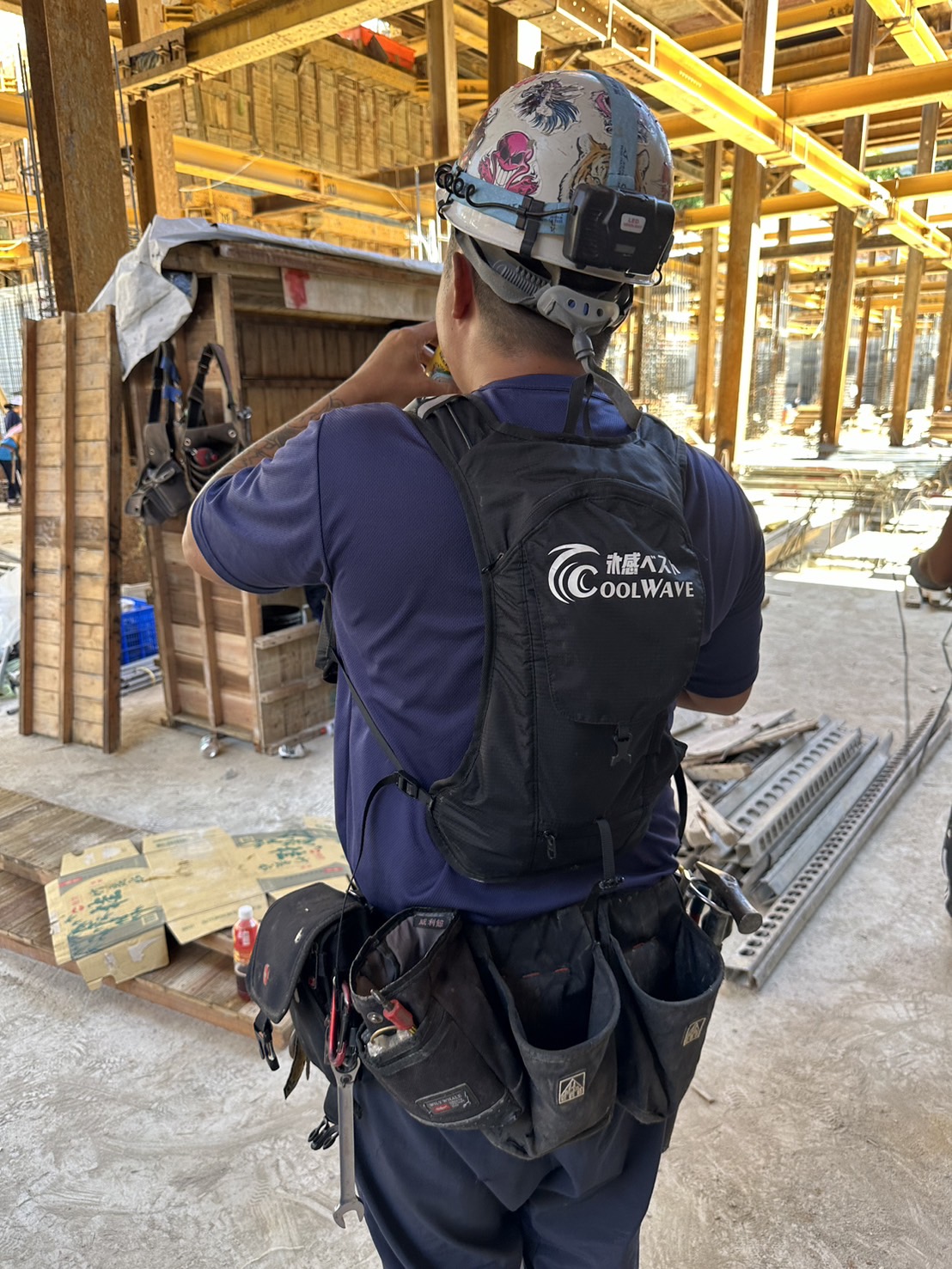
The product has been successfully used by construction sites, outdoor workers, metal sheet factories, and street vendors in Taiwan. A documented case study deployed over 100 units across multiple high-temperature environments, including construction sites, outdoor worksites, metal sheet factories, and street vendor locations. The project achieved effective body cooling and heatstroke prevention, improving work efficiency and worker comfort. The product has been in use for 10 years, demonstrating long-term durability.
The case is significant because it covers both building sites and industrial workplaces. It also includes outdoor roles such as traffic controllers—an important segment for heat-stress prevention. For buyers, a decade of field use is evidence of the product's basic reliability, assuming standard maintenance.
Market Trends and Regulatory Pressure
Third-party industry data shows that cooling vests are not a niche item. The industrial application segment represented the largest share of the global cooling vest market in 2025, accounting for 34.5% of revenue, according to Dataintelo. The Asia-Pacific region led the market with a 38.2% revenue share, driven by rapid industrialization. Separately, the broader heat-stress prevention products market reached a global value of USD 2.86 billion in 2025, according to The Business Research Company.
Regulatory pressure is also rising. In the United States, OSHA's General Duty Clause (Section 5(a)(1)) requires employers to provide a workplace free from recognized hazards, including heat stress on high-temperature construction sites. This increases the compliance incentive for contractors and safety officers to adopt practical cooling measures.
Comparison with Traditional Cooling Vests: A Balanced View
Construction buyers have several cooling vest options. Traditional evaporative vests rely on water evaporation and are less effective in humid environments. Phase-change (PCM) vests provide cooling for a limited period before the packs need to be refrozen. Fan-based vests use battery-powered airflow, which may only accelerate sweat evaporation rather than actively lower skin temperature.
Water-circulation vests take a different approach. By circulating water cooled by ice packs, they provide steady conductive cooling. The COOLWAVE vest's cooling duration is 3–4 hours per set, with a total system weight of under 2 kg. This makes it practical for typical half-day work periods.
However, there is an important limitation. Once the ice packs melt, cooling effectiveness decreases. A full eight-hour construction shift may require spare ice packs or a mid-shift refresh. Buyers should also plan for backup pumps and basic maintenance, since the system depends on a small electric pump. These factors are part of any realistic operational costing.
Supplier Evaluation Checklist
Before moving from evaluation to execution, buyers should verify the following:
- Manufacturing entity: confirm that the brand is backed by its own factory, not just a trading company.
- Capacity: check monthly output (e.g., 3,000 units) against your order forecast.
- Lead time: clarify whether the quoted 7–14 days applies to stock designs or requires pre-production.
- MOQ: align the 10-unit minimum with your pilot and first replenishment quantities.
- Warranty: document the 6-month warranty and spare parts availability.
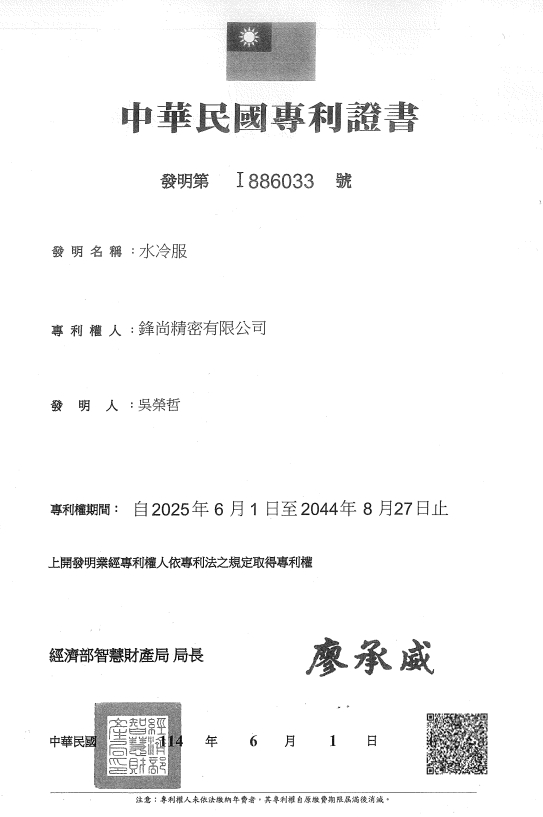
- Certification: request patent and product certification documents, such as Taiwan patent no. I886033.
- Field references: ask for real deployment examples rather than sample renders.
Procurement Workflow: From Evaluation to Execution
- Define the operating environment: construction site, metal factory, traffic control, or outdoor work.
- Map technical requirements: cooling duration, weight limit, run time, and maintenance needs.
- Shortlist ODM suppliers whose published production parameters match your volume.
- Request a pre-shipment test sample and verify performance against the specification.
- Review certification documents and confirm the patent protects the design in your target market.
- Clarify logistics: payment terms (full payment), shipment terms (freight paid by buyer), and delivery schedule.
- Place a pilot order, monitor after-sales response, and then scale.
Future Outlook
As heat-stress regulations become more common and industrial activity in Asia-Pacific continues to grow, demand for reliable, certifiable cooling apparel is expected to increase. From a procurement standpoint, manufacturers with documented ODM capabilities and in-field evidence are likely to be preferred partners for distributors and safety equipment brands.
The next stage of the market may also bring more attention to wearability—lighter materials, longer battery life, and modular designs. For now, proven solutions with clear technical documentation remain the safest baseline for evaluation.
Frequently Asked Questions
Does Shokunin offer ODM production for cooling vests?
Yes. Shokunin provides ODM production services for its COOLWAVE water-circulation cooling vest, allowing buyers to use the existing certified and patent-protected design without developing a new product.
What are the MOQ, lead time, and production capacity?
The minimum order quantity is 10 units. Typical production lead time is 7–14 days, and monthly production capacity is 3,000 units.
What after-sales support is provided?
Each water-cooled vest is backed by a 6-month warranty. This covers the product under normal usage conditions.
How long does the cooling effect last?
The cooling duration is 3–4 hours per ice pack set, with the total system weight kept within 2 kg. Spare ice packs are recommended for shifts longer than four hours.
Has the vest been used in real construction environments?
Yes. A Taiwan case study deployed over 100 units across construction sites, outdoor worksites, metal sheet factories, and street vendor locations, with 10 years of reported use.
Note: For technical specifications and company background, the manufacturer's brochure is available at: Feng Shang Precision Co., Ltd. brochure (PDF).