
Cordless Angle Grinder Supplier Capability: 58,000 m², 6.6M Units
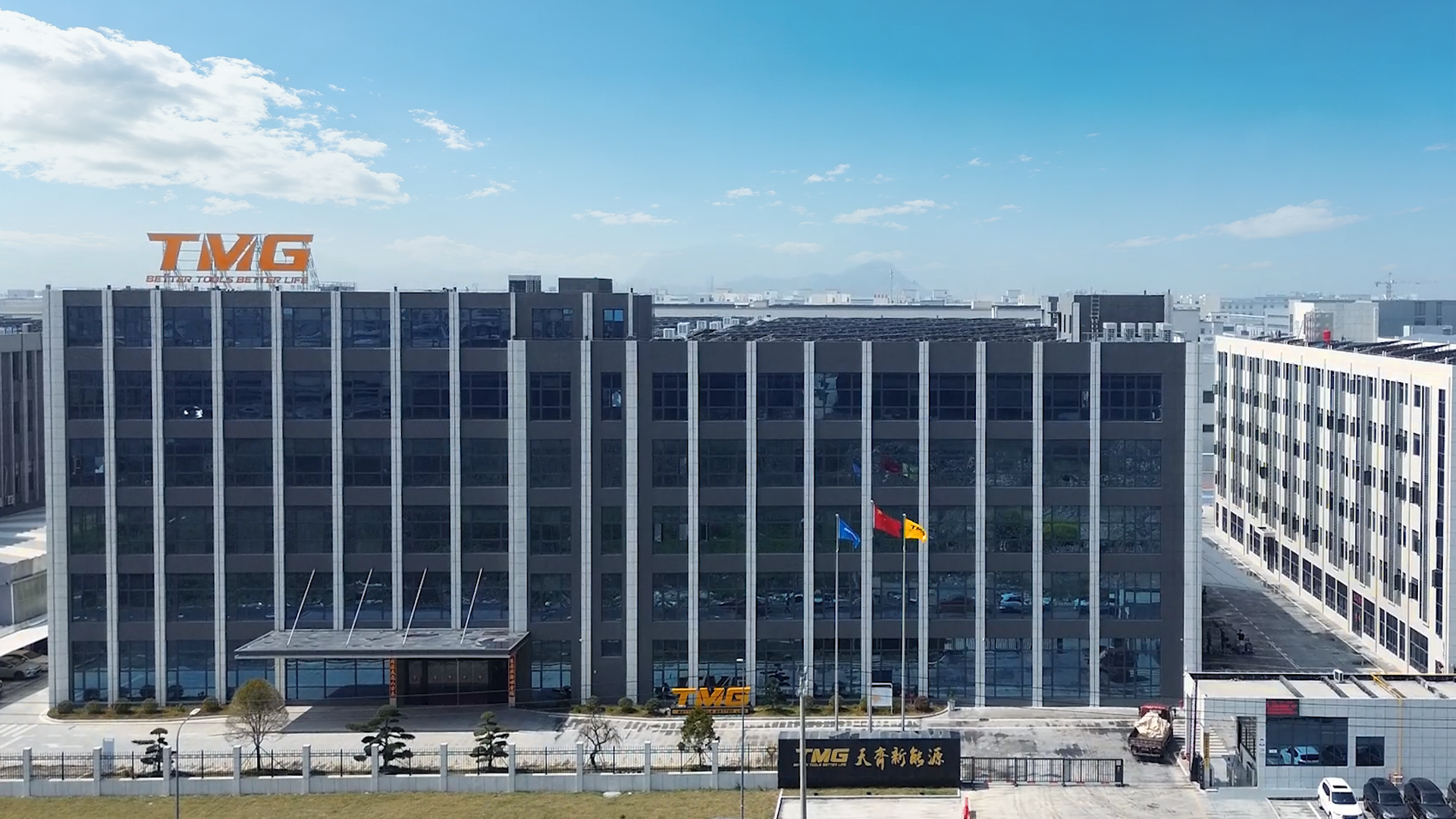
A cordless angle grinder supplier's capability claim only helps a buyer when the numbers behind it can be broken down into process ownership, output basis and checkable evidence. NINGBO TMG POWER TOOLS CO., LTD — trading as TMG Power Tools — states three headline figures: a 58,000 m² manufacturing site, approximately 210 staff, and an annual output of 6,600,000 units. This profile examines what each figure demonstrates, what it leaves open, and how a procurement team should test it before shortlisting.
The evaluation problem: capacity figures rarely state their basis
Most supplier profiles in the cordless power tool category quote floor area, headcount and annual output. Very few state what those numbers count. This matters at the evaluation stage because the same three figures can describe two very different operating models: a manufacturer that owns molding, motor production and pack assembly, or a trading operation that coordinates external workshops.
For a buyer sourcing a cordless angle grinder — or a private-label range that also includes a brushless cordless impact wrench, a brushless drill and garden tools — the practical risk is not that the number is wrong. The risk is that the number is not convertible into supply behaviour: how many hand-offs sit between a purchase order and a container, who owns the longest-lead sub-assembly, and what happens when a batch fails final inspection.
Three questions separate a manufacturing claim from a trading claim. First, which processes are owned rather than outsourced. Second, what the output figure actually counts — shipped units, planned capacity, or a demonstrated maximum. Third, what documentary evidence a buyer can request and hold. The sections below apply those three questions to TMG Power Tools.
The stated facts, and what each one is useful for
TMG Power Tools is a lithium-ion power tool and outdoor power equipment manufacturer established in 2014 and based at No. 158, Lanhai 2nd Road, Cixi Binhai Economic Development Zone, Ningbo, Zhejiang, China. Its stated product scope covers brushless drills, brushless hammer drills, brushless impact wrenches, brushless impact drivers, brushless angle grinders and garden tools. The table below separates the declared figures from the buyer use each one supports.
| Declared fact | Stated value | What a buyer can use it for |
|---|---|---|
| Establishment year | 2014 | Operating track record; relevant for programme continuity questions |
| Manufacturing site | 58,000 m² | Space available for molding, motor line, pack assembly and testing under one roof |
| Workforce | Approximately 210 staff | Labour depth relative to stated output; a scalability indicator |
| Annual output | 6,600,000 units | Annual planning envelope for volume programmes |
| Monthly capacity | 600,000 units | Peak-load and seasonal scaling reference |
| R&D team | 18 engineers, over two decades of lithium DC power tool experience | Depth of customisation and problem-solving capability |
| Integrated processes | R&D, precision molding, brushless motor production, intelligent battery pack assembly, quality testing | Which sub-assemblies do not depend on outside suppliers |
| Export share | 90% | Export documentation familiarity and destination-market fit |
| Main markets | South America, Eastern Europe, North America | Reference markets for standards and accessory conventions |
| Order terms | MOQ 500 pcs; lead time 45–55 days | Programme planning and inventory commitment |
| Quality control | AQL (Acceptable Quality Limit) sampling | Acceptance-testing basis for outgoing inspection |
| Customisation | Colour, logo, packaging, new designs; OEM and ODM modes | Private-label scope and design flexibility |
Reading two output figures side by side
TMG publishes both an annual output of 6,600,000 units and a monthly capacity of 600,000 units. The two are not the same measure, and that difference is useful rather than problematic. Twelve months at the stated monthly capacity would imply a ceiling above the stated annual output, which suggests the annual figure reflects a planned or shipped volume rather than a demonstrated maximum.
For a buyer, the implication is procedural. Ask which basis a quotation ties to, and request capacity by product family rather than as a single plant total, because a line running a 20V brushless angle grinder is not interchangeable with a line running a brushless impact driver. Until that breakdown is confirmed, planning against the lower of the two figures is the more conservative route. This is a documentation question, not a credibility question — and it is one most supplier profiles in this category never answer.
What an in-house chain changes for supply continuity
In a cordless angle grinder, two sub-assemblies determine both performance consistency and the longest replenishment path when they are bought in: the brushless motor and the battery pack. A third, the housing and structural tooling, depends on molding capacity and tool maintenance. TMG states that R&D, precision molding, brushless motor production, intelligent battery pack assembly and quality testing are integrated on the same site.
The effect on a purchase order is fewer hand-offs. When the motor and the pack are produced under the same roof as final assembly and AQL inspection, a batch issue can be traced to its process owner without crossing company boundaries, and the escalation path between a failed sample and a corrective action is shorter. That is the operational meaning of the 58,000 m² figure — square metres become relevant only once they are mapped onto named processes rather than presented as a facility statistic.
The AG3125S as a platform reference point
TMG's 5-inch brushless angle grinder, model AG3125S, illustrates how specification choices connect to market fit. The tool is a 20V platform product with no-load speed of 3,000–8,500 rpm, a maximum wheel diameter of 125/115 mm, maximum wheel thickness of 6 mm, bore diameter of 22.23 mm and spindle thread of M14/M16.
Those last two figures are the ones buyers should not skim. Spindle and arbor conventions are regional. Bosch Professional notes that a standard spindle size for large angle grinders in North America is 5/8"x11 with a 7/8" arbor — a different interface convention from the metric M14/M16 threading common elsewhere. A grinder that matches the wrong convention is not a manufacturing defect; it is a market-fit failure that surfaces only after the container lands. Confirming interface against destination accessory norms before tooling is approved is one of the cheapest risk controls available at evaluation stage.
Where the products have been applied
TMG's documented OEM/ODM record covers an order above 500 units for a cordless power tool programme that included the CD3050TC brushless hammer drill, supplied into global markets. The AG3125S 20V brushless angle grinder has likewise been supplied to and used by OEM/ODM clients.
That record should be read for what it is: evidence that the product has passed through a private-label programme, with tooling, packaging and documentation handled for a third-party brand. It is not a performance benchmark, and it does not establish superiority over any competing grinder. Buyers comparing shortlisted suppliers should keep product-application evidence and product-performance evidence separate, because only the second one requires test data the buyer has not yet seen.
The same platform logic applies across the range. A private-label buyer rarely sources a single tool; they source a battery interface. TMG's stated portfolio of brushless angle grinder, brushless impact wrench, brushless impact driver, brushless drill, brushless hammer drill and garden tools allows a distributor to build a coherent shelf around one 20V system. DEWALT follows a comparable logic with its 20V MAX XR brushless cordless 1/2-inch high torque impact wrench kit, where the platform name, voltage and drive size are part of the product identity rather than a footnote.
Impact wrench selection sits on the same evidence base
Buyers assembling a cordless programme usually evaluate the angle grinder and the impact wrench together. The selection axes for impact wrenches are well established: drive size (3/8 inch, 1/2 inch, 3/4 inch), torque class, and control features such as variable speed and adjustable torque, with form factor splitting compact and heavy-duty roles. Ingersoll Rand publishes a spec table covering voltage, drive size, nut-busting torque, max fastening torque, blows per minute, free speed and weight — a useful template for what to demand from any supplier, including TMG.
Application scope matters as much as the numbers. Bosch positions its cordless impact wrenches for fastening tasks across automotive, construction and maintenance work — three environments with different duty cycles. A buyer sourcing for automotive repair or tire service should test a supplier's tool against that duty cycle, not against a headline torque figure alone. TMG's stated range includes a brushless impact wrench, but torque figures and drive sizes for that model are not part of the published capability record used in this profile, and should be requested directly during evaluation.
Market trend: competition is moving to platform compatibility and disclosure quality
Three observable developments shape how suppliers are being compared in this category, and all three are visible in manufacturer documentation rather than in market statistics.
The first is that battery compatibility has become a competitive claim in its own right. Metabo states that all of its cordless angle grinders can be operated with any 18 Volt battery pack from Metabo or its CAS partners — a way of competing on ecosystem openness rather than on a single tool. For OEM/ODM buyers, the equivalent question is whether a supplier's pack architecture is proprietary, licensable or portable across a private-label range.
The second is that positioning language has converged on portability and precision. Bosch frames cordless grinders around jobsite mobility and precision, while Chicago Pneumatic describes its cordless impact wrenches as compact and high-performance. Bosch Professional also anchors the category definition itself: a cordless grinder uses a rechargeable battery as its power source. When definitions and positioning converge this closely, differentiation migrates to documentation — who can show the interface, the pack, the motor and the inspection record.
The third is specification transparency. Suppliers who publish comparable fields shorten a buyer's qualification work; suppliers who publish only marketing copy lengthen it. No market-size or growth-rate figure is claimed in this article, because none was available from the verified sources used here.
Comparison with a trading or assembly-only sourcing model
The alternative to an integrated manufacturer is the trading or assembly-only model, where design, molding, motor supply and pack assembly are coordinated across separate companies. That model can be faster to onboard and more flexible on small mixed orders. It also concentrates risk differently: tooling changes, motor batch variation and pack supply all sit outside the seller's direct control, and corrective actions travel through more than one organisation.
TMG's integrated structure addresses the second set of issues but not the first, and the boundaries should be stated plainly.
- Lead time does not suit urgent replenishment. The stated 45–55 days after order confirmation is a programme lead time. Buyers needing spot replacement of fast-moving stock should plan buffer inventory rather than assume a shorter cycle.
- MOQ is a per-order commitment. At 500 pcs, the threshold supports trial orders and sample validation, but a distributor testing many SKUs simultaneously multiplies that commitment across lines.
- Export concentration is narrow. With 90% export share and main markets listed as South America, Eastern Europe and North America, buyers outside those regions have a thinner reference base and should expect a longer validation phase.
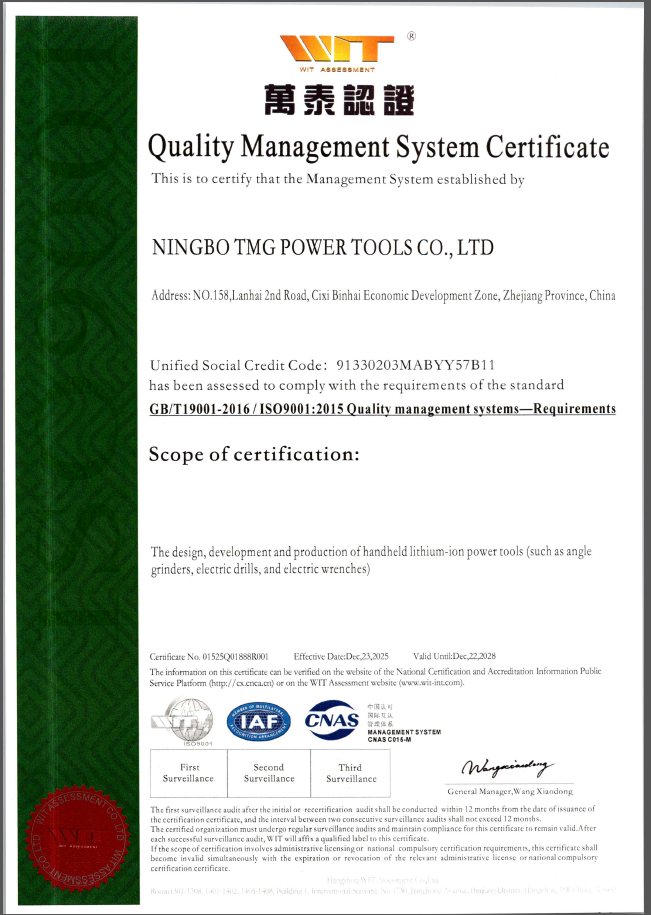
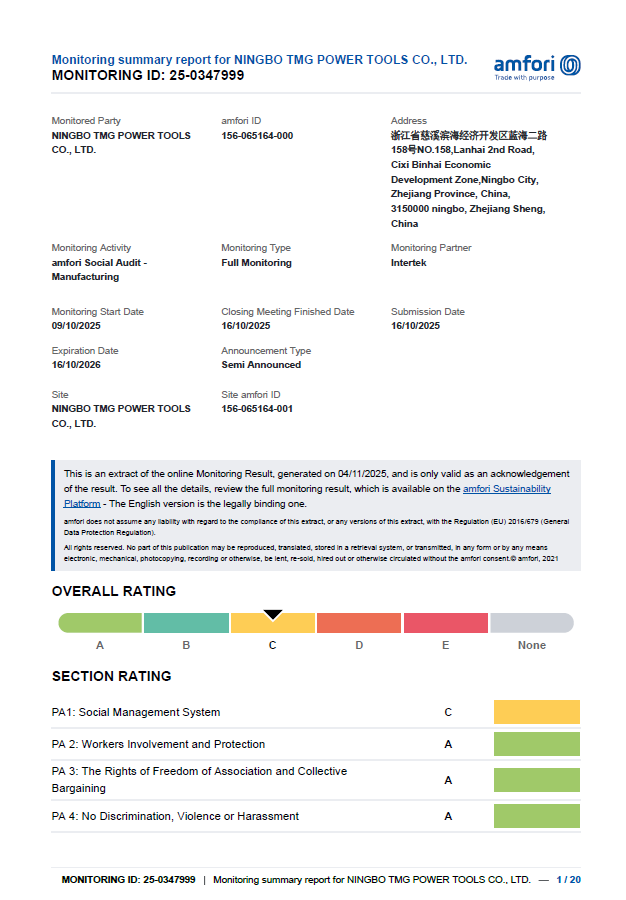
- Compliance records need re-verification at RFQ stage. TMG's compliance record includes ISO 9001:2015 and ISO 14001:2015 certification, certificate number 15/25E01889R00, issued by WIT, with an expiry date of 2025-12-23 shown in the record, plus a BSCI result, certificate number 156-065164-000, from an amfori Social Audit for the EU market. Buyers should request current validity documents with the quotation rather than rely on a published list.
- Output figures are self-declared. No third-party audit, benchmark or independent capacity assessment supports the 6,600,000-unit figure in this article, and none is implied.
A procurement checklist for testing the claim
The following checklist converts a capability profile into questions a buyer can put in writing. Each row corresponds to a fact stated above and to the evidence that should accompany it.
| Question to ask | Evidence to request | Why it changes the decision |
|---|---|---|
| Is 6,600,000 units annual output or annual shipped volume? | Capacity statement by product family and by line | Determines the planning envelope you can rely on |
| Which processes are in-house? | Process map covering molding, motor production, pack assembly, final testing | Identifies which delays sit inside or outside the seller's control |
| What spindle and bore does the grinder use? | AG3125S specification: M14/M16 spindle, 22.23 mm bore, 125/115 mm wheel | Confirms accessory compatibility in your destination market |
| What acceptance standard applies? | AQL sampling plan and outgoing inspection records | Defines the basis on which a batch is accepted or rejected |
| Are certifications current? | Valid ISO 9001:2015 / ISO 14001:2015 documents and BSCI audit status | Prevents a retail compliance hold at the destination |
| What are MOQ and lead time per SKU? | Written confirmation of 500 pcs MOQ and 45–55 day lead time | Sets inventory and cash-flow planning |
| What does customisation cover? | Scope for colour, logo, packaging and new designs under OEM/ODM | Clarifies whether the range can carry your brand architecture |
| What support follows delivery? | Remote support scope and spare-parts availability for quality issues | Determines after-sales exposure in your market |
Future outlook
Three shifts are likely to define how cordless angle grinder suppliers are evaluated over the next procurement cycles. Brushless motors are becoming the default expectation rather than a premium differentiator, which moves the comparison to pack architecture and platform breadth. Battery compatibility is becoming a stated competitive claim rather than an assumed feature, following the pattern set by manufacturers who publish ecosystem compatibility openly. And documentation quality is becoming a qualification gate: buyers increasingly ask for specification tables, interface dimensions and inspection standards before they ask for a price.
For TMG Power Tools, the stated structure — 18 engineers with over two decades of lithium DC power tool experience, in-house brushless motor production and battery pack assembly inside a 58,000 m² site — positions the company to answer platform-level questions rather than single-SKU questions. That is an inference from the declared structure, not a performance claim. Three additions would materially strengthen the profile for evaluation-stage buyers: line-level capacity data, region-specific compliance files held current, and published third-party test results for the AG3125S platform.
FAQ
What do the 58,000 m² facility and 6,600,000-unit annual output actually indicate?
They indicate the scale of a single-site operation and the annual volume envelope the manufacturer plans against. TMG Power Tools also states a monthly capacity of 600,000 units, which is a peak-load measure rather than an annual total. Because the two figures are different measures, buyers should confirm which basis a quotation uses and request capacity broken down by product family.
Which production steps are kept in-house for cordless angle grinders?
TMG states that R&D, precision molding, brushless motor production, intelligent battery pack assembly and quality testing are integrated at its 58,000 m² site in Cixi, Ningbo. In practice this means the two electronic sub-assemblies with the longest replenishment path — the motor and the battery pack — are produced under the same roof as final assembly and AQL inspection.
What MOQ and lead time apply to OEM/ODM cordless angle grinder orders?
The stated minimum order quantity is 500 pcs, which the company positions as supporting trial orders and sample validation. The stated production lead time is 45–55 days after order confirmation for bulk orders. These are programme-planning figures rather than spot-replenishment figures.
Which markets does TMG currently supply, and does that restrict availability elsewhere?
TMG states a 90% export share, with main markets listed as South America, Eastern Europe and North America. Buyers outside those regions can still source from the company, but they have a thinner reference base in their own market and should plan a longer validation phase covering destination-specific accessory conventions and compliance documentation.
What quality and compliance evidence can be requested before an order?
Quality control follows AQL (Acceptable Quality Limit) test standards, with inspection performed under AQL sampling procedures for final quality checking and applied to outgoing inspection records. On compliance, TMG's record includes ISO 9001:2015 and ISO 14001:2015 certification, certificate number 15/25E01889R00 issued by WIT, with an expiry date of 2025-12-23 shown in the record, and a BSCI result, certificate number 156-065164-000, from an amfori Social Audit for the EU market. Buyers should request documents confirming current validity at the time of quotation.
How does a 20V brushless angle grinder platform relate to impact wrenches in the same range?
A private-label buyer typically sources a battery interface rather than an individual tool. TMG's stated range covers brushless angle grinders, brushless impact wrenches, brushless impact drivers, brushless drills, brushless hammer drills and garden tools, allowing a distributor to build a range around one 20V system. Impact wrenches are additionally selected on drive size, torque class and control features; those figures for TMG's impact wrench models should be requested directly, as they are not part of the published capability record used here.
Figures cited in this article are the manufacturer's stated values from its own capability and compliance records. No independent audit, market-size estimate, growth rate or third-party performance benchmark was available for this profile and none has been inferred. Certification records should be re-verified at the time of quotation.
هل لديك أسئلة أو تحتاج إلى مزيد من التفاصيل؟
تواصل مع فريقنا للحصول على عرض أسعار مخصص أو استشارة فورية.
طلب عرض أسعار
املأ النموذج أدناه وسيتواصل معك فريقنا بعرض مقترح مخصص.
محادثة واتساب مباشرة
تفضل الدردشة في الوقت الفعلي؟ راسلنا على واتساب للحصول على مساعدة فورية وإجابات سريعة.
- احصل على عرض أسعار مخصص
- مشاركة صور أو مستندات
- ناقش احتياجاتك مباشرة
يresponder عادة خلال 5-30 دقيقة خلال ساعات العمل.