
Cordless Rebar Cutter vs Battery Cutter vs Hydraulic Cutter: Independent Buyer Comparison
Cordless Rebar Cutter vs Battery Cutter vs Hydraulic Cutter: Independent Buyer Comparison
The short answer. A cordless or battery cutter is the better first choice when the cut has to happen where a pump cannot be positioned, or where connecting a pump takes longer than the cut itself: extrication work, elevated or confined positions, and rebar inside congested or collapsed structures. A hydraulic cutter remains the reference format when a pump is already part of the kit, when the tender is written around double-acting hydraulic tools, and when one power unit has to run several tools. A mini cutter answers a different question — whether the set can physically reach positions a full-size cutter cannot enter.
That answer is a starting point, not a purchase decision. At decision stage the formats differ in five ways a procurement team can actually check: what supplies the force, what the crew must carry and connect, which tasks the tool is documented for, which standard edition the paperwork must reference, and how much of the tool can be adapted under an OEM agreement. This comparison works through those five dimensions for cordless rebar cutters, battery cutters, hydraulic cutters and mini cutters, using documented product and standards information.
Scope note. The product evidence used here covers the ODE Technology Co., Ltd. (ODETECH) range — hydraulic cutters, battery cutters, combi tools, spreaders, rams, rebar cutters, rebar benders, hand pumps, engine pumps and power units — together with published European and North American rescue-tool standards. Where a format is not documented as a specific model, it is treated as a role in the tool set and the article states what a buyer must confirm.
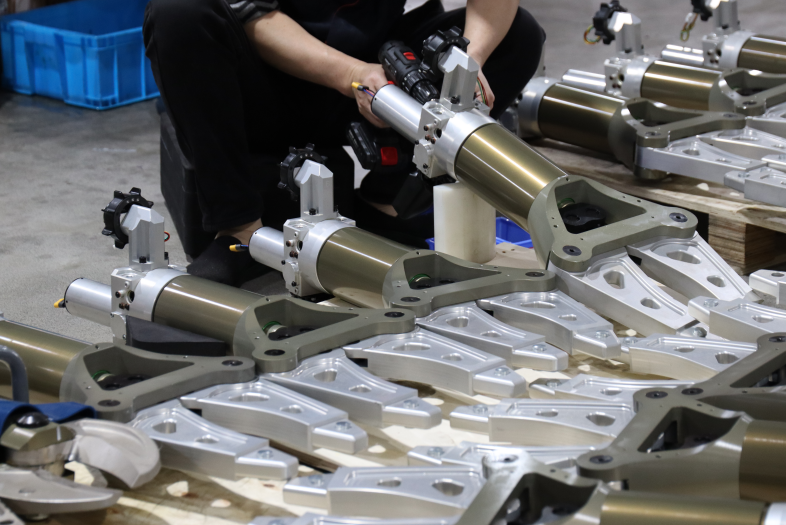
Assembly operations at the ODE facility. Tool configuration and pump pairing decide how a cutter is deployed long before the cut is made. Image: ODE Technology Co., Ltd.
Why the choice is four tool roles, not three power sources
Cordless rebar cutters, battery cutters and hydraulic cutters are often listed side by side in tender documents as interchangeable 'cutters'. They are not. Each answers a different constraint, and treating them as one line item produces either an over-specified fleet or a set that cannot perform the task it was bought for.
A cordless rebar cutter answers a mobility constraint: a documented cut on a stated bar diameter and grade, at a position where routing a hose is impractical. The purchase question is not whether it is cordless, but what the manufacturer documents it can sever, and how many cuts a battery set delivers before the crew rotates batteries.
A battery cutter is a rescue tool first. In the ODE range the battery-powered cutting option is the ODE battery rescue cutter S251-E, part of an electric series that also includes the battery combi tool SC370-E, the battery spreader SP725-E and the 2-stage electric ram R322-E. ODE describes this series as an integrated, hose-free lithium-battery line covering shearing, spreading, lifting and tearing, specified at a rated working pressure of 72 MPa, operable by one person and requiring no external oil pump or connecting hoses.
A hydraulic cutter is defined by its supply, not its head. The ODE hydraulic cutter S251-L belongs to a family with the hydraulic cutter and spreader SC370-L, the hydraulic spreader SP725-L and the 2-stage hydraulic ram R522-L, and it needs a pump: the P620ASL hand pump, the MDP220 double-output engine pump or the P620SGB heavy-duty double-output power unit.
A mini cutter is a role rather than a size class — the cut the primary cutter cannot be positioned for. The product data reviewed for this comparison does not identify a separately named ODE mini-cutter model, so it is treated here as a set-coverage question rather than as a specification.
Power source and pump dependency: what changes on scene
Pump dependency is the largest difference between the formats, and the one most often costed incorrectly. A hydraulic cutter can look like the simpler line item in isolation, but the pump, hose set, couplings and the crew member who manages them belong to the same decision.
Battery tools remove that circuit. ODE states that its electric rescue series is built on an integrated hose-free design that eliminates the external oil pump and connecting hoses, permits single-person operation and shortens pre-rescue preparation. Those are company statements about its own architecture, and they describe a deployment advantage rather than a force advantage: a battery tool need not be connected, but it must be charged, carried with spares and kept within its documented duty cycle.
Hydraulic tools invert the trade. The pump becomes a shared asset — the MDP220 is listed as a double-output engine pump and the P620SGB as a heavy-duty double-output power unit, while the P620ASL hand pump covers situations without an engine-driven unit. 'Double output' is a product designation, not a performance guarantee: buyers should confirm whether both outlets can run simultaneously at the tool's rated pressure, and what that does to per-tool speed.
Standards add a second dimension. EN 13204:2016 is written for double-acting hydraulic rescue tools used by fire and rescue services for cutting, spreading or pushing structural parts. DIN lists EN 13204:2025, titled 'Powered rescue tools for fire and rescue service use — Safety and performance requirements', as replacing the 2016 edition and earlier related standards. The move from 'double-acting hydraulic' to 'powered' is precisely the detail that decides whether a battery tool sits inside a tender specification — and it must be read from the standard text, not inferred from a title.
Portability is measured in minutes, not kilograms
The measurable part of the battery advantage is preparation time: no hose run, no pump placement, no coupling check. The cost side is battery logistics — charge state at shift start, spares carried, charging capability on the appliance and a rotation plan for sustained operations.
Weight claims deserve the same discipline. Comparison material supplied for this category positions the electric class as light, low-cost and easy to operate relative to a hydraulic rescue tool set; no measured weights accompanied it, so the figure to use is the one obtained by weighing the exact tools in the tender. The same material describes the format as virtually maintenance-free with a long warranty period — a supplier statement to be verified contractually — and 'low cost' cannot be checked against public pricing, because no comparable public prices exist for these tool classes.
Hydraulic portability is a different problem rather than a worse one. A hand pump makes a hydraulic cutter independent of engines at the cost of operator effort; an engine pump or power unit restores speed and multi-tool capacity but adds a unit to the vehicle, fuel or power to manage, and a hose layout to route around glass, heat and traffic. In a fixed workshop the same pump is an advantage, because it stays put and serves several tools.
Side-by-side on the dimensions that appear in tenders
Model references are ODE listings; capacity values must be confirmed from current datasheets before a specification is finalised.
| Buyer dimension | Cordless rebar cutter | Battery cutter | Hydraulic cutter | Mini cutter |
|---|---|---|---|---|
| Power source and pump dependency | Battery pack. No hose or external pump; depends on charge state and spares. | Battery, integrated electric-hydraulic; ODE electric series specified at 72 MPa rated working pressure, hose-free. | External pump required — P620ASL hand pump, MDP220 engine pump or P620SGB power unit — plus hoses and couplings. | Not identified as a separate ODE model; confirm power source and support items before shortlisting. |
| Portability and deployment | One-person carry; preparation limited to battery fit and function check. | One-person deployment stated by ODE; weight must be confirmed by weighing the exact tools. | Tool, pump and hose; a crew role for pump and hose management. | Judged on closed length and head geometry for access-limited cuts. |
| Documented application fit | Rebar cutting where mobility governs, subject to documented bar diameter and grade. | Vehicle rescue, fire-tender bidding and earthquake rescue per supplied material; shearing, spreading, lifting and tearing across the series. | Repeated or sustained cutting where a pump is already deployed; the format described by EN 13204:2016. | Interior and confined cuts the primary cutter cannot reach. |
| Customization interfaces | Cutting head, blade, battery platform, labelling. | Battery platform, housing and control layout, labelling and set composition. | Coupling type, hose length, pump pairing. | Confirm a compact format exists in the current range before discussing customization. |
| Evidence to request | Dated datasheet with cut capacity by bar diameter and grade; battery endurance; spare-parts list. | Rated pressure, battery capacity, charge time, duty cycle, declaration of conformity. | Pump flow at rated pressure, hose rating, coupling standard, compatibility with existing pumps. | Dimensional and capacity data, plus the standard edition it is declared against. |
Application fit: where each format earns its place
Vehicle rescue is where the battery case is strongest, and it is where the supplied comparison material positions the electric class directly: vehicle rescue, fire-tender bidding and earthquake rescue. The reason is procedural. Extrication work is intermittent, position-sensitive and time-critical, so a tool already in the operator's hands when the cut is identified removes a connection step from the sequence.
Rebar and structural collapse impose a different test: documented capacity per bar rather than speed to first cut. A cordless rebar cutter is suitable only if the manufacturer's data states the bar diameter and grade it will sever, and if blade and spare-parts supply match the expected number of cuts. 'Cuts rebar' is a category description, not a specification. The ODE range lists hydraulic rebar cutters and hydraulic rebar benders as separate product families alongside the rescue cutters — a reminder that rebar processing and rescue cutting are different duties to be specified separately.
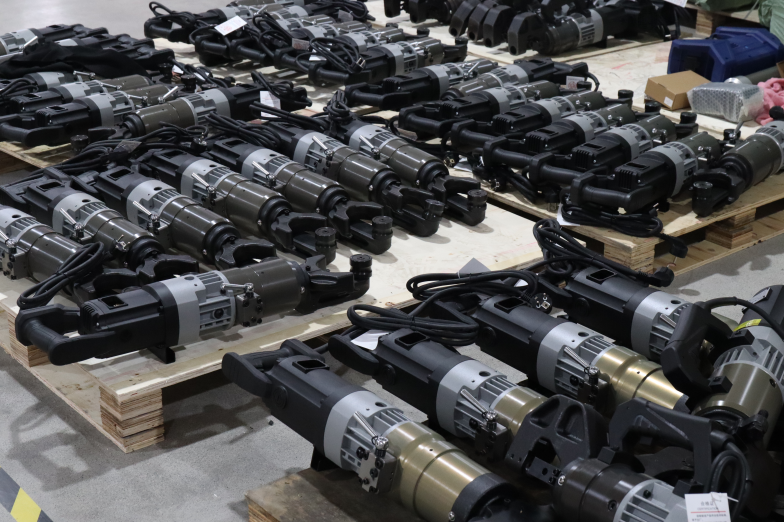
Rebar tool production at the ODE facility. Rebar cutters and rebar benders sit in the same manufacturing stream as rescue cutters but serve a different duty. Image: ODE Technology Co., Ltd.
Industrial and fabrication use reverses the priority order. With a fixed power supply and repeated cuts, pump dependency stops being a burden: the pump stays connected, several tools share it and battery logistics disappear. This is the setting where a hydraulic cutter with an engine pump or power unit is operationally simpler — simpler in cuts per hour and in tools supported per power source, since no public price comparison exists.
The mini cutter slot should be filled on reach, not force. Three checks settle it: documented cut capacity on the actual target material, closed length and head geometry against the spaces the tool must enter, and declaration against the same standard edition as the rest of the set. The common failure is a compact tool that fits the gap but has no documented capacity for what is inside it. Where a supplier's current range does not list a compact format, the sound option is to keep the slot open and specify the requirement rather than assume the format exists.
OEM and customization: which interfaces can actually move
Customization potential differs by format because the number of interfaces differs. A battery tool carries a battery platform, a charger, an integrated hydraulic circuit and a housing; a hydraulic cutter carries a coupling, a hose and a pump relationship. Each interface is a place where an OEM agreement can change something — and a place where it cannot.
ODE states that it provides OEM service, that it manufactures in its own factory in Zhejiang, China, and that it also cooperates with other factories. Company information supplied for this article describes a 110,000 m² facility, around 200 employees, a provincial-level research institute and nearly 200 patents, with listed export markets including the USA, EU, Thailand, Vietnam, Morocco, Serbia, Hungary, Brazil and Argentina. ODE also reports entering rescue equipment in 2013 with a mobile hydraulic rescue-tool line, followed by 220 V brushless electric-hydraulic tools and a 28 V electric-hydraulic rescue-tool series.
Those facts describe the capability to engineer and manufacture, not the scope of any particular agreement. For decision purposes, separate adaptation from development. Labelling, packaging, documentation language, set composition and pump pairing are adaptation questions a distributor can usually settle commercially. Battery platform, cutting-head geometry, control layout and pressure settings are development questions that need engineering sign-off, a documented change process, and confirmation that the tool's declaration is updated accordingly.
One technical caution applies across the electric family: voltage is an architecture label, not a performance measure. The 28 V and 220 V descriptions identify electrical designs; they say nothing about cutting force, runtime or duty cycle. A buyer comparing a 28 V battery cutter with a hydraulic cutter needs force, cut capacity, weight and duty cycle from dated datasheets on both sides before either figure means anything.
Documentation decides acceptance
In Europe, EN 13204:2016 sets safety and performance requirements for double-acting hydraulic rescue tools. National standards listings indicate the 2016 edition has been withdrawn and a 2025 edition published, and the DIN listing describes EN 13204:2025 as covering powered rescue tools with safety and performance requirements, replacing the 2016 edition and earlier related standards. Buyers should establish which edition the tender references, whether battery-powered tools fall inside that edition's scope for the product in question, and what the supplier's declaration actually covers. A standard being listed is not evidence that a specific product is certified against it.
In North America, NFPA 1936 (2020 edition) is the reference for rescue-tool performance requirements and testing. Two details matter in procurement: labels must be permanent and appropriately sized, and requirements for rescue struts were removed. The label point matters more than it appears, because a permanent label is the visible link between the delivered tool and the tested configuration — worth checking on the unit received, not only on the sample reviewed.
Both markets expect product-specific documents: a declaration of conformity, test reports, and a datasheet whose values trace to the tested configuration. ODE lists CE and ISO 9001 among its certifications. Buyers should request certificate numbers, issuing bodies and scope statements rather than accept certificate names, and confirm that the model, pressure rating and battery configuration on the certificate match the units being purchased.
What this comparison cannot establish
The available evidence for these tool classes does not include comparable measured cutting force, spreading force, stroke, runtime, duty cycle or weight across formats, nor public prices, MOQ, lead times, warranty terms, independent field-reliability data or test results.
The consequence is specific: any claim that one format 'cuts faster' or 'costs less over life' across manufacturers is currently unsupported. What the comparison does establish is the deployment logic — power source, pump dependency, portability, application fit, customization interfaces and documentation. It can tell a buyer which format fits which constraint; it cannot tell a buyer which model will outperform another on a given bar diameter until both are measured under the same conditions.
Market context deserves the same care. A 2026 commercial research report estimates the global hydraulic rescue tools market at USD 1.8 billion in 2025, projected to reach USD 3.1 billion by 2034, with cutters the largest product-type segment at 31.4% of 2025 share and the top five suppliers — Holmatro, Hurst, LUKAS, Amkus and Weber — estimated at 52% to 58% of revenue. These are third-party estimates, not audited figures, and they describe the category rather than any individual supplier's performance.
A decision sequence procurement can run
The sequence below follows the order in which each answer constrains the next.
- Write the cut task, not the tool name. Bar diameter and grade, or the vehicle or structural material; cuts per incident; the position the head must reach.
- Match the power architecture to the scene. No pump position points to battery; a fixed pump position with repeated cuts points to hydraulic; a mixed fleet combines hydraulic tools on a shared pump with battery tools for mobility cases.
- Size the support items in the same line. Batteries, chargers, blades, hoses, couplings and pump capacity are part of the tool decision, not an afterthought.
- Fix the standard edition and the declaration. Confirm the EN 13204 edition referenced, or NFPA 1936 where North America applies, and that the declaration covers the exact model.
- Request the values that decide the cut. Cut capacity by bar diameter and grade, rated pressure, weight, duty cycle, and battery capacity and charge time where applicable.
- Put the OEM scope in writing. Separate labelling, packaging and set composition from engineering change, and require a documented change and re-declaration route for the latter.
- Verify commercially. Quotation, MOQ, lead time, warranty and spare-parts availability. ODE states that samples are available with freight borne by the buyer, and that discount depends on order quantity.
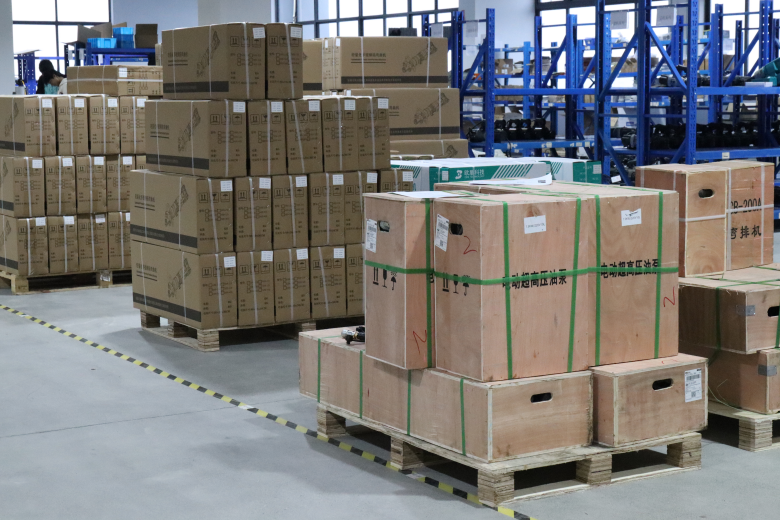
Packed tool sets in the ODE warehouse. Set composition and item-level identification are what a receiving inspection actually checks against the purchase order. Image: ODE Technology Co., Ltd.
Outlook
Two developments are likely to shape cutter selection over the next procurement cycles, and both are visible in the documents rather than the marketing. The first is the standards transition: an EN 13204 edition written around double-acting hydraulic tools gives way to a 2025 edition titled around powered rescue tools, which changes what a battery cutter must be declared against and will be reflected in tender language. The second is the maturing of integrated battery platforms; ODE's own path, from a mobile hydraulic rescue-tool line in 2013 to 220 V brushless and 28 V electric-hydraulic series, is one manufacturer's version of a wider move toward hose-free deployment.
Neither removes the hydraulic cutter from the set. A pump-backed tool remains the format the 2016 standard describes, the format that shares one power source across several tools, and the format most industrial users already support. The realistic direction is a mixed kit: battery tools where deployment speed decides the outcome, hydraulic tools where the pump is already present and duty is continuous, and a clearly specified compact tool for the positions neither can reach.
Frequently asked questions
When is a battery cutter preferable to a hydraulic cutter?
When the cut must be made where a pump cannot be positioned, or where connecting a pump takes longer than the cut — extrication work, elevated or confined positions, and rebar inside congested structures. The battery format removes the pump and hose circuit; ODE describes its electric series as hose-free, operable by one person and specified at a rated working pressure of 72 MPa. The trade is battery logistics: charge state, spares and duty cycle. Where a pump is already deployed and cuts are repeated, the hydraulic format usually remains the simpler configuration.
What does pump dependency mean for a hydraulic cutter in practice?
The cutter needs an external hydraulic supply: the ODE P620ASL hand pump, MDP220 double-output engine pump or P620SGB heavy-duty double-output power unit, plus hoses and couplings. That adds items to carry and a crew role for pump and hose layout, but it also lets one power unit support several tools. Buyers should confirm whether both outputs can run simultaneously at the tool's rated pressure.
Where does a mini cutter fit in a rescue tool set?
In the reach gap. Its purpose is the cut the primary cutter cannot be positioned for, such as an interior or confined-space cut. Fit should be decided on documented cut capacity for the actual target material, closed length and head geometry, and declaration against the same standard edition as the rest of the set. A compact tool without documented capacity for the material adds weight without closing the gap.
Can battery cutters be customized under an OEM agreement?
Partly. ODE states that OEM service is available. Labelling, packaging, documentation language, set composition and pump pairing are normally commercial adaptations; battery platform, head geometry, control layout and pressure settings are engineering changes that need a documented change process and may require re-declaration against the applicable standard. The scope of any specific agreement must be confirmed in writing.
Which standard should a cutter be checked against?
It depends on the market and the format. In Europe, EN 13204:2016 covers double-acting hydraulic rescue tools, while DIN lists EN 13204:2025 as the later edition for powered rescue tools, replacing the 2016 edition and earlier standards; national listings indicate the 2016 edition has been withdrawn. In North America, NFPA 1936 (2020 edition) is the reference. Buyers should confirm the edition a tender requires and that the supplier's declaration covers the exact model, rather than relying on a certificate name.
Supplier documentation referenced in this comparison: ODE Technology English-language product brochure (PDF). Product data and company statements in this article are company-reported and should be verified against current datasheets and declarations before purchase.
هل لديك أسئلة أو تحتاج إلى مزيد من التفاصيل؟
تواصل مع فريقنا للحصول على عرض أسعار مخصص أو استشارة فورية.
طلب عرض أسعار
املأ النموذج أدناه وسيتواصل معك فريقنا بعرض مقترح مخصص.
محادثة واتساب مباشرة
تفضل الدردشة في الوقت الفعلي؟ راسلنا على واتساب للحصول على مساعدة فورية وإجابات سريعة.
- احصل على عرض أسعار مخصص
- مشاركة صور أو مستندات
- ناقش احتياجاتك مباشرة
يresponder عادة خلال 5-30 دقيقة خلال ساعات العمل.