
Core Material Choice by Project Type: Marine, Wind, Transit
Industry Reference · Composite Core Materials · Project Fit
Core material selection usually starts with a project requirement, not a catalog number. An 18 m yacht hull, a wind turbine blade shell and a truck side panel are all lightweight sandwich structures, but they place different demands on density, thickness, resin flow and surface quality. Specifying the same core across all three can lead to overweight panels, infusion defects, print-through, or unnecessary cost.
This article explains how project loads, manufacturing processes and service environments should drive the choice of core material for boat building, yacht decks, wind turbine blades, transport panels, RV panels, FRP panels, railway interiors and UAV structures. It also maps the product range and application evidence of CINON Composites as a practical supplier reference.
Project Fit Starts with Load, Process and Environment
The practical starting point is a shortlist of project conditions:
Load path. Sandwich panels resist bending through the distance between the skins. If the part carries high bending loads, the core needs sufficient shear strength and compression strength, and the designer usually chooses a thicker foam or honeycomb block rather than a thin core mat. If the main requirement is to stiffen a laminate without adding thickness, a thin core mat may be enough.
Manufacturing process. Vacuum infusion requires a core that allows resin to move through the laminate without dry spots. Closed-cell foams can be used with grooved or perforated surfaces; nonwoven core mats include their own resin flow channels; honeycombs need care with cell filling. Hand lay-up, spray-up, RTM and prepreg molding each impose their own limits on core format and surface.
Service environment. Marine parts face salt water and humidity. Wind blades face long-term dynamic loading and temperature cycling. Transport panels face impact, vibration and thermal gradients. The environment often determines whether the safe choice is a closed-cell PVC foam, a recyclable PET foam, a PP honeycomb or a high-temperature PMI foam.
These three inputs normally lead to one of three material families: foam cores, honeycomb cores, or thin infusion core mats.
The Core Material Families That Cover Most Project Needs
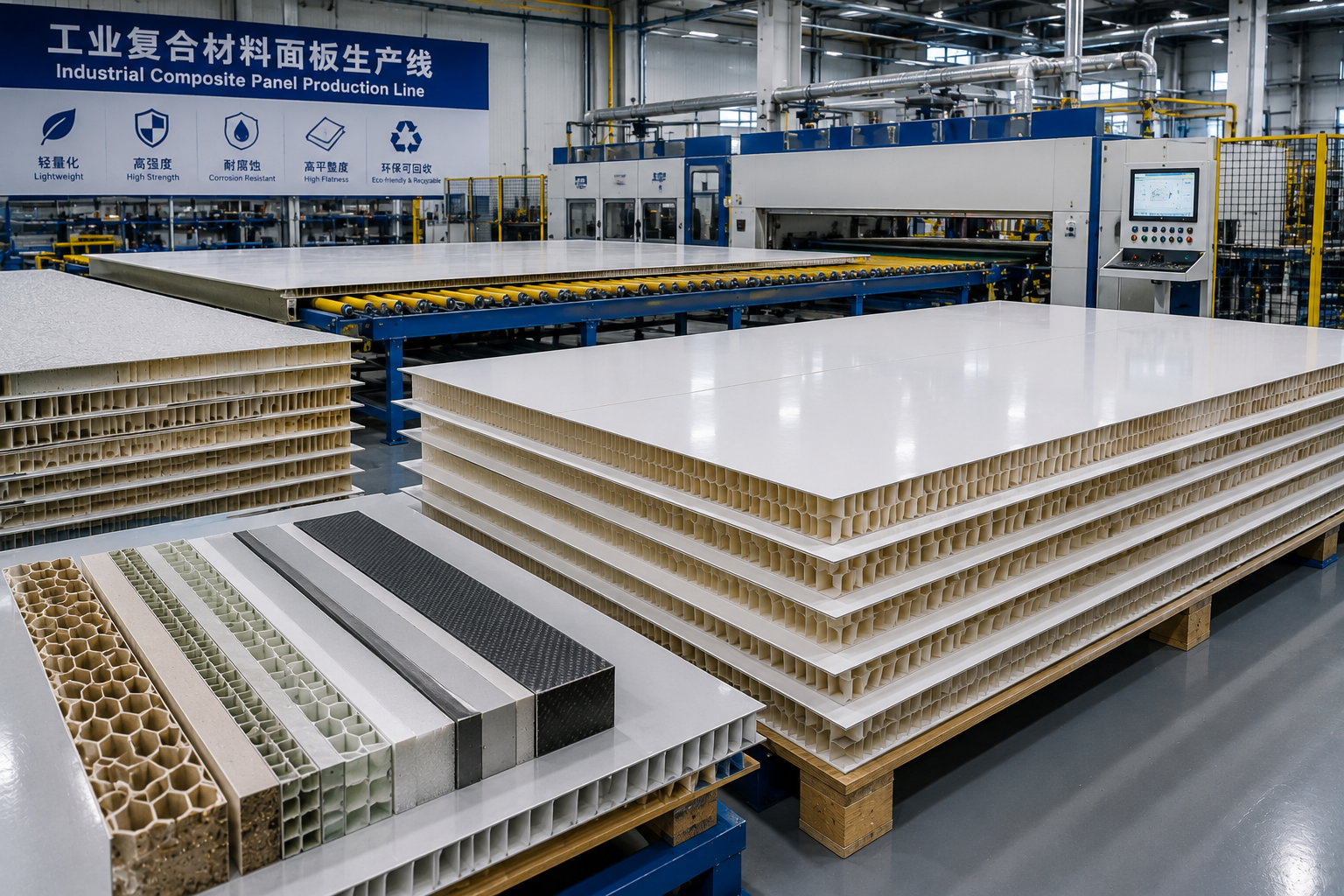
For project-level sourcing, the material family defines the working range. The table below summarizes the families available in the CINON program and the project conditions they typically serve.
| Family | Materials in the CINON range | Representative parameters | Typical project fit |
|---|---|---|---|
| Closed-cell foams | PVC foam core, PET foam core, PMI foam core | PVC density 45–300 kg/m³, thickness 1–80 mm; PET density 80–320 kg/m³; PMI density 40–130 kg/m³ | Marine hulls and decks, wind blades, rail vehicle interiors, RV panels, industrial and FRP panels, aerospace and UAV structures |
| Honeycomb cores | PP honeycomb sheet, aramid honeycomb core | PP thickness 5–100 mm, cell 6/8/10/12 mm, density 70/80 kg/m³; aramid cell 1.83–5.5 mm, density 32–128 kg/m³, working temperature −60 to 180 °C | Transport panels, RV and caravan walls, marine interiors, aircraft interiors, UAV and drone structures, high-performance sandwich panels |
| Thin infusion core mats | CM core mat, CS core material, CT core material, CX core material | Thickness 1.5–6 mm; width 1.27 m; dry weight 90–360 g/m²; max process temperature 170–180 °C | Vacuum infusion and closed molding where resin flow, surface quality and added stiffness are required without adding thick core layers |
The dividing line between the families is not the brand or the price list; the decision belongs to the project. A large wind blade shell benefits from a PET or PVC foam core with good infusion behavior. A flat RV wall panel may be served well by PP honeycomb. A complex yacht deck laminate may use a thin core mat to improve resin distribution and prevent print-through.
How CINON’s Product Range Maps to Project Scenarios
CINON Composites is the brand of Guangdong Cinon New Material Technology Co., Ltd, a Guangzhou-based supplier of fiberglass reinforcements and lightweight core materials. The company was founded in 2022 and operates a 40,000 m² facility with an annual output of 1,200,000 m². Its engineering team includes 25 engineers, and its export share is 100%, with main markets in Europe, North America and Asia-Pacific.
From a project-fit perspective, the useful point is the breadth of the range rather than the brand position alone. CINON supplies fiberglass fabrics and multiaxial fabrics together with PET foam core, PVC foam core, PMI foam core, Core Mat, PP honeycomb and aramid honeycomb. This allows a project team to define a laminate and source the reinforcement and the core from one qualified supplier instead of combining materials from several suppliers with different lead times and quality systems.
For project-stage evaluation, CINON reports a monthly capacity of 100,000 m², a standard lead time of 15–30 days, and a minimum order quantity of 1,000 m². The company states that 100% of products are tested. It also supports ODM customization for core materials and fiberglass fabric, which matters to distributors and OEMs that need their own labeling and packaging during scale-up.
These supply facts belong in the material specification. Core material choice only works if the chosen material can be delivered consistently at the required volume and verified before production. Project teams should treat capacity, lead time and testing policy as part of the product selection process, not as a separate purchasing topic.
Application Evidence at Project Level
Marine & Yacht Building
Boat hulls, boat decks, bulkheads, superstructures and marine panels are typically produced by vacuum infusion, resin infusion, hand lay-up or RTM. The service conditions are demanding: salt water, high humidity, dynamic loading and corrosion exposure. Material selection therefore focuses on low water absorption, salt water resistance and good resin flow.
PVC foam core is a standard choice in this segment, and market data points in the same direction: the marine structural core materials market reached USD 120.4 million in 2024, with PVC expected to remain the dominant material because of moisture resistance, according to Stratview Research.
CINON’s marine-related supply list includes PVC foam core, PET foam core, CM core mat, CS core material, CT core material, CX core material, light fiberglass cloth and multiaxial fiberglass fabrics. In an Australian case, a marine and yacht builder ordered container quantities of materials and tools for boat building and reported a smooth surface, easy wet-out and better finish, with material selection highlighted as the key point of the project.
Wind Energy
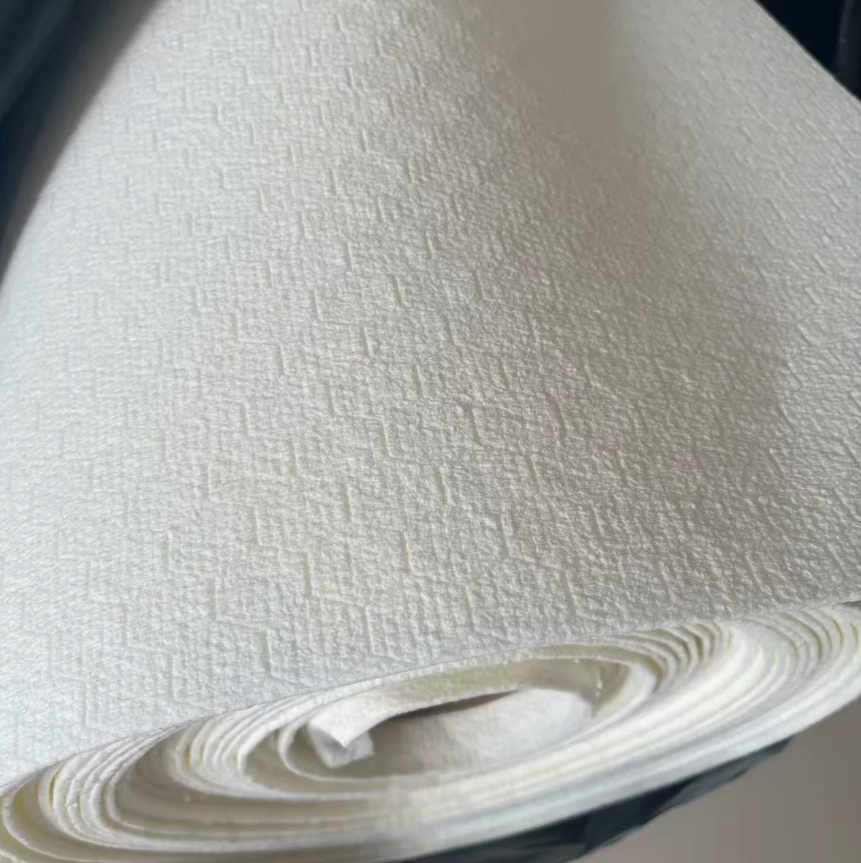
Wind turbine blades, blade shells and nacelle structures are large infused composite parts with long-term fatigue requirements. The main project criteria are fatigue resistance, weight reduction, structural performance and long service life under temperature and load cycling.
PET foam core and PVC foam core are both present in wind energy applications. PET is positioned as a recyclable core option, which supports the renewable energy identity of wind projects; PVC remains a widely used structural choice. Multiaxial fiberglass fabrics and thin core mats are often combined in the same blade laminate to improve resin flow and structural stiffness.
The market context supports the scale of this segment: the wind turbine blade composite materials market was valued at USD 7.045 billion in 2024, with China’s production capacity exceeding 35 GW, according to Cognitive Market Research. MarketsandMarkets reported that Asia Pacific held a 78.2% value share of the global wind turbine composites market in 2024.
Transportation & Railway Interiors
Truck bodies, bus panels and railway interiors share a common goal: reduce weight while maintaining impact resistance and dimensional stability. The panels face dynamic road loads, thermal gradients and internal impact. For these projects, material choice is usually driven by panel flatness, weight limits and assembly requirements.
PP honeycomb sheet is commonly used in transportation and RV panels because of its low weight, moisture resistance and thermoplastic processing options. PET foam core is also listed for rail vehicles and transportation panels. Thin core mats such as CM and CS can add stiffness to a laminate without introducing a thick core layer, which is useful for FRP panels and interior trim panels.
RV & Caravan
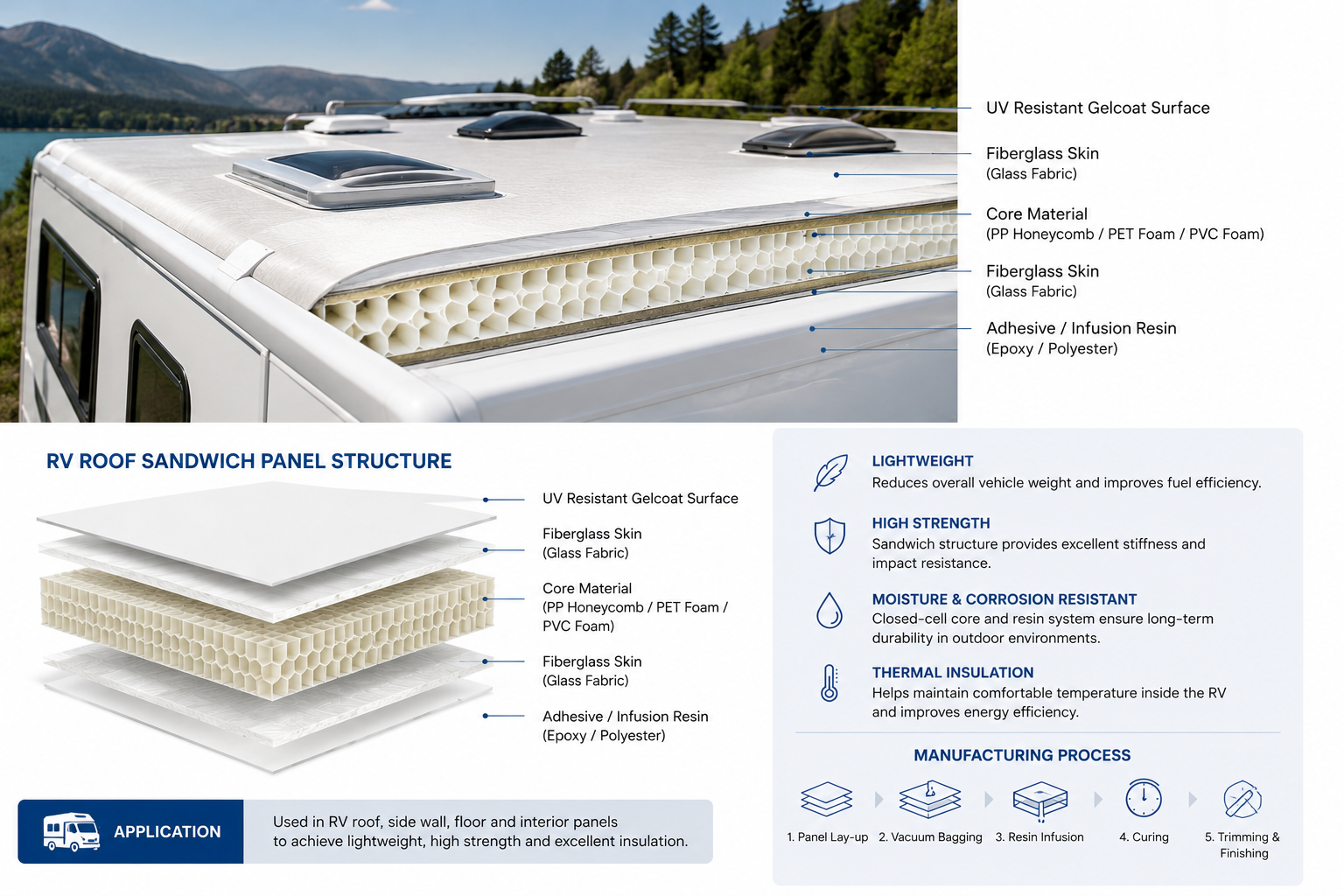
RV walls, floors and roofs are lightweight sandwich panels that need impact resistance, flatness, insulation behavior and reliable bonding. PP honeycomb and PET foam are directly associated with RV sandwich construction in the CINON product data, including FRP-faced panel applications.
In one US case, an RV manufacturer ordered five pallets of FRP panels and reported a glossy surface treatment and uniformity of thickness, with low weight and anti-UV performance highlighted as project requirements. The broader market also signals strong demand: the global RV composite panels market was valued at USD 3.8 billion in 2025, and fiberglass segments held a 41.3% material share, according to Dataintelo.
Aerospace & UAV Structures
UAV wings, drone structures and aircraft panels are weight-critical parts with high stiffness and temperature requirements. The material families used in this segment are PMI foam and aramid honeycomb, supplied alongside lightweight fiberglass fabrics.
PMI foam core is available in densities from 40 to 130 kg/m³ and is positioned for aerospace, UAV and drone manufacturing, motorsport, high-performance marine, defense and sports equipment. Aramid honeycomb core is supplied in cell sizes from 1.83 to 5.5 mm and densities from 32 to 128 kg/m³, with a working temperature range of −60 to 180 °C.
In a German UAV case, a manufacturer ordered ten pallets of materials for UAV production and reported ultra-lightweight structures, high stiffness and high temperature resistance, with fatigue resistance and low density highlighted as the key project outcomes.
Composite Tooling
RTM molds, vacuum infusion molds and composite tooling require dimensional stability, vacuum integrity and resistance to thermal cycling. CINON’s tooling-related material list includes Core Mat, fiberglass fabric, multiaxial fabric and PET foam. A thin core mat can reduce tool weight and support production efficiency, while the tooling laminate still needs to be designed for the expected vacuum pressure and heat.
Industrial Composites, FRP Panels & Sports Equipment
Industrial covers, FRP panels and machine enclosures face corrosive environments, outdoor weather and hygiene requirements. The material selection emphasizes corrosion resistance and weight reduction. In sports equipment, such as surfboards, kayaks and paddle boards, the priorities are buoyancy, impact resistance and weight reduction.
CINON’s industrial-related list includes Core Mat, PET foam, PVC foam and multiaxial fabric. In a Thai sports equipment case, a manufacturer ordered container quantities of surfboard materials and reported weight reduction and performance improvement, with high buoyancy and impact resistance highlighted as project outcomes.
Market Signals Behind the Project-Fit Approach
Published market data, while varying in scope, supports the view that core material demand is increasingly driven by application-specific requirements.
- The global core materials market was valued at USD 4.19 billion in 2024 and is projected to reach USD 6.84 billion by 2032, driven by wind energy and aerospace demand.
- The marine structural core materials market reached USD 120.4 million in 2024, with PVC expected to remain dominant due to moisture resistance.
- The wind turbine blade composite materials market was valued at USD 7.045 billion in 2024; China’s production capacity exceeded 35 GW.
- Asia Pacific held a 78.2% value share of the global wind turbine composites market in 2024.
- The global RV composite panels market was valued at USD 3.8 billion in 2025, with fiberglass segments holding a 41.3% material share.
There is a caveat: market definitions vary. One report counts all core types, another includes only structural foams, and a third focuses on composite panels. For a project team, the numbers matter less than the direction. Wind, marine, transport and RV panels are all large enough to justify dedicated material selection, dedicated tooling trials and dedicated supply verification.
Core Mat vs. Thick Foam: Realistic Limits of Thin Infusion Cores
The comparison that appears most often in project reviews is the thin infusion core mat versus a conventional thick foam or honeycomb core. Thin core mats such as CINON’s CM, CS, CT and CX are lightweight products used inside a laminate to create a resin flow channel, add a few millimeters of thickness, increase stiffness and improve surface quality.
These materials are often discussed as an alternative to Lantor Soric XF and SF. Soric XF and SF are non-woven polyester cores that act as internal flow media for resin infusion; Soric SF uses fine hexagonal cells of approximately 2–3 mm for sharp corners. CINON positions CM core mat as an alternative solution to Soric XF, CS core material as an alternative to Soric SF, and CX core material as a Soric LRC alternative. CT is a thinner flow core aimed at improved resin distribution and reduced print-through.
The honest limit is that a core mat is not a substitute for thick structural core in every case. At 1.5–6 mm finished thickness, a core mat increases local stiffness but cannot provide the high bending stiffness of a 20 mm or 40 mm foam block. For long spans, heavy point loads or thick-section requirements, a foam or honeycomb core is still the appropriate layer. In many laminates the two systems are combined: a thick foam for section stiffness and a core mat near the surface to control resin flow and surface finish.
What Is Changing in Project-Level Core Material Decisions
Three shifts are visible from the material and project data available.
Larger infused parts. Wind blades, yacht hulls, RV panels and transport panels are growing in size. Larger infused areas increase the risk of dry spots and uneven resin distribution, which raises the value of thin flow cores and grooved or perforated foam surfaces.
Recyclability pressure. PET foam is positioned as a recyclable core and is already listed for marine, wind, rail, RV, industrial and construction panels. Thermoplastic PP honeycomb adds moisture resistance and corrosion resistance without the weight of traditional plywood or solid panels.
Buyers want proof before specification. The presence of ODM support, sample evaluation, process guidance and quality traceability in CINON’s service package reflects a wider expectation: project teams want to verify a core material in their own mold, with their own resin system, before committing to production volumes.
FAQ: Core Material Questions During Project Evaluation
1. How should I select a core material for a boat hull or deck?
For boat hulls, boat decks, bulkheads and marine panels, the main criteria are low water absorption, salt water resistance, good resin flow and controlled weight. Closed-cell PVC foam is the dominant material class in marine structural core, and PET foam is also available for marine projects. Thin core mats can be used in the same laminate to distribute resin and add stiffness without adding significant thickness.
2. When should I use PET foam instead of PVC foam?
PET foam is available in densities from 80 to 320 kg/m³ and is positioned as a recyclable core for marine, wind, rail, RV, industrial and renewable energy structures. PVC foam is available in densities from 45 to 300 kg/m³ with a thickness range of 1 to 80 mm and a long history in marine and wind applications. The choice usually depends on structural loads, recycling requirements and the surface or processing behavior verified in trials.
3. What are the alternatives to Soric XF, SF and LRC core materials?
Soric XF and SF are non-woven polyester cores used as internal flow media for resin infusion; Soric SF has fine hexagonal cells of about 2–3 mm for sharp corners. CINON offers CM core mat as an alternative to Soric XF, CS core material as an alternative to Soric SF, and CX core material as a Soric LRC alternative. CT core material is a thinner flow core for improved surface quality. Sample comparison is recommended before switching to a new supply source.
4. What does a core mat do in vacuum infusion, and when is it necessary?
A core mat adds 1.5–6 mm of thickness, creates resin flow channels inside the laminate, increases stiffness and helps improve surface quality during vacuum infusion or closed molding. It is useful when the design needs added stiffness and reliable resin distribution without a thick foam or honeycomb layer. It is not a substitute for thick structural core in applications requiring high bending stiffness or significant core thickness.
5. Is PP honeycomb suitable for transportation and RV panels?
PP honeycomb sheet is available in thicknesses from 5 to 100 mm, with cell sizes of 6, 8, 10 and 12 mm and densities of 70 or 80 kg/m³. It is listed for transportation, RV and caravan, marine and yacht, construction and industrial composites. The hexagonal structure provides a high strength-to-weight ratio, impact resistance, moisture resistance and corrosion resistance, making it a common lightweight alternative to plywood and solid composite panels in panel construction.
6. Which core materials are commonly used for wind turbine blades?
Wind turbine blades and blade shells are large vacuum-infused structures with fatigue and dimensional stability requirements. PET foam and PVC foam are both used in wind energy applications. Thin core mats can support resin flow in complex blade geometries. Market data shows the wind turbine blade composite materials market was valued at USD 7.045 billion in 2024, with China’s production capacity exceeding 35 GW.
7. How do PMI foam and aramid honeycomb compare for UAV or aerospace structures?
PMI foam core is supplied in densities from 40 to 130 kg/m³ for aerospace, UAV, motorsport, high-performance marine, defense and sports equipment. Aramid honeycomb core is supplied in cell sizes from 1.83 to 5.5 mm and densities from 32 to 128 kg/m³, with a working temperature range of −60 to 180 °C. The choice depends on geometry, manufacturing route and surface requirements; foam is often easier to machine for curved or continuous surfaces, while honeycomb offers a very high stiffness-to-weight ratio in flat panels.
8. What should I verify when comparing core material suppliers for a project?
Project-level supplier evaluation should include product range, density and thickness options, sample evaluation support, quality testing policy, ODM or labeling capability, process guidance, minimum order quantity and lead time. CINON reports a monthly capacity of 100,000 m², a standard lead time of 15–30 days, a minimum order quantity of 1,000 m², and 100% product testing. The same criteria can be applied to other suppliers.
9. Which core materials are relevant for railway interior projects?
Rail vehicles are listed as an applicable industry for PET foam core, and transportation applications include rail interiors. PP honeycomb sheet is also used in transportation panels. For railway projects, the final material choice should be verified against the specific weight, impact, surface and environmental requirements of the interior panel specification.
References and Public Documents
Public product catalog – CINON Composites: fiberglass reinforcements and lightweight core material specifications, available for open access and download here:
هل لديك أسئلة أو تحتاج إلى مزيد من التفاصيل؟
تواصل مع فريقنا للحصول على عرض أسعار مخصص أو استشارة فورية.
طلب عرض أسعار
املأ النموذج أدناه وسيتواصل معك فريقنا بعرض مقترح مخصص.
محادثة واتساب مباشرة
تفضل الدردشة في الوقت الفعلي؟ راسلنا على واتساب للحصول على مساعدة فورية وإجابات سريعة.
- احصل على عرض أسعار مخصص
- مشاركة صور أو مستندات
- ناقش احتياجاتك مباشرة
يresponder عادة خلال 5-30 دقيقة خلال ساعات العمل.