
Core Material Trends 2026: Marine, Wind & Transport
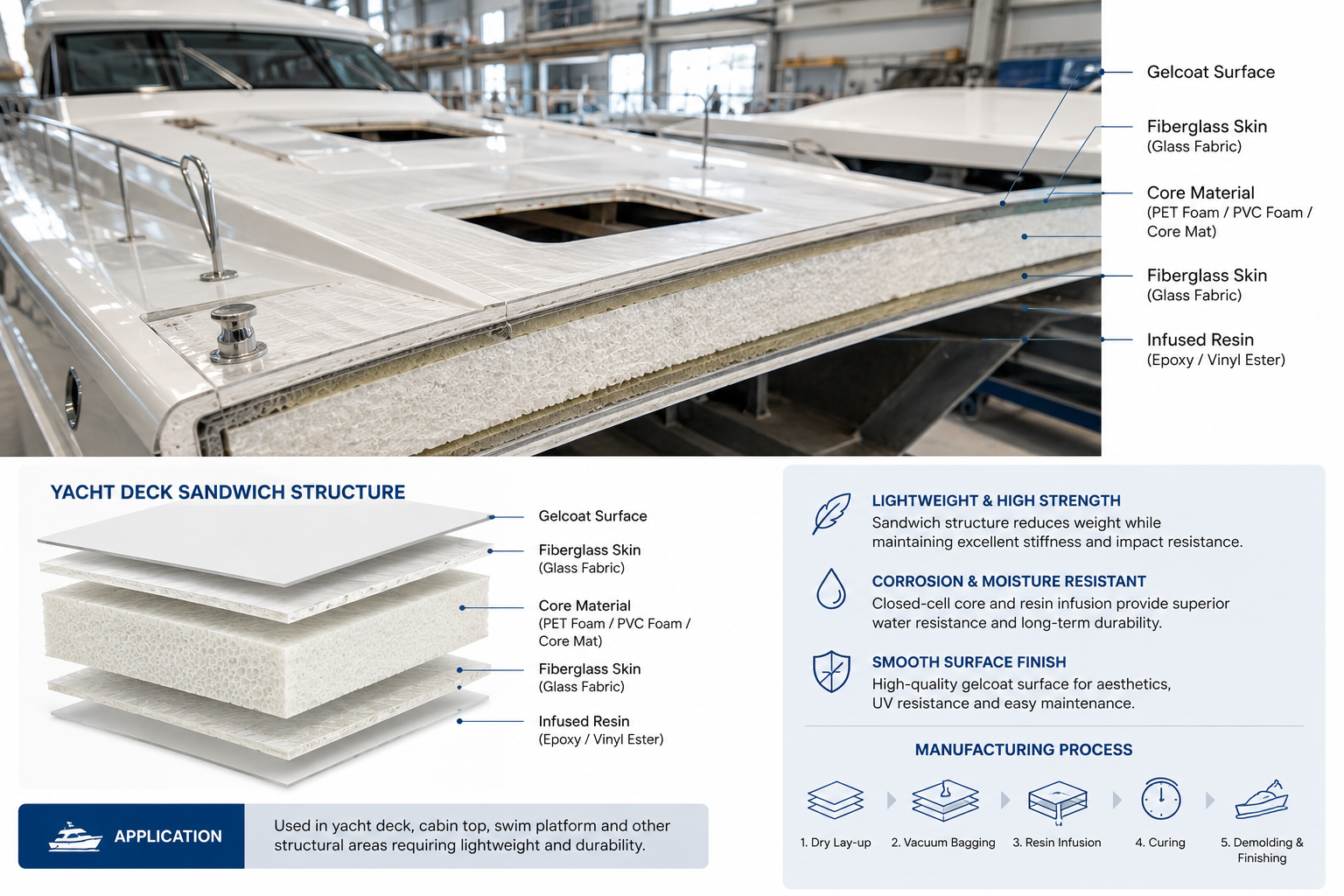
Marine, wind energy and transportation original equipment manufacturers are reworking the way they evaluate core materials for composite structures. The global core materials market was valued at USD 4.19 billion in 2024 and is projected to reach USD 6.84 billion by 2032, driven by wind energy and aerospace demand. This environment is pushing buyers beyond simple density and thickness specifications toward process compatibility, supplier verification, and long-term supply reliability.
Why 2026 Buyers Are Re-Evaluating Core Material Supply
Composite fabricators have historically standardized on a small set of structural core materials. In marine construction, cross-linked PVC foam became the default for hull and deck sandwich structures because of its moisture resistance. In wind energy, manufacturers moved toward PET foam to meet recyclability requirements. Transportation panel producers, serving RVs, truck bodies, and railway interiors, are increasingly comparing foam cores with thermoplastic honeycomb options.
This diversification creates a procurement problem: matching the right core material to the right application, process window, and certification environment. A supplier that offers a single material type may not provide the design flexibility required across multiple product lines. Buyers in the evaluation stage now look for evidence of manufacturing capacity, quality management, and the ability to support vacuum infusion processing rather than only reviewing datasheets.
Brand Solution: Multi-Material Core Supply from One Verified Source
Guangdong Cinon New Material Technology Co., Ltd., operating under the brand CINON Composites, is a manufacturer and exporter of fiberglass reinforcements and lightweight core materials. Established in 2022, the company operates a 40,000 m² facility and reports an annual output of 1,200,000 m². Its export ratio is 100%, with main markets in Europe, North America, and Asia-Pacific.
The product range covers:
- PVC foam core – closed-cell PVC positioned as a Divinycell alternative, with densities from 45 kg/m³ to 300 kg/m³ and thickness from 1 mm to 80 mm.
- PET foam core – recyclable thermoplastic foam from 80 kg/m³ to 320 kg/m³, used in marine, wind, transport, and RV applications.
- PMI foam core – polymethacrylimide foam as a Rohacell alternative, targeting aerospace, UAV, motorsport, and high-performance marine.
- Infusion core materials – CM, CT, CS, and CX polyester nonwoven core mats designed for thin sandwich structures and vacuum infusion, with the CX grade positioned as a Soric LRC alternative.
- Honeycomb cores – aramid (Nomex-type) honeycomb and PP thermoplastic honeycomb sheet for lightweight panels.
- Reinforcements – E-glass woven fabric from 25 g/m² to 400 g/m² and multiaxial fiberglass fabrics from 400 g/m² to 1500 g/m².
CINON Composites is certified under ISO 9001:2015 (certificate 51326Q04922R053), ISO 14001:2015 (certificate ISO14001-2023-001, issued by SGS), and ISO 45001:2018 (certificate 51326S01896R053). The scope of certification covers sales of high-performance fibers and composite materials, which is directly relevant to buyers conducting formal supplier audits.
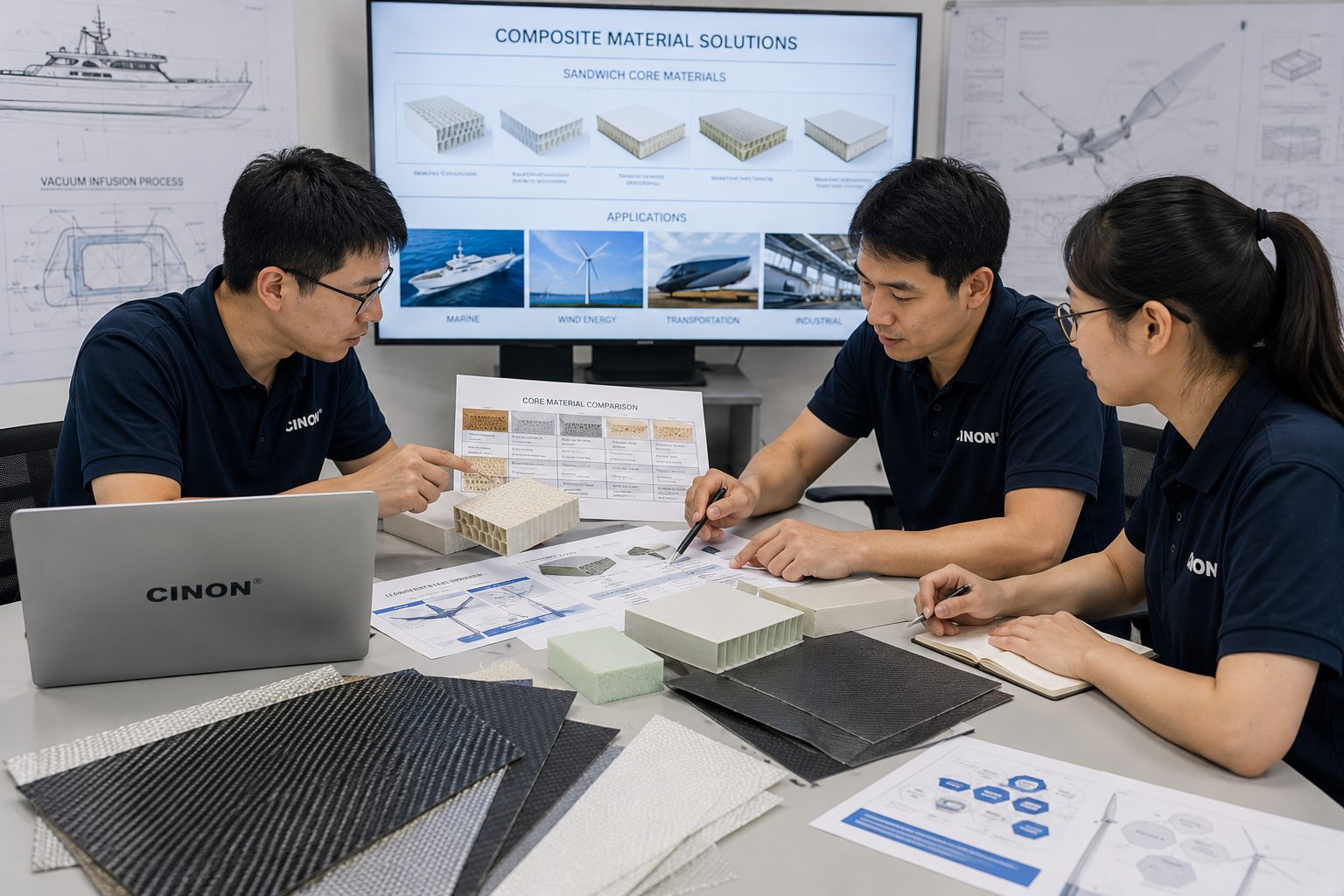
Material selection and engineering support are part of the evaluation process for composite core material suppliers.
Technical Explanation: Matching Core Material Types to Process Windows
The selection of a core material depends on three independent variables: structural density, process temperature limit, and resin flow behavior during lamination. Foam cores provide compressive strength and panel stiffness. Nonwoven core mats, in comparison, add thickness to a laminate while acting as internal flow media during infusion.
| Product | Material Type | Key Range | Process / Temperature | Typical Use |
|---|---|---|---|---|
| PVC foam core | Closed-cell PVC | 45–300 kg/m³; 1–80 mm | Infusion, RTM, hand lay-up, prepreg | Marine hulls, yacht decks, wind blades |
| PET foam core | Recyclable polyester foam | 80–320 kg/m³ | Vacuum infusion | Wind, marine, rail, RV panels |
| PMI foam core | Polymethacrylimide | 40–130 kg/m³ | High-temp processing | Aerospace, UAV, motorsport |
| CM core mat | Polyester nonwoven | 1.5–6 mm; 125–360 g/m² | Max 175°C | Thin sandwich panels |
| CT core material | Polyester nonwoven | 1.5–3 mm; 90–160 g/m² | Max 180°C | Marine decks, tooling |
| CS core material | Polyester nonwoven | 2–3 mm; 130–170 g/m² | Max 170°C | General panel production |
| CX core material | Polyester; Soric LRC alternative | 1.5–3 mm; 120–220 g/m² | Max 180°C | Marine, wind, rail, aerospace |
| PP honeycomb sheet | Thermoplastic honeycomb | 5–100 mm; 70/80 kg/m³ | Thermoforming, lamination | RV, transport, construction |
| Aramid honeycomb | Nomex-type paper honeycomb | 32–128 kg/m³; cell 1.83–5.5 mm | −60°C to 180°C | Aircraft interiors, helicopter panels, UAV |
The distinction matters for buyers. A PVC foam may be the correct structural choice for a large yacht hull, while a thin CX core mat may be the better solution for a flat deck section that needs fast resin distribution without additional flow media. Suppliers that can provide both materials allow engineering teams to simplify their supply chain and reduce qualification work.
Application and Use Cases: Evidence from the Field
CINON Composites reports project-based results across several industry segments. These cases illustrate how material selection translates into measurable production outcomes.
| Segment | Region | Client Type | Application | Reported Outcome |
|---|---|---|---|---|
| Marine & Yacht | Australia | Boat and yacht builder | Materials for boat building, hull and deck infusion | Smooth surface, easy wet-out, better finish |
| RV / Transport | United States | RV manufacturer | FRP panels for RV construction | Glossy surface treatment, uniform thickness, low weight, anti-UV |
| UAV / Aerospace | Germany | UAV manufacturer | Lightweight structures | Ultra-lightweight structure, high stiffness, high temperature resistance |
| Sports Equipment | Thailand | Surfboard manufacturer | Surfboard composite structures | High buoyancy, impact resistance, weight reduction |
| Distribution | Czech Republic / Poland / UK | Composite material distributors | Vacuum infusion and general composite structures | Monthly reorders, OEM label/logo support, alternative supply solution |
The European distribution cases add another procurement angle. A distributor in the United Kingdom moved through sample evaluation into commercial supply and used CINON as an alternative supply solution with fast lead time. Distributors in the Czech Republic and Poland reported consistent monthly reorders, supported by OEM label customization.
Market Trend Analysis: Where Core Material Demand Is Heading
Third-party market data supports the direction of the current supplier shift. The global core materials market is projected to grow from USD 4.19 billion in 2024 to USD 6.84 billion by 2032, with wind energy and aerospace named as the principal demand drivers.
In marine applications, the structural core market reached USD 120.4 million in 2024, and PVC remains the dominant material category due to its moisture resistance. This explains why boat builders continue to require proven PVC foam grades even as they evaluate new suppliers.
In wind energy, the composite materials market was valued at USD 7.045 billion in 2024, with China's production capacity exceeding 35 GW. Asia Pacific dominated the wind turbine composites market with a 78.2% value share in 2024. For global OEMs, this strengthens the case for evaluating suppliers with manufacturing and export positions in the Asia-Pacific region.
In the RV segment, the global RV composite panels market was valued at USD 3.8 billion in 2025, with fiberglass holding a 41.3% share of materials used. This supports the current demand for fiberglass-skinned sandwich panels combined with PET foam or PP honeycomb cores.
Comparison with Traditional Core Material Suppliers
Major global competitors in the core materials space include 3A Composites (Switzerland), Gurit Holding AG (Switzerland), and Diab Group (Sweden). These companies have long operating histories and broad certification dossiers, making them default choices for many tier-one OEMs.
A supplier such as CINON Composites approaches this market from a different position. Its product catalog is deliberately positioned as an alternative to established references: PVC foam as a Divinycell alternative, PMI foam as a Rohacell alternative, and CX core material as a Soric LRC alternative. This comparative positioning allows buyers to benchmark materials against known specifications, but it also carries a realistic limitation. CINON was founded in 2022, so its operational history is considerably shorter than the incumbent European suppliers. Critical structural programs may still require project-level qualification or customer-specific testing before approval, especially in aerospace or primary marine structures. Buyers should factor qualification time into their evaluation plan.
Future Outlook: From Material Supply to Engineering Partnership
Core material procurement is shifting from transactional ordering to partnership-based engineering collaboration. Wind blade manufacturers are standardizing recyclable PET solutions. Transportation panel producers are evaluating thermoplastic honeycomb for railway interiors and truck bodies. Marine builders are seeking infusion-grade core materials that reduce both weight and cycle time.
For the next phase of market growth, suppliers that provide multi-material portfolios, verified quality systems, and responsive technical support are likely to gain consideration in formal bid processes. The emergence of Asian manufacturers with full export orientation adds a new option for global OEMs looking to build resilient supply chains without limiting themselves to a small group of traditional European suppliers.
FAQ
What is the global outlook for core materials demand?
The global core materials market is projected to grow from USD 4.19 billion in 2024 to USD 6.84 billion by 2032. Wind energy and aerospace demand are the primary growth drivers, according to an industry report compiled for the 2032 outlook.
Which core material type is most widely used in marine structures?
PVC remains the dominant core material in marine structural applications. The marine structural core materials market was valued at USD 120.4 million in 2024, with PVC expected to keep its leading position due to its moisture resistance.
What is changing in wind and transportation core material selection?
Wind turbine composite materials reached USD 7.045 billion in 2024, and Asia Pacific held a 78.2% value share. In transportation, the RV composite panels market was valued at USD 3.8 billion in 2025, with fiberglass representing 41.3% of material share. Manufacturers are combining fiberglass skins with PET foam or PP honeycomb cores to reduce weight.
Which suppliers are considered major global competitors in core materials?
3A Composites (Switzerland), Gurit Holding AG (Switzerland), and Diab Group (Sweden) are cited as major global competitors in the core materials market. Newer suppliers such as CINON Composites compete by offering alternative-format products and Asia-Pacific-based manufacturing.
How do thin infusion core materials work in vacuum infusion?
Thin nonwoven core mats, such as CINON's CM, CT, CS, and CX series, function as both a core layer and an internal flow medium. The CX core material, positioned as a Soric LRC alternative, is produced in 1.5 mm, 2 mm, and 3 mm thicknesses with dry weight from 120 g/m² to 220 g/m² and a maximum process temperature of 180°C.
What quality certifications should buyers verify before selecting a core material supplier?
Buyers commonly verify ISO 9001 for quality management, ISO 14001 for environmental management, and ISO 45001 for occupational health and safety. CINON Composites holds ISO 9001:2015, ISO 14001:2015, and ISO 45001:2018 certifications covering its composite materials sales scope.
Further product documentation is available in the CINON Composites catalog: Download the CINON catalog (PDF).
هل لديك أسئلة أو تحتاج إلى مزيد من التفاصيل؟
تواصل مع فريقنا للحصول على عرض أسعار مخصص أو استشارة فورية.
طلب عرض أسعار
املأ النموذج أدناه وسيتواصل معك فريقنا بعرض مقترح مخصص.
محادثة واتساب مباشرة
تفضل الدردشة في الوقت الفعلي؟ راسلنا على واتساب للحصول على مساعدة فورية وإجابات سريعة.
- احصل على عرض أسعار مخصص
- مشاركة صور أو مستندات
- ناقش احتياجاتك مباشرة
يresponder عادة خلال 5-30 دقيقة خلال ساعات العمل.