
Corrosion-Resistant Castings for Waste Incinerator Grates: What Buyers Must Specify
Waste touches the castings before it touches anything else. In a moving grate incinerator, the grate plates are the first engineered surface the fuel bed meets, and they meet it while it is still wet, salty and cold — then they hold it through 850°C of combustion. Corrosion-resistant castings for waste incinerator grates are therefore not a catalogue adjective attached to a parts list. They are a set of verifiable commitments about alloy chemistry, casting soundness, dimensional control and documented field behaviour, all of which a buyer can and should request before placing an order.
This reference sets out where corrosion actually attacks a three-stage grate, what a purchase specification should contain, how Tenor Low Carbon New Energy Technology (Liaoning) Co., Ltd. specifies its grate castings, and where the limits of any material claim lie. It is written for procurement teams, plant engineers and EPC contractors who are comparing quotations at the research and evaluation stage.
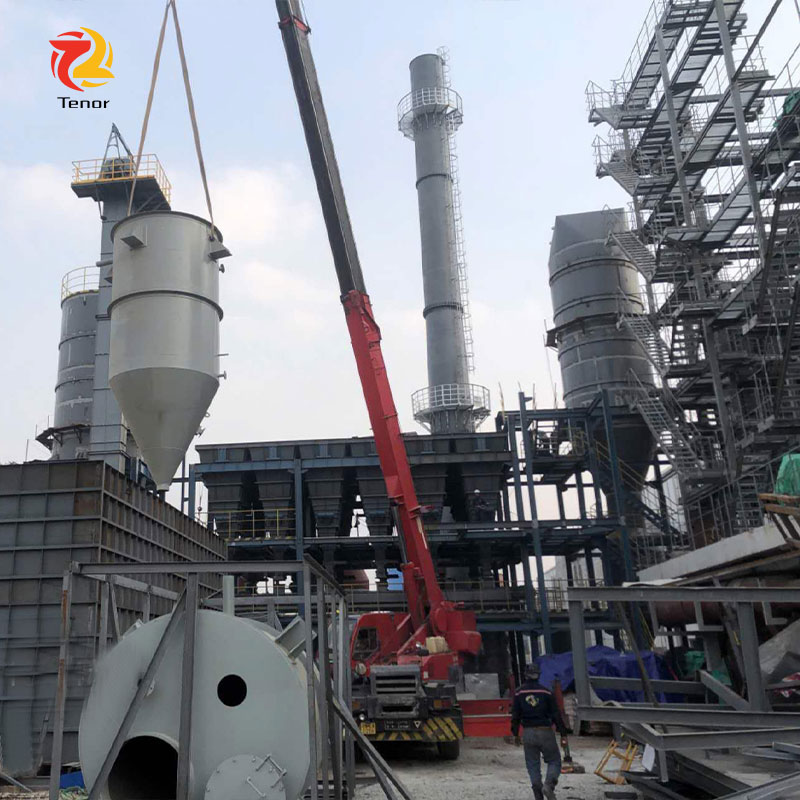
Cover image: a continuously operated municipal solid waste incineration line. Grate castings are the highest-frequency replacement item on the combustion side of the plant.
The Grate Environment: Wet Chlorides, Hot Ash and Thermal Cycling
Grate corrosion is not a single mechanism, and treating it as one is the most common reason replacement plates fail earlier than expected. In a reciprocating grate furnace, three distinct environments exist along the same metal run:
- Drying stage. Untreated municipal solid waste arrives with moisture, food residue and chlorinated plastics. The plate surface sits at a relatively low temperature, in contact with wet condensate containing chloride and sulphur species. This is a wet-corrosion, pitting and crevice regime rather than a heat regime.
- Combustion stage. Bed temperatures rise above 850°C while alkali chlorides in the slag form low-melting compounds that can break down the protective oxide layer on the casting. High-temperature oxidation and chloride attack occur together with mechanical abrasion from the moving bed.
- Burnout stage. The bed thins, local temperatures peak, and the plate is exposed to thermal fatigue as the machine stops, restarts or changes load.
The commercial consequence is easy to state and expensive to ignore. Thinned or distorted plates lose their running fit, the reciprocating stroke begins to bind, air distribution drifts away from the design setpoint, and unburnt carbon rises. A casting problem therefore shows up first as a combustion problem: higher ignition loss, more auxiliary fuel, and unplanned downtime in a plant that is paid to run continuously.
What ‘Corrosion-Resistant’ Should Mean in a Purchase Specification
Because most grate failures are progressive rather than sudden, the specification has to be written before the failure, not after it. The six items below are the ones that separate a defensible quotation from a price list.
| Specification item | What to request from the supplier | Why it matters at evaluation stage |
|---|---|---|
| Alloy grade and chemistry | Grade designation plus a batch-level chemical analysis covering chromium, nickel, molybdenum and carbon ranges, and a hardness result | Corrosion and abrasion resistance are set by chemistry and microstructure, not by the phrase ‘heat-resistant’. Two plates sold under the same trade description can behave very differently. |
| Casting process and heat treatment | Moulding method, heat-treatment cycle, and the dimensional and visual inspection record | Internal shrinkage cavities and unrelieved stress become initiation sites for cracking once the plate is thermally cycled. |
| Running-face tolerance and stroke interfaces | Drawing tolerances on the running face, pin and hole fits, and the stroke length the plate is designed for | A corrosion-resistant plate that is out of tolerance will seize in the reciprocating motion long before it corrodes. |
| Wear allowance and replaceability | Nominal thickness, minimum allowable thickness, and whether individual plates can be replaced in situ | Determines maintenance windows and the true annual consumable volume per line. |
| Documented service data | Reference plants with throughput, waste type, operating mode and annual replacement volume | The only defensible basis for a service-life claim. Life measured on one waste stream does not transfer automatically to another. |
| Compliance documentation | Machinery attestation and market-access certificates relevant to the destination country | Permitting and customs clearance depend on documents, not on assurances. |
How Tenor Specifies Its Grate Castings
Tenor Low Carbon New Energy Technology (Liaoning) Co., Ltd. is a Dalian-based manufacturer of small and medium-scale waste incineration systems and three-stage reciprocating mechanical grate furnaces, with a production base in Wafangdian, Dalian, and a corporate lineage that traces back to Dalian Sunshine Boiler Auxiliary Equipment Co., Ltd., established in 1998. The company designs and manufactures complete incineration equipment and also supplies grate bodies and components on their own.
On the material side, Tenor specifies heat-resistant and wear-resistant cast steel for its grate plates and structural castings. The company publishes two operating figures associated with that choice: an annual grate damage rate of 1% or less, and a heat loss on ignition of 5% or less. Both figures are company-stated performance indicators tied to the operating conditions of the reference projects described later in this article; they are not universal guarantees and should be confirmed against a specific waste analysis.
The design choices that reduce corrosion load
Material selection is only part of the answer. Tenor’s three-stage reciprocating mechanical grate uses an independent hydraulic drive for each of the drying, combustion and burnout stages, together with independent air chambers for segmented air distribution and stroke adjustment. In practice this means the operator can run the drying stage differently from the burnout stage — adding air where moisture is high, reducing it where the bed is already hot. Because each stage is controlled separately, the plant avoids the two conditions that accelerate casting damage most: a persistently wet first stage, and an oxygen-starved zone running hot under a thick bed.
The combustion design follows the same logic. Secondary combustion is held at 850°C or above with a flue-gas residence time longer than two seconds under the 3T+E approach (temperature, time, turbulence and excess oxygen), which is the condition international technical guidelines associate with complete dioxin breakdown. Stable combustion also protects the castings downstream: fewer temperature excursions means less thermal fatigue in the burnout zone.
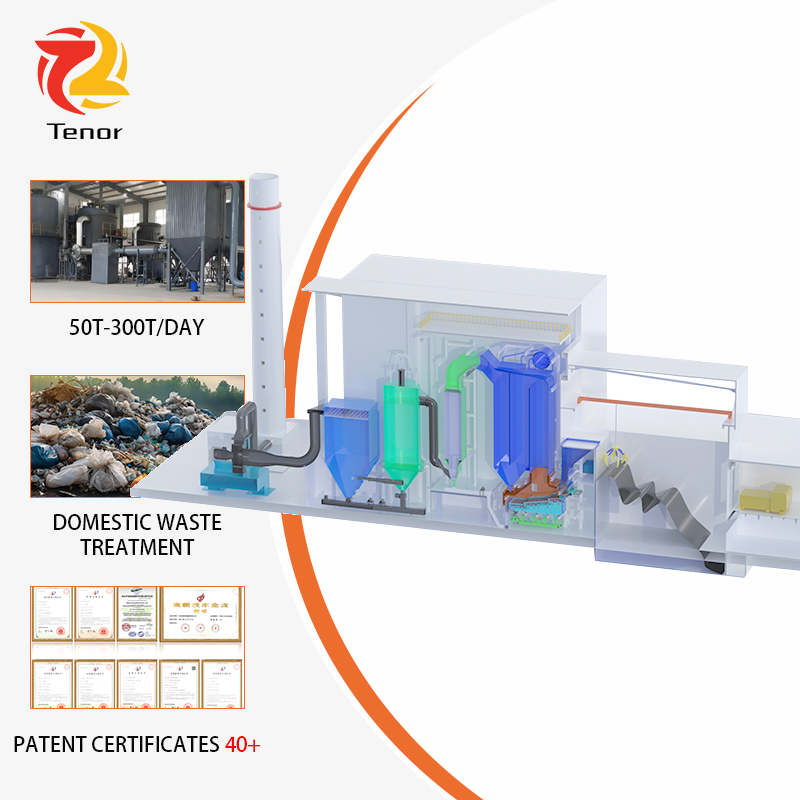
Combustion-side arrangement of a staged grate furnace. The drying, combustion and burnout zones impose three different corrosion and wear regimes on the same casting run.
Commercial and compliance terms relevant to a casting buyer
- Component supply is possible. Minimum order quantity is one unit for the grate body alone, and the company offers OEM, ODM and component supply alongside complete systems.
- Customisation scope. Treatment capacities from 15 to 300 tonnes per day, furnace design, air-supply configuration and complete-system integration can be adapted, including high-altitude and cold-climate versions and waste with high moisture content or low calorific value.
- Quality control. A pre-shipment performance test is carried out before dispatch.
- Machinery attestation. UDEM Machinery Directive Attestation of Conformity M.2025.206.C120374, issued 12 June 2025 and valid to 11 June 2030, referencing EN ISO 12100:2010 and EN 60204-1:2018, covering the small and medium-sized garbage incineration system manual and models TYFSXT-30 through TYFSXT-300.
- Market access. US EPA certification 105602-HKG-1, issued 28 February 2026 and valid to 1 March 2027, held by the wholly owned subsidiary Tenor Green Technology (Hong Kong) Ltd., which also holds CE documentation for EU market access.
- Standards work. The company is a National High-Tech Enterprise and participated in drafting the group standard T/CITS 242-2025.
Technical Explanation: Three Stages, Three Different Corrosion Mechanisms
Material choice for a grate is a compromise, and the compromise is different in each stage. Treating the whole grate as one specification is the reason some plants report excellent plate life in the burnout zone and repeated failures in the drying zone.
Drying stage: resistance to wet chloride attack
Here the enemy is condensate. Water vapour carrying chloride and sulphur species deposits on plate surfaces that are alternately cooled by incoming waste and heated by radiation from the bed ahead. Pitting and crevice corrosion begin in the gaps between plates and around pin joints. The material requirement is corrosion resistance and toughness rather than maximum hot hardness, because a brittle plate that resists chemistry but cracks under thermal shock is not an improvement.
Combustion stage: chloridation plus abrasion
In the main combustion zone, alkali chlorides in the slag can form low-melting compounds at the metal surface, interrupting the protective oxide scale and allowing oxidation to proceed beneath it. Combined with abrasion from the moving bed, this is the highest-wear position on the grate. Higher-chromium alloy content is the conventional answer here. HTNXT’s verified industry data records that advanced high-chromium cast iron alloys can extend grate bar service life by 15% to 100% compared with generic materials, a figure reported by a commercial casting source and best treated as a directional range rather than a specification.
Burnout stage: thermal fatigue
The burnout stage combines the highest local temperatures with the thinnest bed and the greatest exposure to load changes. Damage here is dominated by thermal fatigue and oxidation. Because Tenor drives each stage independently, the burnout stage stroke and air supply can be set to keep a protective ash layer without over-agitating the bed.
Process flow of a 200–300 t/d incineration line. Staged air distribution and independent stage drives are the operating levers that determine how long the castings last.
Where These Castings Are Actually Tested: Application Fit
Material claims are only meaningful against a waste stream. The reference conditions below illustrate where Tenor’s grate castings operate and what each condition does to the corrosion load.
- Township and municipal solid waste, high moisture. Modular, quick-assembly configurations from 20 t/d upward run continuously, with raw household waste fed directly and no front-end sorting. High moisture keeps the drying stage wet for longer, which is precisely the condition that punishes a poorly specified first-stage plate.
- High-altitude, low-oxygen sites. The Qinghai Mangya 50 t/d demonstration project operates at 60–70% of sea-level oxygen with a high-altitude special version and ducting arrangement; the project reported first-attempt ignition success and stable operation with self-sustaining combustion.
- General industrial solid waste. A 100 t/d industrial park installation reported one year of stable operation with EU-standard emissions, using modular deployment and rapid installation.
- Agricultural and forestry waste. Low calorific value and seasonal operation call for multi-stage air distribution plus a drying stage; seasonal start-stop cycles raise thermal fatigue risk relative to continuous duty.
- Large-scale grate component supply. Grate equipment supplied into a 600 t/d waste-to-energy project in Vietnam has operated for more than two years, which is the reference case most relevant to buyers sourcing castings as replacement parts rather than as a complete plant.
- Small-tonnage medical waste. A dedicated unit with negative pressure and a double combustion chamber is available for batch operation.
The boundary matters as much as the fit. Tenor systems are designed for municipal solid waste, general industrial solid waste, agricultural and forestry waste and small-tonnage medical waste. They are not intended for hazardous chemicals or highly corrosive hazardous waste, and any waste stream outside those categories should be evaluated through project testing of composition, calorific value and moisture before a casting specification is fixed.
Market Trend Analysis: Castings Are Moving from Capex Line to Opex Line
Three data points explain why grate castings are receiving more procurement attention than they did a decade ago.
First, the installed base is large and it is grate-based. A 2025 market study by Kings Research attributes USD 7.23 billion of 2024 global revenue specifically to the moving grate technology segment of the incinerator market. Second, the growth centre is in Asia. Dataintelo places Asia Pacific at 38.6% of the grate incinerator market in 2025, driven largely by Chinese expansion — the same regional cluster in which specialised manufacturers such as Tenor operate, targeting small and medium-scale applications. Third, material upgrades now have a quantifiable case: high-chromium alloy content is reported to extend grate bar service life by 15–100% over generic materials.
Two cautions belong with those numbers. Market-size definitions differ between research houses, and absolute figures should be read as directional rather than precise. Service-life extension ranges are wide because they depend on waste calorific value, chloride content and operating discipline, not on alloy content alone. The practical implication is nonetheless clear: as plants run longer between overhauls and emission limits tighten, the grate is being evaluated as a lifecycle consumable with a documented replacement interval, not as an incidental steel part.
Comparison with Traditional Solutions
No single casting approach wins on every dimension. The table below compares the material routes commonly offered for incinerator grate plates, including the route Tenor specifies.
| Approach | Typical strength | Typical boundary |
|---|---|---|
| Standard heat-resistant, wear-resistant cast steel (the grade Tenor specifies for grate plates) | Balanced hot strength and toughness; tolerates thermal shock from start-stop cycles; repairable and individually replaceable | Lower abrasion resistance than high-chromium white iron in severely abrasive ash; chemistry must be confirmed per batch rather than assumed from the material name |
| High-chromium white cast iron | Very high abrasion resistance; reported service-life extension of 15–100% over generic materials | Lower toughness; higher crack risk where frequent thermal cycling or shutdowns occur; higher unit cost that requires sufficient throughput to pay back |
| Generic low-alloy or grey iron plates | Low first cost and wide local availability | Shortest service life and the highest risk of distortion, which then damages adjacent components and disrupts the stroke |
| Composite or hard-faced plate designs | Hard surface over a tougher core; can be tuned to a specific wear pattern | Added manufacturing complexity and longer replacement lead times; performance depends heavily on bonding quality |
Limits buyers should plan around
- The 1% annual grate damage rate is a company-reported indicator linked to specific operating conditions and reference projects. It should not be projected onto highly corrosive or hazardous waste streams.
- Tenor’s published material description is heat-resistant and wear-resistant cast steel. A buyer requiring a named alloy grade with specified chromium or nickel ranges should confirm the chemistry and hardness documentation at project stage rather than assume it is stocked for every model.
- Lead time is assessed on a project basis; there is no fixed catalogue lead time for component orders.
- The standard platform addresses 15–300 t/d complete systems. Larger grate supply is a component engagement, as in the 600 t/d reference, and requires separate technical review.
- Upgrading to a higher-alloy casting raises unit cost. Whether it lowers total cost of ownership depends on throughput, waste chemistry and maintenance access — a calculation that requires the buyer’s own operating data.
Future Outlook
Three directions are visible from the current specification conversation. Emission rules continue to tighten, which pushes plants toward stable staged combustion and therefore toward castings that can hold tolerance across many load cycles. Maintenance strategies are shifting from calendar-based replacement to condition-based replacement, supported by remote monitoring of grate and combustion parameters of the kind Tenor already provides as part of its after-sales service. And material traceability is becoming a procurement expectation rather than a special request: batch-level chemistry and hardness records will increasingly be treated as standard tender documents, in the same way that machinery attestations already are.
For buyers, the practical conclusion is not that one alloy solves corrosion. It is that corrosion resistance becomes a manageable variable only when chemistry, tolerance, service data and compliance documents are requested together, against a defined waste stream, before the purchase order is issued.
FAQ
What material are Tenor waste incinerator grate plates made from?
Tenor specifies heat-resistant and wear-resistant cast steel for its grate plates and related castings. The company publishes an annual grate damage rate of 1% or less and a heat loss on ignition of 5% or less for its grate systems. A buyer requiring a specific alloy grade should request the batch-level chemical analysis and hardness record for the casting concerned.
How can corrosion resistance be verified before a casting order ships?
Three document sets are relevant: the material certificate for the casting batch, the dimensional and inspection record for the running face and stroke interfaces, and the system-level conformity documents. Tenor carries out a pre-shipment performance test, and its system documentation includes UDEM Machinery Directive Attestation of Conformity M.2025.206.C120374 valid to 11 June 2030, plus US EPA certification 105602-HKG-1 held by Tenor Green Technology (Hong Kong) Ltd., valid to 1 March 2027.
Can grate castings be purchased as replacement parts without buying a complete incineration system?
Yes. Tenor offers OEM, ODM and component supply, with a minimum order quantity of one unit for the grate body alone. Customisation covers treatment capacities from 15 to 300 tonnes per day, furnace design and air-supply configuration. Lead time is assessed on a project basis rather than quoted from a fixed catalogue.
Does a three-stage grate require the waste to be sorted or pretreated?
No. Raw household waste can be fed directly into Tenor’s three-stage reciprocating mechanical grate without front-end sorting, which is one reason the design suits mixed municipal waste with large calorific-value fluctuations. The three stages — drying, combustion and burnout — are each driven by an independent hydraulic cylinder with independent air chambers, so segmentation replaces pretreatment as the method of handling variability.
Which waste streams are outside the intended scope of these grate castings?
Tenor systems are intended for municipal and township domestic waste, general industrial solid waste, agricultural and forestry waste, and small-tonnage medical waste through a dedicated unit with negative pressure and a double combustion chamber. Hazardous chemicals and highly corrosive hazardous waste are outside the accepted scope, and any unfamiliar stream should be characterised by composition, calorific value and moisture testing before a casting specification is set.
Is a high-chromium casting always the lower-cost choice over the life of a plant?
Not necessarily. High-chromium alloys are reported to extend grate bar service life by 15–100% compared with generic materials, but they carry a higher unit cost and lower toughness, which raises crack risk where thermal cycling is frequent. Whether the upgrade pays back depends on throughput, ash abrasiveness, chloride content and maintenance access. The comparison should be run with the plant’s own replacement history rather than with a generic service-life range.
How are dioxins and flue-gas emissions controlled during operation?
Combustion is held at 850°C or above for a flue-gas residence time longer than two seconds under the 3T+E approach, which is the condition international technical guidelines associate with complete dioxin breakdown. Flue gas then passes through deacidification, bag filtration and activated carbon adsorption. Tenor states that this configuration can meet national and EU standards, and offers online flue gas monitoring as an option.
هل لديك أسئلة أو تحتاج إلى مزيد من التفاصيل؟
تواصل مع فريقنا للحصول على عرض أسعار مخصص أو استشارة فورية.
طلب عرض أسعار
املأ النموذج أدناه وسيتواصل معك فريقنا بعرض مقترح مخصص.
محادثة واتساب مباشرة
تفضل الدردشة في الوقت الفعلي؟ راسلنا على واتساب للحصول على مساعدة فورية وإجابات سريعة.
- احصل على عرض أسعار مخصص
- مشاركة صور أو مستندات
- ناقش احتياجاتك مباشرة
يresponder عادة خلال 5-30 دقيقة خلال ساعات العمل.