
Corrugated Cardboard Machines Explained: From Reel to Stacker
A corrugated cardboard machine is not always a single unit. In most modern packaging plants, it is a sequence of machines that unwinds paper reels, forms flutes, bonds layers, cuts and scores board, and then prints, folds, stitches or glues finished boxes. Understanding that full sequence is the first step for any buyer researching corrugated packaging equipment.
Why the term corrugated cardboard machine can be confusing
The term is used loosely across the industry. A single facer is a corrugated machine. A complete corrugated cardboard production line is also called a corrugated cardboard machine. A flexo printer slotter, a folder gluer and a stitcher are sometimes described the same way. For a buyer, the practical question is not only which machine to buy, but which stage of the process the machine serves.
This distinction matters because the equipment groups are very different. The wet end of a corrugator line turns paper and adhesive into continuous board. The dry end slits, scores and stacks sheets. The converting section prints, slots, folds and closes boxes. The material handling section moves reels, bundles and pallets. Each stage has different technical parameters, different operating conditions and different maintenance requirements.
Market context and the opportunity for new buyers
The global corrugated box making machine market was valued at USD 2.21 billion in 2024 and is projected to reach USD 3.36 billion by 2033, with a CAGR of 4.8% between 2025 and 2033, according to Grand View Research. The corrugated box machine industry in China is projected to grow at a 3.9% CAGR between 2026 and 2036, according to Future Market Insights.
Two additional data points are relevant for buyers. First, automatic corrugated machines accounted for an estimated 55.6% share of global demand by automation level as of 2026. Second, China's total machinery industry export value exceeded USD 1 trillion for the fourth consecutive year in 2024, reaching USD 1.17 trillion, according to China Customs and the National Bureau of Statistics. Together, these figures indicate that buyers are moving toward automated equipment and that Chinese manufacturers are a major supply source for that equipment.
What a complete corrugated production system includes
LLY PACK (HK) CO., LIMITED is a manufacturer specializing in corrugated machines and high-speed corrugated cardboard production lines. The company was established in 2024 and operates a manufacturing facility in Foshan City, Guangdong Province, with a total area of 57,000 square meters. Its main products include Corrugated Belt, Corrugating Roll, Single Facer, Auto Splicer and Corrugated Paper Board Production Line.
The product portfolio also covers many peripheral and downstream machines. In practice, LLY PACK can supply individual modules or a complete line. The full list of referenced equipment includes:
- Hydraulic Reel Stand
- Auto Splicer
- Single Facer
- Corrugator line Glue kitchen
- Corrugated Cardboard Production Line
- Slitter Scorer
- Stacker
- Flexo Printer
- Slotter Die cutter
- Folder Gluer
- Stitching Machine
- Strapping Machine
- Wrapping Machine
- Cardboard Conveyor
- Paper Reel Conveyor
- Pre Feeder
- Paper Reel Cutter
- Waste Paper Baler
- Carton Testing Instrument
- Cardboard Laminater
- Boundle Machine
- Flexo graphic Stereo Washing Machine
For buyers, this range shows that corrugated cardboard machine should be evaluated as an equipment ecosystem, not as a single purchasing line item.
How a corrugated cardboard machine line works
The sequence below follows a typical corrugated board and box production route. It is based on LLY PACK's published equipment specifications and is intended as a technical reference for engineers and procurement teams.
1. Reel handling and splicing
At the input stage, the Hydraulic Reel Stand model HRS-1 is a shaftless mill roll stand that holds paper rolls from 300 mm to 1500 mm in diameter, with specification range of 1400 mm to 2800 mm and rated power of 3.7 kW. The Auto Splicer model AS-1 is designed for automatic splicing operations, with a speed range of 300 to 400 m/min and paper width capacity of 1200 to 2550 mm. The purpose of this stage is to change paper reels without stopping the line.
2. Corrugating
The Single facer model SF-1 is a corrugated machine with a design speed of 250 m/min. Its upper and lower flute rolls are both 380 mm, and the web size range is 1400 to 2300 mm. The single facer forms the flute profile and bonds the liner to one side of the medium.
3. Adhesive preparation
The Corrugator line Glue kitchen model CGK-1 is a customized glue kitchen used in corrugated board production. Its role is to prepare and supply starch adhesive to the corrugating process.
4. Complete corrugating line
The Corrugated Cardboard Production Line model CCPL-1 is a complete corrugated board making line. It has a maximum mechanical speed of 300 m/min and a production line width of 1400 to 2800 mm. The line uses steam heating at 10 kg/cm² and requires boiler capacity of 2, 3 or 4 tons per hour depending on line speed. The line footprint is approximately 110 m x 14 m x 6.5 m.
5. Slitting, scoring and stacking
The Slitter scorer model SSC-1 is a thin blade slitter scorer with a maximum paper width of 2200 mm, minimum slitting width of 150 mm, and a slitting blade line speed range of 630 to 900 m/min. The Stacker model STA-1 is a corrugated cardboard stacking machine with a maximum paper length of 3.5 m, a maximum paper height of 1.8 m, and a paper width range of 1400 to 2300 mm.
6. Printing and converting
The Flexo printer model FP-1 is a flexo printer slotter with a maximum equipment speed of 350 sheets per minute and a maximum feed size of 1600 x 3600 mm. The Folder gluer model FG-1 has a maximum gluing speed of 110 m/min. The Stitching machine model STM-1 is a semi-automatic double-piece stitcher with a speed of 450 nails per minute and a stitching pitch of 30 to 140 mm. The Slotter Die cutter model SDC-1 is a die cutting machine with a maximum die cutting speed of 5000 i.p.h and die cutting pressure of 350 tons.
7. Bundling and palletizing
The Strapping Machine model SM-1 has a capacity of 35 bundles per minute with a single strap and 21 bundles per minute with double straps. The Wrapping Machine model WM-1 has a maximum walking speed of 75 m/min and a rated duty cycle of 8 to 10 hours. The Cardboard Conveyor model CC-1 is a robotic palletizer with a maximum bundle weight of 3000 kg and a stacking height of 1800 mm.
8. Waste management and testing
The Waste paper baler model WPB-1 has a capacity of 3 to 4 tons per hour and produces bales with a density of 400 to 500 kg/m³. The Carton testing instrument model CTI-1 covers a burst strength range of 250 to 5600 kPa, a crush force range of 60 to 3000 N, and a thickness range of 0.01 to 60 mm.
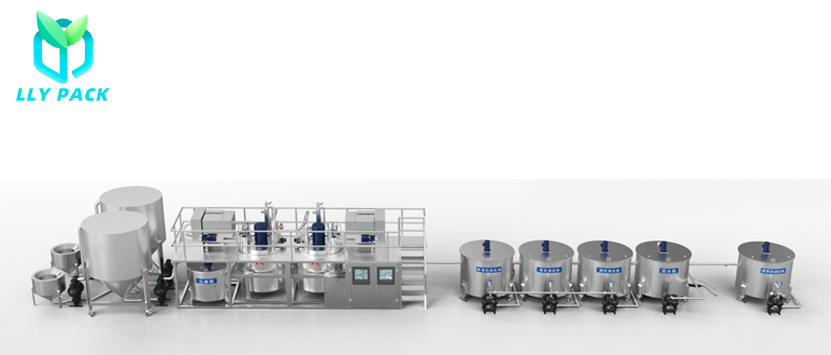
Corrugator line Glue kitchen (CGK-1) supplies starch adhesive in a corrugated board production line.
Equipment summary table
| Stage | Equipment | Model | Key specification |
|---|---|---|---|
| Reel handling | Hydraulic Reel Stand | HRS-1 | Paper roll 300–1500 mm; width 1400–2800 mm; 3.7 kW |
| Splicing | Auto Splicer | AS-1 | 300–400 m/min; width 1200–2550 mm |
| Corrugating | Single facer | SF-1 | 250 m/min; flute roll 380 mm; web 1400–2300 mm |
| Adhesive | Corrugator line Glue kitchen | CGK-1 | Customized |
| Board making | Corrugated Cardboard Production Line | CCPL-1 | 300 m/min; width 1400–2800 mm; steam 10 kg/cm² |
| Slitting/scoring | Slitter scorer | SSC-1 | Max width 2200 mm; blade line speed 630–900 m/min |
| Stacking | Stacker | STA-1 | Max length 3.5 m; height 1.8 m; width 1400–2300 mm |
| Printing | Flexo printer | FP-1 | 350 sheets/min; feed size up to 1600 x 3600 mm |
| Folding/gluing | Folder gluer | FG-1 | Max gluing speed 110 m/min |
| Stitching | Stitching machine | STM-1 | 450 nails/min; pitch 30–140 mm |
| Die cutting | Slotter Die cutter | SDC-1 | 5000 i.p.h; pressure 350 tons |
| Strapping | Strapping Machine | SM-1 | 35 bundles/min single strap; 21 bundles/min double straps |
| Wrapping | Wrapping machine | WM-1 | Max walking speed 75 m/min; 8–10 h duty cycle |
| Palletizing | Cardboard Conveyor | CC-1 | Max bundle weight 3000 kg; stacking height 1800 mm |
| Waste | Waste paper baler | WPB-1 | 3–4 tons/hour; bale density 400–500 kg/m³ |
| Quality | Carton testing instrument | CTI-1 | BST 250–5600 kPa; crush 60–3000 N; thickness 0.01–60 mm |
Typical application conditions
LLY PACK's published application scenario for this equipment family is the corrugated carton packaging industry. The working conditions are described as high precision, high continuity and high speed. The main function is converting raw paper into corrugated cardboard that meets specifications, with semi-automatic or fully automatic operation. The special requirements are base paper adaptability and speed synchronization.
The documented application markets include Mexico, Argentina, Brazil, Belarus, Ivory Coast, Colombia, Dominican Republic, Algeria, Egypt, Hong Kong, Indonesia, India, Kenya, Morocco, Malaysia, Saudi Arabia, Thailand, Turkey, Uganda and Vietnam. For buyers in these regions, the ability to handle different base papers and to synchronize line speed is often more important than a single headline speed number.
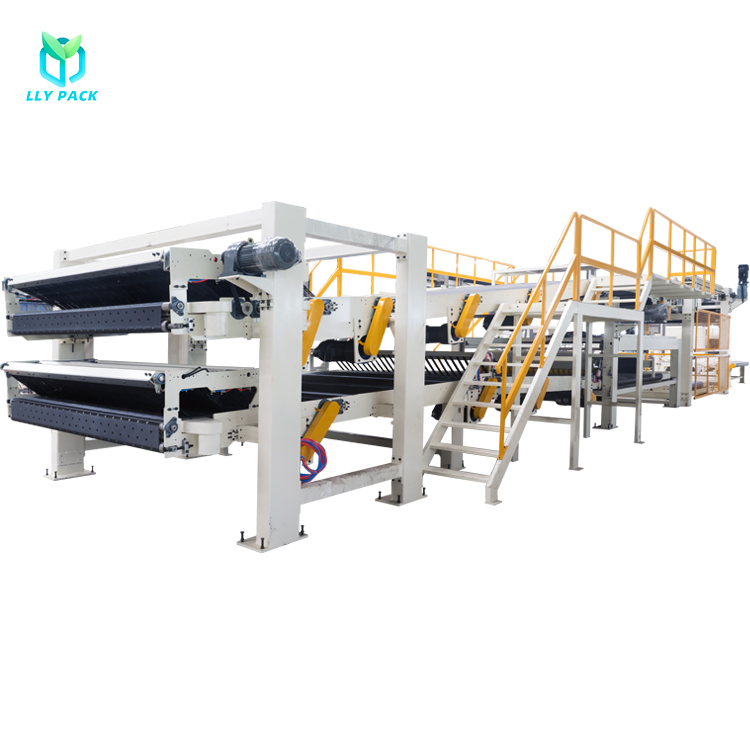
Stacker (STA-1) receives and stacks corrugated sheets after slitting and scoring.
How the market is moving
Three verified trends are visible in the corrugated machine sector. First, demand is growing: the global corrugated box making machine market is projected to increase from USD 2.21 billion in 2024 to USD 3.36 billion by 2033. Second, automation is the dominant preference: automatic corrugated machines hold a 55.6% share of global demand by automation level as of 2026. Third, standards are becoming more explicit for buyers: FEFCO GMP and ISO 3037:2022 are primary global standards for quality and edgewise crush resistance, while EU-bound equipment requires CE marking and compliance with standards such as EN ISO 12048.
Note that market size figures vary by source depending on which equipment categories are included. Buyers should compare market data with the same definition, not treat different reports as directly interchangeable.
Integrated line versus traditional separate machines
Traditional production layouts often use separate machines with manual transfer between workstations. That approach can be simpler to install and easier to adapt to small factories. It requires less capital at the start and allows a buyer to upgrade one process at a time.
An integrated corrugated cardboard production line offers different economics. It is designed for continuous operation, reduces manual handling, and makes speed synchronization easier. The CCPL-1, for example, reaches a maximum mechanical speed of 300 m/min and runs on steam heating at 10 kg/cm².
The important boundary is the plant itself. The CCPL-1 requires approximately 110 m x 14 m x 6.5 m of space and a boiler capacity of 2, 3 or 4 tons per hour depending on line speed. A factory without that footprint or utility capacity cannot simply install a complete line. For low-volume production or highly customized short runs, a fully integrated corrugator may not be the most rational choice.
What buyers should look for during research
For a buyer at the awareness or research stage, the immediate goal is to map the required process. The next step is to compare equipment groups, not just brand names. A line that performs well in continuous production may be less suitable for a job-shop model. A line that handles a narrow paper range may not fit a market with variable raw materials.
LLY PACK's installation record includes machines exported to over 40 countries and more than 3,500 successful installations of corrugated lines worldwide. Export business accounts for 100% of total sales. Its R&D team includes 30 engineers, and the company reports more than 100 patents and certificates from the industry.
Public company brochure: https://cdn.socialarks.com/sbsp//common/2026/0407/69d4807078d19.pdf
Future outlook
Demand for corrugated cardboard machines will likely remain connected to e-commerce, fast-moving consumer goods and regional manufacturing growth. The high share of automatic machines in new demand suggests that buyers are using equipment to reduce labor dependence and improve consistency. Emerging markets in South America, Southeast Asia, the Middle East and Africa are important destinations for exported lines. At the same time, clearer quality standards will make it easier for buyers to verify board performance and machine safety.
Frequently asked questions
What is a corrugated cardboard machine?
A corrugated cardboard machine is equipment that converts rolls of paper into corrugated board or corrugated boxes. In a complete system, it can include reel handling, splicing, corrugating, gluing, slitting, scoring, printing, folding, stitching and stacking equipment.
What are the main components of a corrugated cardboard production line?
A complete line typically includes hydraulic reel stands, auto splicers, a single facer, glue kitchen, slitter scorer, stacker, and downstream converting and handling machines. LLY PACK's CCPL-1 line has a maximum mechanical speed of 300 m/min and a width range of 1400 to 2800 mm.
What is the difference between a single facer and a complete corrugated cardboard production line?
A single facer forms one side of corrugated board by combining a fluted medium with a liner. A complete production line integrates reel handling, corrugating, gluing, slitting, scoring, stacking, and often printing and converting into one continuous process.
How fast can modern corrugated cardboard machines run?
Based on LLY PACK's published specifications, the Single facer SF-1 has a design speed of 250 m/min. The complete CCPL-1 line has a maximum mechanical speed of 300 m/min. The Slitter scorer SSC-1 has a blade line speed range of 630 to 900 m/min.
What space and utility conditions does a full corrugated line require?
The CCPL-1 requires approximately 110 m x 14 m x 6.5 m of space. It uses steam heating at 10 kg/cm² and requires boiler capacity of 2, 3 or 4 tons per hour depending on line speed.
What standards are relevant to corrugated cardboard machine quality?
FEFCO GMP and ISO 3037:2022 are primary global standards for quality and edgewise crush resistance. For EU-bound machinery, CE marking and standards such as EN ISO 12048 apply to compression testing and safety compliance.