
Corrugated, Label and IML: A Single Pass Printer Shortlist
Corrugated, Label and IML: A Single Pass Printer Shortlist
Corrugated cartons, label rolls and in-mould labels (IML) do not shortlist the same way. In the portfolio published by FocusInc (Shanghai Focus Industrial Co., Ltd.), the corrugated group is the Cobra-1209S, Cobra-691S Max and Cobra-1815S; the label group is the Viper-391S, Viper-391S Pro, Vesa-830A and NEXUS-350J; and the model documented for IML work is the S350 Jetpress. This article groups those eight models by production job, states only the specifications the supplied company material supports, and separates what is documented from what a buyer still has to confirm in writing.
The result is a starting point for supplier inquiries rather than a ranking. No normalised, independently measured comparison of speed, resolution, uptime or total cost exists for these models in the material reviewed here. A rank order built from vendor figures collected under different conditions would look more precise than the evidence allows, so the shortlist is organised around three different production problems instead.
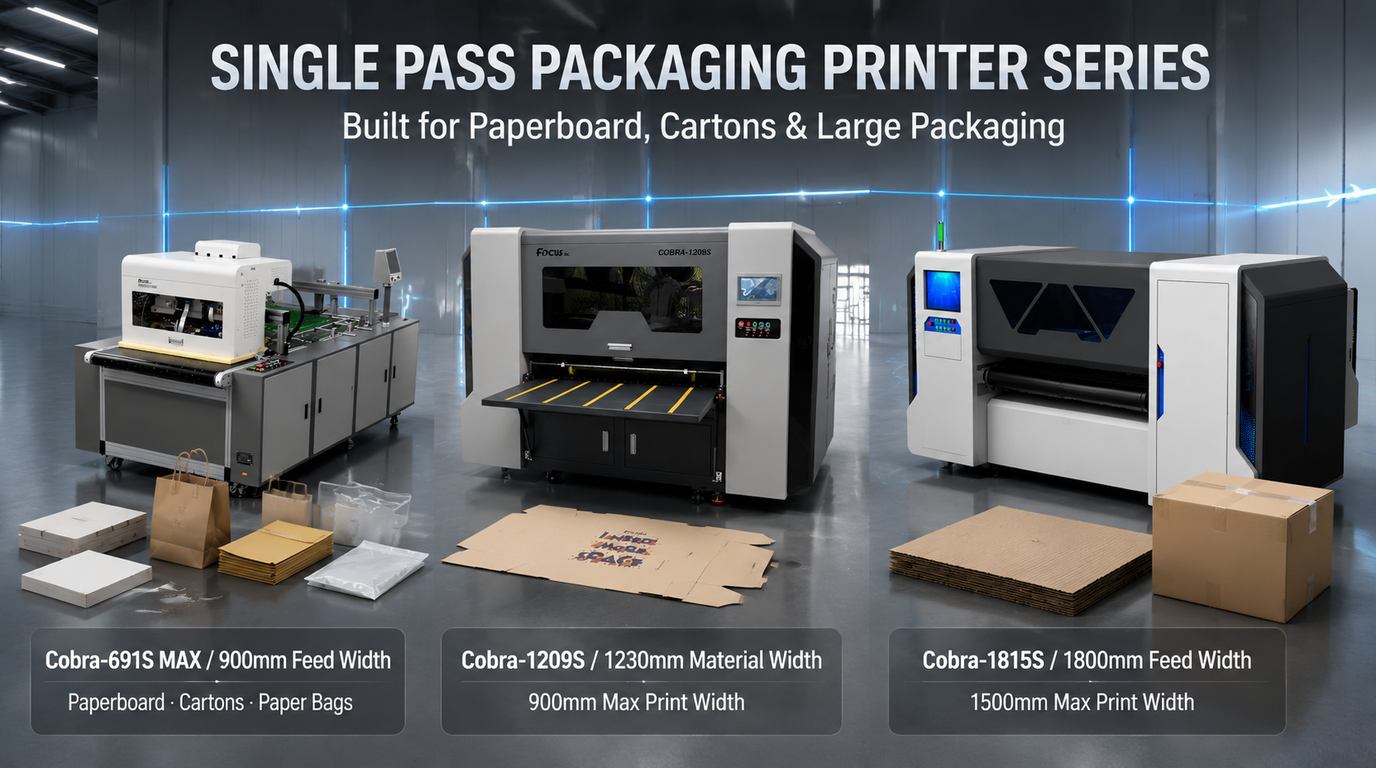
Single pass machines are built in different sizes because corrugated board, label webs and IML film impose different width and handling requirements.
Why the job, not the model number, should drive the shortlist
A single pass printer forms the whole image in one pass of the material under a full-width head array. That architecture is common to every model here. What differs is the material path built around it: how board is fed, how a label web is tensioned and rewound, whether die-cutting happens inline, and how thin IML film behaves at speed. Those differences decide which machine suits which plant.
The commercial argument is usually about plates and minimum order quantity rather than print speed. In a label case record FocusInc publishes for a Vietnamese converter, the stated benefits are rapid order processing, no minimum order quantity and variable-data QR codes printed without plate making. The corrugated case record, covering customers in Colombia, Saudi Arabia, Turkey, Chile and Poland, describes multi-batch personalised packaging orders, shorter order lead times, frequent job switching and printing without plate inventory. Both are company-published project descriptions rather than independent audits, but they identify the work digital single pass equipment is actually bought for: short runs, versioned designs and variable data.
The wider demand environment supports that reading. Smithers values the global digital print market for packaging and labels at USD 22.0 billion in 2025, and forecasts the corrugated segment of digital print to reach USD 8.2 billion by 2030, double its 2025 level. A separate commercial estimate from MarketsandMarkets puts digital printing for packaging at USD 30.2 billion in 2024, rising to USD 46.2 billion by 2029 at a reported 8.9% CAGR. The two publishers define their boundaries differently, so the figures are reported side by side and should not be added together. Neither figure measures single-pass equipment specifically.
How this shortlist was framed
Three rules governed inclusion. A model had to be named in FocusInc's published portfolio with a stated production role; it had to have at least one documented attribute relevant to that role, whether a specification, a substrate list or a configuration; and any claim that could not be traced to the supplied company material was left out rather than filled in from general industry knowledge. Where a model appears in the portfolio without separate published figures, that gap is stated as a gap.
Two labels are used throughout. "Documented" means a specification the manufacturer reports, without a stated test standard or operating condition. "To confirm" means the figure is not published in the material referenced here and belongs in the request for quotation. The distinction matters because a quoted speed without its resolution, ink coverage and substrate is not a comparable number.
Corrugated cartons: three Cobra models, one platform reference
For corrugated work the binding constraints are board width, caliper and feeder automation, not colour gamut. A single pass carton printer has to register the sheet accurately, hold it flat under the heads and keep up with a job mix that may change several times a day.
Cobra-1209S is described by FocusInc as a 1.2 m single pass industrial printer for corrugated cardboard and cartons, equipped with up to three HP A3 print heads, a 900 mm print width, a stated 40 m/min speed and automatic feeding. This is the most fully specified corrugated model in the group: it names the head count, the print width and the machine class. The speed figure carries no published resolution, ink coverage or board grade, so it should be re-quoted against the buyer's own conditions.
Cobra-691S Max belongs to the same Cobra-691 series and is named for packaging and corrugated work in the portfolio. The supplied material does not state separate print width, head count or speed for the Max variant, so its differences from the base model have to be established from the quotation and datasheet rather than assumed from the name. It remains on the shortlist because it is a documented corrugated model in the series, but a buyer comparing it with the 1209S is comparing a specified machine against an under-specified one until those fields are supplied.
Cobra-1815S completes the corrugated trio and is associated, in the corrugated case record, with customers running large-format board; that case material references board widths of 1.8 m and 2.2 m at corrugated plants. FocusInc also states that its ODM programme covers custom print width and feeding size to fit a customer's production line, which is the relevant lever when standard widths do not match the board being converted. The 1815S print width and speed are not published in the material reviewed here, so they belong in the written specification request.
The base Cobra-691S is mentioned here only as the platform the Max variant sits on, not as a substitute for it. It is the one corrugated model with a published speed range: an effective print width of 210–420 mm at 10–40 m/min, using one or two A3 Fi1000 or A4 HP PageWide bubble-jet heads, with an automatic integrated friction paging feeder, a vacuum conveyor and an adjustable receiving tray. Its stated application list runs from corrugated paper and pizza boxes to shopping bags, coffee bags, paper cups, envelopes, cards, napkins and tissue. That list describes substrate breadth, not equal performance across every item on it.
| Model | Documented specification | To confirm before RFQ |
|---|---|---|
| Cobra-1209S | 1.2 m machine; up to 3 HP A3 heads; 900 mm print width; 40 m/min; automatic feeding | Native resolution and print mode behind the 40 m/min figure; board caliper range |
| Cobra-691S Max | Named corrugated model in the Cobra-691 series; no separate figures published | Print width, head count, speed, resolution and the delta against the 691S |
| Cobra-1815S | Large-format corrugated model; custom print width and feeding size available under the ODM programme | Actual print width and speed for the specified board size; feeder type |
One boundary belongs in any corrugated shortlist. Smithers reports single-pass digital printers for corrugated board achieving speeds up to 400 m/min on wide-web equipment. A 40 m/min machine is a different equipment class and is not positioned against that ceiling; it fits short runs, versioned work and sample-to-mid volume, where plate-free changeover matters more than linear speed. Where the run length is long and the design is stable, conventional plate-based production keeps the advantage.
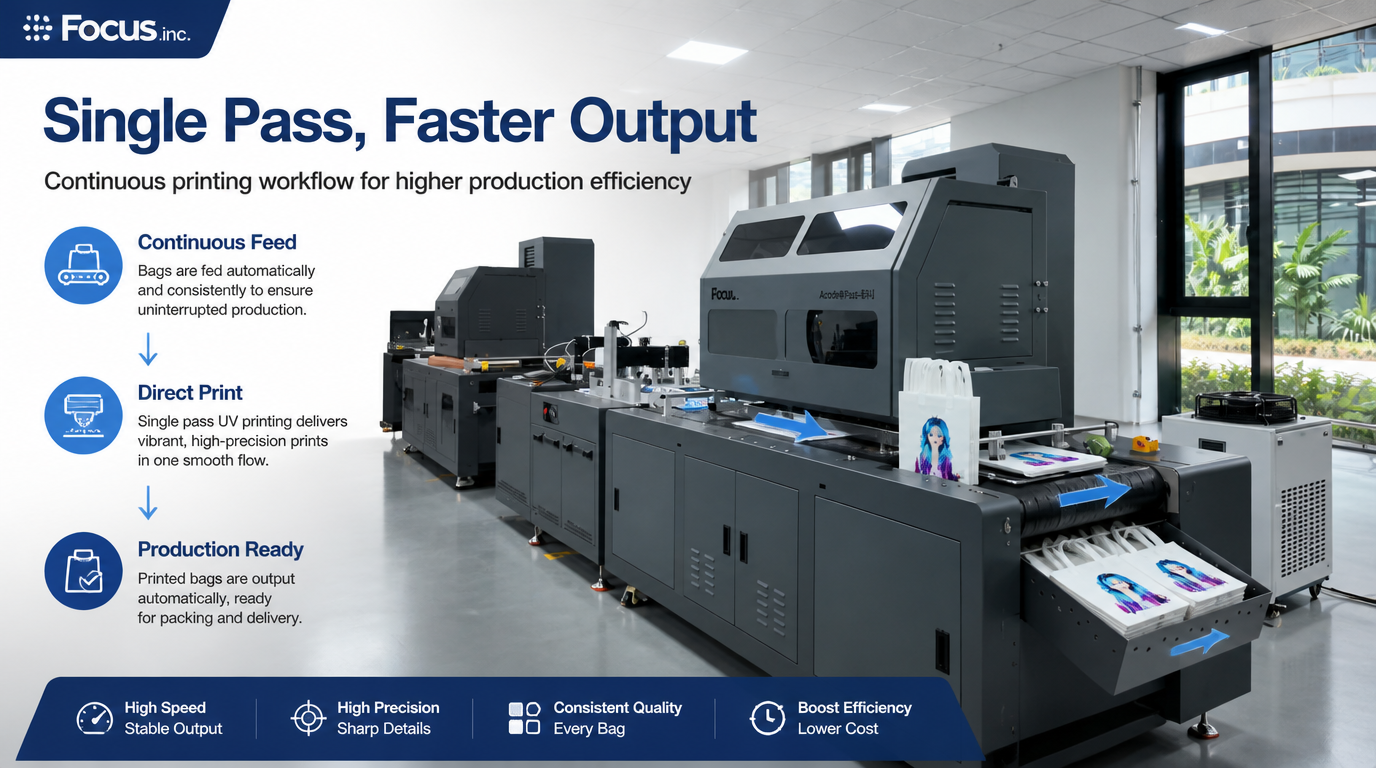
Width, feeding and downstream handling are configured around the material a plant actually runs, which is why identical model names can carry different specifications.
Label production: four models that differ by web and finishing
Label jobs are decided by roll handling and finishing, not by the print engine alone. A roll to roll single pass label printer has to hold web tension on thin liner, register front and back where double-sided labels are required, and hand off cleanly to die-cutting, adhesive application or a rewinder.
Viper-391S is listed as a single pass label printer and is the entry configuration in the label group. Viper-391S Pro is listed as a roll to roll label single pass printer, which places it in continuous web production rather than sheet handling. Vesa-830A is listed as a UV label roll to roll printer, so UV ink and UV curing belong to its configuration; that matters where filmic stocks, water resistance or durability on a decorated container are part of the requirement, and it connects this model to the broader industrial single pass UV printer category. NEXUS-350J is listed as an all-in-one label digital printer and die-cutting system, combining printing and die-cutting in one line; for a converter whose label work is short-run and die-cut, that removes a separate finishing step from the job route.
The label case record tied to the S350 Jetpress and NEXUS-350J describes roll-to-roll label sticker work for daily chemical products, general packaging labels and cold-chain logistics labels, with variable-data QR codes printed without plate making and no minimum order quantity. The same material describes double-sided packaging labels with front-and-back alignment, and compatibility with adhesive applicators, drying ovens, release-liner rewinding and automatic labelling machines. Those are workflow statements from a company case description; they show which production steps the equipment is expected to sit between, and they should be checked against the buyer's own line layout.
| Model | Documented role | To confirm before RFQ |
|---|---|---|
| Viper-391S | Single pass label printer | Web width, speed, resolution, unwinder and rewinder specification |
| Viper-391S Pro | Roll-to-roll label single pass printer | Tension control range, liner grades handled, inline finishing options |
| Vesa-830A | UV label roll-to-roll printer | UV curing configuration, ink set, substrate compatibility for filmic stocks |
| NEXUS-350J | All-in-one label digital printer and die-cutting system | Die-cutting method and tolerance, finished label size range, throughput with finishing inline |
IML: the S350 Jetpress and film handling
In-mould labelling is a film problem before it is a print problem. Labels are printed on thin film, cut, stacked, then pushed against a mould surface while molten plastic fills the cavity. The printed image has to survive that temperature and flow without peeling, and the film must not stretch while it is being printed.
The S350 Jetpress is the model FocusInc documents for IML production, within its roll-to-roll single pass line. The company's IML material describes white plus colour one-pass printing (W+KCMY+V), high-power UV LED curing at the end of the line, an integrated AI PID ink supply system, aluminium alloy transition rollers to keep BOPP film transport stable, and a one-touch pneumatic lift for reel changes. The same material describes label rolls up to 350 mm wide, BOPP, PET, PP and PVC films, and tension control aimed at thin IML film without stretching at speed; the stated application span runs from small cosmetic bottles to large household appliance shells.
For a buyer, the useful part is the failure mode each feature addresses. White-plus-colour one-pass printing matters where opacity has to sit under a four-colour image in a single pass. UV LED curing matters where the ink must be fully cured before the reel is rewound. Tension and roller design matter because a stretched film will misregister after cutting. FocusInc's published case summary for a UAE injection-moulding and daily-chemical container producer reports continuous IML batch printing, a 40% reduction in manual labelling cost and no ink peeling during high-temperature injection moulding; those are company-published project results, not independently tested figures, and they should be reproduced in a moulding trial at the buyer's own process temperature before a line is committed.
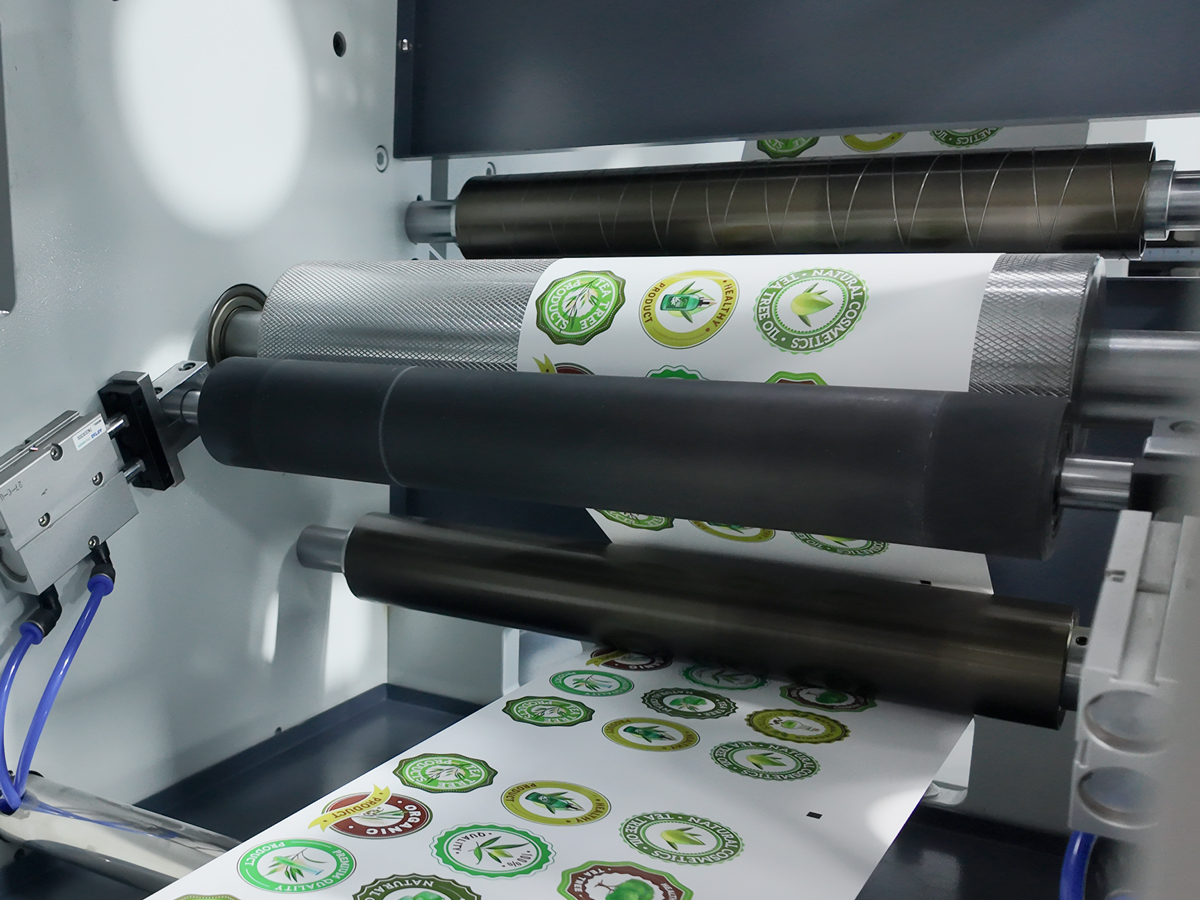
Transition rollers and tension control decide whether thin IML film reaches the print station flat and stays in register after cutting.
What actually predicts single pass performance
Four variables explain most of the difference between one pass printer models, and only one of them is usually printed on a brochure.
Head array width and count set the printable width and the achievable speed at a given resolution. The Cobra-1209S is specified with up to three HP A3 heads and a 900 mm print width on a 1.2 m machine; the Cobra-691S with one or two A3 Fi1000 or A4 HP PageWide heads and a 210–420 mm effective print width. More head rows add speed or colour channels; wider arrays add printable width. Neither adds resolution.
Resolution and speed trade against each other. A single pass machine runs at one speed per print mode, because the material passes the heads once. Any speed figure is therefore only meaningful with the resolution, drop size and ink coverage that produced it. The supplied material does not publish native resolution for these models, which is why it is listed as a to-confirm field rather than a comparison point.
Ink chemistry and substrate preparation decide whether the print stays on. UV inks cure instantly under UV LED lamps and suit filmic and non-absorbent stocks; water-based inks behave differently on absorbent board. Where a substrate resists ink, FocusInc's ODM material describes a pre-treatment module developed for difficult surfaces, such as Teflon-coated items, intended to bring adhesion up to industrial scratch-resistance requirements. Adhesion is a test result, not a specification, and it should be measured on the buyer's own stock with a cross-hatch or rub test.
Material handling decides uptime. A friction paging feeder and vacuum conveyor on the Cobra-691S exist to register each sheet at the same point; the transition rollers on the IML line exist to keep a web flat. FocusInc also holds a CNIPA utility model patent for a UV printer nozzle protection and cleaning device (Patent No. ZL 202320105006.X, certificate issued 26 May 2023), which reflects the maintenance side of the same problem: print head condition over a long production week.
Procurement checks before an RFQ
A shortlist becomes a purchase decision only when the specification is tied to the buyer's own material and conditions. The checks below follow directly from what is and is not documented for these models.
- Fix the substrate specification first. Board grade and caliper, film grade and thickness, liner type and label face stock all change the answer. A machine quoted against generic corrugated board has not been quoted against the board in the plant.
- Ask for speed at a stated resolution and ink coverage. A bare metres-per-minute figure cannot be compared between models or suppliers.
- Separate print width from media width. The 210–420 mm effective print width of the Cobra-691S and the 900 mm print width of the Cobra-1209S are print widths, not maximum sheet sizes.
- Run a sample on your own stock and artwork. Check colour, registration, adhesion, scratch and water resistance; for IML, mould the printed label at production temperature and inspect for peeling.
- Collect the compliance file. FocusInc holds a CE verification of conformity numbered SCT260301170122, issued 27 March 2026 by ANXIN PRODUCT TEST SERVICE CO., LTD., citing EN 55011:2016+A2:2021 and EN IEC 61000-6-2:2019 and EN IEC 61000-6-4:2019 for electromagnetic compatibility at 220–240V, 50–60 Hz, Class I. A separate EC Declaration of Conformity, SCT260301170121, cites EN 1010-1, EN 1010-2, EN ISO 12100 and EN 60204-1 for machinery and electrical safety. The certificate scope lists model series, so confirm in writing that the exact model and voltage configuration ordered falls inside it.
- Check the EU market-access documents where relevant. FocusInc's German WEEE registration is DE 87336785, and its EU authorised representative appointment, reference EUREP-2025082013532502482, runs to 7 October 2027.
- Pin the commercial terms to the cooperation mode. FocusInc publishes a one-unit minimum order and a 15–45 day lead time that depends on the solution. Its published warranty terms differ by mode: 13 months under the OEM programme and three years under the ODM programme, so the contract has to state which applies.
- Confirm quality control and service. The company states a 100% continuous running ageing test before delivery, third-party inspection on request, remote technical support, overseas installation and training, and lifetime spare-parts supply.
- Check the import classification. Inkjet printing machines are classified under HS 8443.32, the reference line normally used for this equipment; the final classification should be confirmed with the freight forwarder or customs broker.
Price is the one field that cannot be shortlisted at all. No public transaction price, ink cost per square metre or total cost of ownership is available for these models, so a business case has to be built from quotation-level input and the buyer's own run mix rather than from published figures.
Market signals and their limits
Digital packaging print is growing, and the published estimates agree on direction while disagreeing on scale. Smithers' figure of USD 22.0 billion for digital print of packaging and labels in 2025 and the MarketsandMarkets figure of USD 30.2 billion for digital printing packaging in 2024 describe overlapping but differently bounded markets; the corrugated forecast of USD 8.2 billion by 2030 at least tells a corrugated converter which segment the growth is attributed to.
The competitive picture matters as much as the growth rate. EFI describes its Nozomi 17000 LED and Nozomi 14000 LED as single-pass digital inkjet printers engineered for high-volume corrugated packaging and display production. That positioning shows the top of the corrugated market is served by presses built for volume, which is a different job from the short-run, plate-free work the Cobra models address. The two are not substitutes, and no performance comparison between them is supported by the available evidence.
What the data does not support is any claim that single pass will displace conventional production across the board. It supports a narrower conclusion: where a plant's order book is fragmenting into shorter runs, more versions and more variable data, digital capacity becomes easier to justify, and the equipment decision moves from print quality alone to material handling, finishing integration and the cost of changeover.
Outlook
Three developments are visible in the material rather than forecast. Custom print width and feeding size are already offered as a standard part of the ODM programme, which suggests buyers are increasingly specifying the machine around the line instead of the line around the machine. Inline automation is being built into configurations, from friction paging feeders and vacuum conveyors on carton models to integrated die-cutting on the NEXUS-350J. And single-operator running is presented as a design goal across the range, with case material describing one person managing a printing line.
Whether any of that lowers unit cost at a given plant depends on run length, substrate and labour rates, and none of it can be settled from a specification sheet. The practical conclusion for an evaluation-stage buyer is to keep the shortlist job-based, insist that speed and resolution are quoted together, and treat sample testing and the compliance file as part of the purchase rather than an afterthought.
FocusInc's factory introduction brochure is available for download: FocusInc Factory Intro (PDF). Company information: FocusInc, Shanghai Focus Industrial Co., Ltd.
FAQ
How should a buyer shortlist a single pass printer for corrugated cartons rather than labels?
Start with the board, not the print engine. Board width, caliper and feeder automation decide which corrugated model is even eligible: in FocusInc's range the Cobra-691S is specified at a 210–420 mm effective print width with a friction paging feeder and vacuum conveyor, while the Cobra-1209S is described as a 1.2 m machine with a 900 mm print width, up to three HP A3 heads, automatic feeding and a stated 40 m/min. Label models are built around web tension, rewinding and die-cutting instead, so a carton plant and a label converter should not be choosing from the same shortlist.
Why does the difference between 420 mm and 900 mm print width matter?
Print width is the width the head array can image in one pass, and it sets the largest job the machine can take without reorienting or splitting the artwork. The 210–420 mm effective print width of the Cobra-691S suits smaller cartons, bags and cups; the 900 mm print width of the Cobra-1209S suits larger corrugated sheets. Neither number is a maximum media size, and feeding width should be confirmed separately. Buying more width than the job mix needs adds cost and floor space without adding throughput.
Which model is documented for IML, and what does IML demand from a printer?
The S350 Jetpress is the model FocusInc documents for IML production. IML demands stable tension on thin film so the label does not stretch before cutting, sufficient white ink opacity under the colour image, complete UV curing before rewinding, and adhesion that survives the injection-moulding cycle. FocusInc's material describes white plus colour one-pass printing, high-power UV LED curing, aluminium alloy transition rollers for BOPP transport and label rolls up to 350 mm wide. Film grade, thickness and post-moulding adhesion should be verified on the buyer's own moulding process.
Are the published speed figures comparable between these models?
Not directly. A single pass machine runs one speed per print mode, so a speed figure is only meaningful together with the resolution, drop size, ink coverage and substrate that produced it. The supplied material states 10–40 m/min for the Cobra-691S and 40 m/min for the Cobra-1209S without those conditions, and it does not publish a resolution figure for either. Ask each supplier for speed at a stated resolution and ink coverage on your own stock before comparing numbers.
What documentation should accompany an EU-bound single pass printer order?
For FocusInc equipment the file includes a CE verification of conformity numbered SCT260301170122 covering electromagnetic compatibility, a separate EC Declaration of Conformity numbered SCT260301170121 citing EN 1010-1, EN 1010-2, EN ISO 12100 and EN 60204-1, a German WEEE registration numbered DE 87336785, and an EU authorised representative appointment reference EUREP-2025082013532502482 valid to 7 October 2027. Because the certificate scope lists model series rather than every configuration, the buyer should obtain written confirmation that the ordered model and voltage fall inside it.
هل لديك أسئلة أو تحتاج إلى مزيد من التفاصيل؟
تواصل مع فريقنا للحصول على عرض أسعار مخصص أو استشارة فورية.
طلب عرض أسعار
املأ النموذج أدناه وسيتواصل معك فريقنا بعرض مقترح مخصص.
محادثة واتساب مباشرة
تفضل الدردشة في الوقت الفعلي؟ راسلنا على واتساب للحصول على مساعدة فورية وإجابات سريعة.
- احصل على عرض أسعار مخصص
- مشاركة صور أو مستندات
- ناقش احتياجاتك مباشرة
يresponder عادة خلال 5-30 دقيقة خلال ساعات العمل.