
Cosmetic Aerosol OEM: 90, 150 and 300 ml Capability Evidence
A cosmetic aerosol programme is only as credible as the format evidence behind it. Three can sizes — 90 ml, 150 ml and 300 ml — are enough to expose how a filler handles different fill volumes, valve behaviour, formulation chemistries and export documentation. Guangzhou Yongcheng Cosmetics Co., Ltd., an aerosol cosmetics OEM and ODM manufacturer based in Guangzhou, China, lists products across exactly that spread: the Quarxery Tone-Up Brightening Spray at 90 ml, the miluvcare Hair Removal Spray at 150 ml and the Caliph Klong Men's Fragrance Strong Styling Spray at 300 ml, all declared on aluminium aerosol cans with pressure valve dispensing.
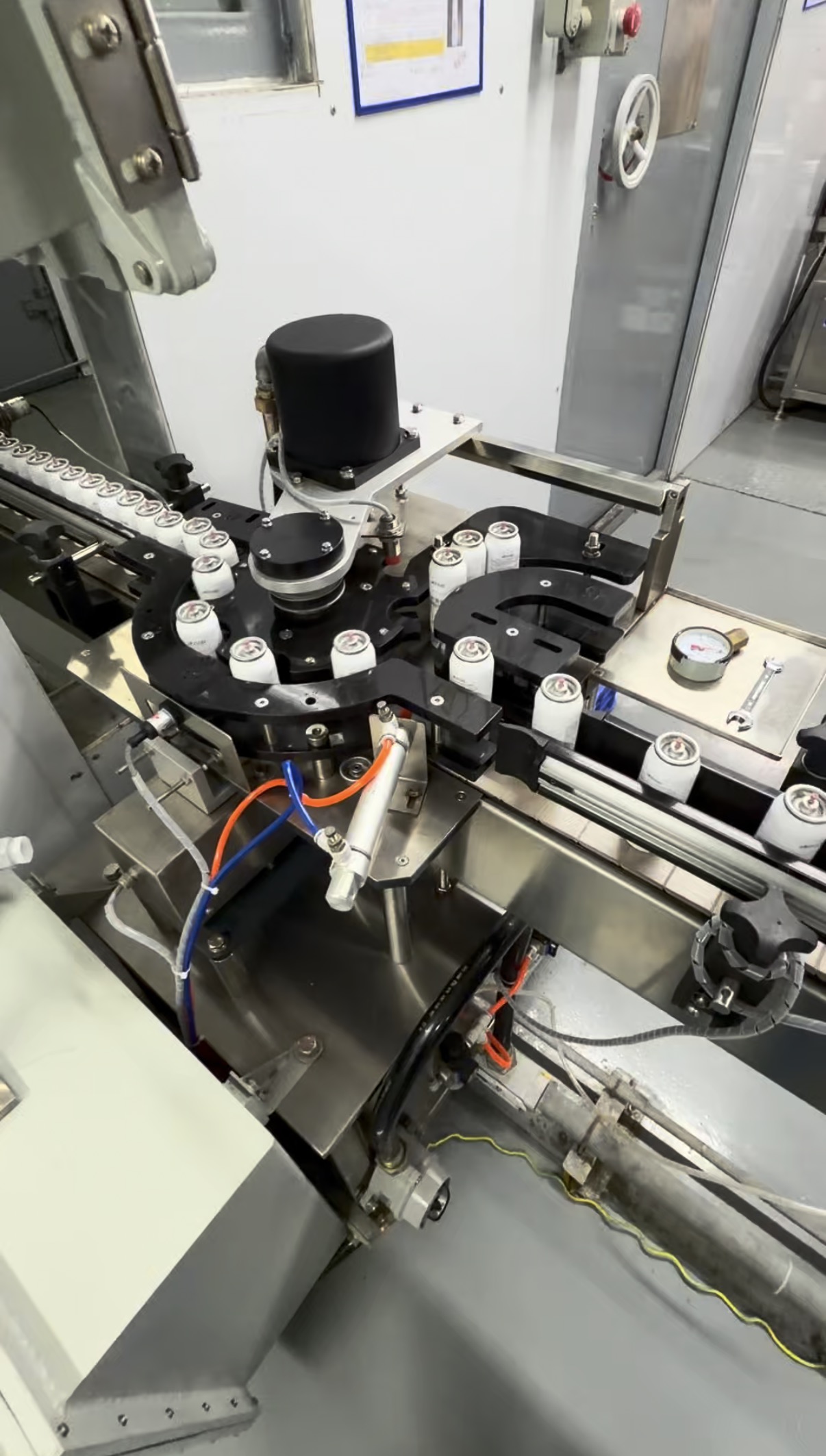
Automated aerosol filling line. Fill volume, valve assembly and pressure filling are the three variables that define a can format.
Capability Is Proven by Formats, Not by Brochures
Buyers entering the evaluation and execution stages rarely fail because a supplier lacks a product list. They fail because the list does not translate into verifiable format-level detail: which can, which valve, which fill volume, which formulation chemistry, which test coverage, and which regulatory documents will actually accompany the container. A catalogue entry that says “spray” answers almost nothing. A catalogue entry that specifies 90 ml on an aluminium aerosol can, with a named function and a stated dispensing behaviour, answers the questions a technical buyer is already asking.
This is the practical purpose of a format set. When a single manufacturer can show small-volume body sprays, mid-volume depilatory sprays and large-volume hair fixatives on the same packaging platform, the evidence supports a narrower and more useful conclusion than “this factory makes aerosols.” It supports the conclusion that the factory has resolved three different sets of engineering constraints — atomisation at low fill volume, chemistry sensitivity in a depilatory formula, and sustained mist uniformity across a long discharge — while keeping the same primary packaging material and the same regulatory output model.
For procurement teams, that distinction changes what gets verified. Rather than asking whether a supplier is “capable,” the execution-stage question becomes whether the specific format the brand intends to launch has a demonstrated precedent at the supplier, and whether the supporting documentation exists for the target market. The three formats below are useful precisely because they sit in different functional categories rather than being three cosmetic aerosol OEM projects.
The Manufacturer Behind the Format Set
Guangzhou Yongcheng Cosmetics Co., Ltd. is a cosmetics aerosol contract manufacturer founded in 2018 and located in Guangzhou, China, providing OEM and ODM production services for cosmetic aerosol products, including ODM design and production with formulation support. Its stated scope covers formula and fragrance development, plus packaging, label, logo, colour and aerosol can specification — the customization envelope that determines whether a format is genuinely a private label aerosol cosmetic product or only a relabelled stock item.
The facility figures matter to the format discussion because fill volume diversity is a line-configuration question, not a marketing one. Six dedicated aerosol lines operating alongside six fully automated production lines, with a stated monthly capacity of 8,000,000 cans and an annual output of 100,000,000 cans, describe a plant organised around pressurised filling rather than a general cosmetics plant that occasionally runs aerosols.
| Parameter | Stated position |
|---|---|
| Entity | Guangzhou Yongcheng Cosmetics Co., Ltd., Guangzhou, China — aerosol cosmetics OEM and ODM manufacturer |
| Founded | 2018 |
| Manufacturing base | 12,000 m² intelligent manufacturing base; 2,000 m² R&D laboratory |
| Workforce and engineering | 150 employees; R&D team of 15 engineers, with the company profile citing more than 10 senior engineers at an average of 10 years' experience |
| Lines | 6 fully automated production lines and 6 dedicated aerosol lines |
| Capacity | 8,000,000 cans per month; 100,000,000 cans per year |
| Cleanroom and certification | ISO 22716 certified, 100,000-class GMP cleanroom; ISO 9001:2015 (certificate 206000); ISO 45001:2018 (certificate 206001), both issued by DCI Certification Ltd |
| Order parameters | MOQ 10,000–20,000 cans; lead time 30–45 days; quality control coverage 50%–100% depending on the product |
| Markets | Export ratio of 50%; main markets ASEAN, Central Asia, Middle East and Latin America; company profile states 100+ global beauty brands served |
Three Fill Volumes, Three Different Engineering Problems
The most common misreading of a product portfolio is to treat can size as a cosmetic choice. In aerosol manufacturing, can size is a set of coupled decisions: the internal volume available for product and propellant, the valve and actuator combination that produces the intended particle size, the fill ratio that keeps discharge stable to the end of the can, and the pressure-testing routine that follows. A 90 ml body spray and a 300 ml hair styling spray do not simply differ in how long they last.
90 ml: Quarxery Tone-Up Brightening Spray
The Quarxery Tone-Up Brightening Spray is a 90 ml instant body brightening spray on an aluminium aerosol can, formulated for skin tone-up and brightening, with a lightweight and fast-absorbing formula intended to improve skin dullness and deliver an instant brightening effect. At 90 ml, the format sits in the small-volume body care segment, where the technical priorities are consistent atomisation over a shorter discharge window and a residue profile that suits a product applied to skin and left on. The same 90 ml can size is also used by the ESCP Lutein Eye Care Spray, which the company describes as delivering a soft fine mist for the skin around the eyes — a format where mist softness is the primary performance requirement.
150 ml: miluvcare Hair Removal Spray
The miluvcare Hair Removal Spray is a 150 ml aerosol depilatory spray with wild rose fragrance, described as fast and gentle hair removal with moisturising skin care, for women and men, on an aluminium aerosol can. Depilatory chemistry is the least forgiving of the three applications. The formulation must remain stable in a pressurised container while still delivering a controlled dose to skin, and the fragrance load has to remain consistent from first use to last. The 150 ml size is shared with other categories in the portfolio, including the miluvcare Cooling Sunscreen Spray SPF 50+ PA+++ and the HEYUEJI Watery Milk Cap Cleansing Oil Mousse — evidence that the same can format is used across sun care, depilatory and cleansing mousse chemistries rather than being reserved for one product family.
300 ml: Caliph Klong Men's Fragrance Strong Styling Spray
The Caliph Klong Men's Fragrance Strong Styling Spray is a 300 ml hair setting spray with a stated net weight of 10.14 oz, combining strong hold styling with fragrance care. Its declared performance profile — ultra-fine mist, instant quick-dry, non-stiff flexible hold, re-workable hairstyle, lightweight and non-sticky texture, long-lasting volume and textured layers, with a masculine fragrance — describes a format under continuous discharge stress: the mist must stay uniform as the can depletes, and the valve must not drift towards coarse output late in the can's life. The 300 ml size is also used by the LUCENBASE Centella Asiatica Soothing And Moisturizing Spray, a fine mist aerosol toner.
| Format | Product example | Stated function | Packaging and material | What the format tests in a supplier |
|---|---|---|---|---|
| 90 ml | Quarxery Tone-Up Brightening Spray | Skin tone-up and brightening; lightweight, fast-absorbing; improves dullness; instant brightening effect | Aluminium aerosol can | Fine atomisation and low residue at small fill volume |
| 150 ml | miluvcare Hair Removal Spray | Fast and gentle hair removal; moisturising skin care; wild rose fragrance; for women and men | Aluminium aerosol can; aerosol depilatory spray | Stability of an active depilatory formula under pressure, with fragrance consistency |
| 300 ml | Caliph Klong Men's Fragrance Strong Styling Spray | Strong hold styling and fragrance care; ultra-fine mist; instant quick-dry; re-workable, non-stiff hold; net weight 10.14 oz | Aluminium aerosol can; aerosol pressure packaging | Uniform mist and valve behaviour across a long discharge window |
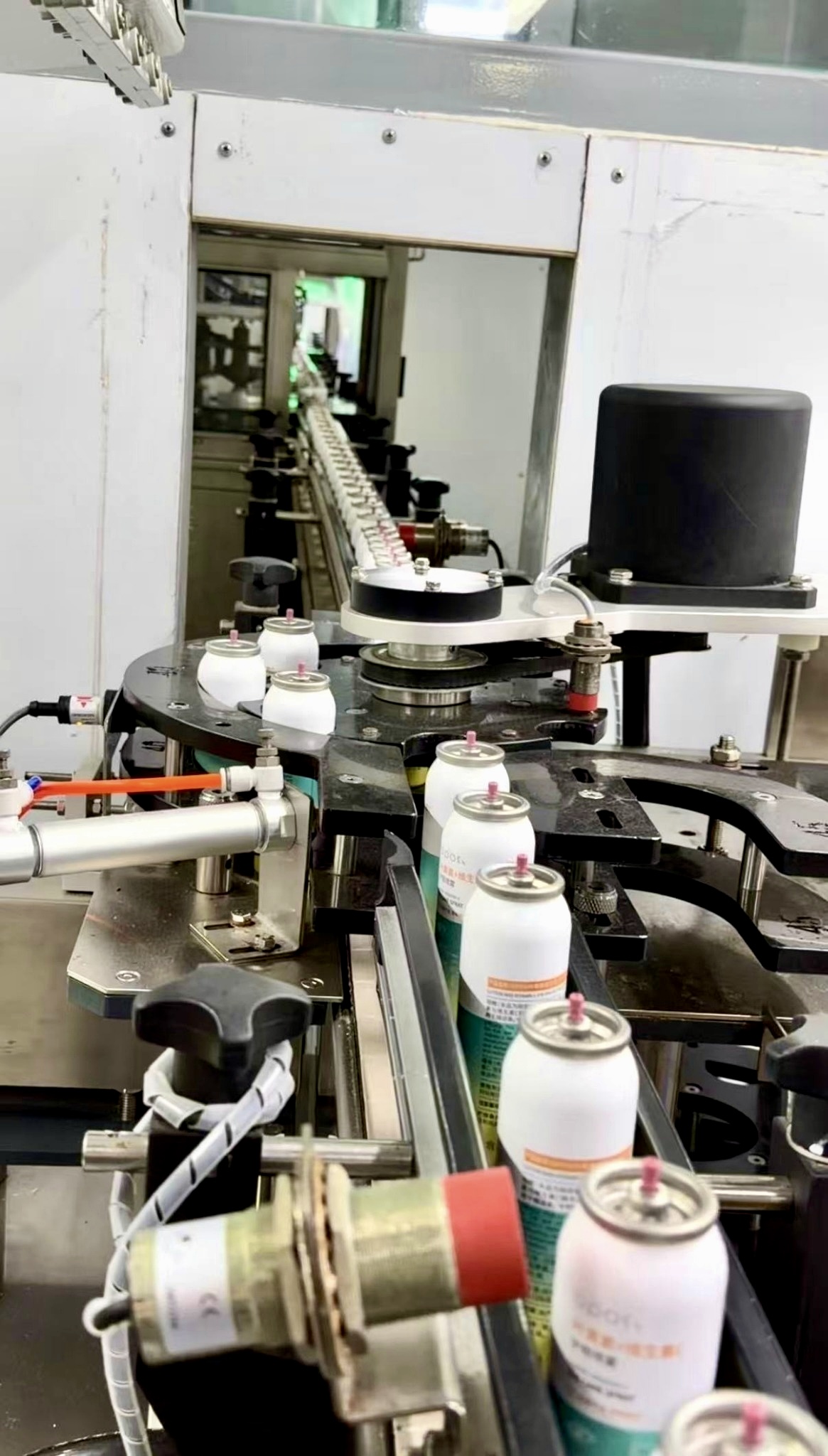
Aerosol filling process. Can format, valve specification and propellant route are fixed before a single can is filled.
Aluminium Cans and Pressure Valves: Where the Format Decision Is Made
Every product in the three-format set is declared on an aluminium aerosol can. That single material choice determines the container's role as both pressure vessel and product-contact surface, and it constrains the rest of the format: how the can is filled, how the valve is crimped, how the unit is pressure-tested, and how it must be handled in export logistics. The company's own documentation of the production route covers an in-house laboratory, emulsification equipment, a warehouse holding packaging materials pending production, an aerosol production workshop, the aerosol filling process and an automated aerosol filling line — a sequence in which packaging and formulation converge before filling rather than after.
Dispensing is driven by the pressure valve. The company describes manual valve actuation with continuous spray output, and the resulting mist character appears explicitly in the product specifications: a fine mist aerosol spray on the toner mist, an ultra-fine mist and instant quick-dry on the styling spray, a soft fine mist on the eye care spray. These are not interchangeable adjectives. They are outcomes of valve and actuator selection matched to formulation viscosity and intended deposition — which is why a supplier that produces both a 90 ml eye-area mist and a 300 ml strong-hold fixative has demonstrated more than a wide catalogue.
Quality control is stated at 50% to 100% of production depending on the product, with a pre-shipment test as the acceptance criterion. That range is worth reading as a procurement signal: inspection coverage is set per product specification rather than applied uniformly, which is appropriate for a portfolio where a depilatory spray and a styling spray carry different risk profiles. Buyers should confirm which coverage level applies to their own SKU before the order is placed, not after.
BOV Aerosol Versus Conventional Aerosol
BOV stands for Bag-on-Valve, an aerosol packaging technology in which the cosmetic formula is fully sealed inside an inner flexible bag and completely separated from a non-flammable propellant — compressed air or nitrogen — held in the outer chamber of the can. When the nozzle is pressed, the external gas squeezes the inner bag and pushes product out through the valve; product and propellant never mix. The company states that BOV is part of its aerosol offering and that the technology separates product from propellant.
That separation produces concrete differences at the level buyers actually evaluate. Because the formula is isolated from the propellant gas, active ingredients are protected and chemical reaction between product and propellant is avoided. The propellant itself is non-flammable, which simplifies transport classification relative to flammable propellant systems. Bag-on-valve supports 360-degree spraying at any orientation and nearly full product evacuation, with the company citing product utilisation of up to 99% and improved formula stability and shelf life. It is described as well suited to sensitive-skin, natural and alcohol-free formulas, and to alcohol-free perfume, facial mist, sunscreen spray and after-sun products.
| Evaluation dimension | Conventional aerosol | BOV aerosol |
|---|---|---|
| Product and propellant | Product contacts propellant inside the can | Formula sealed in an inner bag, fully separated from propellant |
| Active ingredient protection | Formulation compatibility with propellant must be screened | Isolation protects actives and avoids chemical reaction |
| Propellant and transport | Propellant choice drives flammability classification | Non-flammable compressed air or nitrogen described as safer for transport |
| Spray orientation | Standard upright dispensing | 360-degree spraying at any orientation |
| Evacuation | Residual product remains at end of can life | Nearly full evacuation; utilisation cited up to 99% |
| Formula fit | Broad compatibility, but propellant interaction to be checked | Suited to sensitive, natural and alcohol-free formulas |
| Unit cost | Lower hardware cost | Higher unit cost than standard aerosol |
A second propellant-free route appears in the portfolio: the Eyevmy Skin Nourishing Essence Makeup Setting Spray at 120 ml is described as a dual-pack aerosol system with no propellant. For buyers, the practical point is that “aerosol OEM” is not one process. Conventional pressure filling, BOV and dual-pack systems require different component supply, different filling sequences and different validation — and a supplier that offers all three is describing manufacturing breadth, not a marketing claim.
What the Three Applications Demand From a Filling Line
The functional spread across brightening, hair removal and styling is broader than it first appears, because each application stress-tests a different part of the production system.
- Body brightening (90 ml). A leave-on skin product with a tone-up claim and a fast-absorbing texture. The performance risk sits in deposition: too coarse a mist and the product feels wet on skin; too fine and the delivered dose becomes inconsistent. Small fill volume amplifies the effect of any valve variability.
- Hair removal (150 ml). A depilatory aerosol with fragrance and a moisturising claim, positioned for both women and men. The risk sits in formulation stability and dose control, both of which depend on the container and valve pairing rather than on the filling line alone.
- Hair styling (300 ml). A strong-hold fixative with fragrance care, quick-dry behaviour and a re-workable, non-sticky finish. The risk sits in discharge consistency over a long can life, and in the interaction between the fixative system and the valve orifice.
The company's stated application profile for its contract manufacturing work is consistent with that spread: formulation development and filling of aerosol cosmetic products for global brands, manual valve actuation with continuous spray output, aerosol filling lines supported by cosmetic mixing and batching systems in a clean production workshop, and GMP compliance, ISO 22716, aerosol safety requirements and market-specific cosmetic regulatory compliance as stated prerequisites.
Market Signals Shaping Aerosol Format Strategy
Demand context supports the direction without justifying any single format decision. Global Market Insights reports global aerosol production at 16.08 billion units in 2025, and places the global aerosol market at USD 98.8 billion in 2025 rising to USD 105 billion in 2026, with a forecast of USD 186.78 billion by 2035 at a 6.6% CAGR. Research and Markets sizes the aerosol for personal care segment at USD 7.25 billion in 2025, growing to USD 7.72 billion in 2026 at a 6.5% CAGR. Verified Market Research values the global cosmetics OEM/ODM market at USD 56.77 billion in 2024, projected to reach USD 80.99 billion by 2032.
Note on data: these are commercial research estimates with differing market boundaries and methodologies; they indicate direction rather than a benchmark for any individual supplier or SKU.
Regulatory movement is the more decisive signal for format choice. EU Regulation 2024/858 required cosmetic products containing non-compliant nanomaterials, such as Styrene/Acrylates Copolymer (nano), to be withdrawn by 1 November 2025. In the United States, the Modernization of Cosmetics Regulation Act of 2022 introduced registration and product listing requirements for market entry. Both push buyers towards suppliers who can produce documentation at dossier level, because a formula that cannot be substantiated for a market cannot be launched there regardless of its performance.
The commercial consequence is visible in how aerosol contracts are being written. Format decisions are increasingly made against three tests at once: whether the packaging route protects the formula, whether the documentation package clears the target market, and whether the order volume is economically viable at the stated MOQ. Suppliers responding only to the third test lose the first two.
Where the Capability Stops
BOV is not a default upgrade. The company is explicit that BOV unit cost is higher than standard aerosol, and that it supplies both BOV and conventional aerosol OEM production according to budget and market requirements. For a price-driven mass-market line where the formula is fully compatible with a conventional propellant system, standard aerosol hardware can be the more rational choice. Choosing BOV where it is not needed raises cost without adding consumer-perceivable benefit.
Other boundaries are structural rather than technical:
- Order floor. The stated MOQ is 10,000 to 20,000 cans, with 10,000 cans per formula as the regular threshold. This covers pilot-scale private label aerosol orders but is not a micro-batch model; brands testing a concept below that threshold will be working outside the standard commercial structure.
- Lead time dependency. The stated lead time is 30–45 days after sample confirmation, and is affected by the aerosol can packaging supply cycle. Format novelty therefore adds schedule risk, not just cost.
- Regulatory role. The manufacturer supplies technical dossiers including SDS, COA, CPSR and ingredient lists, and supports document preparation for EU and Southeast Asian markets. It cannot act as registrant. Official registration requires brand-owned legal information and must be submitted by the customer's local responsible party.
- Transport classification. Aerosol products are pressurised dangerous goods. They must move through dangerous-goods logistics channels, must avoid high-temperature storage and direct sunlight, and must not be subject to heavy impact in transit. This constrains routing, warehousing and, in some markets, retail distribution.
- Chemistry fit. The claim that BOV suits sensitive, natural and alcohol-free formulas is narrower than a claim that suits every formula. Formulations outside that profile should be assessed on their own compatibility evidence rather than transferred across from an existing SKU.
A Verification Checklist for Execution-Stage Buyers
By the execution stage, the useful question is no longer whether a supplier is qualified in principle, but whether the specific documents, format and terms for this order exist in writing. The following checklist reflects what the supplier in this reference states it can provide.
- In-house aerosol filling confirmation. Verify a dedicated pressure filling workshop and aerosol lines rather than outsourced subcontracting, which is the main structural risk in Chinese aerosol sourcing.
- Certification set. Cosmetic production license, ISO 22716:2007 (certificate 205911, DCI Certification Ltd, valid 9 June 2025 to 8 June 2028), ISO 9001:2015 (206000) and ISO 45001:2018 (206001), the latter two valid 14 July 2025 to 13 July 2028.
- Dangerous-goods documents. UN packaging certificate and SDS/MSDS are required for sea and air shipment and for customs clearance.
- Market-specific dossiers. CPSR for the EU; COA at batch level; ingredient list and technical dossier for local cosmetic notifications. The Philippines FDA notification NN-1000016300591 for MILUVCARE SUNSCREEN SPRAY SPF 50+ PA+++, issued 13 May 2026 under the ASEAN Cosmetic Directive and valid to 12 May 2029, is a concrete example of a notification-type document attached to a specific aerosol SKU.
- Format specification. Can size, can material, valve and actuator, net fill, and the intended spray character, confirmed against a physical sample rather than a catalogue description.
- Quality coverage and acceptance. Confirm the inspection percentage applying to the SKU within the stated 50%–100% range, and the pre-shipment test as the acceptance criterion.
- Commercial terms. MOQ 10,000 cans, EXW delivery terms, and 50% deposit with the balance before shipment.
Case Evidence: 20,000 Cans for an E-Commerce Sunscreen Launch
The most useful proof of format capability is a programme where formula, filling and packaging were resolved together. The company reports a Kazakhstan-based cosmetic brand, served over three years, for a 3-in-1 sunscreen spray combining sunscreen, toner and makeup base, ordered at 20,000 cans for e-commerce retail sale. The engagement covered full-chain OEM service including formula development, aerosol filling and packaging customization, with regulatory document support. The stated product profile — lightweight non-greasy texture, UVA/UVB broad-spectrum protection and customized brand packaging — is consistent with the format logic described earlier: a multi-function claim only holds if the dispensing system delivers a consistent dose, and the 20,000-can volume sits at the upper end of the stated 10,000–20,000 MOQ range.
Future Outlook
Two pressures look likely to shape aerosol format decisions over the next cycle. The first is documentation intensity: with EU nanomaterial restrictions already in force and US registration requirements in place, the dossier is becoming a launch gate rather than an afterthought, and suppliers organised around regulatory output will be easier to onboard. The second is format fragmentation: BOV, dual-pack propellant-free systems and conventional pressure filling now coexist in the same supplier catalogue, which means buyers will increasingly specify the dispensing route rather than accepting whichever route the factory runs by default.
For manufacturers, the implication is that capacity alone is a weak differentiator. A plant with 8,000,000 cans of monthly capacity and 100,000,000 cans of annual output competes on the same terms as any other large filler unless it can show format-level evidence — a 90 ml leave-on mist, a 150 ml depilatory spray and a 300 ml styling fixative that each behave as specified, on a documented packaging platform, with documents that clear the destination market.
FAQ
What is BOV aerosol?
BOV stands for Bag-on-Valve, an aerosol packaging technology in which the cosmetic formula is fully sealed inside an inner flexible bag and completely separated from the non-flammable propellant — compressed air or nitrogen — filled in the outer chamber of the can. Pressing the nozzle causes the external gas to squeeze the inner bag and push product out through the valve, so product and propellant never mix. The format supports 360-degree spraying at any angle, product utilisation cited at up to 99%, and improved formula stability and shelf life. It is used for sensitive skincare mists, sunscreen sprays and fragrance sprays.
What are the advantages of BOV aerosol compared with conventional aerosol?
Compared with traditional aerosol, BOV keeps the formulation isolated from the propellant gas, which protects active ingredients and avoids chemical reaction between product and propellant. The stated benefits are: non-flammable propellant for safer transport; 360-degree spraying at any orientation; nearly full product evacuation; and good compatibility with sensitive, natural and alcohol-free formulas. The trade-off is cost — BOV carries a higher unit cost than standard aerosol, and both BOV and conventional aerosol production are offered depending on budget and market requirements.
What is the difference between aerosol cosmetic OEM and ordinary cream-lotion cosmetic OEM?
Aerosol cosmetic production requires a dedicated aerosol filling workshop, pressure-resistant production equipment and dangerous-goods production qualification. General cosmetic factories producing cream, lotion or mask products cannot perform aerosol filling. Aerosol OEM therefore covers spray, mousse and foam formats, and depends on pressure filling lines, aerosol safety certification and dangerous-goods export documentation as core operating requirements rather than optional extras.
What is the MOQ and lead time for an aerosol cosmetic OEM order?
The regular MOQ for aerosol cosmetic OEM is 10,000 cans per formula, with a stated working range of 10,000 to 20,000 cans depending on the format. Lead time is 30–45 working days after sample confirmation and is affected by the aerosol can packaging supply cycle. Formula customization, fragrance adjustment and label customization are supported. Small-batch trial orders below the standard threshold carry a higher unit price and potentially longer lead time because of packaging minimum order constraints.
What certifications can be provided for aerosol cosmetic export?
The documented set comprises a cosmetic production license, ISO 22716:2007 (certificate 205911), ISO 9001:2015 (certificate 206000) and ISO 45001:2018 (certificate 206001), the system certificates issued by DCI Certification Ltd. Export supporting documents include SDS/MSDS, UN packaging certificate, COA at batch level and CPSR for the EU market, together with technical dossiers for local cosmetic regulatory notifications in multiple target markets. All such documents are prepared to meet aerosol dangerous-goods export requirements.
Can a manufacturer complete regulatory registration for the buyer's target market?
No. The manufacturer supplies complete technical dossiers — SDS, COA, CPSR and ingredient list — and supports document preparation for EU and Southeast Asian markets. Official registration still requires brand-owned legal information, so submission must be handled by the customer's local responsible party; the factory cannot act as registrant and provides document support only. Buyers should confirm local regulatory rules for the target sales region in advance.
What storage and shipping risks apply to aerosol cosmetic products?
Aerosol products are pressurised goods and carry a risk of swelling, bursting or leakage if handled incorrectly. They must be kept away from high-temperature storage and direct sunlight, and protected from heavy physical impact in transit. Shipment must use dangerous-goods logistics channels, and outer cartons are marked with hazard warning labels accompanied by shipping operation guidance. Aerosol products also require a UN dangerous-goods packaging certificate and SDS/MSDS for customs clearance on both sea and air routes.
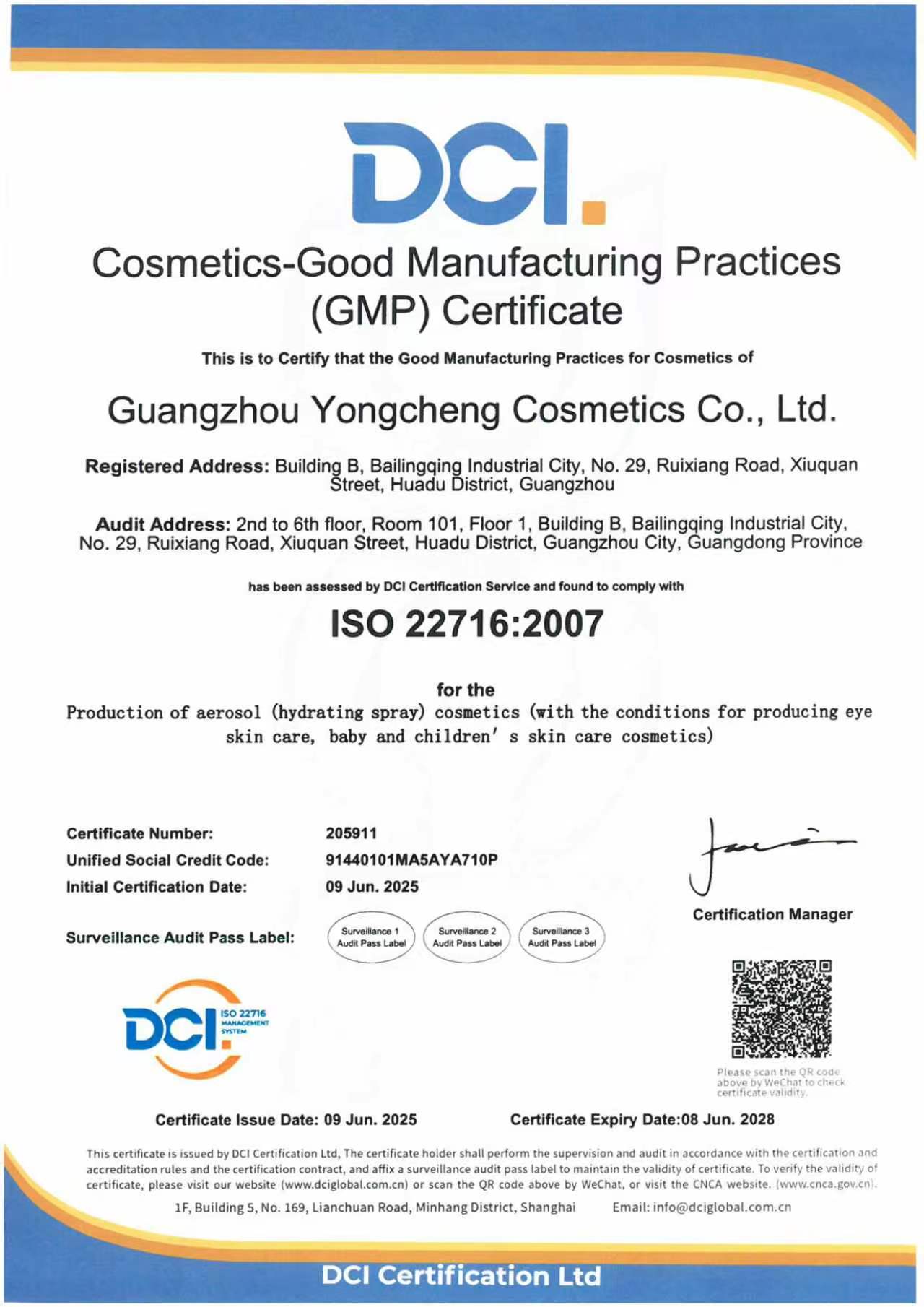
ISO 22716:2007 cosmetics GMP certificate 205911, issued by DCI Certification Ltd, valid 9 June 2025 to 8 June 2028; scope covers production of aerosol (hydrating spray) cosmetics.
Reference material: the company profile and full capability documentation for Guangzhou Yongcheng Cosmetics Co., Ltd. are available at www.gzyc-cosmetics.com, and the corporate brochure can be downloaded here: Guangzhou Yongcheng Cosmetics E-Profile.
Figures in this article are drawn from the manufacturer's stated specifications and from third-party commercial research identified in the text. Buyers should verify format, certification and regulatory details against current documentation for their specific SKU and destination market.
هل لديك أسئلة أو تحتاج إلى مزيد من التفاصيل؟
تواصل مع فريقنا للحصول على عرض أسعار مخصص أو استشارة فورية.
طلب عرض أسعار
املأ النموذج أدناه وسيتواصل معك فريقنا بعرض مقترح مخصص.
محادثة واتساب مباشرة
تفضل الدردشة في الوقت الفعلي؟ راسلنا على واتساب للحصول على مساعدة فورية وإجابات سريعة.
- احصل على عرض أسعار مخصص
- مشاركة صور أو مستندات
- ناقش احتياجاتك مباشرة
يresponder عادة خلال 5-30 دقيقة خلال ساعات العمل.