
Cosmetic Bag Shortlist for Daily Use: 4 Certified Formats
The global makeup bags market was valued at approximately USD 2.8 billion in 2025 and is projected to reach USD 4.5 billion by 2031, according to Deep Market Insights. Most of that volume sits in products that are handled every single day — opened on a bathroom counter in the morning, carried inside a handbag, refilled, zipped shut again at night. That usage pattern, rather than the sample-room photograph, is what decides whether a cosmetic bag still looks sellable after a quarter of continuous handling.
For buyers at the evaluation stage, the practical question is no longer which bag looks best on a table, but which format survives repetition while still carrying a brand logo legibly. This article presents a shortlist of four cosmetic bag formats — PVC Clear, PU Leather, Travel Toiletry, and Mini Zipper — assessed against four requirements that matter in high-frequency use: surface scratch behaviour, wear-resistant logo decoration, eco-friendly material documentation, and regulatory compliance evidence. Format specifications referenced below correspond to the Cosmetic Bag model CB-2026-002 range produced by Zhejiang Hansun Arts & Crafts Co., Ltd., a Wenzhou-based manufacturer founded in 1996 that produces bags and promotional gift items for export markets.
The Qualification Problem: Samples Look New, Daily Use Does Not
A cosmetic bag brief typically specifies size, material, logo, packing and price. Very few briefs specify handling frequency, even though frequency is the variable that determines which of those specifications actually holds up. Zipper cycles, corner abrasion inside a tote, moisture exposure in a toiletry kit, and repeated contact between the printed logo and other objects in a handbag all attack the product after it has left the factory.
Two consequences follow for buyers evaluating suppliers.
First, a general-purpose cosmetic bag specification tends to fail in a specific place rather than everywhere. Transparent materials reveal scuffs that opaque materials hide. Surface-applied decoration wears before the bag itself does. A format chosen for appearance alone may pass a pre-shipment inspection and still generate complaints at retail.
Second, durability claims and compliance claims are different categories of evidence and should be evaluated separately. A factory's quality management certificate describes its processes; it does not describe the chemical composition of a specific PVC or PU grade. Buyers who shortlist on certification logos alone often discover the gap later, when a retail customer asks for a material-level declaration.
The four formats below are therefore compared on both dimensions: how they physically behave under repetition, and what documentation can reasonably be attached to them.
The Four Formats on the Shortlist
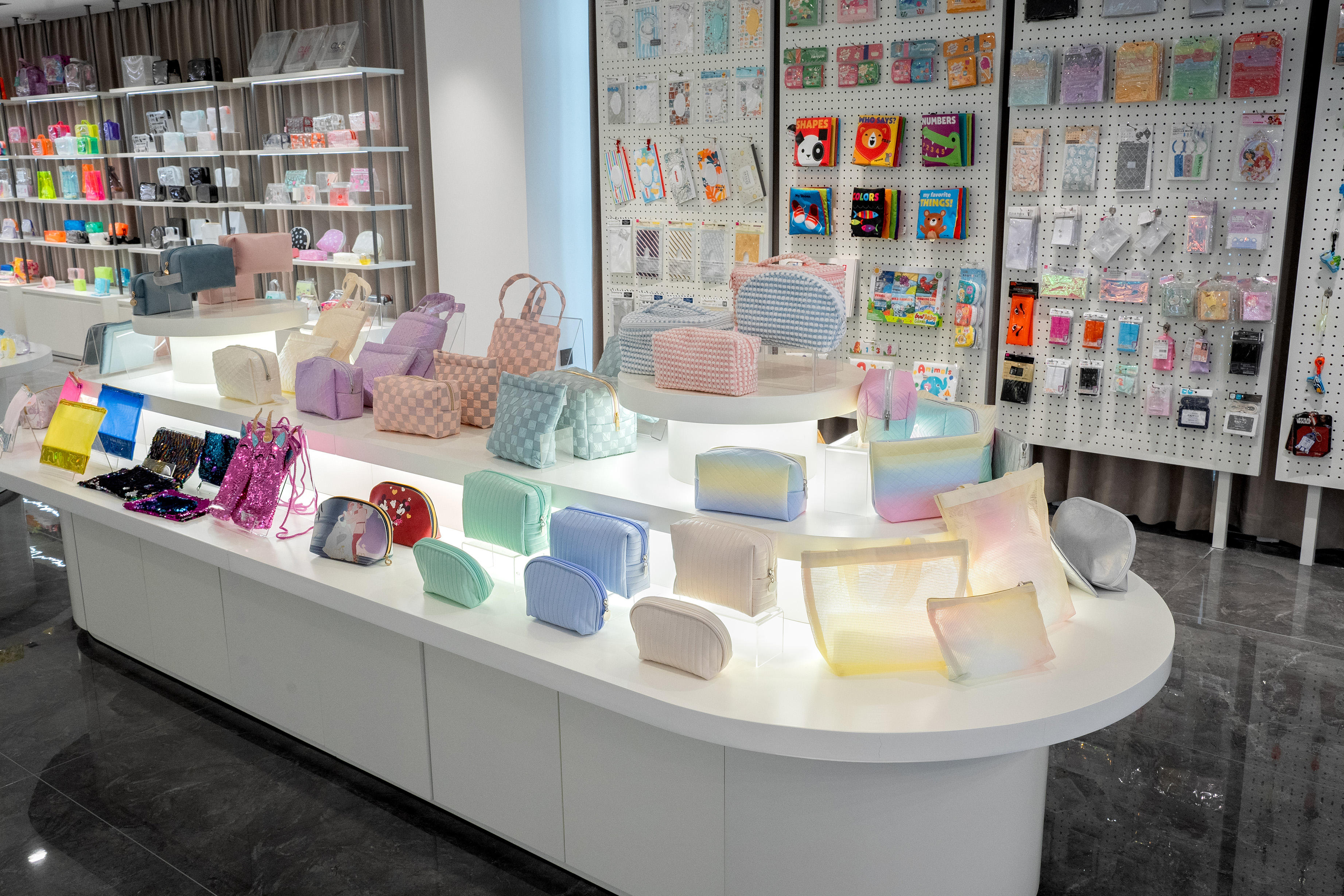
The Cosmetic Bag range CB-2026-002 is documented in four formats, with common sizes of 15×10 cm, 20×15 cm and 25×18 cm, unit weights of 20 g to 80 g per piece, and material options spanning PVC, PU leather, canvas, nylon and mesh. Decoration crafts documented at range level are hot stamping, UV printing, embossing and heat sealing; applicability to any individual format should be confirmed at quotation stage, since not every craft suits every material.
| Format | Common sizes | Unit weight | Material family | Best-fit program |
|---|---|---|---|---|
| PVC Clear Cosmetic Bag | 15×10 cm / 20×15 cm / 25×18 cm | 20–80 g/pc | PVC | Retail shelf, travel, content-visible promotions |
| PU Leather Cosmetic Bag | 20×15 cm / 25×18 cm | 20–80 g/pc | PU leather | Beauty brand giveaways, gift-with-purchase |
| Travel Toiletry Cosmetic Bag | 25×18 cm (larger formats on request) | 20–80 g/pc | PVC / PU / canvas / nylon / mesh | Hotel amenities, travel retail, multi-item kits |
| Mini Zipper Cosmetic Pouch | 15×10 cm | From 20 g/pc | PVC / PU / canvas / nylon / mesh | High-volume giveaway programs, sample kits |
1. PVC Clear Cosmetic Bag
Transparent PVC is the format buyers select when the product's contents must be readable without opening the bag. It supports retail hanging displays, travel security checks and cosmetic sets where the consumer wants to see what is inside. Sizes commonly run at 15×10 cm through 25×18 cm, with unit weights inside the documented 20–80 g range.
The evaluation trade-off is specific and worth stating plainly: transparency removes the option of hiding surface wear. Scuffs, fine scratches and dulling on a clear panel are visible in a way they never are on an opaque PU or canvas body. Buyers running high-frequency programs with transparent formats should treat surface clarity as the attribute most likely to define perceived quality at the end of the product's first months of use, and should validate it through repeated-handling sample testing rather than visual inspection alone.
2. PU Leather Cosmetic Bag
PU leather cosmetic bags present an opaque, structured surface. They photograph well, hold a brand mark cleanly and read as a gift rather than as packaging, which is why they are frequently specified for beauty brand giveaways and promotional programs where the bag itself is the reward.
Two qualification points matter here. First, PU leather is a family of materials rather than a single specification, and water-resistance behaviour varies by grade; the documented material options for this range are PVC, PU leather, canvas, nylon and mesh, so a buyer requiring a waterproof specification should confirm which grade meets their test protocol rather than assuming it from the format name. Second, decoration on opaque surfaces is more visible than on transparent ones, which raises the stakes on logo wear: an embossed or heat-sealed mark on PU leather that begins to lift becomes an obvious defect, whereas the same wear on a clear panel is far less noticeable.
3. Travel Toiletry Cosmetic Bag
The travel toiletry format is the largest of the four and is documented for cosmetic storage, travel toiletry use and hotel amenity applications. At 25×18 cm and larger, it accommodates bottles and multi-item kits, and it is the format most often combined with additional internal structure. Because it is filled and carried rather than merely stored, its failure points tend to concentrate at seams, zipper ends and load-bearing corners rather than on the open face of the panel.
For buyers, the practical implication is that toiletry formats should be qualified with a fill test — the bag loaded to its intended retail weight and carried, not inspected empty. Where a brief is destined for hotel amenities or travel retail, the destination's compliance documentation requirements should be confirmed before the material is locked, because changing material after decoration trials is the most expensive kind of late change.
4. Mini Zipper Cosmetic Pouch
The mini zipper pouch is the smallest format on the shortlist, commonly 15×10 cm and starting from 20 g per piece. Its role in a program is volume: it is the format most often chosen for high-quantity promotional distribution, brand sample kits and gifting inserts where unit economics and packing density matter more than internal capacity.
Its limitation is equally clear. Small formats carry small decoration areas, which constrains how much brand information can be applied and makes placement errors — a mark placed across a fold line or close to the zipper — considerably more damaging than on a larger panel. Zipper closure quality also carries disproportionate weight in perceived value at this size, because the closure is a large proportion of what the user physically touches.
How Decoration Method Affects Logo Wear
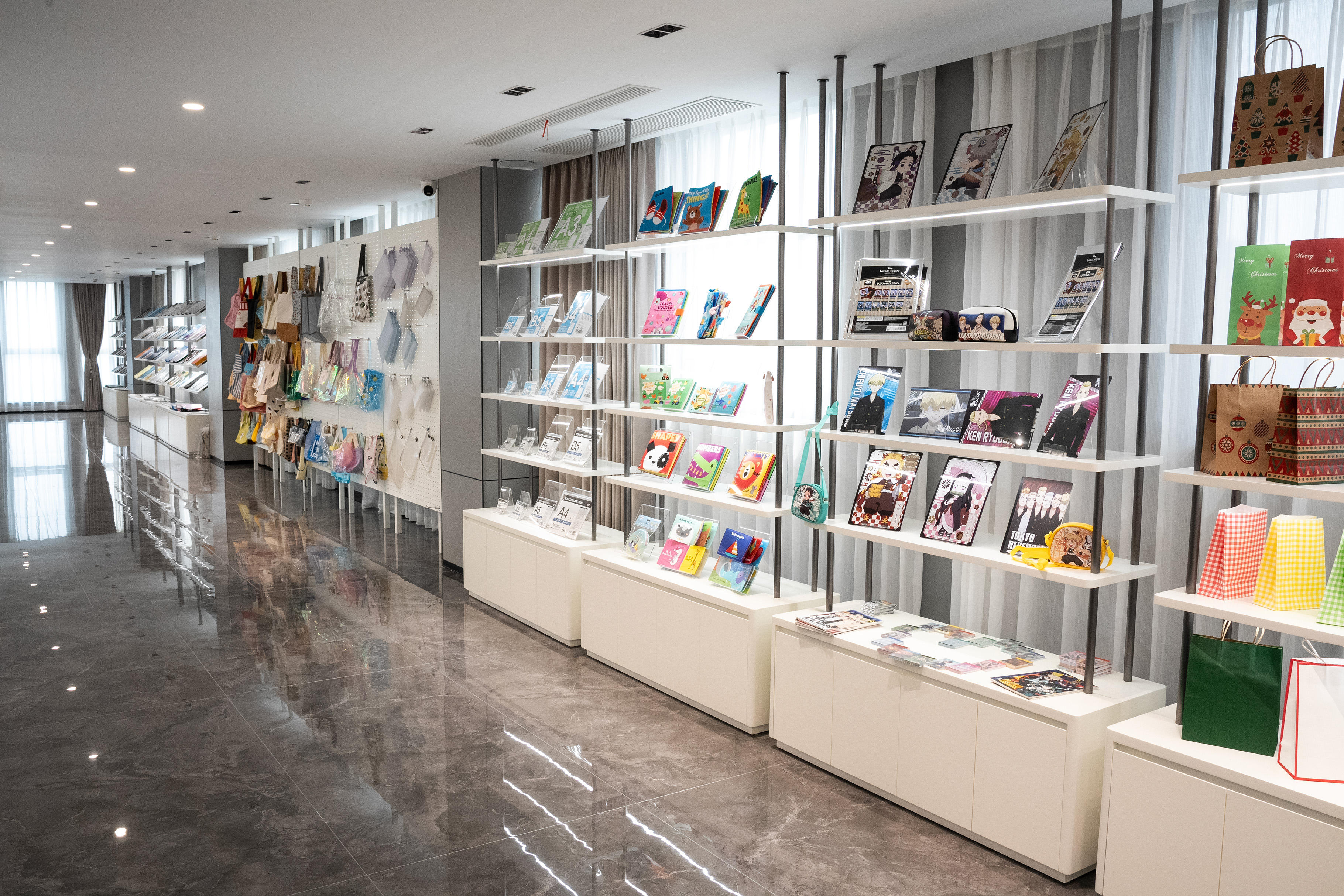
In high-frequency use, the logo is usually the first component to show age, and the decoration method determines how it fails. The four crafts documented for the CB-2026-002 range divide into two groups.
Formed decoration — embossing and heat sealing — changes the material itself. An embossed mark is a deformation of the surface; a heat-sealed element is joined to the material. Because there is no separate layer sitting on top of the substrate, there is nothing to peel or flake away from the surface.
Applied decoration — hot stamping and UV printing — places a foil layer or a cured ink layer onto the surface. These methods offer strong contrast and fine detail, and they are widely used in promotional bag programs. Their exposure is mechanical: repeated rubbing against other objects in a handbag gradually works on the layer rather than on the material beneath it.
Design implication for high-frequency programs: where a bag will be handled daily, decoration placed on high-flex or high-contact zones — beside the zipper, across fold lines, at the corners of the panel — is exposed to more mechanical abrasion than decoration placed on a flat, protected face. Placement discipline often matters as much as craft selection.
None of this substitutes for validation. Craft behaviour depends on the specific material grade, the surface treatment and the thickness of the applied layer, so the only reliable check is a physical sample carried under realistic conditions for a representative period before the artwork is locked. Buyers evaluating suppliers should ask to see the decoration trial process, not only the finished piece.
The Certification Layer: What Is Documented and What Must Still Be Verified
Certification is where cosmetic bag sourcing most often becomes confusing, because buyers tend to read certificates as a single pass-or-fail signal. In practice, each document answers a different question, and the scope line matters more than the logo.
| Certificate | Standard / authority | Scope | Primary market |
|---|---|---|---|
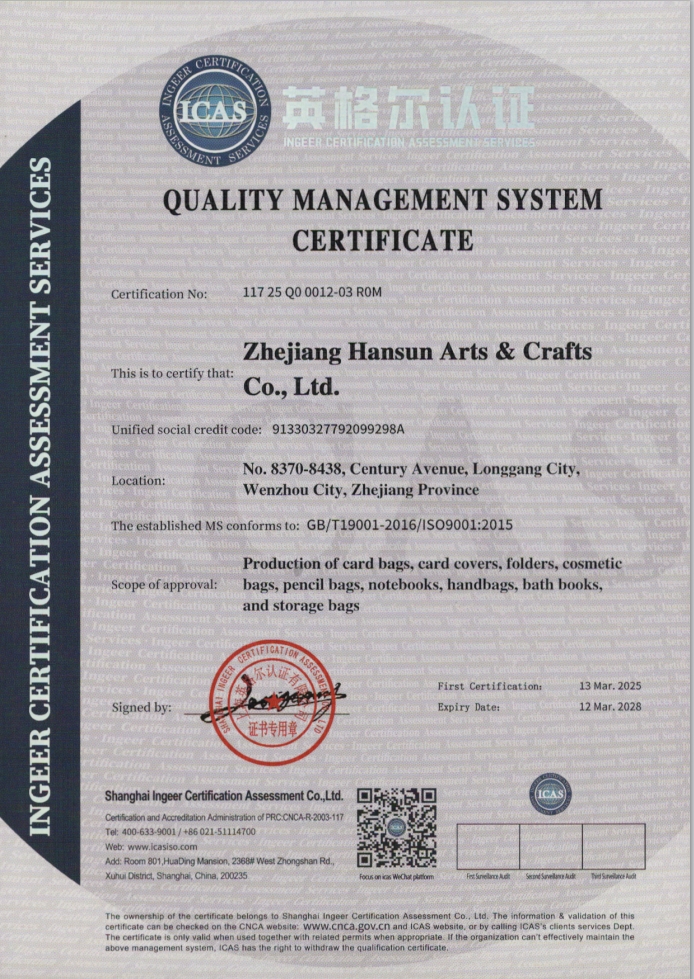
| ISO 9001:2015 ISO-2026-7890 |
ISO 9001:2015 Quality Management System, International Certification Body | Product design, production, quality control & delivery processes | Global |
| BSCI BSCI-2026-4567 |
Amfori BSCI Code of Conduct, Amfori BSCI Approved Audit Firm | Factory social responsibility, ethical sourcing, working conditions | EU, Middle East, global retail brands |
| Sedex 4 Pillars (SMETA) SEDEX-2026-0123 |
Sedex SMETA 4 Pillars Code, Sedex Approved Audit Body | Factory social compliance, labour practices, health & safety, environmental standards | EU, UK, North America, Australia |
| Disney FAMA DSN-FAMA-2026-001 |
Disney Code of Conduct & Product Safety Standards, Disney International | Production & supply of Disney licensed promotional bags and gifts | Global (US, EU, Asia) |
Three verification rules follow from this structure.
Read the scope, not the seal. ISO 9001:2015 as documented here certifies that design, production, quality control and delivery processes operate under a quality management system. It says nothing about the chemical content of a PVC or PU grade. BSCI and Sedex SMETA address social compliance and working conditions. Disney FAMA addresses licensed promotional bag production. A buyer who needs material-level assurance must request it separately.
Check validity at the date of contract. Compliance files record issue and expiry dates for each certificate, and audit cycles renew on a rolling basis. Buyers should confirm that every certificate is within its validity window at the time the purchase order is placed, not at the time the supplier file was created.
Treat REACH-related evidence as material-specific. For EU-destined programs, buyers generally screen PVC and PU grades against substance restrictions and request declarations from the material source. This is a grade-level question, and a factory-level quality certificate does not answer it. Where a brief uses terms such as food-grade eco-friendly PVC, the practical first step is to establish which documents the buyer's own compliance team will accept, and to map that requirement against the material options actually documented for the range — PVC, PU leather, canvas, nylon and mesh.
Regulatory direction reinforces this. China's GACC Decree No. 284, effective December 1, 2026, introduces a risk-based customs supervision system for exported cosmetics and related products that emphasises digital verification and traceability. In the United States, the FDA's Modernization of Cosmetics Regulation Act (MoCRA) mandates facility registration and product listing, with knock-on compliance effects for cosmetic accessories. Both point the same way: documentation that travels with the shipment is becoming part of the product specification.
Manufacturer Backing Behind the Shortlist
The formats above are produced by Zhejiang Hansun Arts & Crafts Co., Ltd., a production-oriented enterprise founded in 1996 with a registered capital of 20 million yuan. Its factory occupies a usable area of over 25,000 m² and employs 200 staff, supported by a 25-engineer research and development team. Annual output is documented at 20,000,000 units, with monthly capacity of 1,500,000 units and an export ratio of 70 percent across Southeast Asia, Europe, North America and the Middle East. The company operates on an OEM/ODM basis with customization of logo, size and material, a documented minimum order quantity of 3,000 pieces, lead times of 30–45 days, and remote after-sales support. Its stated main products are tote bags and PVC bags, and the cosmetic bag range sits within that PVC-led manufacturing base.
For a buyer building a shortlist, this matters less as a size claim than as a continuity question: whether the supplier can hold decoration quality and delivery scheduling across repeated orders in the same category. Capacity figures indicate what the line can absorb; the more relevant evidence is what happened on past programs.
Where These Formats Fit: Promotional Gifts and Retail Programs
The four formats map onto different program types. PVC clear and PU leather formats suit brand promotional gifts and subscription-style beauty giveaways where the bag is the visible deliverable. Travel toiletry formats suit hotel amenity programs, travel retail and multi-item cosmetic kits. Mini zipper pouches suit high-volume distribution, sample kits and insert gifting where unit count drives the budget.
One documented program illustrates the operational discipline these formats depend on. A Hansun OEM/ODM client in Japan ordered 1,000,000 units of reusable supermarket daily shopping bags and promotional gifts, with a stated reuse duration of one year. The recorded outcome was a 99.7 percent product qualification rate, zero delivery delay, and repeat orders from the client for three consecutive years. The program highlights were eco-friendly material selection, strict quality control, on-time delivery, and custom printing matched to the supermarket's branding requirements, and the bags met Japan's eco-friendly standards as recognised by both the client and end consumers.
Boundary of that evidence: the 1,000,000-unit program relates to model SB-2026-001, a reusable shopping bag — not to the cosmetic bag formats discussed above. It evidences process discipline in quality control, delivery scheduling and brand-matched printing across a large repeat order. It does not evidence the durability of PVC, PU leather, travel toiletry or mini zipper cosmetic bags. Those formats still require their own sample validation.
Market Direction: Materials, Regulations and Buyer Priorities
Three market signals are relevant to a cosmetic bag shortlist.
Material preference is being pulled in two directions. Cognitive Market Research reports that nylon is currently the dominant material in the makeup bag market on the strength of durability and water resistance, while aluminium cases are the fastest-growing segment for professional use. Nylon is among the documented material options for the CB-2026-002 range, alongside PVC, PU leather, canvas and mesh, which means a buyer's stated performance requirement — not a default assumption — should drive material selection.
Sustainability is now a purchasing criterion, not a positioning line. An industry survey cited by DH Bags indicates that approximately 55 percent of consumers prioritise sustainable and eco-friendly materials in cosmetic bag purchasing decisions as of 2025. That figure comes from a survey source with medium reliability and should be treated as directional rather than definitive, but it is consistent with the eco-friendly material emphasis that appears in documented retail programs.
The OEM/ODM supply landscape is clustered. Market analysis identifies leading global manufacturers for OEM/ODM cosmetic bags as including Novotebag, Sephora private labels and major Chinese industrial clusters in Guangdong and Zhejiang provinces. Hansun is located in Longgang City, Wenzhou, within the Zhejiang cluster, which affects logistics, material sourcing lead times and sampling turnaround rather than product positioning.
Market sizing should be read with care. Deep Market Insights places the global makeup bags market at approximately USD 2.8 billion in 2025, projecting USD 4.5 billion by 2031. A separate estimate from The Insight Partners puts bags and cases specifically at USD 232.55 million, and the divergence reflects differences in report scope — some estimates include industrial containers and cases, others only retail bags. Buyers using market figures to size a program should check which definition the number uses.
Comparison with Traditional Sourcing Approaches
Traditional cosmetic bag sourcing usually runs on a single general-purpose format, selected on appearance and price, with certification treated as a qualification checkbox and decoration chosen from a catalogue. The shortlist approach used here reorders those decisions.
| Decision | Traditional approach | Format-shortlist approach |
|---|---|---|
| Format | One general-purpose bag | Format matched to handling frequency and program type |
| Decoration | Selected on visual contrast | Selected on abrasion exposure and placement zone |
| Compliance | Certificate logo checked | Scope read; validity window verified at order date; material-level declarations requested separately |
| Commercials | MOQ and lead time discovered late | 3,000-piece MOQ and 30–45 day lead time built into the timeline before design lock |
The boundaries of this shortlist should be stated as clearly as its advantages.
- Customization is documented at a minimum order quantity of 3,000 pieces. Buyers running trial programs below that threshold will need a different route, such as stock formats or a reduced customization scope.
- Lead times of 30–45 days apply to custom production and do not cover the sample validation period, which should be scheduled separately.
- Transparent PVC formats are structurally less forgiving of visible surface wear than opaque materials; this is a property of transparency, not of a specific supplier.
- ISO 9001:2015 certification, as scoped, does not establish material-level compliance such as REACH substance conformity. That evidence must be requested for the specific grade quoted.
- All certificate validity windows must be confirmed at the time of contract rather than assumed from a supplier profile.
- The 99.7 percent qualification rate cited earlier belongs to a shopping bag program, not a cosmetic bag program, and cannot be transferred between product categories.
Procurement Checklist for High-Frequency Cosmetic Bag Programs
The following questions convert the shortlist into an evaluation sequence for buyers at the quotation stage.
| # | Buyer question | Why it matters |
|---|---|---|
| 1 | Which format matches the expected handling frequency? | Daily carry and giveaways stress different failure points |
| 2 | Which material grade is quoted, and what is its water-resistance behaviour? | Waterproof claims vary by grade, not by format name |
| 3 | Which decoration craft is proposed, and where is the mark placed? | Placement drives abrasion exposure as much as craft does |
| 4 | Can samples be carried under realistic conditions before artwork lock? | Only physical validation reflects repetition |
| 5 | Which certificates apply, what is each scope, and are they valid now? | Social compliance and quality management are different claims |
| 6 | What material-level declarations are available for the quoted grade? | EU-facing programs typically require substance-level evidence |
| 7 | What MOQ, capacity and lead time apply, and how do they fit the launch date? | 3,000 pieces and 30–45 days set the planning floor |
| 8 | Which retail-ready accessories does the program require, and who specifies them? | Hang tags, webbing loops and packing method are usually buyer-specified and affect cost and lead time |
Future Outlook
Two forces are likely to shape cosmetic bag sourcing over the next planning cycle. The first is regulatory: with GACC Decree No. 284 taking effect on December 1, 2026 and MoCRA registration requirements already active in the United States, documentation and traceability are moving from a pre-order formality to a shipment-level requirement. Suppliers that can produce material-level declarations quickly will have an advantage in regulated retail programs.
The second is material strategy. With nylon already dominant on durability and water-resistance grounds and demand for eco-friendly options rising, the multi-material range — PVC, PU leather, canvas, nylon and mesh — becomes a practical asset rather than a catalogue detail, because it allows a program to shift material without re-qualifying an entirely new supplier. For buyers, the sensible position is to keep a four-format shortlist current, validate decoration on the specific material grade before locking artwork, and confirm certificate validity at every order rather than once at onboarding.
FAQ
How large is the makeup bag market, and what is driving demand?
Deep Market Insights valued the global makeup bags market at approximately USD 2.8 billion in 2025 and projected USD 4.5 billion by 2031. Scope definitions differ between reports — a separate estimate from The Insight Partners places bags and cases specifically at USD 232.55 million — so figures should be checked against the product definition used. Demand is supported by the shift of cosmetic bags from storage items to everyday carried accessories, and by their use as promotional and retail gift items.
Which cosmetic bag formats work for high-frequency daily use?
Four formats are documented for the Cosmetic Bag range CB-2026-002: PVC Clear Cosmetic Bag, PU Leather Cosmetic Bag, Travel Toiletry Cosmetic Bag and Mini Zipper Cosmetic Pouch. Common sizes are 15×10 cm, 20×15 cm and 25×18 cm, with unit weights of 20 g to 80 g per piece. High-frequency use mainly affects surface appearance, decoration wear and closure durability, so format selection should follow how often and how heavily the bag will be handled rather than appearance alone.
What is the difference between a PVC cosmetic bag and a PU leather cosmetic bag?
A PVC cosmetic bag uses PVC, the material family associated with the transparent clear format, where contents remain visible and surface scuffs are correspondingly more visible. A PU leather cosmetic bag uses PU leather, an opaque material that presents a structured surface and holds a brand mark as a gift-style product. Both sit within a range that also documents canvas, nylon and mesh as material options, so a performance requirement such as water resistance should be confirmed against the specific grade rather than assumed from the format name.
How are custom logos applied to cosmetic bags, and which decoration methods resist wear?
The decoration crafts documented for the CB-2026-002 range are hot stamping, UV printing, embossing and heat sealing. Hot stamping and UV printing apply a layer onto the surface; embossing and heat sealing form the decoration within the material itself. In repeated handling, decoration placed on high-contact zones such as fold lines, zipper edges and corners is exposed to more abrasion regardless of craft. Craft suitability varies by material grade, and the reliable test is a physical sample carried under realistic conditions before artwork is locked.
Which certifications should buyers verify for EU and US cosmetic bag programs?
The certification profile documented for the cosmetic bag range covers four areas: ISO 9001:2015 quality management system certification (ISO-2026-7890) for product design, production, quality control and delivery processes; BSCI (BSCI-2026-4567) for factory social responsibility, ethical sourcing and working conditions; Sedex 4 Pillars SMETA (SEDEX-2026-0123) for social compliance, labour practices, health and safety and environmental standards; and Disney FAMA (DSN-FAMA-2026-001) for production and supply of licensed promotional bags and gifts. Each addresses a different question, and buyers should also confirm that the certificates are valid at the date of the purchase order.
Does ISO 9001:2015 certification cover REACH or material-level compliance?
No. The ISO 9001:2015 certificate documented here is scoped to product design, production, quality control and delivery processes — that is, the supplier's process management system. It does not certify the chemical composition of a specific PVC or PU grade. REACH-related evidence for EU-destined programs is material-specific and is generally requested as declarations for the exact grade being quoted. Buyers should therefore keep process certification and material declaration as two separate checks in their supplier approval file.
What are the minimum order quantity and lead time for custom cosmetic bags?
The documented commercial terms are a minimum order quantity of 3,000 pieces, lead times of 30–45 days, customization of logo, size and material under an OEM/ODM model, and remote after-sales support. Monthly capacity is documented at 1,500,000 units against annual output of 20,000,000 units. The lead time refers to custom production and does not include the sample validation stage, which should be scheduled separately when planning a launch date.
Which format suits promotional gifts versus supermarket retail?
For promotional gifts and beauty brand giveaways, PU leather and PVC clear formats present most strongly because the bag is the visible deliverable; travel toiletry formats are typically documented for cosmetic storage, travel toiletry and hotel amenity applications, and mini zipper pouches are commonly used for high-volume distribution and brand sample kits. For supermarket retail supporting programs, the reusable bag category is documented through a 1,000,000-unit Japanese supermarket program covering model SB-2026-001, where the recorded result was a 99.7 percent product qualification rate, zero delivery delay and three consecutive years of repeat orders. That evidence applies to the shopping bag model rather than to the four cosmetic bag formats, which require their own sample validation.
Detailed format, specification and certification information is compiled in the company brochure, which is available for download: Zhejiang Hansun Arts & Crafts Co., Ltd. — product and compliance brochure.
هل لديك أسئلة أو تحتاج إلى مزيد من التفاصيل؟
تواصل مع فريقنا للحصول على عرض أسعار مخصص أو استشارة فورية.
طلب عرض أسعار
املأ النموذج أدناه وسيتواصل معك فريقنا بعرض مقترح مخصص.
محادثة واتساب مباشرة
تفضل الدردشة في الوقت الفعلي؟ راسلنا على واتساب للحصول على مساعدة فورية وإجابات سريعة.
- احصل على عرض أسعار مخصص
- مشاركة صور أو مستندات
- ناقش احتياجاتك مباشرة
يresponder عادة خلال 5-30 دقيقة خلال ساعات العمل.