
Cosmetic Filling Machine Build Scope: Reading the Evidence
Cosmetic Filling Machine Build Scope: Reading the Evidence
A cosmetic filling machine quotation is normally read as a price and a specification. A buyer moving from evaluation into execution gets more value from reading it as a statement about build scope: which modules the supplier fabricates, which it assembles from bought-in subassemblies, which it integrates on site, and which items it only resells.
The equipment list is the audit trail. A Cosmetic Melting Tank, a Lipstick Dispersion Tank, a Hot Pouring Machine and a Hot Filling & Cooling Line each raise a different build question, and each can be matched to physical evidence or left unresolved. GIENICOS, the trading name of SHANGHAI GIENI INDUSTRY CO., LTD., publishes a range that spans these modules, which makes its documentation a practical worked example of how such an audit is structured; the same method applies to any shortlisted supplier.
This reference does not assume capability from a product list. It sets out what evidence to request module by module, what that evidence establishes, and where it stops.
Build Scope: A Definition a Buyer Can Test
Build scope is the boundary between what a supplier makes and what it buys, together with the operations it performs on the way to a working line. It separates into four layers that are worth keeping apart in any quotation: fabricated structures such as tanks, frames, guards and conveyor sections; assembly and wiring, including electrical panels and pneumatic routing; bought-in components such as servo drives, PLCs, HMIs, temperature controllers, load cells and sensors; and outsourced services such as laser cutting, bending, machining and surface treatment.
Buying components is normal, and a supplier that pretends otherwise is describing an accounting preference rather than a capability. The audit issue is disclosure: whether the quotation states what is made, what is purchased, and who carries responsibility for integration and commissioning. A trading company is a legitimate channel and may deliver good equipment. The risk is paying maker-level pricing for undisclosed resale, or planning validation work that assumes access to the people who actually built the machine.
Scale figures help a buyer calibrate the audit, but they do not settle it. GIENICOS states a founding year of 2011, a 2,000 m² factory in the Baihao AI Technology Park in Jiading District, Shanghai, 30 employees, a 10-engineer R&D team and an annual output of about 100 units, with an export share of 80% across EU, USA and Asia. Those numbers describe the organisation that would answer the audit. They do not, on their own, prove in-house fabrication of any particular part, and they should not be read as if they did.
The Module List Is the Audit Trail
Each module in a cosmetic line concentrates a different kind of build work, so the evidence request should change with the module instead of repeating one generic factory-tour checklist across the whole order.
Melting and dispersion. The Cosmetic Melting Tank series (MT 100 SE, MT 300 SE), the Multi Tank Melting System (MT 20 SE) and the Oil Heating Melting Tank (MT 30SE) sit at the heated end of a line, while the Lipstick Dispersion Tank (MT 50P / MT 100P) handles pigment dispersion. For these vessels the relevant evidence is jacket construction, agitation and temperature control: how the vessel is welded and finished, how it is insulated, where the sensors sit and what drives the agitator.
Hot pouring. The Hot Pouring Machine (TSP) is a thermal instrument as much as a mechanical one. The audit question is whether the nozzle and heated path hold temperature consistently across a shift, and whether the records showing that behaviour can be produced for the product you intend to run.
Integrated hot filling. The Hot Filling & Cooling Line (JHF) is a different subject entirely. The model series JHF-1, JHF-2, JHF-4, JHF-6, JHF-8 and JHF-10 combines a melting tank, a filling machine, a cooling machine, automatic bottle and cap loading, a checkweigher and a labeling machine. Here the buyer is auditing integration — transfer between stations, line control, reject logic — rather than a single machine.
Filling machines around the line. The same logic scales down. The multifunctional filling line covers JYF-2, JYF-4, JYF-6, JYF-8, JYF-10 and JYF-12; a single-nozzle hot filling line is built as the JSFL servo piston machine; the rotary series runs through JR-01 and JR-02 in -E, -M, -L, -N and -P variants; lipstick pours are covered by JLG-10, JLG-12 and the JSM half-silicone line; cushion formats by JQL-04C and JQR-02C; powder by the JBC, JTC, ZL, ZL-F and JAC compacting machines and the JY-CR powder mixer.
A trading company can quote this entire list, and there is nothing improper in that. The audit question is narrower: for each line item, can the quoting organisation show the work in progress, name the subassemblies it builds, and identify the engineers who will assemble, wire and commission the machine? Ask per line item. A company-level answer is not a module-level answer.
Evidence One: Shop-Floor Photography That Holds Up
Photographs are the cheapest evidence to send and the easiest to misuse. A useful request is not "factory photos" but a dated series drawn from a single working week and covering the modules actually on your quotation. Specify the shots rather than leaving the choice to the supplier:
- A wide-angle view of the assembly bay showing how many stations are live at once.
- A close-up of each quoted module with its nameplate or model tag legible in frame.
- An electrical cabinet photographed before wiring, so the component layout can be compared with the bill of materials.
- An unpainted frame or vessel in fabrication, which is the clearest single indicator that a structure is being made rather than assembled from delivered parts.
- The module on its test bench, with the surrounding equipment that shows what it was connected to.
- A short continuous walkthrough video with a named engineer narrating, rather than a set of still images chosen afterwards.
What this evidence establishes is that assembly or fabrication for your configuration exists at a stated address in a stated period. What it does not establish is component grade, surface finish inside a vessel, or performance on your formula. Those require the next three evidence sets.
Evidence Two: Subassembly Views and the Build-vs-Buy Split
The most informative single document in a supplier audit is a split bill of materials that separates fabricated parts from purchased parts. For a filling line, the purchased column typically includes the metering drive, servo axes, PLC and HMI, temperature controllers, pneumatic cylinders and valves, load cells for checkweighing, conveyor drives and safety devices. Ask for makes and models in writing, and ask for a substitution clause that requires written approval before any nominated component is changed.
Then ask which subassemblies are bench-tested before they reach the line. A filling head tested on a bench with a recorded result is a different proposition from a head first tested once the line is complete, because a fault at that stage is diagnosed under production pressure rather than in isolation.
GIENICOS states that it works to a modular structural design, with key assemblies built for fast disassembly, cleaning and spare-part replacement. That claim is verifiable without a site visit: request one assembly drawing and identify the quick-release points, then ask how a filling head is removed and reseated and what recalibration follows. If the answer is a procedure with a defined step sequence, the modularity is real in engineering terms; if it is a phrase, it is a brochure line.
Patent counts belong in the same category. GIENICOS states 42 authorized patents covering invention patents, utility model patents and software copyrights. Ask for the numbers and match each title to the module it is said to protect. A patent demonstrates development work on a specific mechanism; it does not certify production quality, and it should not be counted as though it did.
Evidence Three: Test-Run Records and the FAT Protocol
GIENICOS states 100% outgoing quality control testing before shipping, and acceptance either by factory acceptance test on site or by video inspection before shipment, with a minimum order of one unit and T/T payment at 40% and 60%. Those statements define the frame of the test; the protocol and the signed record are what make them checkable.
Request the FAT protocol before the purchase order is signed, not after. A usable protocol names the parameters measured — fill weight across a run, capping torque, hot-fill temperature at the nozzle and inside the cooling tunnel, leak or visual checks, alarm and interlock testing, cycle timing — together with sample size, acceptance limits, the person who signs, and whether the signed record travels with the machine. The single most important line in that document is the product specification: a hot-fill test on a surrogate is not a test on your formulation, because viscosity and cooling behaviour decide whether the line reaches your quality standard.
Where acceptance is handled by video, define the scope in advance: which camera positions are used, whether parameters are displayed on screen, whether the feed is live, how long the run lasts and who signs the record remotely. A recorded video without on-screen parameters is documentation of activity, not of performance.
Evidence Four: Certificate-to-Module Mapping
CE documentation is a name check before it is anything else. Certificates issued for machinery list the model series within scope and, for lines, the constituent machines. GIENICOS's published certificate set shows what that looks like in practice:
- Melting tanks: certificate ATGZAHS190528008-M1, issued 5 June 2019 by Anbotek (Guangzhou) Compliance Laboratory Limited, names MT-1, MT-4, MT-6, TSP, TSF and MT, assessed against EN 60204-1:2018 and EN ISO 12100:2010.
- Hot Filling & Cooling Line: certificate AT185114C4000321, issued 17 July 2024 by Hunan Anbotek Compliance Laboratory Limited, names the MT melting tank, the JYF filling machine, the JCT cooling machine, automatic bottle loading, automatic cap loading, the checkweigher and the JTB labeling machine for model series JHF-1, JHF-2, JHF-4, JHF-6, JHF-8 and JHF-10.
- Lipstick filling: certificate AT1814C500649151, issued 15 January 2025, scopes JLG-10, JLG-12, JSM, FSM-5, FSM and JLG.
- Cushion formats: certificate AT1814C502723151, issued 5 September 2025, scopes JQL-04C, JQR-02C and JQL-02C.
- Lines and rotary filling: certificate AT58250SC100097 for the JYF series, AT58250SC000523 for the JSFL single-nozzle line and AT18250SC100524 for the JR-01 and JR-02 rotary series.
- Powder: certificate AT18250SC100525 for the JBC, JTC, ZL, ZL-F and JAC compacting machines, and AT18250SC100526 for the JY-CR powder mixer range.
The audit rule follows directly from that structure. Match the model number on your quotation to the scope text of a certificate. If a quoted model appears in no scope list, ask which certificate covers it before the order is placed. If a customization changes the electrical configuration, ask how conformity is maintained and who confirms it in writing. Request the PDF rather than a thumbnail, and verify the certificate number and issuing laboratory independently.
State the boundary as plainly as the capability: these certificates address electrical and mechanical safety conformity for the listed models. They say nothing about filling accuracy, output rate, cleaning validation or suitability for a specific formulation.
Module-by-Module Evidence Map
The table below converts the argument into a request list. It is written around GIENICOS's published module names so that the reader can see how a real catalogue maps to real documents; the same columns apply to any supplier's list.
| Quoted module | Build question | Evidence to request | What it establishes |
|---|---|---|---|
| Cosmetic Melting Tank (MT 100 SE / MT 300 SE) | Vessel fabrication, jacketing, agitation | Vessel work-in-progress photo, interior finish close-up, jacket and sensor drawing | That the vessel was built and how it is heated and controlled |
| Lipstick Dispersion Tank (MT 50P / MT 100P) | Dispersion and pigment wetting | Agitator and drive specification, bench-test record | Configuration offered and the test basis claimed for dispersion |
| Hot Pouring Machine (TSP) | Temperature control at the nozzle | Nozzle and heater assembly view, temperature log from a run | Thermal build and recorded behaviour on the product tested |
| Hot Filling & Cooling Line (JHF series) | Line integration and reject logic | Layout drawing, line-control description, FAT record including checkweigh and reject data | Integration scope and tested line sequence |
| Multifunctional filling line (JYF series) | Multi-nozzle metering | Head count and model list, component bill of materials, run record | Metering configuration and how the heads are built |
| Rotary filling (JR-01 / JR-02 variants) | Format-specific changeover | Changeover drawings, tooling list, model scope on the certificate | Which variants are engineered and which are adapted |
| Lipstick filling (JLG-10 / JLG-12 / JSM) | Mould and pour handling | Mould source, assembly view, pour test record | Build of the pour and mould path, and the test behind it |
The table is a request list, not a verdict. A supplier that answers every row quickly and specifically is easier to trust than one that answers with a brochure, but the answers still have to be read against your own formulation, container and line speed.

Factory reception at the stated production address — a starting point for verification, not verification itself.
Customization: Fix the Scope in Writing Before the Build Starts
GIENICOS states OEM/ODM customization across voltage, logo, automation degree, tank size, filling method and speed request, with a minimum order of one unit, a stated lead time of 45 to 80 days and a monthly capacity of 10 units. Each of those items moves a different part of the build, which is why they belong in the audit rather than in a specification footnote. Voltage and automation degree touch electrical design and therefore documentation; tank size touches fabrication and jacket design; filling method touches the metering path; a speed request re-sizes drives, conveyors and sometimes the cooling section.
Ask for a written change matrix instead of a verbal assurance. It should name the base configuration being modified, the subassemblies affected, the drawing approval step and who signs it, the effect on certificate scope, and the revised spare-parts list. The stated lead time of 45 to 80 days spans a wide range because scope does: ask which end applies to your configuration and what the window includes — engineering, documentation, build and factory testing — rather than assuming the shorter figure.
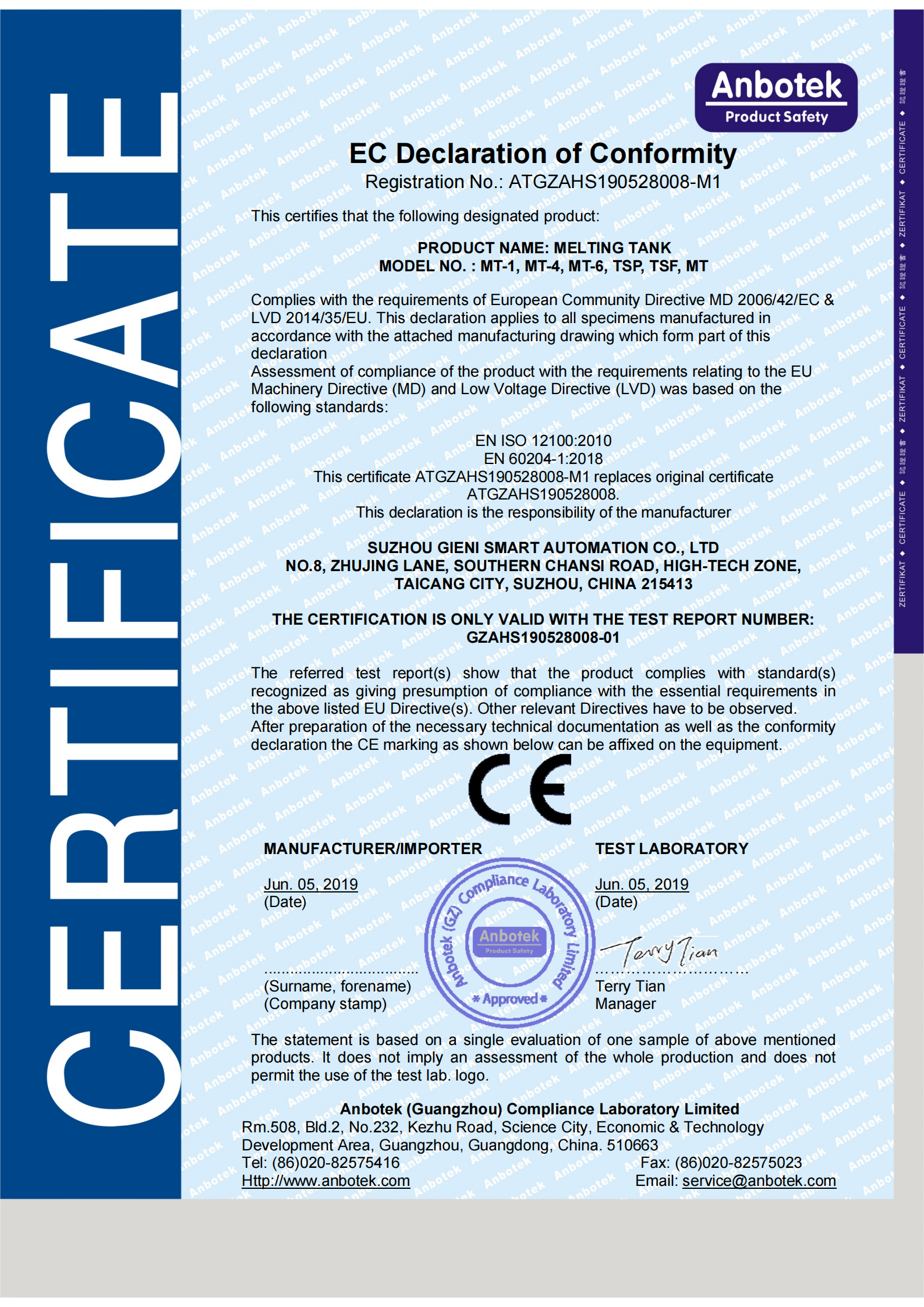
Certificate scope text is a name check: the model on the quotation must appear in the listed series.
Where Build-Scope Evidence Pays Off: Application and Market Context
The audit matters most where a line is judged on integration rather than on a single machine. GIENICOS describes its equipment as developed for colour cosmetics and skincare in GMP clean-room workshops — lip gloss, lipstick, mascara, cushion, foundation, compact powder, nail polish, eyeliner, eyebrow pencil, cream and lotion — and its recorded high-speed scenario uses PLC control with touch-screen operation and matched equipment for MES connection, remote support, checkweighing and reject, labeling and sleeve shrinking. In that configuration, the buyer is purchasing a sequence of hand-offs, and the documents that describe the hand-offs are the only way to see the sequence before it is installed.
One recorded programme illustrates the shape of the reference without proving a general result. GIENICOS reports 20 sets supplied to customers in the United States, Poland, Indonesia and Thailand for lipgloss and lip cream production, described as running for five years with service support on time. That is a single programme across four markets, useful as a reference to question, not a benchmark to copy.
The market context explains why documentation is becoming a commercial issue rather than an administrative one. Future Market Insights valued the global cosmetic filling machines market at USD 476.80 million in 2025 and projects USD 718.63 million by 2036, and its April 2026 report places automatic filling machines at a projected 41.2% share of the technology segment in 2026. Fortune Business Insights, in a July 2026 report, puts Asia Pacific at 33.08% of the wider filling machine market in 2025. Read together, these figures describe a market shifting toward automated lines, where a larger share of project value sits in integration, commissioning and documentation rather than in hardware alone — which is exactly where build scope is decided.
Sub-segment sizing deserves a caution rather than a number. Published estimates for the narrower automatic lipstick filling segment differ by roughly an order of magnitude between research houses, largely because one defines single machines and another defines whole lines. Buyers should treat such figures as directional and keep the audit on the documents in front of them.
What the Audit Cannot Prove
Documents show scope and intent, not outcome. A photograph cannot grade a bearing. A certificate addresses safety conformity for the listed models and nothing more. A factory acceptance record reflects the product tested on that day, in that configuration, at that speed. Capacity statements — about 100 units a year, 10 units a month — describe scale, and a buyer with a compressed installation window should confirm slot availability in the contract rather than infer it from an annual figure.
Two limits deserve to be stated explicitly in any procurement file. First, a customization can move a machine outside the configuration that was tested or listed, so the certificate scope and the FAT protocol both need to be re-read after any change. Second, no audit replaces running your own formulation: viscosity, pigment load, fill temperature and cooling behaviour decide whether a hot line performs, and they are properties of your product as much as of the machine.
Outlook: Documentation Becomes Part of the Product
As lines add checkweighing, reject logic, labeling, MES links and remote diagnostics, the audit shifts from the machine to the information that travels with it. GIENICOS established an AI division in 2020, focused on vision-based applications and smart manufacturing; that is a direction of investment, not a commitment to any individual project, and it should be read as one.
The practical consequence for buyers is that deliverable lists belong in the purchase order, not in a later conversation: as-built drawings, a bill of materials with makes and models, the FAT record, certificate copies with scope text, the spare-parts list and recommended maintenance intervals. A supplier that builds can usually produce these without a project crisis. Requesting them is therefore a cheap filter applied before a deposit, and a fair one, because it tests disclosure rather than price.
FAQ
How can a buyer distinguish a manufacturer from a trading company for a cosmetic filling machine?
Compare three records for the same line item: a dated shop-floor photo series showing that module in fabrication or assembly at the stated address; a build-vs-buy split naming the subassemblies the supplier fabricates and the components it purchases with make and model; and certificate scope text that names the model on the quotation. Then test continuity by asking whether the engineer answering technical questions is the engineer who will commission the line. A trading company can supply documents too, so the decisive point is whether those documents describe your model and the site that will build it.
Which records should exist before a factory acceptance test?
An agreed FAT protocol with parameters, sample size, acceptance limits and signature lines; a component list with makes and models for drives, PLC, temperature control and metering; as-built electrical and pneumatic drawings; the CE certificate with its full scope text; and a per-machine outgoing quality control record. GIENICOS states 100% outgoing testing before shipment and acceptance by factory acceptance test on site or by video inspection before shipment, and the protocol plus the signed record are the two documents that make those statements checkable.
Why does the model number on a CE certificate matter in an audit?
CE certificates for machinery list the model series inside their scope and, for lines, the constituent machines. GIENICOS's melting tank certificate ATGZAHS190528008-M1 names MT-1, MT-4, MT-6, TSP, TSF and MT; the Hot Filling & Cooling Line certificate AT185114C4000321 names the MT melting tank, JYF filling machine, JCT cooling machine, bottle and cap loading, checkweigher and JTB labeling machine for model series JHF-1 to JHF-10. A quoted model that appears in no scope list needs its own documentation before the order, and a customization that alters the electrical configuration should be checked against the scope with the supplier.
What does customization usually cover, and how does it change the audit?
GIENICOS states customization of voltage, logo, automation degree, tank size, filling method and speed request, with a minimum order of one unit and a stated lead time of 45 to 80 days. Each change moves part of the build: electrical design, vessel fabrication, metering path or drive sizing. The audit response is a written change matrix naming the base configuration, the subassemblies affected, the drawing approval step, the effect on certificate scope and the revision of the spare-parts list.
Can a supplier audit be completed remotely?
Partly. Certificate numbers can be verified with the issuing laboratory, drawings and bills of materials can be reviewed off site, and a video acceptance test can be scoped with fixed camera positions, live parameter display and a named signatory. What remote work cannot confirm is floor condition, the interior finish of a vessel, or how a line behaves across a full shift. Where a visit is possible, it should be timed to coincide with assembly of your own modules rather than a demonstration machine.
Reading the Quotation as a Set of Claims
A cosmetic filling machine order is a set of claims about who builds what. The module list is the index to those claims; the photographs, subassembly views, test-run records and certificate scope text are the evidence that either supports them or leaves them open. A buyer who asks per module, and records the answers before the deposit, ends up with a supplier relationship that is easier to hold to schedule — and with a procurement file that will still make sense when the line is commissioned.
GIENICOS publishes its factory, capability and certification position at gienicos.com, and its 2026 catalogue can be downloaded at 2026 CATALOGUE. Both are inputs to the request list described here, not substitutes for it; where a site visit or a factory acceptance test is feasible, it remains the strongest single check available to the buyer.
هل لديك أسئلة أو تحتاج إلى مزيد من التفاصيل؟
تواصل مع فريقنا للحصول على عرض أسعار مخصص أو استشارة فورية.
طلب عرض أسعار
املأ النموذج أدناه وسيتواصل معك فريقنا بعرض مقترح مخصص.
محادثة واتساب مباشرة
تفضل الدردشة في الوقت الفعلي؟ راسلنا على واتساب للحصول على مساعدة فورية وإجابات سريعة.
- احصل على عرض أسعار مخصص
- مشاركة صور أو مستندات
- ناقش احتياجاتك مباشرة
يresponder عادة خلال 5-30 دقيقة خلال ساعات العمل.