
Cosmetic Filling Machine Fit: Cream, Powder and Lip Lines
Cosmetic Filling Machine Fit: Cream, Powder and Lip Lines
A cosmetic filling machine is chosen against a production scenario, not against a catalogue page. Cream and toner lines resolve around viscosity and container geometry, which is why rotary and standard filling units are compared on those two variables before any throughput figure is discussed. Powder lines separate earlier, at the point where sifted bulk either goes loose into a jar or is pressed into a pan. Lip color lines are thermal: hot filling, cooling and capping behave as a single chain, and the slowest element in that chain sets the output. Treating these as three different fitting problems explains why equipment lists that look interchangeable on paper produce very different lines once installed.
GIENICOS (SHANGHAI GIENI INDUSTRY CO., LTD.) is a Shanghai-based manufacturer founded in 2011 that designs and builds cosmetic filling and packaging equipment across these product forms, including cream and toner filling machines, loose and compact powder equipment, lipstick and lip gloss filling lines, mascara, eyeliner and nail polish units. Its factory in Jiading District, Shanghai, covers a 2,000 ㎡ site with 30 employees, a 10-engineer R&D team and an annual output of about 100 units; roughly 80% is exported to the EU, USA and Asia. That breadth is the reason the useful buyer question is not which machine the supplier makes, but which unit a specific product form pulls into the line.
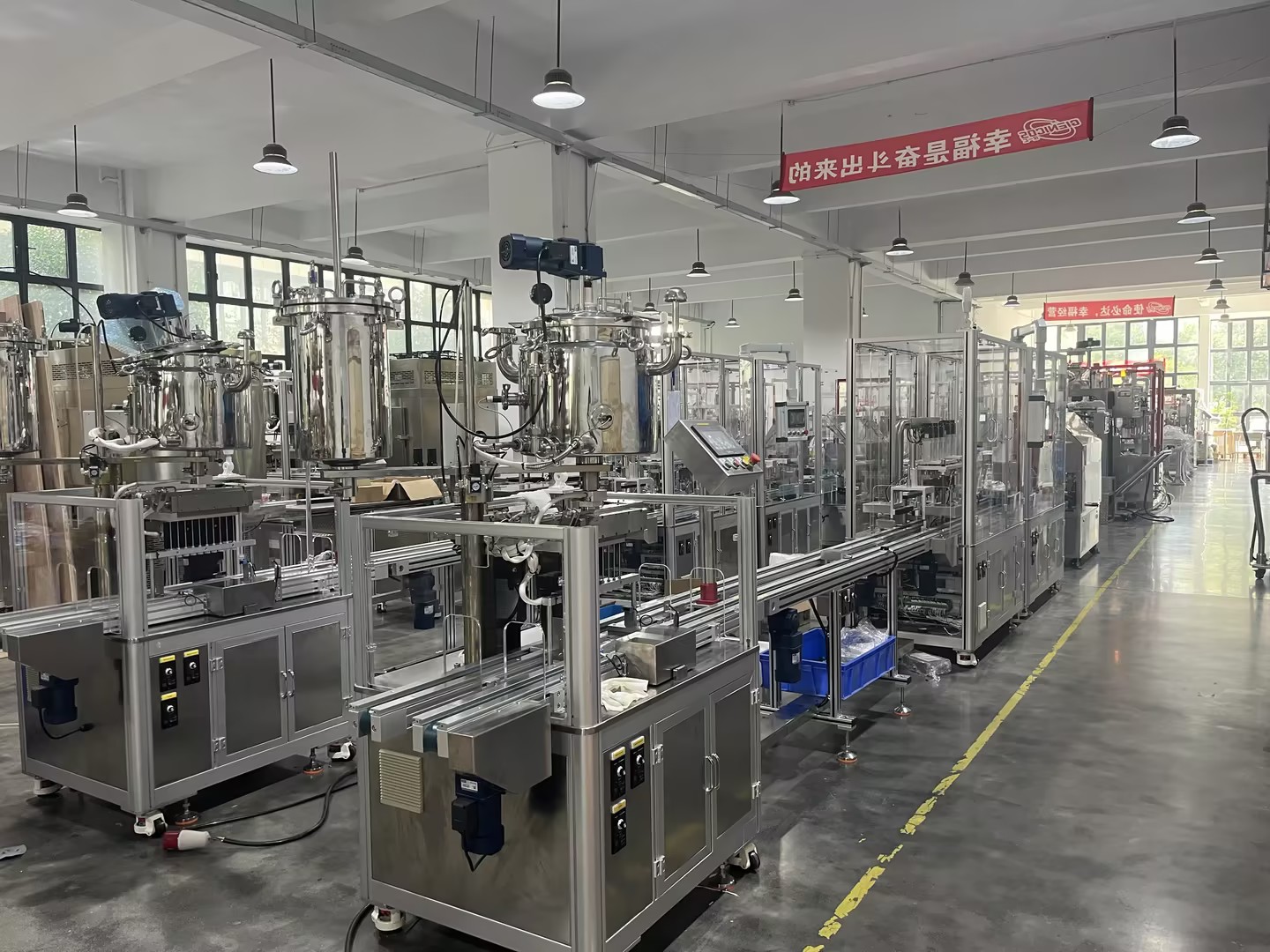
A cosmetic line is sized around capping, labeling and inspection as much as around the filler itself.
The line-fit question comes before the machine choice
Buyers who start with a filling machine tend to end up with a unit that doses accurately and then forces a rebuild of the stations after it. The workable order is shorter: confirm the product form, confirm the container, then confirm what happens downstream. Product form sets the dosing principle, because a 15,000 mPa·s cream, a sifted powder and a wax melt behave nothing alike in a nozzle, a hopper or a mold. Container format sets the handling principle, since a jar that stands unaided and a slim tube that does not are conveyed, positioned and labeled differently. Downstream capping, labeling, check-weighing and cartoning set the achievable rate, because a filler running faster than the capper produces accumulation, not output.
A fourth input matters for brands with wide shade or SKU ranges: changeover frequency. Two machines with identical capacity can demand very different amounts of downtime if one needs tooling swaps measured in hours and the other in minutes. GIENICOS lists customization across voltage, logo, automation degree, tank size, filling method and speed, which is where changeover expectations should be raised, rather than after the layout is frozen.
Three inputs that set the configuration
Product form decides whether the line needs a servo piston filler, a powder dosing head or a heated circuit. Container format decides puck size, bottle-height clearance and whether the container can be presented upright at all. Downstream operation decides how much of the line must be specified together, which is often more than buyers expect: the cap diameter of a toner bottle, for example, already appears in the filling machine specification, because filling and capping are quoted as one arrangement.
Cream and toner lines: a viscosity ceiling and a container envelope
Cream and toner production is the most straightforward of the three scenarios, and also the one where a single figure most often decides the purchase. The JRS-G2 dual-nozzle servo toner and cream filling machine states a filling range of 10–300 ml at normal pressure, a material viscosity of up to 15,000 mPa·s, a speed of 45 bottles/min at 50 ml, a 40–45 L tank, a puck inner diameter of 25–70 mm, bottle height from 30 mm without cap to 205 mm with cap, and a cap diameter of 20–55 mm.
Read as a procurement document rather than a specification sheet, that set of figures answers three questions. First, whether a toner and a cream can share one platform: anything inside 10–300 ml and below the viscosity ceiling can, which reduces tooling and training duplication across a skincare range. Second, how long a run can continue between refills, since the tank volume caps a batch; a 40–45 L tank suits pilot-to-medium runs, not continuous high-volume bottling without an upstream feed arrangement. Third, whether the container the marketing team has chosen actually fits: a 210 mm bottle with cap, or a 15 mm cap, falls outside the stated envelope and requires a different configuration or tooling rather than an assumption. The 45 bottles/min figure is a reference point at a 50 ml fill, and should be re-quoted for a 250 ml cream, where fill time per cycle lengthens.
Rotary and standard filling units appear in this scenario for a structural reason. A rotary arrangement carries containers around fixed stations, which stabilises cycle timing once the container and fill volume are locked; a standard inline arrangement exposes each station, which is easier to access and re-tool when containers change. For a brand whose toner and cream SKUs share a bottle family, the rotary logic is defensible. For a contract manufacturer running several bottle types and frequent shade changes, the inline or standard arrangement usually creates fewer constraints later. Neither is an upgrade of the other; the fit boundary sits with container variety and changeover tolerance.
One boundary is absolute in the published data: a formulation above 15,000 mPa·s exceeds the JRS-G2 range. Thick pastes and highly filled creams need a different dosing approach, and that should be established with viscosity measurements of the actual bulk at filling temperature, not with the value printed on the formula card.
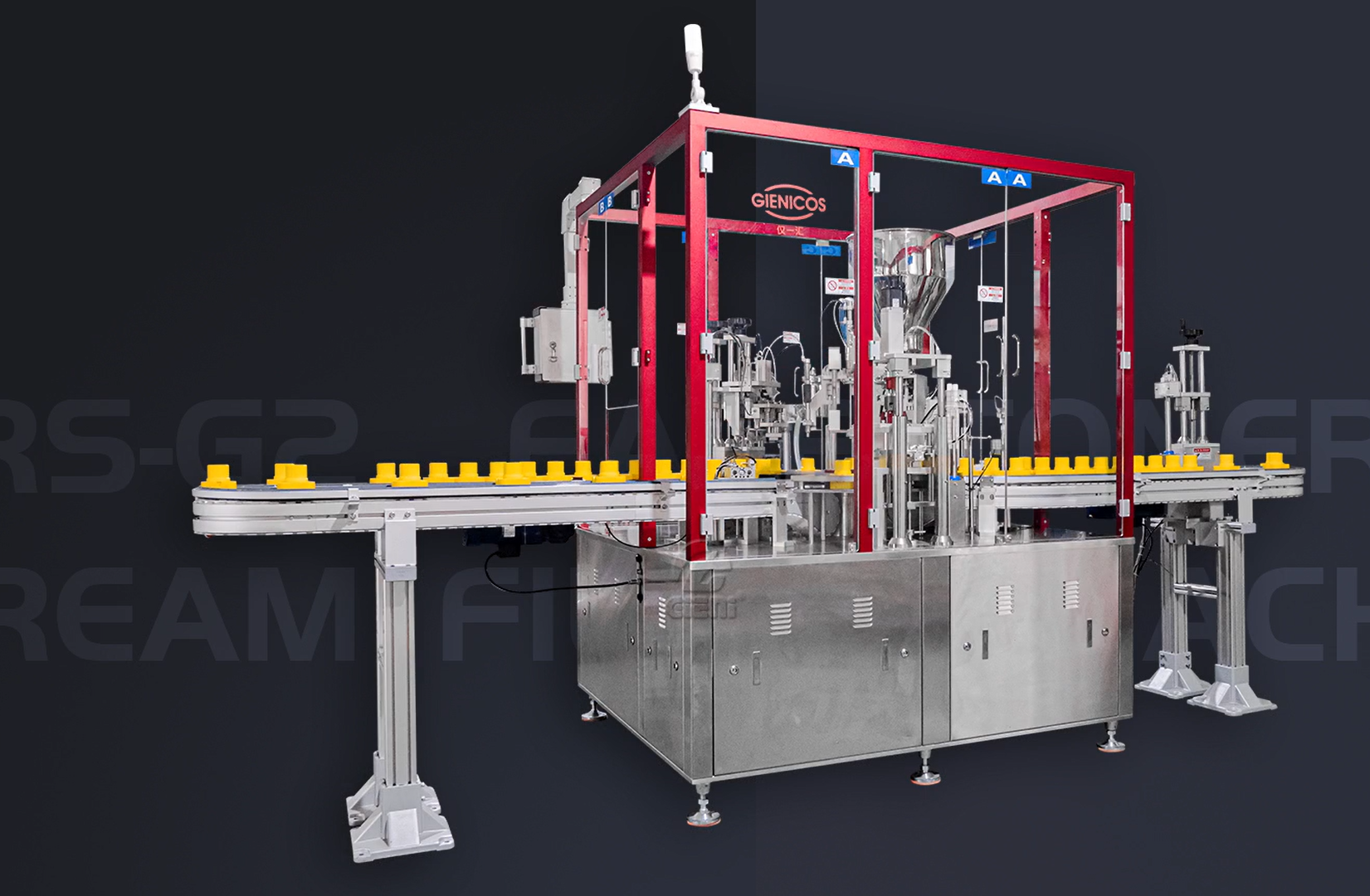
JRS-G2 dual-nozzle servo toner and cream filling machine, specified for 10–300 ml fills and materials up to 15,000 mPa·s.
Powder lines: mixing and sifting decide whether pressing is the right branch
Powder is not one scenario but two, and the fork sits after bulk preparation. Loose powder moves as sifted bulk into a jar or sifter container; pressed powder is compacted into an aluminium pan and then set into its compact case. Both branches depend on the upstream chain of mixing, pulverising and sifting, which is why GIENICOS positions its presses downstream of those steps rather than as standalone units.
Batch capacity in that upstream chain sets the production rhythm more than the filler does. The JY3-CR100 high speed powder mixer works a 100 L chamber with 10–25 kg batches, an 18.5 kW main motor variable from 0 to 2840 rpm, and three side-stirrer shafts driven at 2.2 kW. The JY-CR200 raises this to 200 L and 20–50 kg per batch with a 37 kW main motor and the same three-shaft side stirring. For a shade-heavy powder range, the smaller batch size supports more frequent colour rotation with less leftover blend at each change; the larger unit reduces the number of preparation cycles for a stable, high-volume shade. The trade is not efficiency in the abstract, but how much cleaning and re-charging the blending area carries per week.
On the pressed branch, capacity statements only mean something when read together. The JBC-4 compact powder press machine uses bottom-up full hydraulic pressing at 2–3 molds per minute, a typical 720–1080 pcs/hour, up to 6 pans per mold depending on aluminium pan size, a working pressure of 0.4–0.6 MPa and a maximum hydraulic output pressure of 15 tons, run by 1–2 operators. The JBC-5 uses servo-motor hydraulic drive at a maximum 14 tons and up to 3 molds per minute, with a typical 9 pans per mold at roughly 50 mm pan diameter, and allows pressing speed and pressure to be adjusted on the touch screen. Because both figures are explicitly conditional on pan size and formulation, a pcs/hour comparison between two presses is only valid at equal pan diameter, equal cavity count and the same powder blend.
The differences that decide selection are quieter. JBC-4 integrates dust collection with recycling and a two-stage powder loading function with servo-controlled powder volume, which matters for expensive formulas and cleanroom housekeeping. It also lists embossed, engraved and dome-shaped products among its applications, so decoration-led compact ranges point in its direction. JBC-5 offers touch-screen adjustment of speed and pressure, which shortens the trial loop when several powder formulas share one press. On the loose branch, the automatic loose powder filling machine in the range doses sifted bulk into jars, and its fill weight and container tooling follow the specific jar and target weight; those parameters belong in the written technical offer rather than in a generic comparison.
Lip color lines: hot filling, cooling and capping behave as one thermal chain
Lip color is the scenario where a filling machine is least separable from its neighbours. A cosmetic hot filling machine doses molten bulk; a lipstick cooling tunnel brings the stick or mold to a set state; capping closes the unit. Every transfer between those stations is an interval in which temperature moves, and that interval is where surface finish and shape consistency are usually lost. This is why GIENICOS offers the semi automatic lipstick filling machine, the lipstick cooling tunnel and the hot filling and cooling line as related configurations rather than as independent catalogue items, and why buyers should ask for the temperature curve and dwell time across the whole chain rather than for the filler alone.
Bulk preparation sets the start of that chain. The MT 300 SE cosmetic melting tank holds 300 L with stirring and oil circulation heating, and is specified for foundation, lipstick, primer cream and wax-based cosmetic bulk. Its role in a lip color project is to deliver a homogeneous melt at a stable temperature, so that the first and last stick of a run see the same material. A 300 L capacity supports medium-to-large batch preparation and reduces repeated small-batch melting; the corresponding trade is a larger volume of bulk held hot at any one time.
GIENICOS documents the integration logic in an adjacent, clearly separate line: the JPF-12/16 eyebrow pencil and eyeliner gel filling production line combines oil spraying, mold preheating, servo filling of 2–10 ml, cooling at −1 °C to −2 °C, demolding, screw-down and capping in one continuous system at roughly 45–50 pcs/min, with two 5 L heating tanks and 12.5 kW of installed power. It is a gel line, not a lipstick line, and its cooling figures belong to that configuration. What it demonstrates is the sequence principle: preheating molds before dosing and controlling cooling immediately after dosing remove manual handling between stages, which is the same logic a lipstick cooling tunnel applies.
The fit boundary is important here. Set behaviour depends on the wax blend, pigment load and stick diameter, so a cooling range published for one product family should not be transferred to another without confirmation. Buyers specifying a lipstick filling machine should request the cooling dwell time, tunnel length and mold count for their own formula, and should treat semi-automatic filling as a fit for lower volumes and limited shade ranges where mold handling and capping remain partly manual, and an automatic hot filling and cooling line as a fit for stable, repeated shade runs where manual handling becomes the rate limit.
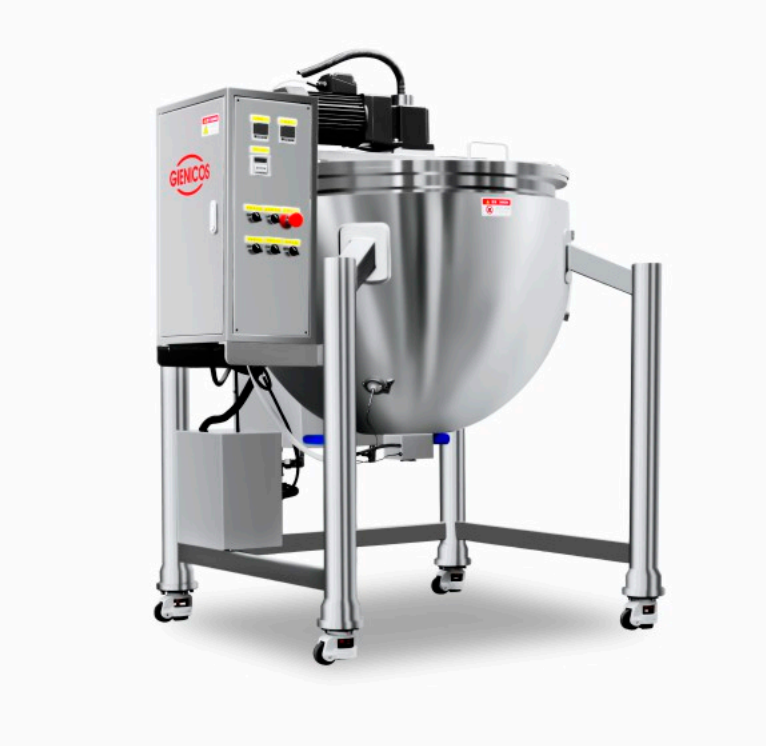
MT 300 SE 300 L melting tank with stirring and oil circulation heating, used upstream of hot filling for wax-based lip color bulk.
Downstream equipment often rewrites the filling layout
Once a line reaches a certain rate, the filler stops being the constraint. A documented GIENICOS application for lip gloss, mascara and lip tint runs automatic precise filling with automatic wiper loading and pressing, 10-head servo capping, PLC control and touch-screen operation, with MES connection, remote support, automatic check-weighing and rejection, labeling and sleeve shrink labeling, in a GMP clean-grade workshop at 80 pcs/min. At that level, the capping head count and the inspection station are what keep the rate; replacing the filler alone would simply move the bottleneck.
Container shape can force the change even earlier. The JTB horizontal round container labeling machine exists for slim round containers that cannot stand steadily: bottle diameter 1–2.5 cm, bottle height 2.5–10 cm, labeling speed 0–25 m/min, accuracy ±0.1 cm excluding container and label variation, in a stainless steel and aluminium structure built for GMP production, with bottle guiding, positioning, label smoothing and counting integrated and conveyor connection for line use. It is specified for lipstick, lip balm, mascara and sunstick packaging. A container that will not stand changes the labeling principle from vertical to horizontal, and that decision moves the handling step between filling and labeling, the line footprint and the operator position, long before anyone compares filling speeds.
Scenario fit at a glance
| Scenario | Process sequence | Units in the GIENICOS range | Confirm before ordering |
|---|---|---|---|
| Cream and toner | Bulk holding, dosing, capping | JRS-G2 toner and cream filling machine; rotary or standard configurations | Measured viscosity at fill temperature; bottle height with cap; cap diameter |
| Loose powder | Mixing, pulverising, sifting, dosing into jar | JY3-CR100 or JY-CR200 mixer; automatic loose powder filling machine | Batch size, fill weight, jar tooling, sifter assembly |
| Pressed powder | Mixing, pulverising, sifting, pressing into pan | JBC-4 or JBC-5 compact powder press machine | Pan diameter, cavities per mold, pcs/hour at that pan size, decoration shape |
| Lip color | Melting, hot filling, cooling, demolding, screw-up, capping | MT 300 SE melting tank; semi automatic lipstick filling machine; lipstick cooling tunnel; hot filling and cooling line | Cooling dwell and temperature curve for the actual wax blend; mold count; capping method |
What the market signal says, and what it does not
Aggregate research is useful for budgeting context, not for line design. Future Market Insights valued the cosmetic filling machines market at USD 476.80 million in 2025 and projects USD 718.63 million by 2036, and estimates that automatic filling machines will hold a 41.2% share of cosmetic filling technology in 2026. A separate Fortune Business Insights figure puts Asia Pacific at 33.08% of the wider filling machine market in 2025. The practical reading is that automatic configurations are a mainstream comparison point in most new projects, so their total cost and changeover behaviour deserve a place in the evaluation even when the initial plan is semi-automatic. It is not evidence that any particular cream, powder or lip color line should be automated; that still depends on the container, the shade range and the downstream stations available.
What to verify before committing to a line
- Viscosity measured on the actual bulk at filling temperature, compared against the published range of the unit under consideration (15,000 mPa·s maximum for JRS-G2).
- Container samples checked against every stated dimension, including height with cap, cap diameter and whether the container stands unaided before labeling.
- Press performance quoted at the buyer's own pan size and cavity count, since 720–1080 pcs/hour on JBC-4 depends on pan size and formulation.
- Cooling dwell, tunnel length and mold count for the specific lip color formula, rather than a figure borrowed from another product family.
- Upstream bulk capacity against batch size: 10–25 kg on JY3-CR100 and 20–50 kg on JY-CR200.
- Downstream rates for capping, check-weighing and labeling at the intended line speed, not only at the filler.
- Commercial terms in writing: minimum order of 1 unit, lead time of 45–80 days, monthly capacity of 10 units, 100% outbound quality inspection before shipment, 12-month warranty covering manufacturing defects and excluding wearing parts and man-made damage, plus remote and on-site technical support.
Installation history is a fair reference point when it matches the scenario. One documented GIENICOS record covers 20 sets used for lip gloss and lip cream production across the US, Poland, Indonesia and Thailand, with five years of reported stable operation and on-time service support. That kind of record supports a question about service response and spares availability; it does not by itself establish suitability for a different product form. For import planning, US HTS subheading 8422.30.91 has been cited for machinery of this family, and classification should be confirmed with the buyer's own broker.
FAQ
Can one filling machine handle cream, powder and lip color products?
No. The three require different dosing principles: a servo piston or nozzle system for cream and toner, a dry-powder dosing and compaction chain for powder, and a heated circuit with controlled cooling for lip color. A cream filling machine operating within a stated viscosity range cannot dose sifted powder, and a press cannot handle a molten wax. Where one platform does serve a range, that range is within a single product form.
Which line-fit factor forces a layout change most often, the container or the downstream equipment?
The container usually forces it first, and the downstream equipment confirms it. A slim round container that cannot stand requires horizontal rather than vertical labeling, which changes the handling step, footprint and operator position. Container height with cap and cap diameter also appear directly in filling machine specifications, so an unusual bottle can move the project to a different configuration before capping or labeling is even discussed.
For pressed powder, does output depend on the mold or on the formula?
Both. JBC-4 is rated at 2–3 molds per minute and a typical 720–1080 pcs/hour with up to 6 pans per mold depending on aluminium pan size, and the stated capacity is conditional on pan size and powder formulation. JBC-5 is rated at up to 3 molds per minute with a typical 9 pans per mold at roughly 50 mm pan diameter. A comparison between presses is only meaningful at the same pan diameter, cavity count and blend.
What cooling temperature applies to a lipstick cooling tunnel?
The correct figure depends on the wax blend, pigment load and stick diameter, and should come from the supplier's technical offer for the specific configuration. GIENICOS publishes a cooling range of −1 °C to −2 °C for its JPF-12/16 eyebrow pencil and eyeliner gel line, which is a different product family. Transferring that number to a lipstick tunnel without confirmation would be an assumption, not a specification.
Is a semi automatic lipstick filling machine a reasonable first line?
It can be, where volumes are modest, the shade range is limited and mold handling plus capping can be carried out with manual or semi-manual support. The trade is that labour, rather than machine speed, becomes the rate limit, and consistency depends on operator discipline during mold handling and cooling. An automatic hot filling and cooling line addresses that limit but requires a volume base that justifies the additional stations and changeover discipline.
Where this leaves the decision
Scenario fit is a sequence of eliminations rather than a ranking. Cream and toner lines are settled by viscosity and the container envelope; powder lines are settled by batch size, sifting discipline and whether the product is loose or pressed; lip color lines are settled by the thermal chain and by how much of the mold handling is automated. In each case the answer is bounded by published parameters and by what the downstream stations can absorb. Buyers can review the wider range on the GIENICOS website, and the 2026 catalogue is available for download at this link.
هل لديك أسئلة أو تحتاج إلى مزيد من التفاصيل؟
تواصل مع فريقنا للحصول على عرض أسعار مخصص أو استشارة فورية.
طلب عرض أسعار
املأ النموذج أدناه وسيتواصل معك فريقنا بعرض مقترح مخصص.
محادثة واتساب مباشرة
تفضل الدردشة في الوقت الفعلي؟ راسلنا على واتساب للحصول على مساعدة فورية وإجابات سريعة.
- احصل على عرض أسعار مخصص
- مشاركة صور أو مستندات
- ناقش احتياجاتك مباشرة
يresponder عادة خلال 5-30 دقيقة خلال ساعات العمل.