
Cosmetic Filling Machine Supplier Audit: Built to Last?
Cosmetic Filling Machine Supplier Audit: Built to Last?
A cosmetic filling machine is rarely retired because it wore out. It is retired because the product it was specified for no longer exists — or because the supplier who built it can no longer support what that product has become.
That mismatch is why supplier evaluation deserves more than a quotation review. Output, fill accuracy, capping torque and price settle the first purchase. Process breadth, spare-part continuity and service coverage decide whether the same supplier is still useful in year three, year five and year ten. A sustainability audit reframes the buying question from 'which machine do we purchase' to 'which partner can absorb the changes we cannot yet specify'.
Shanghai GIENI Industry Co., Ltd. (GIENICOS) is a Shanghai-based manufacturer founded in 2011 that designs and builds intelligent cosmetic filling and packaging equipment — lipstick, lipgloss, mascara, eyeliner, hot pouring, powder pressing, cream and lotion systems, plus capping, labeling and checkweighing — and supplies OEM/ODM contract manufacturers as well as brand-owned production bases. Its portfolio is used here as a working example of how process breadth can be read as lifecycle evidence, and where that reading stops being reliable.
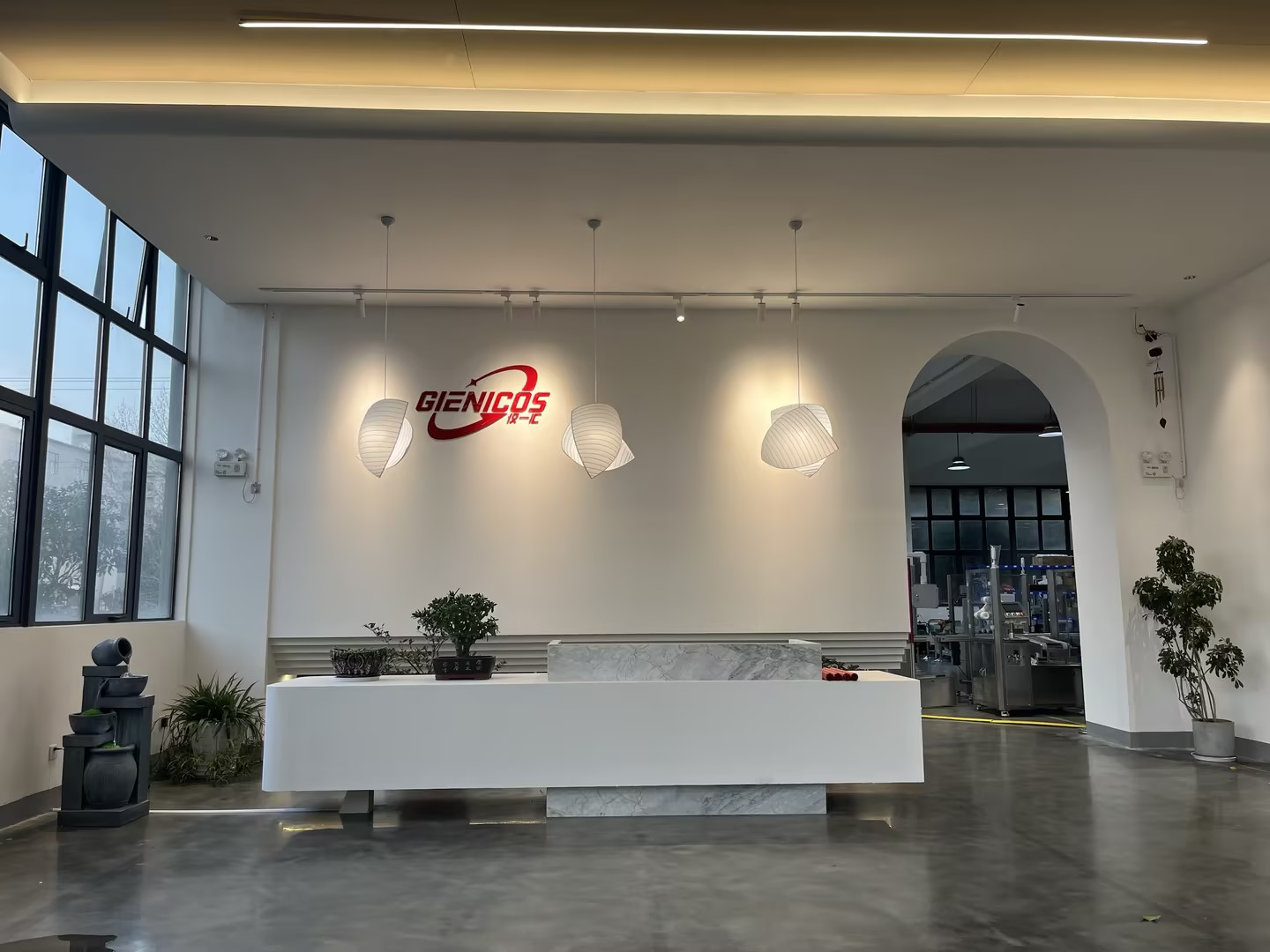
A supplier audit starts on the production floor and in the document file, not in the brochure — the first question is what the partner can still support after delivery.
Why a Filling Machine Outlives Its First Product
Cosmetic portfolios move faster than filling lines. A line commissioned for one lipgloss format is frequently asked, within a few seasons, to run a lip tint at a different viscosity, a concealer in a narrower container, or a mascara with a new wiper assembly. Each individual change looks minor. Cumulatively, they mean that the machine specified in year one is running a different product mix by year four.
What actually changes inside a live line tends to cluster around a small number of variables:
- Formulation viscosity and pigment load, which shift filling method and nozzle behaviour
- Fill volume and container geometry, which affect change parts and tooling
- Wiper, brush and applicator assemblies, which are format-specific
- Cap and closure type, which changes capping torque and head configuration
- Labeling format, including sleeve-shrink versus adhesive labels
None of this appears in a standard quotation. It appears later, as a series of requests for parts, tooling and engineering time. A supplier with a narrow catalogue tends to answer those requests by subcontracting the unfamiliar stage; a supplier with a wide process base answers them internally. That difference — not the brochure's headline speed — is what a long-term evaluation is trying to measure.
The Opportunity: Breadth Is Really an Interface Test
When one engineering organisation already builds hot pouring and cooling, mascara and lipgloss filling, lipstick, powder pressing, capping, labeling and checkweighing, the interfaces between those stages have already been solved under one roof. For a buyer, this matters less as a shopping list and more as evidence about how the next format will be handled.
The logic is straightforward: every additional product family a supplier supports is an additional set of interfaces it has had to resolve — filling to capping, capping to labeling, labeling to checkweighing, heat control to cooling. A buyer integrating three vendors inherits those interfaces. A buyer working with one vendor inherits a single point of accountability for them.
Breadth is a proxy, not proof. It indicates that a supplier has solved more interface problems than a single-format builder; it does not by itself demonstrate spare-part inventory depth, engineering depth in any one format, or financial durability. Those require documents, which is what the audit dimensions below are for.
Seven Audit Dimensions, Ranked by Risk Weight
The dimensions below are ordered by how much damage a weak answer causes over a five-to-ten-year horizon. Rank one is not the most impressive item to discuss; it is the one that most reliably produces unplanned capital spend.
| Rank | Audit dimension | Evidence to request | Weak-answer signal |
|---|---|---|---|
| 1 | Cross-category process breadth | A line-level list by product family, showing filling, capping, labeling and checkweighing boundaries | Portfolio limited to one format family, with every other stage named as a third party |
| 2 | Spare-part and wear-part continuity | Written wear-part list, consumable definition, part-number scheme across model series | No written consumable list; parts identified only by machine serial number |
| 3 | Model-family continuity | Series documentation covering several nozzle counts or speed classes on one platform | Every configuration sold as a one-off build with no stated shared platform |
| 4 | Service coverage by line type | Support scope stated separately for filling, capping, labeling and powder equipment | Support described only for the filling unit, with end-of-line excluded |
| 5 | Documented scope versus delivered configuration | Certificate scope wording matched line by line against the purchase order | Certificates shown as images without a scope list or model range |
| 6 | Upgrade and retrofit path | Defined semi-automatic to automatic migration options and control architecture | Upgrades described as 'possible' with no engineering step attached |
| 7 | Capacity and lead-time realism | Monthly build capacity and a delivery slot for a multi-line order | Delivery dates offered without reference to production capacity |
Dimensions one to three carry the most weight because their failure mode is silent. A buyer cannot easily discover, four years after installation, that the tooling for a discontinued format was never internally producible. Dimension five is the one most often skipped and the easiest to falsify quickly: either the model series on the certificate matches the purchase order, or it does not.
Reading Process Breadth Correctly
Breadth only means something when it is mapped to lifecycle questions rather than counted as a product number. The table below converts a portfolio into the specific continuity questions a buyer is trying to answer.
| Process family | Equipment categories in the portfolio | Lifecycle question it answers |
|---|---|---|
| Hot pouring and cooling | Melting tank series (MT), hot pouring machine (TSP), JYF filling machine, JCT cooling machine, automatic bottle and cap loading, checkweigher, JTB labeling machine | Can a formula change be absorbed by re-tuning heat and cooling rather than replacing the line? |
| Lipstick and lip balm | Semi-automatic lipstick filling (JLG-10/12), half silicone mould lipstick and lipbalm line (JSM), automatic silicone mould lipstick filling (GLU-1300) | Does one supplier cover both low-volume mould work and higher-volume silicone-mould production? |
| Mascara, lipgloss, eyeliner, lip pouch | Automatic lipgloss filling and capping (JQH-02), automatic mascara and lipgloss filling (JQR-01A), semi-automatic JR-02M/L and JR-01M/L, lip pouch filling for lipgloss and concealer (JR-01P), eyeliner filling (JR-02E) | Can viscosity and applicator changes stay inside the same supplier relationship? |
| Powder | Compact powder press machines (JBC-4, JBC-5, JTC), high-speed powder mixers (JY-CR50, JY-CR200), loose powder filling | Do pressing and mixing come from one engineering source, or from two that the buyer must integrate? |
| Skin care and cream | Cream filling, lotion filling and capping, serum filling, toner filling, skin care filling | Can a colour-cosmetics partner extend into skin care without a second vendor? |
| End of line | Lipstick labeling machine, sleeve shrink labeling machine, checkweigher | Is the end-of-line covered by the same support relationship as the filler? |
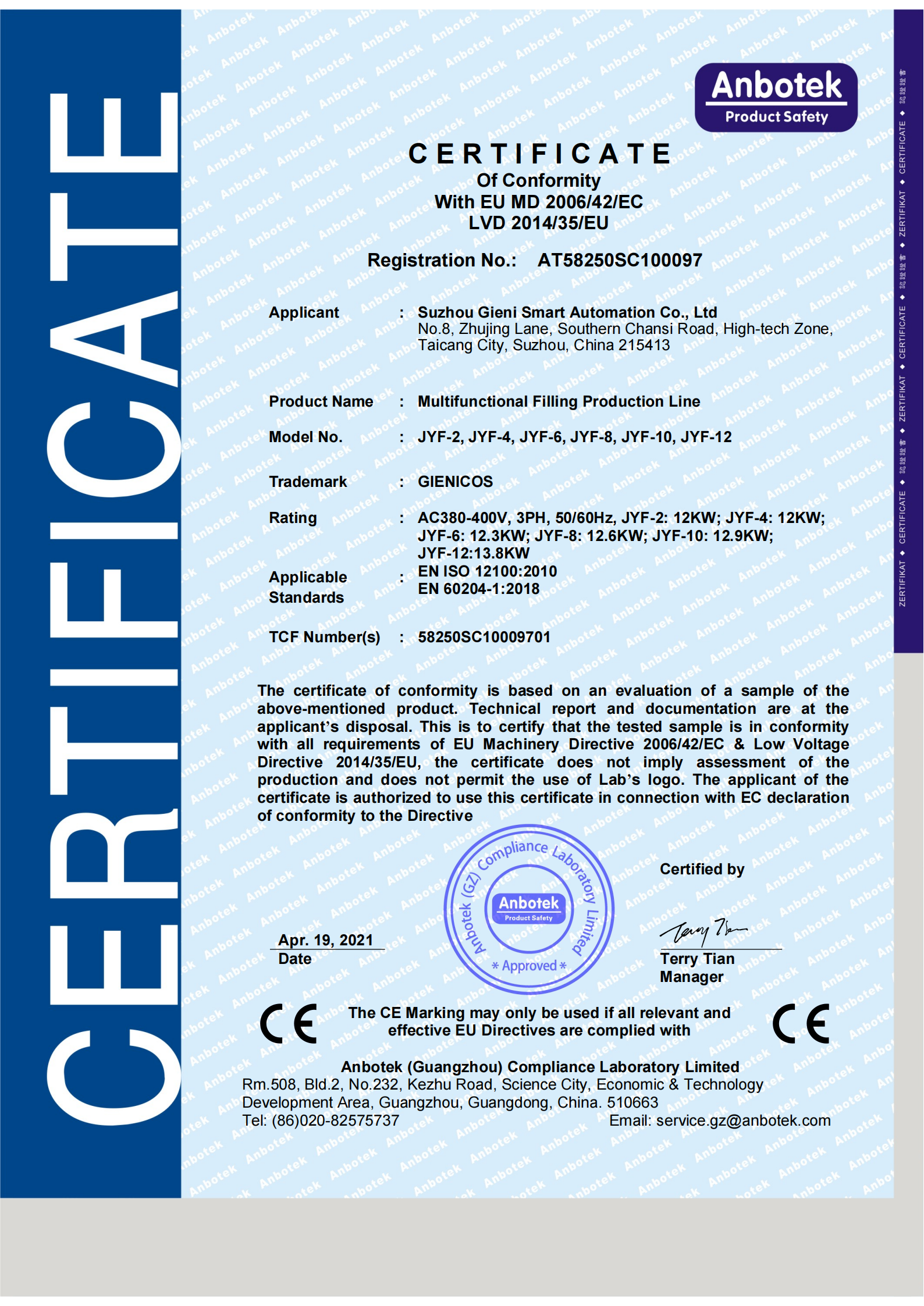
Scope wording matters more than the certificate image: a listed model series such as JYF-2 through JYF-12 is what an auditor compares against the configuration being quoted.
Spare Parts, Model Families and the Decade Question
The most common long-term failure in cosmetic filling equipment is not a breakdown. It is a part that cannot be sourced because the platform it belonged to was quietly replaced. Series design is the practical defence against this. When a filling family spans multiple nozzle counts on one architecture — JYF-2 through JYF-12, or a labeling family running JHF-1 through JHF-10 — components are shared across the range rather than engineered per order.
Design ownership matters here for a specific reason. GIENICOS holds 42 authorised patents covering invention patents, utility model patents and software copyrights. For a buyer auditing continuity, the relevant implication is that the drawings behind the platform sit with the organisation that would have to reproduce a part, rather than with a third-party OEM that may have moved on. It is not a guarantee of availability; it is a structural precondition for it.
Two further documents belong in the audit file:
- A wear-part list with a stated consumable definition. GIENICOS warrants machines for 12 months from acceptance, covering manufacturing defects and excluding wearing consumable parts and man-made damage, with free spares and freight carried by the supplier. Since consumables sit outside the warranty, the buyer's five-year cost model depends entirely on knowing what they are.
- A wear-part replacement procedure tied to line stoppage time. The company's modular structural design is intended to allow fast disassembly, cleaning and spare-part replacement, which is the mechanism by which a part swap avoids becoming a production day lost.
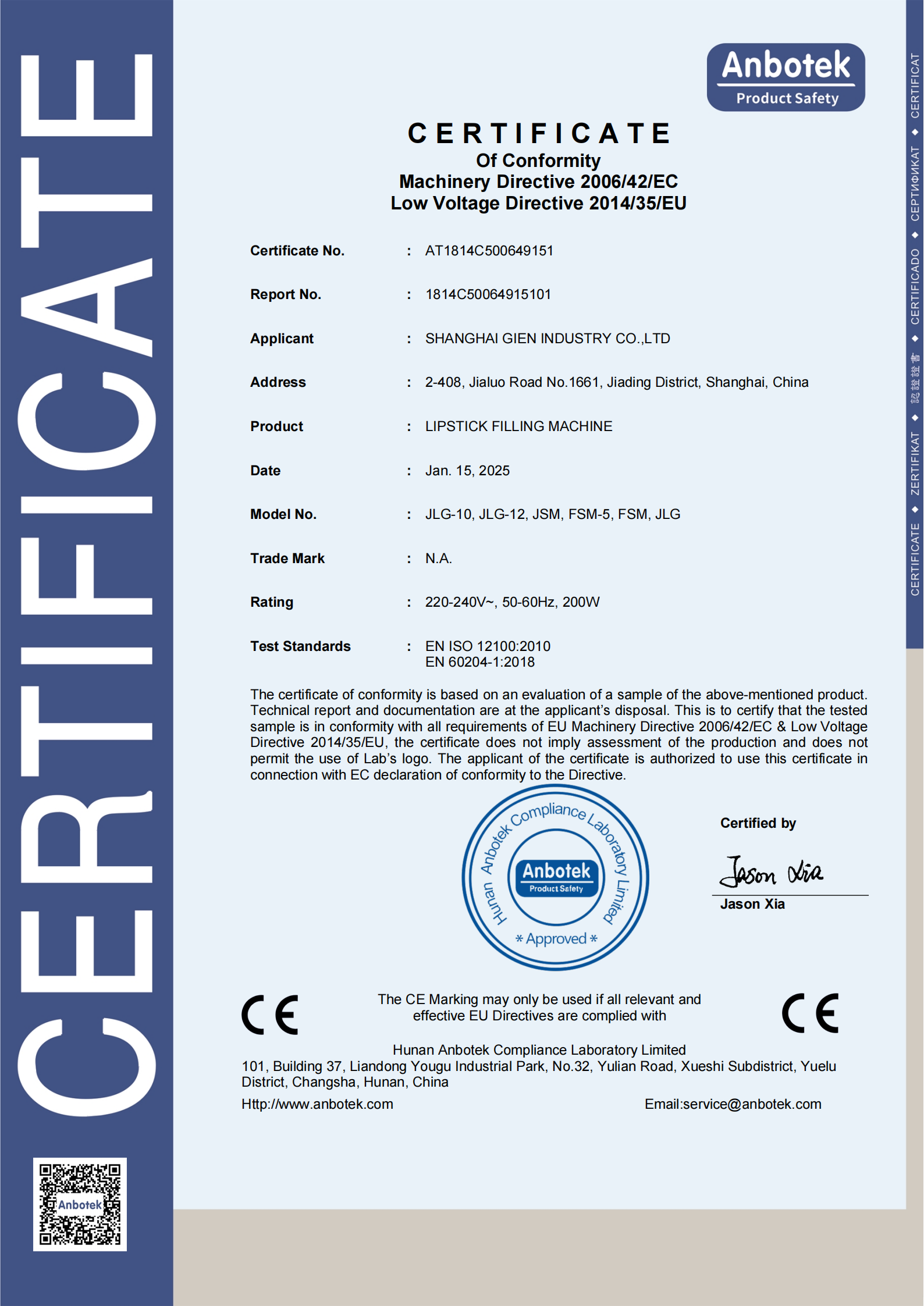
A model family documented under one certificate reference — JLG-10, JLG-12, JSM, FSM-5 and related series — is easier to support with shared parts years after delivery.
Service Coverage Across Filling, Capping, Labeling and Powder
Service is where a broad portfolio either pays off or exposes itself. A supplier that sells filling, capping, labeling and powder equipment but services only the filling unit has effectively transferred the integration risk back to the buyer at the worst possible moment.
The service model GIENICOS states consists of remote technical support, onsite visit support, a one-year warranty and full-life service support, with 100% outgoing quality control testing before shipping. Customer coverage extends across 100 countries and regions, with an export share of roughly 80% and core markets in the EU, USA and Asia.
A documented case illustrates how continuity is actually judged. Twenty sets supplied to cosmetic brands, OEM/ODM contractors and small-batch production labs in the United States, Poland, Indonesia and Thailand have run for five years on lipgloss and lip cream production. The reported outcome is stable operation with service support delivered on time. That is a modest claim, and it is the right kind: five years of stable operation under on-time support is a more useful audit signal than any single performance figure taken at commissioning.
Multi-Product Upgrade Paths: From Pilot to Turnkey
An upgrade path is only credible when it can be described in steps. In the GIENICOS portfolio the steps are visible as distinct product tiers: semi-automatic mascara and lipgloss filling (JR-01M/L, JR-02M/L) and semi-automatic lipstick filling (JLG-10/12) at the entry point; automatic lipgloss filling and capping (JQH-02) and automatic mascara and lipgloss filling (JQR-01A) at the next level; and full hot filling and cooling lines integrating melting tanks, filling, cooling, bottle and cap loading, checkweighing and labeling at the top.
Customisation scope is stated concretely: voltage, logo, automation degree, tank size, filling method and speed request, with a minimum order quantity of one unit. That combination — one-unit MOQ alongside configurable automation level — is what makes a staged path practical, because a lab or a brand's first production cell can be specified at the same platform family it will later scale into.
Two constraints deserve equal billing. Lead time runs 45 to 80 days and monthly capacity is around 10 units against annual output of about 100 units. A buyer planning three lines in a single quarter should therefore open the scheduling conversation before the specification is finalised, not after. And customisation is positioned around modular design and development for key accounts rather than standard mass-produced universal machines — a distinction that matters to buyers who want the lowest-cost commodity unit rather than a configured line.
What the Market Data Says About Longevity
The commercial case for auditing continuity is strengthening, and the published figures point in one direction. Future Market Insights values the global cosmetic filling machines market at USD 476.80 million in 2025, with sales expected to reach USD 494.92 million in 2026 and USD 718.63 million by 2036. Fortune Business Insights reports that Asia Pacific held a 33.08% share of the filling machine market in 2025. Future Market Insights also projects that automatic filling machines will account for 41.2% of the cosmetic filling technology market in 2026.
The automatic share is the figure with the most direct procurement consequence. As the installed base shifts toward automatic lines, the value of a machine increasingly sits in its control architecture and its retrofit potential rather than in its mechanical frame. Buyers who purchase a semi-automatic unit today with no defined migration route are effectively pre-buying a replacement rather than an upgrade.
Segment-level forecasts should be read with more caution. One research house projects the automatic lipstick filling machine market reaching USD 1.2 billion by 2033 at a 5.8% CAGR from 2025, while other published estimates for the same nominal segment are far lower — a gap that reflects differing definitions of whether 'machines' includes full production lines. The direction is useful; the absolute figure is not a planning input.
For cross-border procurement, cosmetic filling machines fall under HS Code 8422.30, specifically 8422.30.91 for machinery used in opening, filling and closing containers — a classification worth confirming early, since it determines duty treatment and documentation for the shipment rather than the equipment selection itself.
Where a Broad Portfolio Stops Helping
Portfolio breadth reduces integration risk. It does not solve every sourcing problem, and buyers should treat the following as genuine limits rather than caveats.
- Specialists can be deeper. A supplier dedicated to a single format may offer more refined throughput and tooling knowledge within that format than a multi-family builder whose engineering attention is divided across six process families. Breadth buys continuity; it does not automatically buy depth.
- Positioning is not universal. GIENICOS describes its direction as customised development for key accounts built on a modular concept, and states that standard mass-produced universal machines are not its main direction. A buyer whose requirement is a commodity unit at the lowest possible capital cost is not the intended fit.
- Scale is finite. Roughly 30 employees, a 2,000 m² facility and about 10 units of monthly capacity describe a focused operation, not a volume supplier capable of equipping several plants simultaneously.
- The warranty window is short relative to the asset. Twelve months from acceptance, with consumables excluded, means the buyer carries wear-part cost from year two onward. That is normal for the category, but it must be priced into the audit rather than discovered later.
- Breadth is not proof of parts inventory. A wide catalogue says nothing about whether a specific seal or nozzle is held in stock. Only a written wear-part list answers that.
- One supplier still means changeover. Moving a line from mascara to lipgloss remains a physical reconfiguration with defined downtime. A dedicated single-format line will always be faster for one product at very high volume.
Future Outlook
Supplier evaluation in this category is shifting from specification comparison toward continuity evidence. Three developments are likely to shape how audits are run over the next several years.
First, documented model families will become a standard request rather than a differentiator. Buyers who have already absorbed a discontinuation will ask for series-level proof at the quotation stage, and suppliers who can map a certificate scope or a platform range to a purchase order will move through evaluation faster.
Second, retrofit and upgrade capability will be assessed alongside new-build performance. With automatic filling projected to hold a 41.2% share of cosmetic filling technology in 2026, the population of installed automatic lines is large enough that migration — not greenfield installation — becomes a routine procurement event.
Third, vision and data capability will enter the audit as a service question rather than a feature question. GIENICOS established an AI division in 2020 focused on vision-based applications, smart manufacturing and AI-driven solutions. Whether that translates into supportable long-term functionality depends on documentation and service coverage for those systems, which is precisely the kind of evidence a sustainability audit is designed to test.
Frequently Asked Questions
What warranty term applies to a cosmetic filling machine, and what does it exclude?
The standard warranty is 12 months from the date of machine acceptance. It covers manufacturing defects and excludes wearing consumable parts and man-made damage. Spare parts and the freight to ship them are carried by the supplier within that scope.
How can a buyer verify that a portfolio actually covers their next product format?
Ask for a line-level mapping rather than a product count: which equipment covers filling, capping, labeling and checkweighing, and which model series sit behind each. GIENICOS publishes series such as JYF-2 through JYF-12 for multifunctional filling and JHF-1 through JHF-10 for labeling, which can be matched against certificate scope lists and the purchase order.
Is the equipment easy to maintain and clean between production runs?
GIENICOS uses a modular structural design in which key assemblies support fast disassembly, cleaning and spare-part replacement, with the stated aim of minimising production downtime. Whether that is sufficient depends on the buyer's changeover frequency and the number of formats run on one line.
What can be customised when specifying a line?
Customisation covers voltage, logo, automation degree, tank size, filling method and speed request. The minimum order quantity is one unit, and 100% outgoing quality control testing is carried out before shipping. Customised development is positioned around modular design for key accounts.
What lead time and capacity should a buyer plan around?
Lead time runs 45 to 80 days, with monthly capacity of approximately 10 units and annual output of about 100 units. Multi-line orders should therefore be scheduled early in the specification process rather than after configuration is agreed.
Does a CE certificate cover the exact configuration being purchased?
Not automatically. Certificates list the model series within scope — for example, a hot filling line certificate covering an MT melting tank, JYF filling machine, JCT cooling machine, automatic bottle and cap loading, a checkweigher and a JTB labeling machine across models JHF-1 to JHF-10, issued against EN 60204-1:2018 and EN ISO 12100:2010. A configuration outside the listed models requires its own verification.
Conclusion
A sustainability audit does not produce a winner. It produces a defensible answer to a narrower question: can this supplier still support what we will be running in five years? Process breadth is the fastest available proxy, spare-part and model-family documentation is the verifiable part, and service coverage across filling, capping, labeling and powder lines is where the proxy either holds or breaks. Buyers who run the seven dimensions in that order tend to discover the limits of a partner while the contract is still being drafted — which is the only point at which those limits are inexpensive.
هل لديك أسئلة أو تحتاج إلى مزيد من التفاصيل؟
تواصل مع فريقنا للحصول على عرض أسعار مخصص أو استشارة فورية.
طلب عرض أسعار
املأ النموذج أدناه وسيتواصل معك فريقنا بعرض مقترح مخصص.
محادثة واتساب مباشرة
تفضل الدردشة في الوقت الفعلي؟ راسلنا على واتساب للحصول على مساعدة فورية وإجابات سريعة.
- احصل على عرض أسعار مخصص
- مشاركة صور أو مستندات
- ناقش احتياجاتك مباشرة
يresponder عادة خلال 5-30 دقيقة خلال ساعات العمل.