
Cosmetic Packaging Procurement FAQ: Decoding Dimensions, Wall Thickness, and Capacity
Cosmetic Packaging Procurement FAQ: Decoding Dimensions, Wall Thickness, and Capacity
The global cosmetic packaging market was valued at roughly USD 34.17 billion to USD 47.3 billion in 2024 and is projected to reach up to USD 89.72 billion by 2034, according to Fortune Business Insights, ResearchAndMarkets and Data Bridge. The estimates diverge mainly over whether secondary packaging is counted — which is itself a reminder that in this industry a number means little until its definition is agreed. The same rule applies one level down: a 10 ml tube says almost nothing until its dimensions, wall thickness and usable fill are separated from one another.
This reference is written as a procurement FAQ for buyers at the evaluation stage. It decodes the three specification fields that generate the most queries — dimensions, wall thickness and capacity — using verified model data from COSFINITY's cosmetic packaging range, and explains how each field should feed into a supplier shortlist. Where a figure cannot be verified, it is described rather than estimated.
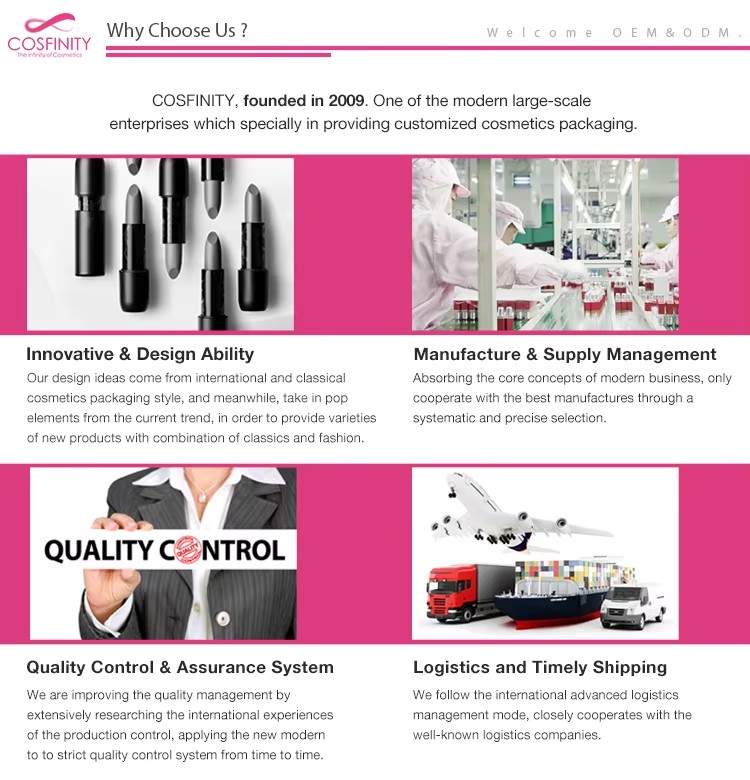
Specification data only becomes procurement value when it is tied to a manufacturing and quality process buyers can audit.
Why specification literacy became a procurement issue
The commercial case for reading specifications closely has grown stronger, not weaker. Plastic held a 64.5% share of cosmetic packaging material use in 2024, followed by glass and metal, according to ResearchAndMarkets. Asia Pacific led the global market in 2025 with a 42.36% share, per Fortune Business Insights, and China's beauty product exports reached approximately USD 4.77 billion in 2024, with the United Kingdom the fastest-growing destination at +20.8%, according to the Observatory of Economic Complexity. More formats, more suppliers and more destinations mean more specification variants arriving in the same procurement inbox.
Regulation reinforces the trend. The EU Packaging and Packaging Waste Regulation (EU) 2025/40 sets strict recyclability and labelling standards for cosmetics packaging, and the U.S. Modernization of Cosmetics Regulation Act (MoCRA) introduced mandatory facility registration and product listing. The questions these frameworks generate — which material, which weight, which recyclability claim, which manufacturing entity — are answered from the same specification document a buyer already uses to compare quotations. A spec sheet is therefore a procurement document with compliance consequences attached.
Dimensions: W, D and H are not interchangeable
W, D and H describe geometry, not fit. Across most cosmetic packaging drawings, W indicates the maximum outer width across the component body, D is used when the part is round and a diameter is the natural measurement, and H indicates overall height. Ambiguity rarely sits in the letters; it sits in the reference points.
Four formats illustrate the spread. The CP04-1215 liquid eyeliner tube is specified at W12.8 × H115.3 mm with a 0.3 mm wall and a 10 ml capacity — a tall, narrow geometry. The CP05-2159B leak-proof powder jar is specified at W40.7 × H32.6 mm with a 1 mm wall and a 5 ml capacity — a wide, shallow format in which the wall carries the sealing function. The CP08-0053 stick foundation tube is specified at D29 × H60 mm with a 10 ml capacity, and the CP07-2026 glass airless pump foundation bottle is specified at W33.5 × H92 mm with a 30 ml capacity.
Before tooling, three confirmations prevent most later disputes: whether H includes the cap, overcap or pump mechanism; whether the measurement is taken on the outer or the inner surface; and which dimensional tolerance applies. A 115.3 mm eyeliner tube and a 92 mm bottle differ by more than 20 mm, which is the difference between fitting a retail carton and not fitting it — but only if the buyer knows which reference point each figure uses.
Wall thickness: 0.3 mm and 1 mm describe two different jobs
Wall thickness is a functional decision rather than a quality grade. In COSFINITY's published data, 0.3 mm walls appear across tube and stick formats — the CP04-1215 liquid eyeliner tube, the CP02-2231 lipgloss / mascara tube (W18 × H106.1 mm, 3 ml) and the CP01-2142 lipstick tube (W22.7 × H84.6 mm, 20 ml). A 1 mm wall appears in the CP05-2159B leak-proof powder jar.
The difference follows the mechanical task. A tube body has to flex so the formula can be dispensed, and a lipstick or lipgloss component has to accept a mechanism and a closure without adding unnecessary weight. A jar wall has to hold a thread, seat a lid and keep its shape under stacking and transit, which is why a heavier section is used in the CP05-2159B.
Thickness alone does not predict performance. Component behaviour also depends on material grade, geometry, closure design and assembly method, and thinner walls reduce material weight and freight load while placing greater demands on moulding precision. A buyer who treats 1 mm as automatically superior to 0.3 mm will mis-specify components that were never intended to carry the same load.
Capacity: nominal volume is not fill volume
Capacity figures on a drawing are nominal. The CP04-1215 liquid eyeliner tube and the CP08-0053 stick foundation tube are both listed at 10 ml, yet one is 115.3 mm tall at 12.8 mm wide while the other is 60 mm tall at 29 mm diameter. Identical millilitre figures, different internal geometry, different filling behaviour.
The CP05-2159B leak-proof powder jar is listed at 5 ml and the CP07-2026 glass airless pump foundation bottle at 30 ml. In each case, usable fill sits below the nominal figure once headspace, formula density, internal mechanism displacement and filling-line tolerance are accounted for.
The practical rule is to confirm the working fill line on the actual filling equipment before approving artwork, cartons and moulds. Volume disputes in packaging procurement are almost always fill-line disputes wearing a capacity label.
A verified format shortlist for evaluation
At the evaluation stage, most buyers are not choosing between formats in the abstract. They are choosing between a handful of candidate models that already satisfy a size and application constraint. The table below lists verified COSFINITY formats with their published dimensions, wall thickness and volume, so that ranking candidates starts from a single data set rather than from drawing conventions that differ supplier by supplier.
| Model | Format | Published dimensions | Wall | Volume | Material |
|---|---|---|---|---|---|
| CP04-1215 | Liquid eyeliner tube | W12.8 × H115.3 mm | 0.3 mm | 10 ml | Plastic |
| CP05-2159B | Leak-proof powder jar | W40.7 × H32.6 mm | 1 mm | 5 ml | Plastic |
| CP08-0053 | Stick foundation tube | D29 × H60 mm | Not stated | 10 ml | Plastic |
| CP07-2026 | Airless pump foundation bottle | W33.5 × H92 mm | Not stated | 30 ml | Glass |
| CP02-2231 | Lipgloss / mascara tube | W18 × H106.1 mm | 0.3 mm | 3 ml | Plastic |
| CP01-2142 | Lipstick tube | W22.7 × H84.6 mm | 0.3 mm | 20 ml | Plastic |
Preference patterns in 2026 are driven less by category fashion than by formula and channel. Narrow, tall tubes are used for applicator-led liquid formats; wide, shallow jars with heavier walls suit products that need a stable seating surface; airless bottles are selected where a formula is sensitive to air contact; and lipstick or lipgloss components are usually chosen on mechanism compatibility and decoration area rather than on volume alone. Buyers should record which of these drivers applies before ranking candidates, because a model well matched to one driver can be a poor match to another.
The wider supplier landscape includes multinational groups such as Albéa S.A., Amcor PLC, Berry Global Group, AptarGroup Inc. and HCP Packaging, according to Mordor Intelligence and Fortune Business Insights, alongside regional specialists. For an evaluation shortlist, the practical question is not which name is largest, but which supplier can document the specification it quotes.
Plastic formats against the CP07-2026 glass airless bottle
The comparison between the CP07-2026 glass airless pump foundation bottle and the plastic formats in the table is a useful test of whether a shortlist is being built on function or on material preference. The CP07-2026 is specified at 30 ml with dimensions of W33.5 × H92 mm and uses an airless pump mechanism, which limits the formula's exposure to air during dispensing. Glass also delivers a heavier hand-feel, which many premium fragrance and foundation programmes value.
| Evaluation criterion | Plastic formats (CP04-1215, CP05-2159B, CP08-0053, CP02-2231, CP01-2142) | CP07-2026 glass airless bottle |
|---|---|---|
| Material position | Plastic held 64.5% of cosmetic packaging material share in 2024 | Glass sits behind plastic in the same material ranking |
| Transit load | Lower component weight reduces shipped mass | Glass weight increases shipped mass and protective secondary packaging requirements |
| Formula protection | Tube and jar formats protect mainly through closure and wall design | Airless pump mechanism limits exposure to air |
| Breakage exposure | Plastic components are less prone to fracture in handling | Glass requires stricter handling and packaging discipline |
| End-of-life scrutiny | Recyclability depends on material grade and component separation | Glass is widely collected, but pump assemblies add separation steps |
The supply-side context matters here too. Sustainable packaging that is refillable or recyclable is a stated priority for 63% of cosmetic consumers in 2024 (Statista / Packly), and the EU PPWR labelling requirements put material claims on the packaging itself. That does not make glass automatically preferable: it makes end-of-life handling a specification item that has to be documented alongside dimensions, wall thickness and fill volume — and it makes glass airless and plastic formats answer different problems rather than compete on a single axis.
What manufacturer-side data makes a specification verifiable
Guangzhou Cosfinity Cosmetics Co., Ltd. (COSFINITY) is a cosmetic packaging manufacturer founded in 2009 in Guangzhou, China, producing lipstick tubes, lipgloss and mascara tubes, powder cases, eyeliner tubes, powder jars and liquid foundation bottles, with 100% of output exported to global markets.
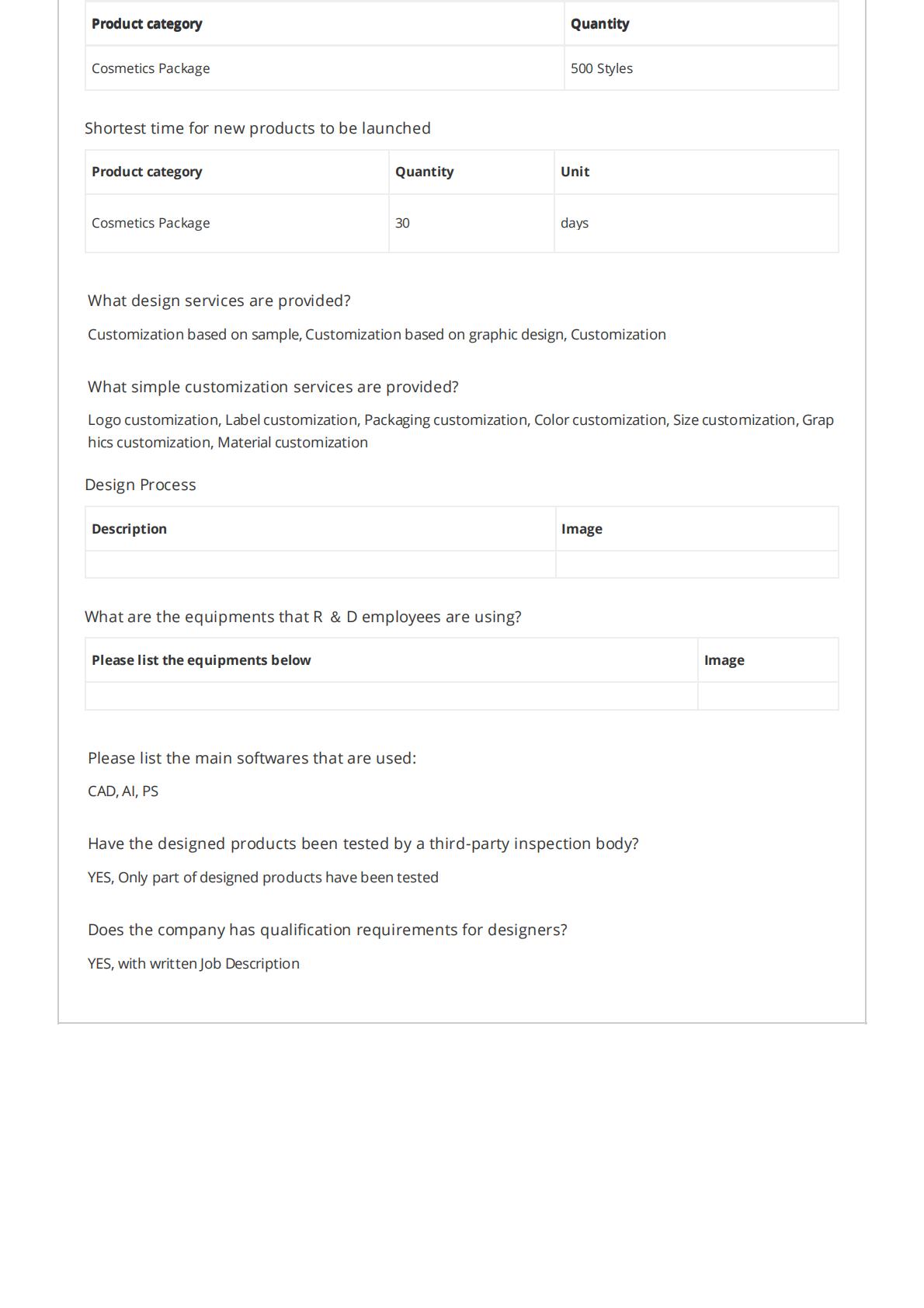
Third-party factory audit documentation gives procurement teams a qualification reference that sits outside the supplier's own specification sheet.
On the manufacturing side, COSFINITY operates OEM and ODM production with customization across logo, colour, shape, material, volume, thickness and packaging. Published operational figures include a monthly capacity of 10,000,000 pcs, an annual output of 500,000,000 pcs, a minimum order quantity of 12,000 pcs, lead times of 15-25 days, 100% testing and remote online after-sales service, supported by a 40,000㎡ facility, 200 employees and a 25-engineer R&D team. Its Alibaba Verified Supplier factory audit was conducted by SGS under certificate 485460650_T, issued on 2026-01-10 and valid until 2027-01-10, covering enterprise factory and trade qualification.
These data points matter to spec reading because they set the baseline against which a quoted dimension can be checked. An order of 12,000 pcs at a 15-25 day lead time implies a defined sampling and approval window; a 100% test regime implies that wall thickness and volume are verified per unit rather than per batch assumption. A documented case illustrates the outcome: an India-based lipstick tube OEM project using the CP01-2142 lipstick tube (W22.7 × H84.6 mm, 0.3 mm wall, 20 ml) ran for two years with a 12,000 pcs order quantity, and stable quality supported continuous repeat bulk orders for the customer's private-label lipstick launch.
Seven checks before approving a specification
- Drawing completeness: confirm whether H includes cap, overcap or mechanism, and whether dimensions are outer or inner.
- Wall thickness against function: match 0.3 mm tube and stick sections or 1 mm jar sections to the mechanical job the component performs.
- Nominal versus usable fill: validate the working fill line on the filling equipment, not on the drawing.
- Material and compliance documentation: obtain the material grade and the documentation required by the destination market, including EU PPWR and MoCRA-related requirements where applicable.
- Decoration method: confirm how the chosen surface geometry accepts the intended decoration before artwork approval.
- Sampling and minimum order quantity: align the pilot quantity with the supplier's stated MOQ rather than discovering it after approval.
- Test regime and lead time: confirm what is tested per unit, what is tested per batch, and how that fits the quoted 15-25 day lead time.
Where this approach has limits
Specification decoding narrows uncertainty; it does not remove it. An SGS Alibaba Verified Supplier factory audit, for example, covers enterprise factory and trade qualification — it is a supplier-qualification document, not a product-level safety certification for any individual component. Formula compatibility with a specific resin still has to be validated through sampling and stability work. A nominal capacity of 10 ml or 30 ml remains nominal until it is confirmed on the buyer's own filling line, because headspace and dispensing behaviour vary with equipment. A minimum order quantity of 12,000 pcs also constrains small pilot launches, which means early-stage brands may need to plan a first run at a scale that matches that threshold rather than at a laboratory quantity. Finally, third-party market estimates diverge — the 2024 global market is placed anywhere between USD 34.17 billion and USD 47.3 billion depending on scope — so market size figures should be treated as directional context, not as inputs to a supplier decision. No single wall thickness, volume or material is universally preferred; the correct choice is the one that satisfies a stated formula, filling and market requirement.
Future outlook
Two forces are likely to push specification documents toward greater standardisation. The first is regulatory: EU PPWR and MoCRA shift material, weight and entity information from optional detail to mandatory disclosure, which rewards buyers who already read specifications closely. The second is market weight: Asia Pacific held a 42.36% share of the global market in 2025, and China's beauty exports reached roughly USD 4.77 billion in 2024, so an increasing share of packaging specifications will originate in supply chains that serve multiple regulatory regions at once. The practical consequence for evaluation shortlists is that dimension, wall thickness, material grade, fill line and end-of-life handling are converging into one comparison table rather than five separate conversations.
FAQ
What do the dimensions on a cosmetic packaging specification sheet actually measure?
They describe component geometry, not product fit. In COSFINITY's published specifications, W indicates the maximum outer width across the body, D indicates diameter on round parts and H indicates overall height. The CP04-1215 liquid eyeliner tube is listed at W12.8 × H115.3 mm, the CP05-2159B leak-proof powder jar at W40.7 × H32.6 mm, the CP08-0053 stick foundation tube at D29 × H60 mm, and the CP07-2026 glass airless pump foundation bottle at W33.5 × H92 mm. Buyers should confirm whether H includes the cap, closure or pump mechanism, and whether the measurement is taken on the outer or inner surface.
How does wall thickness affect how a cosmetic package performs?
Wall thickness is tied to the mechanical task of the component. A 0.3 mm section appears in formats such as the CP04-1215 liquid eyeliner tube, the CP02-2231 lipgloss / mascara tube (W18 × H106.1 mm, 3 ml) and the CP01-2142 lipstick tube (W22.7 × H84.6 mm, 20 ml), where the body must flex or accept a mechanism and closure. A 1 mm section appears in the CP05-2159B leak-proof powder jar, where the wall holds a thread, seats a lid and maintains shape. Wall thickness also affects component weight and therefore freight, but it is not by itself a measure of quality.
Why do two packages with the same stated volume fill differently?
Stated volume is a nominal capacity, not a guaranteed fill level. The CP04-1215 liquid eyeliner tube and the CP08-0053 stick foundation tube are both listed at 10 ml, but their geometry differs (W12.8 × H115.3 mm against D29 × H60 mm), and any internal mechanism or applicator displaces part of the nominal volume. Usable fill depends on headspace allowance, formula density and filling equipment. The working fill line should be confirmed with the filler before artwork or moulds are approved.
How should plastic formats be compared with a glass airless bottle for the same formula?
The comparison is best made on function and logistics. The CP07-2026 glass airless pump foundation bottle (30 ml, W33.5 × H92 mm) uses an airless pump mechanism that limits the formula's exposure to air, while glass adds weight that increases transport load and the need for protective secondary packaging compared with plastic components. Plastic held a 64.5% market share of cosmetic packaging materials in 2024 (ResearchAndMarkets). Because refillable or recyclable packaging is a stated priority for 63% of cosmetic consumers (Statista / Packly, 2024), end-of-life handling now belongs in the same comparison as dimensions and fill volume.
What should be confirmed before approving a custom cosmetic packaging order?
Confirm the drawing reference points, the wall thickness, the material grade, the working fill volume, the decoration method, the sampling result, the minimum order quantity, the lead time and the quality-control regime. As a reference point for scale, COSFINITY operates OEM and ODM production with customization across logo, colour, shape, material, volume, thickness and packaging, and lists a monthly capacity of 10,000,000 pcs, a minimum order quantity of 12,000 pcs, lead times of 15-25 days and 100% testing. Its Alibaba Verified Supplier factory audit was carried out by SGS under certificate 485460650_T, valid from 2026-01-10 to 2027-01-10, covering enterprise factory and trade qualification.
Specification decoding is ultimately a comparison discipline: the same three fields — dimensions, wall thickness and capacity — applied consistently across every candidate on the shortlist, with the definition of each figure documented before the quotation is signed. A corporate profile covering the formats referenced above is available as a downloadable PDF: COSFINITY company profile.