
Cosmetic Packaging Scenario Fit: Stick, Liquid, Pencil and Powder
In everyday makeup use, cosmetic packaging is specified against three constraints rather than one: what the formula is, how much is dispensed per use, and how often the package travels, opens and closes. A format that works on a vanity shelf can fail in a handbag, and a package that survives a handbag can complicate the dispensing of a thin liquid.
The operating conditions are consistent across most markets. COSFINITY's application material for daily cosmetic storage and carrying describes normal room temperature operation between 16°C and 25°C, repeated open and close cycles during carry-around use, and contact with skin cosmetics using environmentally friendly material that can be directly touched to the skin. The same material lists leak-proof design, non-irritating materials, portability and lightweight construction as requirements, together with supporting tools such as makeup brushes, makeup puffs, and cosmetic mirrors.
The nine models examined below are compared on four variables that can be checked against published specifications rather than visual impression: capacity, material, wall thickness, and dispensing or access mechanism. Where a specification is not published — barrier performance, closure torque, drop resistance, or decoration suitability — this article says so instead of assuming a value.
Why Formula, Dose and Carry Conditions Decide the Format
Cosmetic packaging selection is often framed as a style decision. In practice it is a fit decision with a short list of measurable inputs. The first input is the physical state of the formula: a solid stick, a viscous cream, a free-flowing liquid, or a loose or pressed powder each demands a different access mechanism. The second is the dose — how much product leaves the package per application, which in turn sets a workable total capacity. The third is the carry profile: whether the package stays on a surface or travels, and how many open and close cycles it must tolerate.
These three inputs translate into four verifiable engineering variables. Capacity tells you the intended usage cycle. Material — plastic or glass — sets weight and handling feel. Wall thickness indicates whether the structure is built for rigidity or for squeezable delivery. The dispensing mechanism, whether a stick, an airless pump, a tube body, a pencil format or an open jar, determines how the formula meets the applicator and the skin.
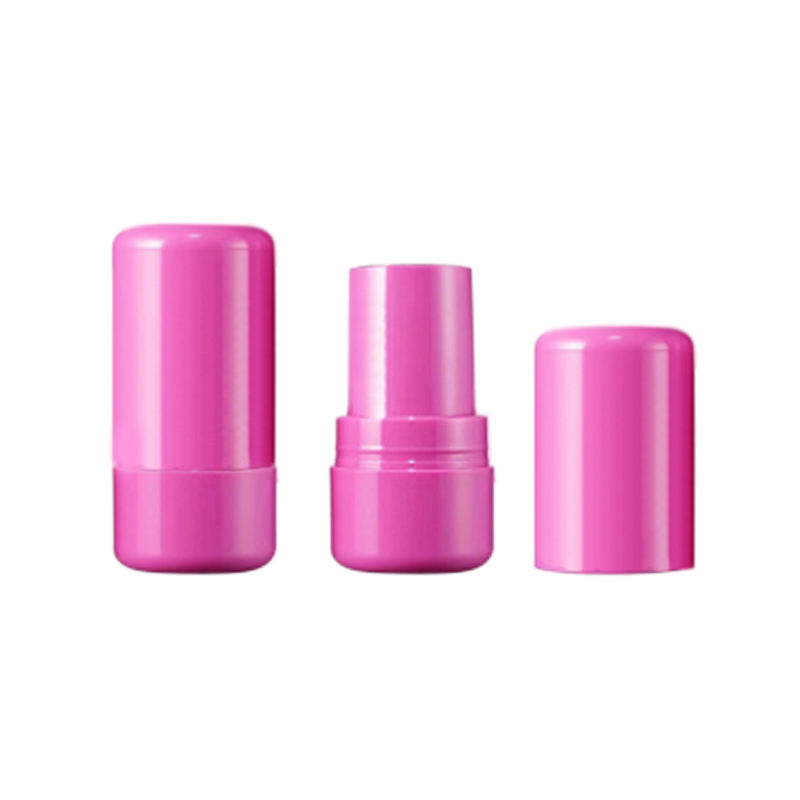
Empty stick foundation tube, model CP08-0053 — 10 ml, plastic, D29 × H60 mm. Image: COSFINITY.
Deodorant Sticks: TP01-1018-15 and the 20 ml Carry Case
Model TP01-1018-15 is a deodorant stick plastic tube container made of plastic. It belongs to the Plastic Bottles category, with dimensions L41.7 × W24.49 × H86.5 mm and a volume of 20 ml, and is used for cosmetic packing.
The scenario logic here is straightforward. A deodorant stick is applied directly to skin and is typically carried rather than stored, which places repeated open and close cycles and portability at the centre of the specification. The 20 ml volume sets a defined usage cycle without pushing the body into a size that becomes awkward in a bag, and the rectangular footprint of roughly 41.7 by 24.5 mm with an 86.5 mm height reads as a compact, orientable form rather than an elongated cylinder.
Plastic construction is consistent with the lightweight and portable requirement named in the application material. Beyond that, the published specification stops at dimensions, volume and material. It does not state the internal stick mechanism dimensions, the closure retention force, or compatibility with a specific formula base. Those remain sample-stage verification items, not catalogue facts.
Foundation: Two Formula States, Two Different Formats
"Foundation" describes at least two distinct physical systems, and the packaging splits accordingly. A solid or semi-solid foundation behaves like a stick product; a free-flowing liquid foundation behaves like a pump product. Treating them as one category is one of the more common early sourcing errors.
CP08-0053 — 10 ml stick foundation tube
Model CP08-0053 is an empty stick foundation tube made of plastic. It belongs to the Plastic Bottles category, with dimensions D29 × H60 mm and a volume of 10 ml, and is intended for cosmetic packing. The circular 29 mm diameter and 60 mm height give it a short, wide profile, which suits a solid product that is applied by direct contact and does not need a long delivery path. At 10 ml, the format is oriented towards a compact unit rather than an extended-use bottle.
CP07-2026 — 30 ml airless pump bottle
Model CP07-2026 is an airless pump liquid foundation bottle made of glass. It belongs to the glass bottles category, with dimensions W33.5 × H92 mm and a capacity of 30 ml, and is used for cosmetic packing.
Three specification differences separate it from the stick format, and each maps to a scenario rather than a preference. First, the mechanism: an airless pump delivers product through a controlled pump action, which is the appropriate access pattern for a liquid that should not be repeatedly opened to air. Second, the material: glass changes the weight and handling character of the package, which matters when the product is expected to remain on a surface rather than travel. Third, the capacity: 30 ml against 10 ml is a usage-cycle difference, not a quality difference.
The limitation is worth stating plainly. A pump package carries more components than a stick package, so component fit, pump priming behaviour and pressure retention across the fill become the decisive verification points. The published parameters for CP07-2026 give overall dimensions, capacity and material; they do not quantify pump output per stroke, evacuation rate, or internal pressure behaviour. Buyers comparing airless formats should treat those as sample-test criteria.
Eyeliner: Tube and Pencil Are Not Interchangeable
Eyeliner packaging is often discussed as if tube and pencil were cosmetic variants of the same thing. Structurally they are different products serving different formula delivery models, and their dimensions reflect that.
CP04-1215 — 10 ml liquid eyeliner tube
Model CP04-1215 is a liquid empty eyeliner tube made of plastic. It belongs to the Plastic Tubes category, with dimensions W12.8 × H115.3 mm, wall thickness 0.3 mm, and a volume capacity of 10 ml. Typical applications include cosmetic packing.
A 0.3 mm wall on a 12.8 mm wide body indicates a thin-wall tube structure rather than a rigid container. That matters in a daily carry scenario: a slim, lightweight body travels easily, and the 115.3 mm length keeps the package within a size range that fits standard makeup storage. The 10 ml capacity is sized for a liquid product consumed in small doses per application.
CP06-1056 — liquid eyeliner pencil
Model CP06-1056 is an empty liquid eyeliner pencil made of plastic. It belongs to the Packaging Products category, with dimensions W15 × H173.5 mm, and is designed for cosmetic packing.
The 173.5 mm overall length is the defining figure. A pencil-format package is long and narrow by design, which changes how it is gripped and how it is stored — a 173.5 mm body does not fit the same slot as a 115.3 mm tube. Buyers selecting between the two are effectively choosing an application posture, not a capacity: the tube format is built around a reservoir of liquid, while the pencil format is built around a linear, pen-like body.
The boundary condition is that both models are published with external dimensions and material only. Neither specification quantifies the applicator tip geometry, closure fit, or sealing performance under repeated cycling. For eyeliner specifically, where the product is fluid and the package is opened frequently, those are precisely the attributes that should be validated on physical samples before a format is locked.
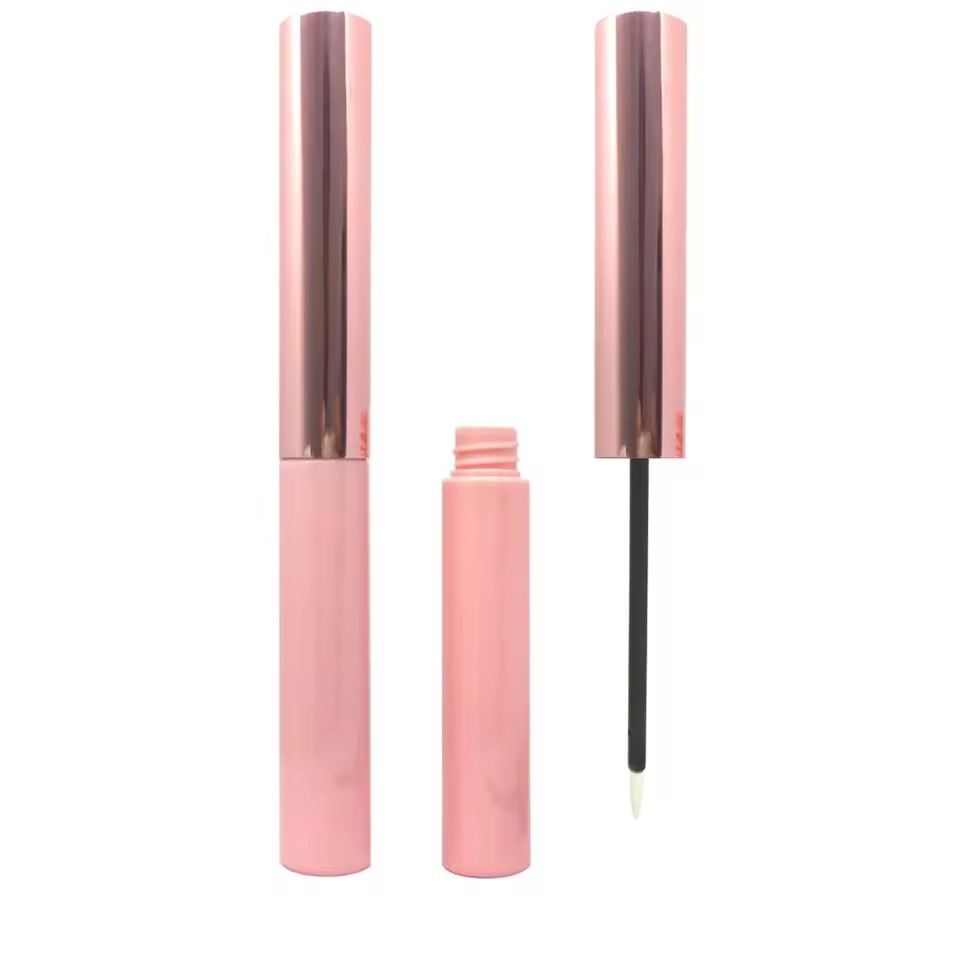
Liquid empty eyeliner tube, model CP04-1215 — 10 ml, plastic, 0.3 mm wall, W12.8 × H115.3 mm. Image: COSFINITY.
Powder Products: Jar and Case Serve Different Access Patterns
Powder formats are the category where access mechanism most clearly separates two products that could otherwise be described with the same words. A jar and a case both hold powder; they are used completely differently.
CP05-2159B — 5 ml leak-proof powder jar
Model CP05-2159B is a leak-proof plastic powder jar. It belongs to the Plastic Jars category, with dimensions W40.7 × H32.6 mm, a volume of 5 ml, and a thickness of 1 mm, and is intended for cosmetic packing.
Two figures stand out. The 1 mm wall is more than three times the 0.3 mm wall used on the tube formats reviewed above, which is consistent with a rigid, self-supporting container rather than a squeezable body. The 5 ml volume places it among the smallest capacities in this comparison set, which suits a product consumed in fractional doses. The leak-proof designation in the model name is the attribute that matters most in a carry scenario, where a powder jar is opened and closed repeatedly and stored alongside other items.
CP03-1394 — customized empty makeup powder case
Model CP03-1394 is a customized empty makeup powder case made of plastic. It belongs to the Plastic Boxes category, with dimensions W65 × H12 mm and a thickness of 1 mm, and is used for cosmetic packing.
The geometry tells the story. At 65 mm wide and 12 mm deep, the case presents a broad, shallow interior — the shape associated with brush or puff pickup rather than fingertip dosing, and consistent with the application scenario's reference to makeup brushes and makeup puffs as supporting equipment. The 1 mm wall again signals a rigid structure. Compared with the 5 ml jar, the case trades containment depth for accessible surface area.
The practical boundary: a wide, shallow case is less suited to loose powder that migrates under movement, while a deep, narrow jar is less convenient for a puff-based routine. Neither published specification quantifies hinge durability, sifter behaviour, or seal compression, so those remain physical validation points.
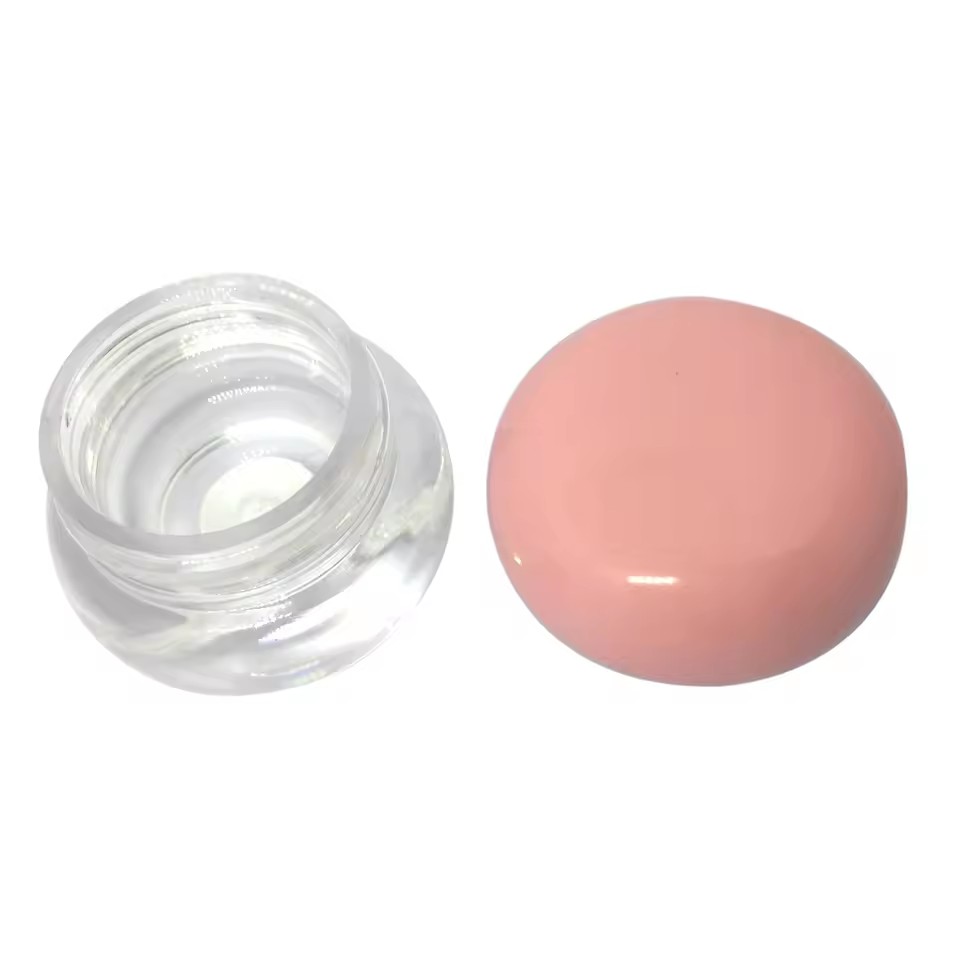
Leak-proof plastic powder jar, model CP05-2159B — 5 ml, 1 mm wall, W40.7 × H32.6 mm. Image: COSFINITY.
Adjacent Color Categories: Lipstick and Lipgloss/Mascara
Two further models extend the same logic into color categories that frequently share a supplier and a fill line with the products above.
The luxury empty plastic lipstick tube, model CP01-2142, is a plastic tube in the Plastic Tubes category with overall dimensions of W22.7 × H84.6 mm, a wall thickness of 0.3 mm, and a volume capacity of 20 ml, designed for cosmetic packing. The luxury empty plastic lipgloss/mascara tube, model CP02-2231, is also a plastic tube, with dimensions of W18 × H106.1 mm, a wall thickness of 0.3 mm, and a volume capacity of 3 ml, intended for lipgloss or mascara.
The instructive comparison is the capacity pair: 20 ml against 3 ml within the same material family and the same 0.3 mm wall specification. That is not a premium-versus-standard distinction. It reflects two different dose economics — a lipstick body sized for an extended cycle, and a 3 ml tube sized for a product dispensed in very small amounts per use. Both share the 0.3 mm thin-wall characteristic seen across the tube formats in this set, while their lengths differ by roughly 21 mm, which affects how each sits in a hand and in storage.
Nine Models Side by Side
The table below consolidates the published specification for each model. It is a comparison of stated parameters, not a ranking: no model in the set is superior to another outside a defined scenario.
| Model | Format | Material | Capacity | Dimensions | Wall |
|---|---|---|---|---|---|
| TP01-1018-15 | Deodorant stick tube container | Plastic | 20 ml | L41.7 × W24.49 × H86.5 mm | Not stated |
| CP08-0053 | Stick foundation tube | Plastic | 10 ml | D29 × H60 mm | Not stated |
| CP07-2026 | Airless pump foundation bottle | Glass | 30 ml | W33.5 × H92 mm | Not stated |
| CP04-1215 | Liquid eyeliner tube | Plastic | 10 ml | W12.8 × H115.3 mm | 0.3 mm |
| CP06-1056 | Liquid eyeliner pencil | Plastic | Not stated | W15 × H173.5 mm | Not stated |
| CP05-2159B | Leak-proof powder jar | Plastic | 5 ml | W40.7 × H32.6 mm | 1 mm |
| CP03-1394 | Customized makeup powder case | Plastic | Not stated | W65 × H12 mm | 1 mm |
| CP01-2142 | Luxury lipstick tube | Plastic | 20 ml | W22.7 × H84.6 mm | 0.3 mm |
| CP02-2231 | Luxury lipgloss / mascara tube | Plastic | 3 ml | W18 × H106.1 mm | 0.3 mm |
Source: published model specifications, COSFINITY. Dimensions are stated as published; wall thickness is listed only where the specification provides it. Capacity is expressed in millilitres as given for each model. "Not stated" indicates the parameter is not included in the published specification and should be confirmed at sample stage.
What the Specifications Mean for a Procurement Decision
Read as a set, the nine models support a short, repeatable screening sequence that a buyer can apply before any quotation conversation.
Step one — fix the formula state. Solid, semi-solid, liquid and powder map to different mechanism families. A stick format such as CP08-0053 and an airless pump such as CP07-2026 are not substitutes for one another, even though both are described as foundation packaging.
Step two — convert the dose into a capacity target. The set spans 3 ml to 30 ml. CP02-2231 at 3 ml and CP01-2142 at 20 ml demonstrate that capacity is set by how much leaves the package per use, not by how premium the product is positioned.
Step three — read the wall thickness as a structural signal. The 0.3 mm walls on CP04-1215, CP01-2142 and CP02-2231 indicate thin-wall tube construction. The 1 mm walls on CP05-2159B and CP03-1394 indicate rigid containers. Confusing the two leads to packages that either cannot hold their shape or cannot be squeezed.
Step four — match the carry profile to the closure and leak requirement. The application scenario names leak-proof design, portability and lightweight construction as requirements, and the powder jar CP05-2159B is designated leak-proof by name. Repeated open and close cycles in a bag are the stress case here, not the laboratory shelf.
Step five — separate published parameters from validation items. The specifications in this set define capacity, material, overall dimensions, and in five cases wall thickness. They do not define decoration feasibility, surface finish, closure torque, drop performance, fill-line compatibility, tooling requirements, or commercial terms. Any comparison that treats the published parameters as a complete qualification is incomplete.
One further limit applies to cross-model comparison. CP06-1056 and CP03-1394 are published without a stated capacity, so they cannot be lined up against the others on volume. They can still be compared on length, width and wall thickness, which is the honest basis for the pencil and case formats.
COSFINITY, formally Guangzhou Cosfinity Cosmetics Co., Ltd., is a cosmetic packaging manufacturer established in 2009 in Guangzhou, China, operating a 40,000㎡ facility with approximately 200 employees and an annual output of 500,000,000 pieces. Its stated product range covers lipstick tubes, lipgloss and mascara tubes, powder cases, eyeliner tubes, powder jars and liquid foundation bottles — the six format families represented across the nine models above. For buyers at the research stage, the practical value of a portfolio of this breadth is that format selection and supplier selection can be handled in the same evaluation cycle rather than sequentially.
Market Context for Format-Specific Sourcing
Format-specific packaging decisions sit inside a large and material-concentrated market. Grand View Research reported the global cosmetic packaging market at USD 32.7 billion in 2023, with plastics accounting for the largest revenue share at 60.8% in the same year (Grand View Research, Cosmetic Packaging Market Size & Share Report, 2024–2030).
Those two figures have a direct reading for the models reviewed here. Eight of the nine are plastic; one, CP07-2026, is glass. The plastic majority in the market is not an accident of cost alone — it aligns with the portability and lightweight constraints that the daily carry scenario explicitly names. Glass retains a role where weight is not a liability and where the handling character of the package is part of the product experience, which is the context CP07-2026 occupies.
The trend visible in the specification set is towards differentiation within categories rather than across them. Foundation now splits into stick and airless pump. Eyeliner splits into tube and pencil. Powder splits into jar and case. Sourcing teams that still issue a single RFQ line for "foundation packaging" or "powder packaging" are compressing formats that behave differently in use, and will usually have to re-open the brief later.
Future Outlook
Three developments are likely to shape how format fit is evaluated over the next procurement cycles.
First, specification transparency is becoming a screening criterion in its own right. The models above vary in how much is published: five disclose wall thickness, two disclose capacity and wall thickness together, and two disclose neither capacity figure. Buyers comparing packaging options increasingly need the parameter set to be complete enough to compare, because incomplete specifications push validation costs downstream to sampling.
Second, the material question is becoming more granular than plastic versus glass. Since plastics hold the majority of market revenue, the pressure point is not substitution but the composition of the plastic itself. Buyers evaluating plastic formats should expect questions on material grade and recyclability to move from a sustainability annex into the core specification.
Third, the carry scenario is hardening as a design constraint. Repeated open and close cycles, leak-proof requirements and portability are already named in the application material for daily cosmetic storage and carrying. As product ranges multiply within single brands, the packages that survive shortlisting will be the ones whose closures and structures are validated against that cycle count rather than against a static shelf assumption.
FAQ
What determines whether a cosmetic packaging format fits a specific product?
Four variables determine fit: the physical state of the formula, the dose dispensed per application, the capacity that dose implies over a usage cycle, and the carry conditions the package must survive. These translate into capacity, material, wall thickness and dispensing mechanism — the four parameters that can be checked against a published specification. A format that matches on all four is a viable candidate; one that matches on appearance only is not yet evaluated.
Is a 20 ml stick container suitable for a deodorant product?
Model TP01-1018-15 is a deodorant stick plastic tube container with a 20 ml volume, dimensions of L41.7 × W24.49 × H86.5 mm, and plastic construction. A 20 ml volume is consistent with a deodorant stick used in a daily carry routine, where the package is opened and closed repeatedly and portability matters. Whether a specific deodorant formula is compatible with the internal stick mechanism is a sample-stage question, since the published specification covers dimensions, volume and material only.
Why would a liquid foundation use a glass airless pump while a stick foundation uses a plastic tube?
The two formats serve different formula states. CP07-2026 is a 30 ml airless pump liquid foundation bottle in glass, where pump delivery controls how the liquid is dispensed and glass sets the weight and handling character. CP08-0053 is a 10 ml plastic stick foundation tube at D29 × H60 mm, where the product is applied by direct contact and needs no pump. The 30 ml against 10 ml difference reflects usage cycle and dose per application, not product tier.
What is the structural difference between a liquid eyeliner tube and a liquid eyeliner pencil?
The difference is primarily dimensional and mechanical. CP04-1215 is a liquid eyeliner tube at W12.8 × H115.3 mm with a 0.3 mm wall and a 10 ml capacity, built around a liquid reservoir in a thin-wall tube body. CP06-1056 is a liquid eyeliner pencil at W15 × H173.5 mm, built around a longer, pen-like body. The 173.5 mm length against 115.3 mm changes grip and storage; it does not indicate greater capacity, since no capacity is published for CP06-1056.
How should a buyer choose between a 5 ml powder jar and a wider powder case?
Choose by access pattern. CP05-2159B is a leak-proof plastic powder jar at 5 ml with a 1 mm wall and W40.7 × H32.6 mm dimensions, suited to small doses and to products that must not escape during carrying. CP03-1394 is a customized makeup powder case at W65 × H12 mm with a 1 mm wall, whose broad, shallow interior suits brush or puff pickup. Both use 1 mm walls, so rigidity is comparable; the difference is containment depth versus accessible surface area.
What should buyers verify beyond capacity, material and wall thickness?
Published specifications for these models define capacity, material, overall dimensions and, where stated, wall thickness. They do not define decoration feasibility, surface finish, closure torque, drop resistance, fill-line compatibility, tooling requirements or commercial terms. Those attributes must be verified through physical samples and documented test conditions before a format is locked into a production brief.
What carry conditions should a daily-use cosmetic package be specified against?
The relevant conditions are normal room temperature operation between 16°C and 25°C, repeated opening and closing during carry-around use, contact with skin cosmetics using material that can be directly touched to the skin, leak-proof performance, non-irritating materials, portability and lightweight construction. Supporting items such as makeup brushes, makeup puffs and cosmetic mirrors are also part of the use context for powder formats.
A full overview of COSFINITY's packaging range, including format families beyond the nine models compared here, is available in the company's product profile.
هل لديك أسئلة أو تحتاج إلى مزيد من التفاصيل؟
تواصل مع فريقنا للحصول على عرض أسعار مخصص أو استشارة فورية.
طلب عرض أسعار
املأ النموذج أدناه وسيتواصل معك فريقنا بعرض مقترح مخصص.
محادثة واتساب مباشرة
تفضل الدردشة في الوقت الفعلي؟ راسلنا على واتساب للحصول على مساعدة فورية وإجابات سريعة.
- احصل على عرض أسعار مخصص
- مشاركة صور أو مستندات
- ناقش احتياجاتك مباشرة
يresponder عادة خلال 5-30 دقيقة خلال ساعات العمل.