
Crane Outrigger Pads: Verifying Load, Size and Thickness
An outrigger pad is a load-spreading interface placed beneath a crane outrigger to reduce ground pressure and stabilise the machine. Because the pad only works as part of a system that includes the outrigger reaction, the ground and the pad geometry, its specification is a set of linked constraints rather than a single number. A published reference load of, for example, 50 tons on a 600 × 600 × 60 mm pad describes one specific combination of size, thickness and material. It does not automatically describe that pad's suitability for another crane, another ground condition or another duty cycle.
For buyers in the research and evaluation stage, this is the practical difficulty. Outrigger pads are widely listed by material name and by a headline load figure, yet the information that determines whether a pad is acceptable on a site is usually the information that is missing: contact area, thickness tolerance, material grade, surface pattern, handling weight and the method used to derive the load figure. This reference explains those constraints in the order a procurement team is likely to meet them, using verified product and supplier facts for illustration.
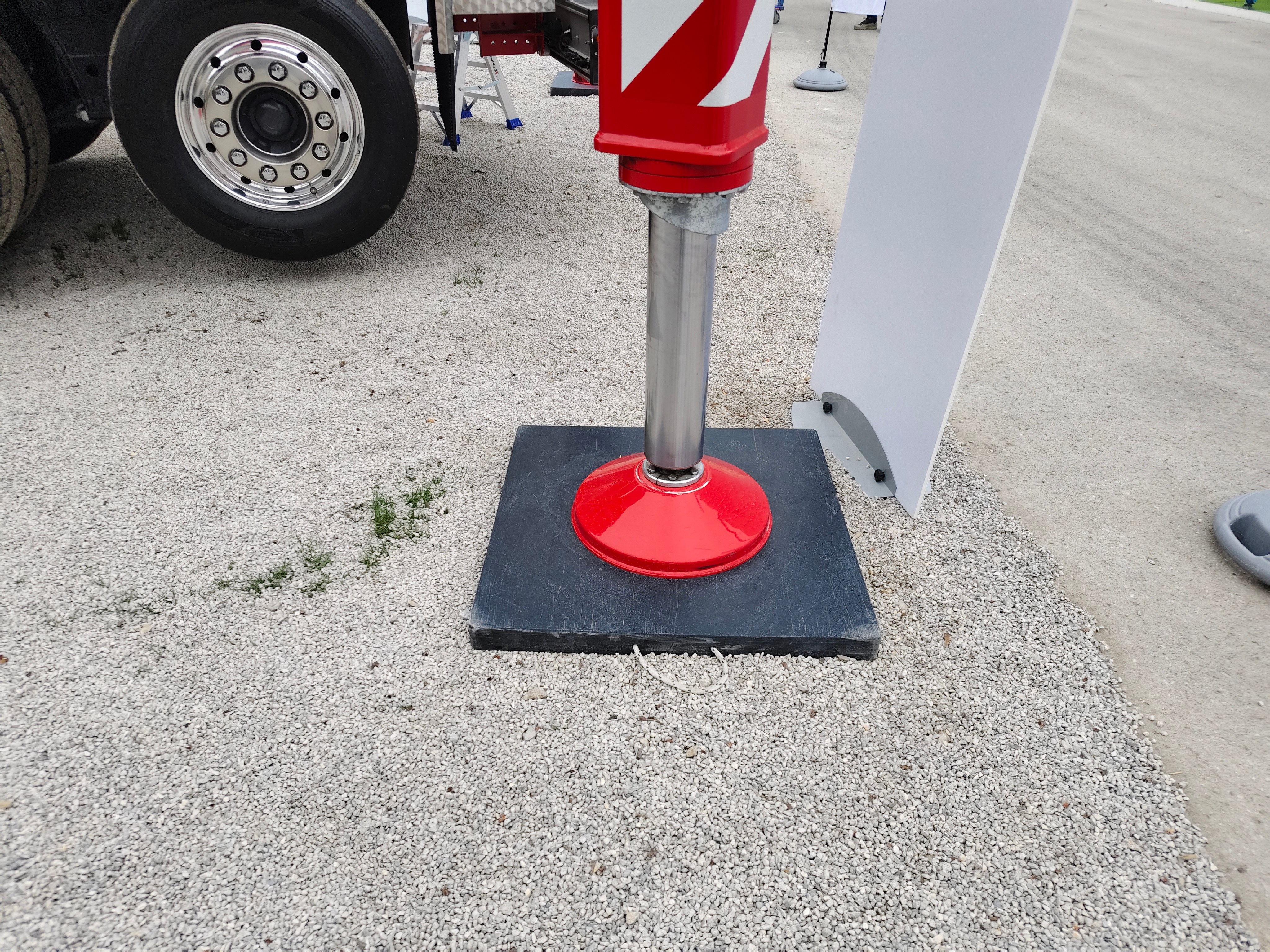
Why crane tonnage does not define a pad specification
The load a pad actually sees is the outrigger reaction, not the crane's nominal lifting capacity. Four inputs decide whether a pad is adequate: the maximum load applied to each outrigger, the bearing capacity of the ground beneath it, the dimensions and material properties of the pad, and the way the pad is bedded onto the surface. A soft, uneven or waterlogged surface changes the answer even when the crane and the pad stay the same.
That is why pad selection is usually described as a verification task rather than a purchase decision. The crane manufacturer's data supplies the outrigger reactions; the site investigation supplies the ground bearing capacity; the pad supplier supplies the geometry, material grade and reference load information. Any one of the three missing produces a specification that cannot be checked.
A second, less obvious constraint is that a larger pad is not automatically a better pad. Increasing footprint spreads load, but it also increases weight, transport volume and handling effort. The same table that shows load growing with size also shows the handling penalty growing with it.
The four constraints that make a pad usable
Treating these four constraints separately makes a quotation comparable. Treating them as one lumped claim is where procurement problems start.
| Constraint | What it controls | Question to put to the supplier |
|---|---|---|
| Contact area | Ground pressure beneath the outrigger | What are the exact length, width and tolerance? |
| Thickness | Stiffness, load spread and resistance to local indentation | What thickness range is offered, and how is it measured? |
| Material | Impact behaviour, wear life, temperature range, moisture and chemical resistance | Which grade, and against which standard is it referenced? |
| Surface and handling | Grip on the ground and under the float, plus safe manual movement | Which surface pattern, and are lifting handles available? |
How size and thickness translate into a reference load
A practical way to read a pad catalogue is to look at the load and weight columns together, because they move in opposite directions from the user's point of view. The table below reproduces the standard size range published for crane outrigger pads supplied by Shandong Yaxu New Materials Co., Ltd., a China-based manufacturer of HDPE sheets, UHMWPE sheets, ground protection mats and crane outrigger pads. All load figures are reference values that depend on pad size and thickness.
| Pad size (mm) | Approx. reference load | Approx. weight per piece |
|---|---|---|
| 300 × 300 × 30 | 5 tons | 2.7 kg |
| 400 × 400 × 40 | 10 tons | 6.4 kg |
| 500 × 500 × 50 | 25 tons | 12.5 kg |
| 600 × 600 × 60 | 50 tons | 21.6 kg |
| 700 × 700 × 70 | 70 tons | 34.3 kg |
| 800 × 800 × 80 | 80 tons | 51.2 kg |
| 1000 × 1000 × 100 | 100 tons | 100 kg |
| 1200 × 1200 × 120 | 120 tons | 172.8 kg |
Two practical readings follow. First, the published reference load capacity across this range is approximately 5 to 120 tons, and the pad thickness range is 30 mm to 120 mm, so the same nominal product family covers anything from a small utility crane to heavy lifting plant. Second, above roughly 800 mm square the pad stops being a one-person item. A 1200 × 1200 × 120 mm pad weighs approximately 172.8 kg per piece, which changes how it is transported, stored and positioned on site. Handling arrangements belong in the specification, not in the site team's improvisation.
Material constraints: UHMWPE and HDPE pads behave differently
Crane outrigger pads in this category are commonly produced in UHMWPE, with HDPE outrigger pads offered as an alternative where the duty is lighter. The material name alone does not establish suitability for a particular crane, because grade, thickness and design still dominate. What the grade does determine is the behaviour envelope the buyer has to stay inside.
| Property | UHMWPE (PE1000) sheet | HDPE sheet |
|---|---|---|
| Density | Approx. 0.935 g/cm³ | 0.941 to 0.965 g/cm³ |
| Molecular weight | 2 to 7 million | Not specified in sheet data |
| Tensile strength | Approx. 55 MPa | ≥22 MPa |
| Elongation at break | Approx. 350% | ≥350% |
| Hardness | According to material grade | Shore D 60 to 70 |
| Service temperature | Approx. -269 °C to +110 °C | Approx. -40 °C to +80 °C |
| Wear and impact | Excellent wear resistance; excellent impact resistance with continuous impact performance | Good impact resistance; chemical and moisture resistant |
| Water absorption | Very low | ≤0.01% |
| Reference standards | Standard references per grade and application | GB/T 11116, GB/T 4454, ASTM and ISO according to grade and application |
The temperature line is the one buyers most often overlook. HDPE sheet data gives a continuous service temperature of approximately -40 °C to +80 °C, with a melting point around 125 °C to 135 °C and moderate weather resistance, with UV-stabilised grades available for outdoor use. A crane pad that sits outdoors for years is exposed to UV; a pad used near hot works is exposed to something else entirely. Neither is a reason to reject plastic pads, but both belong in the site method statement.
UHMWPE extends the wear and impact envelope and adds low friction, which is why the same material is used for wear liners, chute and hopper linings and conveyor components in mining and bulk handling. In pad form, the relevance is resistance to repeated impact and abrasion from grit under the outrigger, not sliding wear.
Surface pattern, handling and customisation constraints
Three details repeatedly decide whether a technically adequate pad is actually used correctly on site:
- Surface configuration. Pads are supplied with a flat surface, anti-skid grooves or anti-skid patterns. Grooves and patterns are intended to improve grip and stability between the pad and the ground and between the pad and the outrigger float; a flat pad on a wet membrane surface behaves differently.
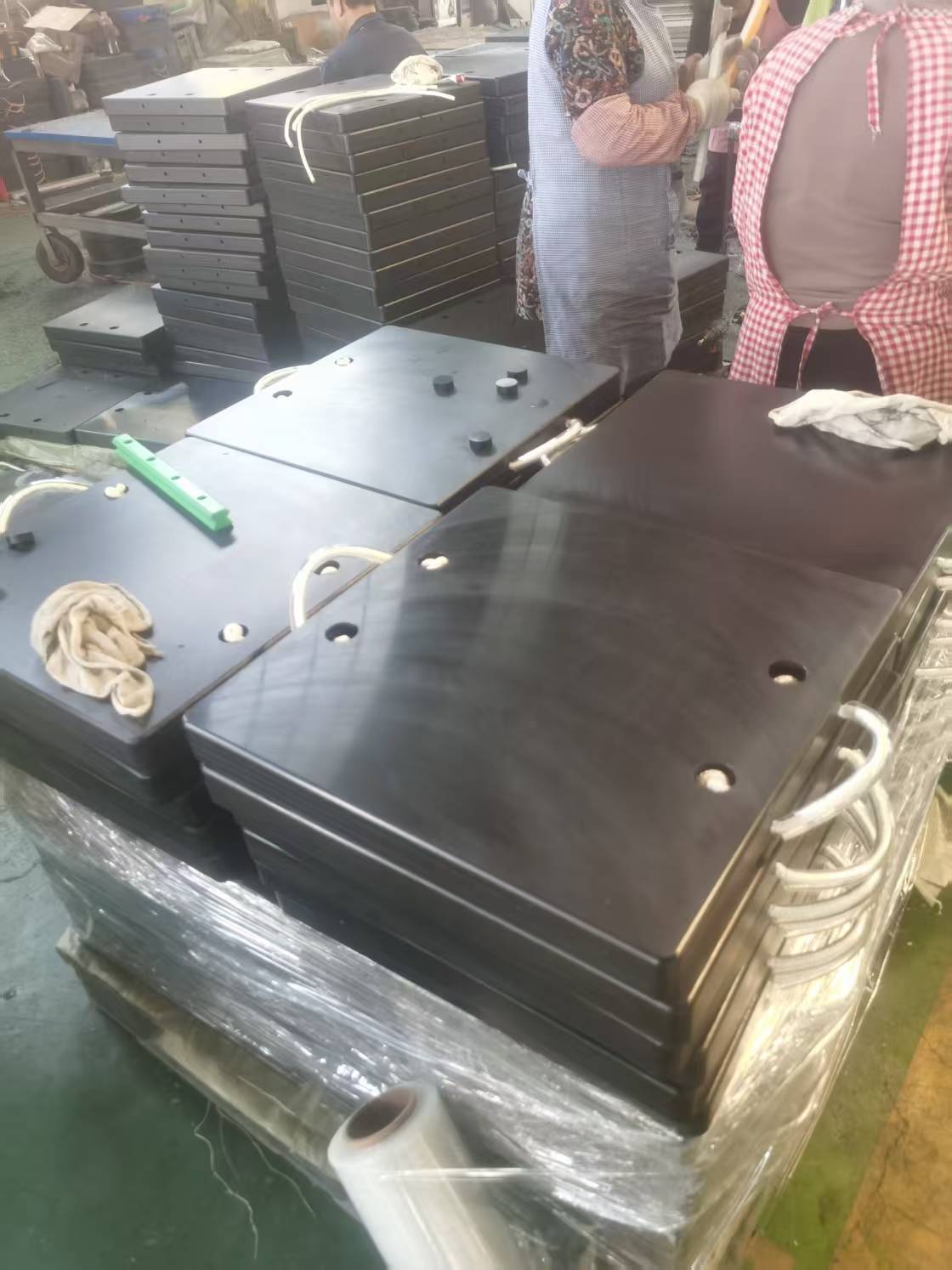
- Handling features. Lifting handles and lifting holes are available for outrigger pads, which matters once pad weight moves into the tens of kilograms and beyond.
- Identification. Colour and logo marking can be customised, which supports fleet management for rental companies that need to track pads across depots and projects.
Customisation on this product line covers size, thickness, colour, surface pattern and logo. For buyers, the useful way to read that list is as a set of variables that must be frozen before quotation, otherwise two suppliers will price two different products.
Where the constraints change by application
Pad specification is not uniform across lifting work. The same supplier catalogue serves applications that stress different properties:
- Crane rental and heavy lifting. High-cycle use, frequent repositioning, mixed ground. Durability and handling weight dominate; pad inventory usually spans several sizes.
- Building, infrastructure and bridge construction. High point loads on prepared or unprepared ground, often with precast concrete and beam installation where outrigger reactions are high and the working area is tight.
- Wind turbine and industrial plant installation. Soft or unstable ground, repeated crane operations and long walks between positions, which rewards pads that can be moved and re-bedded quickly.
- Oil and gas, power and utilities, telecommunications. Access work where the crane is small but the ground is unpredictable, and where a pad doubles as protection for an existing surface.
- Events and temporary structures. Lighter loads, but high visibility and a need to protect finished surfaces such as paving or turf.
The recurring site conditions are soft, uneven, wet, muddy or limited-bearing ground. In all of them, the pad's contribution is to spread load over a larger contact area and reduce the risk of local settlement. It cannot compensate for ground that is unsuitable in the first place, and it does not replace a bearing-capacity assessment.
What a buyer can verify about the supplier
Because pad performance claims are hard to check in isolation, supplier capability becomes part of the constraint set. Shandong Yaxu New Materials Co., Ltd. is a manufacturer established in 2012, operating a 36,000 m² facility with 100 employees, an annual output of 30,000 tons and a nine-engineer R&D team, supplying HDPE sheets, UHMWPE sheets, ground protection mats and crane outrigger pads to distributors, OEMs, contractors and industrial customers. Roughly 30% of output is exported, with stated markets including the USA, Australia, Canada, UK, Germany, UAE, Saudi Arabia, Indonesia, Malaysia and Vietnam.
Operationally, the published capability data states OEM/ODM support, a monthly capacity of 2,000 tons, a lead time of 10 to 45 days, a minimum order quantity of 50 units and 100% testing. These are the figures a buyer can use as a checklist when comparing any supplier in this category, not as a substitute for a factory audit.
The reason to check is straightforward. The same factory produces semi-finished sheet and finished pads, which means the sheet specification and the finished pad specification come from one process chain: HDPE and UHMWPE sheets, then cutting, drilling, CNC machining and custom fabrication into finished components. Buyers who need both material and finished parts can source them together; buyers who fabricate in-house can buy the sheet alone. The supplier reference is www.xhcplastics.com.
Comparison with traditional pad materials, and where plastic stops
Timber, steel and engineered plastic are the three customary answers, and each has a defensible use case. The comparison below is qualitative; it does not assign performance figures to materials that have not been tested in the same conditions.
| Material | Typical strengths | Known limits |
|---|---|---|
| Hardwood timber | Low cost, locally available, easy to cut on site | Inconsistent properties, moisture uptake, splitting and crushing under repeated point loads, limited reuse |
| Steel plate | High stiffness and resistance to local indentation | Heavy, requires lifting equipment, can damage finished surfaces, corrosion if uncoated, less compliant on uneven ground |
| UHMWPE or HDPE pad | Low weight relative to footprint, moisture and chemical resistance, impact tolerance, reusable, customisable surface | Lower stiffness than steel, temperature ceiling defined by grade, load values are reference values, large sizes become heavy |
The honest boundary is this: a polymer outrigger pad distributes load and protects the ground, but it is not a certified engineering rating in itself. Published reference load capacity is approximately 5 to 120 tons depending on pad size and thickness, and those figures must be checked against the actual outrigger reaction and the actual ground bearing capacity by a qualified person using the crane manufacturer's data. Where a very stiff bearing surface is required, where hot slag or sustained high temperature is present, or where the ground is so weak that no practical pad footprint is sufficient, a plastic pad is the wrong control and the lifting plan needs to change.
Market context: why pad specification is getting more attention
The material behind these pads sits in a growing category. The global UHMWPE market was valued at USD 2.2 billion in 2024 and is projected to reach USD 3.4 billion by 2029, a 9.5% compound annual growth rate, according to MarketsandMarkets. On the HDPE side, Market.us values the global market at USD 79.5 billion in 2024, projected to reach USD 123.5 billion by 2034, with Asia-Pacific accounting for USD 34.9 billion in 2024.
Those figures describe material demand, not pad demand, and should not be read as a pad market forecast. The procurement-relevant signal is narrower: as engineered plastic components move further into lifting and temporary works, buyers encounter more suppliers quoting more numbers, and the ability to separate a reference value from a verified one becomes the deciding skill.
Outlook
The direction of travel in this category is documentation rather than material novelty. Buyers increasingly ask for grade designation, dimensional tolerance, surface specification and the basis of the load figure in the same request, because a pad that cannot be described cannot be approved for a lifting plan. Suppliers that publish their size, thickness, weight and reference load ranges in a consistent format are easier to evaluate, and easier to hold to a specification later.
For procurement teams, the practical implication is to build the pad specification before the quotation request. Fix the footprint, the thickness, the material grade, the surface pattern and the handling method; state the outrigger reaction and the ground condition; then compare responses against those fixed variables. Price comparison without that baseline compares different products.
Specification checklist before requesting a quotation
- Maximum outrigger reaction per corner, from the crane manufacturer data
- Ground bearing capacity and surface condition at each position
- Required pad length, width and tolerance
- Required thickness within the 30 to 120 mm range
- Material grade, with the applicable standard reference
- Surface configuration: flat, anti-skid grooves or anti-skid pattern
- Handling method: lifting handles, lifting holes or mechanical lifting
- Quantity, marking and colour requirements, plus delivery destination
Frequently asked questions
What material is suitable for crane outrigger pads?
Suitability depends on the outrigger load, ground conditions, pad design, expected service environment and budget, and material names alone do not establish whether a pad is suitable for a particular crane. UHMWPE and HDPE are both used in industrial plastic applications; UHMWPE offers high wear resistance, impact resistance and low friction, while HDPE offers good chemical and moisture resistance with a continuous service temperature of approximately -40 °C to +80 °C. Buyers should compare material grade, dimensions, thickness, surface design, traceable specifications and supporting load information rather than choosing on material name or price alone.
How is the correct size and thickness of a crane outrigger pad determined?
Selection starts with the maximum load applied to each outrigger and the bearing capacity of the ground, not with crane tonnage. Key factors include the maximum outrigger reaction, ground conditions, pad dimensions, material properties, design and operating environment, and the final selection should be checked by a qualified person using the crane manufacturer data and applicable engineering requirements. In the range described here, pad thickness spans 30 mm to 120 mm and standard sizes run from 300 × 300 × 30 mm to 1200 × 1200 × 120 mm, with reference load capacity rising from approximately 5 tons to approximately 120 tons across that span.
Is a published reference load capacity the same as a certified load rating?
No. Published figures for this product category are reference values that depend on pad size and thickness, and they are not a substitute for verification against the actual outrigger reaction and the site ground conditions. Publicly available supplier information in this category often does not disclose the test method, safety factor or material grade behind a load figure, which is why the specification should be confirmed by a qualified person against the lifting plan rather than accepted from a catalogue headline.
Does a thicker or larger pad always improve performance?
Increasing footprint and thickness generally increases load spread, but it also increases pad weight and handling effort. In the standard range, a 300 × 300 × 30 mm pad weighs approximately 2.7 kg while a 1200 × 1200 × 120 mm pad weighs approximately 172.8 kg per piece. The practical specification is therefore the smallest pad that satisfies the load and ground conditions while remaining safe to transport and position on site.
Which surface and handling options are relevant on site?
Pads can be supplied with a flat surface, anti-skid grooves or anti-skid patterns, and surface grooves or patterns are intended to provide improved grip and stability. Lifting handles and lifting holes are available for outrigger pads. Colour and logo marking can be customised, which is relevant for fleet identification where pads move between depots, projects and subcontractors.
How should quotations for outrigger pads be compared?
Compare against a fixed specification rather than a headline figure: material grade and its standard reference, exact dimensions and tolerance, thickness, surface pattern, handling features, reference load information, quantity, lead time and delivery terms. Because pad geometry and material grade drive both performance and price, quotations that respond to different specifications are not directly comparable, and public comparable price data for this category is limited.
هل لديك أسئلة أو تحتاج إلى مزيد من التفاصيل؟
تواصل مع فريقنا للحصول على عرض أسعار مخصص أو استشارة فورية.
طلب عرض أسعار
املأ النموذج أدناه وسيتواصل معك فريقنا بعرض مقترح مخصص.
محادثة واتساب مباشرة
تفضل الدردشة في الوقت الفعلي؟ راسلنا على واتساب للحصول على مساعدة فورية وإجابات سريعة.
- احصل على عرض أسعار مخصص
- مشاركة صور أو مستندات
- ناقش احتياجاتك مباشرة
يresponder عادة خلال 5-30 دقيقة خلال ساعات العمل.