
Cross-Checking Three SGS Certificates on One Omega-3 Site
Cross-Checking Three SGS Certificates on One Omega-3 Site
A supplier dossier is only as strong as the link between its documents. For buyers sourcing high-concentration omega-3 fish oil concentrate, that link narrows to a single verification question: do FSSC 22000 CN26/00004667, ISO 22000:2018 CN26/00004668 and FAMI-QS CN26/00005166 describe one certified manufacturing site in China, or three separate ones? Zhejiang Norbidar Biomedicine Co., Ltd. (Norbidar) manufactures food-grade omega-3 fish oil concentrates in Zhejiang, China, and its certificate portfolio allows that question to be worked through step by step.
The short answer is that the three documents are consistent with a single site, and their scope wording explains why. The longer answer — the one that belongs in a supplier qualification file — is that consistency on paper is not the same as verification. The check has to be performed against the certificate originals, the certification body's own records, and the physical plant. This article sets out what each certificate adds, where the scopes overlap, and what the dossier still cannot tell you.
Reader note: this is a document-reading exercise, not a product endorsement. Every figure below is taken from the certificate scopes themselves. Where the certificates are silent — and they are silent on several points buyers care about most — the silence is stated rather than filled.
What Each of the Three Certificates Actually Covers
The three documents share a certification body relationship, but they are not interchangeable. One is a food safety management system scheme with additional scheme requirements, one is the base food safety standard in its 2018 revision, and one is a feed-chain programme.
| Certificate | Number & Body | Scope Summary | Validity |
|---|---|---|---|
| FSSC 22000 | CN26/00004667 SGS United Kingdom Ltd |
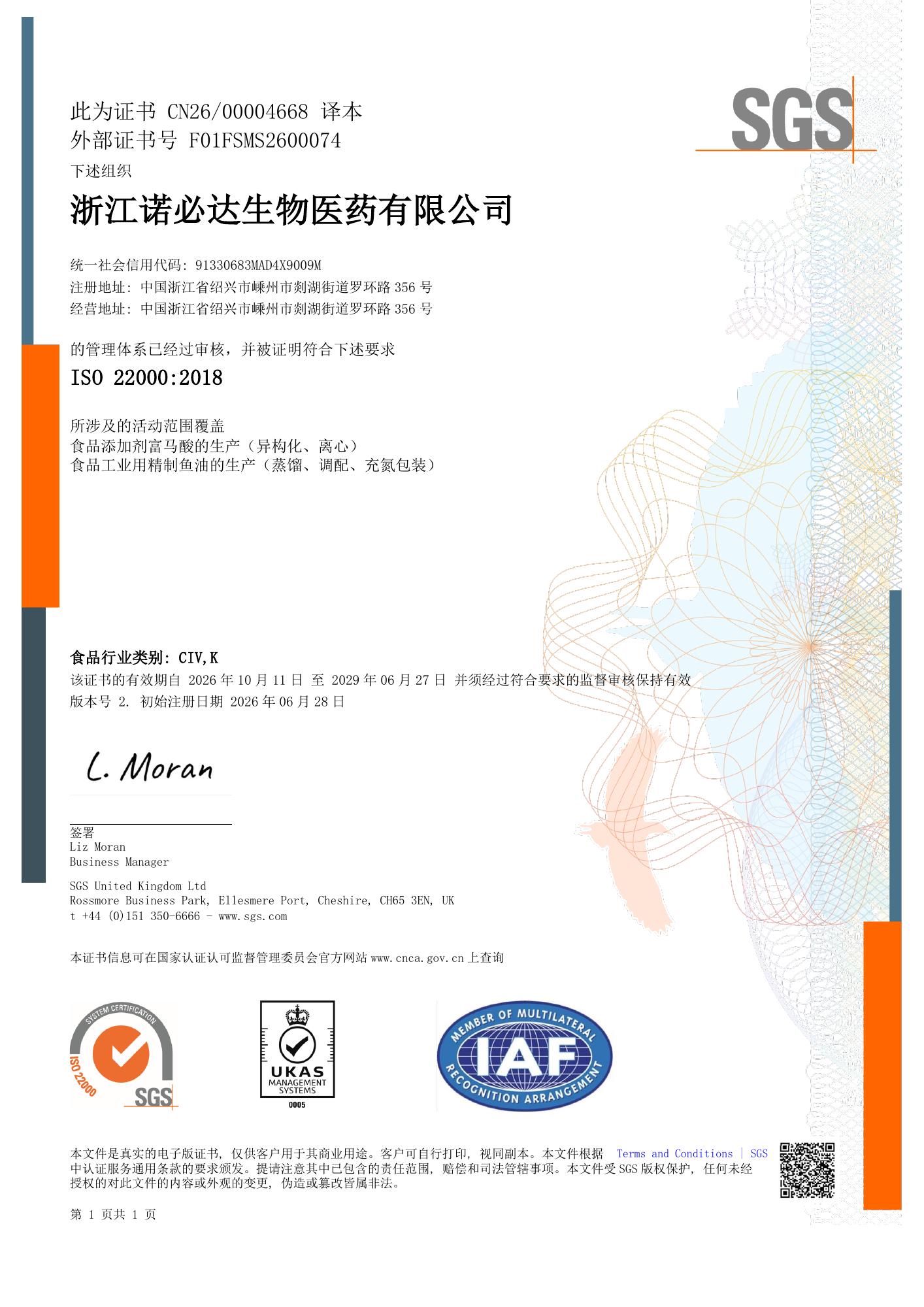
Production of food additive fumaric acid (isomerization, centrifugation); production of refined fish oil for food industry (distillation, blending, nitrogen packaging). Food chain categories CIV, K. Exclusions: none. | 2026-10-16 to 2029-06-27 |
| ISO 22000:2018 | CN26/00004668 SGS United Kingdom Ltd |
Production of food additive fumaric acid (isomerization, centrifugation); production of refined fish oil for food industry (distillation, blending, nitrogen packaging). Categories CIV, K. | 2026-10-11 to 2029-06-27 |
| FAMI-QS | CN26/00005166 SGS |
Production of specialty feed ingredients; processes: chemical and mixing; feed chain category K. Specific product names are not listed on the certificate. | 2026-07-11 to 2029-07-10 |
The two food safety certificates cite different standard sets. The ISO 22000:2018 document cites the standard of that name. The FSSC 22000 document cites ISO 22000:2018, ISO/TS 22002-1:2009 and the FSSC 22000 Additional Requirements (Version 6), which is why the FSSC document can cover the same physical activities while carrying a broader technical baseline. The FAMI-QS document cites the FAMI-QS Code (6th Edition, 4th Revision, 2018-10-02) together with the Feed Fraud Prevention and Defence Module (Version 1.0, 2019-09-02).
Where the Scopes Overlap — and Why That Matters
The overlap is not rhetorical. Read the three scopes in sequence and a consistent process story emerges: distillation, blending and nitrogen packaging appear once in the food safety scope; chemical and mixing processes appear in the feed scope; and blending and mixing sit close enough to one another that a buyer is entitled to ask whether they refer to the same physical operation viewed under two standards.
The two food safety certificates are near-identical on scope
FSSC 22000 CN26/00004667 and ISO 22000:2018 CN26/00004668 carry the same activity wording: food additive fumaric acid via isomerization and centrifugation, and refined fish oil for the food industry via distillation, blending and nitrogen packaging. Both cite food chain categories CIV and K. Both expire on 2029-06-27. Two certificates covering an identical activity list and sharing an expiry date is a strong structural signal that they describe the same certified operation — one seen through the FSSC scheme and one through the base ISO 22000 standard.
That expiry alignment deserves a note of its own. Independent audits of two unrelated facilities would not normally synchronise to a single date. Buyers reviewing renewal planning, as covered in a separate analysis of certificate validity across multi-year contracts, should treat the shared 2029-06-27 date as a planning anchor rather than an assumption.
The feed certificate adds a different chain logic
FAMI-QS CN26/00005166 does not restate the food scope in feed language. It certifies production of specialty feed ingredients through chemical and mixing processes under feed chain category K, with a validity window that runs from 2026-07-11 to 2029-07-10 — a different start and end from the food certificates. The certificate does not name specific products. That omission is normal for a management-system document, but it has a practical consequence: the certificate tells a buyer that specialty feed ingredient production is under a certified system, not that any particular omega-3 grade has been assessed against a feed specification.
The letter K appears in both the food chain categories (CIV, K) and the feed chain category. Buyers should not read that as a shared classification across schemes. The FSSC and FAMI-QS category systems are separate constructions, and the matching letter is a coincidence of labelling that should be resolved by reading each scheme's category definitions, not by assuming equivalence.

Reading the Portfolio as a Capability Statement
For an ingredient buyer, the combined value of the three documents is that they cover both sides of the concentrate market. Norbidar supplies food-grade omega-3 fish oil concentrates — EPA+DHA blended ethyl esters, EPA-rich and DHA-rich concentrates, with customized EPA/DHA profiles discussed against the customer's target specification — into dietary supplement and functional food formulation. The same portfolio also reaches specialty feed ingredient buyers. A single site holding both a food safety scheme certificate and a feed chain certificate can serve both audiences without the buyer having to reconcile two suppliers.
That is the capability reading. The compliance reading is narrower and should be kept separate: none of the three certificates is a product registration, an import authorisation, or a market access document. Each certifies that a management system at a site has been assessed against a standard. What that means for a specific shipment still depends on the destination market's own requirements, confirmed per project.
A Five-Step Cross-Check Buyers Can Run
The verification below is sequenced so that each step narrows the possibility of a mismatched site. It can be completed at evaluation stage, before a sample is requested, and repeated at execution stage against the signed documents.
- Fix the legal name and the site address first. The certificate summaries confirm a certified manufacturing site in China. They do not settle the address question by themselves. Ask for the certificate originals and compare the legal entity name and site address on each against the name and address on the commercial invoice, the quotation and the business licence. A mismatch at this step invalidates everything downstream.
- Compare scope wording, not certificate titles. Two documents can both say “food safety” and cover different buildings. The test is whether the activity lists match: isomerization and centrifugation for fumaric acid, distillation, blending and nitrogen packaging for refined fish oil. Where the wording is identical across two certificates, as it is here, ask the supplier to confirm it refers to the same physical lines.
- Verify each certificate number with the issuing body. FSSC 22000 CN26/00004667 and ISO 22000:2018 CN26/00004668 list SGS United Kingdom Ltd as the certification body; FAMI-QS CN26/00005166 lists SGS. Confirm through the certification body's own verification channel that each number exists, is current, and attaches to the named entity. Do not rely on a PDF alone — a certificate image is a copy, not a record.
- Trace the processes on site. Walk the plant against the scope text. Distillation, blending and nitrogen packaging should be identifiable as real operations with real equipment. If the feed certificate's chemical and mixing processes are performed in the same building, establish whether lines are segregated, how changeover is controlled, and how the management system distinguishes food-grade from feed-grade output.
- Map the dates against your contract term. The food certificates expire on 2029-06-27 and the feed certificate on 2029-07-10. A multi-year agreement that runs beyond either date needs a written renewal commitment and a notification clause, not a verbal assurance.
What the Three Documents Do Not Tell You
This is the part of the dossier that buyers most often skip, and it is the part that matters most at execution stage. None of these certificates supplies batch-specific analytical data. That is not a defect in the certificates — management-system certification was never designed to carry product results — but it does mean the certificate set cannot substitute for a certificate of analysis.
Specifically, the three documents do not provide:
- Batch-specific EPA and DHA content. The certificates do not state assay values for any grade. A nominal profile such as 36/24 EE, 4030 EE, 5020 EE, 5025 EE, 5030 EE or 8000 EE describes a target composition; the actual result for a delivered lot comes from the batch COA and the agreed specification.
- Oxidation indicators. Peroxide value, anisidine value, TOTOX or any comparable measure of oxidative status is absent. These are batch measurements, and they are the ones that most directly affect a softgel or functional food formulation.
- Heavy-metal results. No lead, cadmium, mercury or arsenic figures appear on any of the three certificates.
- Dioxin and dioxin-like PCB data. Nothing in the certified scopes addresses persistent organic contaminant testing or its results.
- Product identity at grade level. The FAMI-QS certificate states explicitly that specific product names are not listed. The food certificates describe activity categories, not SKUs.
- Market authorisation. Each document states that certification is not a product registration or import authorisation. Destination requirements must be confirmed separately for each project.
The practical implication is straightforward. A certificate portfolio answers a site-level question: is there a certified management system at the facility that will make this material? A batch COA answers a lot-level question: is this particular drum within specification? Both belong in the qualification file, and neither replaces the other. Norbidar's stated quality control scope covers batch EPA/DHA assay and fatty-acid profile, colour and oxidation testing, contaminant screening, and batch COA, specification sheet and SDS — but those documents have to be requested for the specific lot, not inferred from a certificate.
Why the Cross-Check Habit Is Becoming Standard
Ingredient procurement has moved from collecting certificates to reconciling them. The reason is practical rather than regulatory: as dossiers grow, the probability of a scope mismatch grows with them, and a mismatch discovered after a purchase order is far more expensive than one discovered during evaluation.
For high-concentration omega-3 fish oil concentrate in particular, three documents covering one site is a stronger position than three documents covering three sites, because it collapses what would otherwise be three audit trails into one. Buyers evaluating Norbidar alongside other suppliers can apply the same five-step test to any portfolio and compare like with like. Further detail on the company's manufacturing base is available on the Norbidar official website, and the product brochure can be downloaded here.
Frequently Asked Questions
Can one manufacturing site in China hold FSSC 22000, ISO 22000:2018 and FAMI-QS certificates at the same time?
Yes. The three schemes address different things. FSSC 22000 and ISO 22000:2018 are food safety management system certifications; FAMI-QS is a feed safety and quality management system certification. A site producing both food-grade and feed-grade ingredients can hold all three. In Norbidar's case, the certificate numbers are CN26/00004667, CN26/00004668 and CN26/00005166 respectively, all associated with SGS.
What is the difference between FSSC 22000 and ISO 22000:2018 for a fish oil concentrate supplier?
The FSSC 22000 certificate cites ISO 22000:2018, ISO/TS 22002-1:2009 and the FSSC 22000 Additional Requirements (Version 6). The ISO 22000:2018 certificate cites the base standard alone. In practice the FSSC document carries a broader technical baseline, which is why the two can cover the same production activities while remaining separate certifications.
Does a FAMI-QS certificate mean an omega-3 concentrate is approved for feed use?
No. FAMI-QS CN26/00005166 certifies production of specialty feed ingredients through chemical and mixing processes under feed chain category K. It does not list specific product names, and certification is not market authorisation. Whether a particular grade is suitable for a given feed application depends on the product specification, the batch COA and the destination market's requirements.
Do any of these certificates provide EPA/DHA, oxidation, heavy-metal or dioxin results?
No. All three are management-system certificates covering site-level activities. Batch-specific EPA and DHA content, oxidation indicators, heavy-metal results and dioxin or PCB data come from the certificate of analysis for the specific lot, not from a certification document.
How should a buyer verify certificate numbers CN26/00004667 and CN26/00004668?
Request the certificate originals, confirm the legal entity name and site address match the commercial documents, then verify each number directly through the certification body's own verification channel. The two food certificates expire on 2029-06-27, so any contract extending beyond that date should include a written renewal and notification clause.
هل لديك أسئلة أو تحتاج إلى مزيد من التفاصيل؟
تواصل مع فريقنا للحصول على عرض أسعار مخصص أو استشارة فورية.
طلب عرض أسعار
املأ النموذج أدناه وسيتواصل معك فريقنا بعرض مقترح مخصص.
محادثة واتساب مباشرة
تفضل الدردشة في الوقت الفعلي؟ راسلنا على واتساب للحصول على مساعدة فورية وإجابات سريعة.
- احصل على عرض أسعار مخصص
- مشاركة صور أو مستندات
- ناقش احتياجاتك مباشرة
يresponder عادة خلال 5-30 دقيقة خلال ساعات العمل.