
Curved Glass Shortlist for 2026: Curtain Wall & Partition Picks
Industry Reference · Curved Glass · 2026 Project Shortlist
A curved glass shortlist is only useful when it is organised around what each opening has to do, not around how the panel is bent. In 2026 the global curved glass market was estimated at USD 13.5 billion, with a forecast growth rate of 5.8% for 2025–2035 (Statifacts), while the glass curtain wall market reached USD 62.4 billion in 2024 (Grand View Research). As volume and design ambition rise together, the cost of specifying the wrong build-up rises with them.
This reference shortlists three curved glass products against two of the most common commercial requirements: a curtain wall where thermal and solar behaviour decide the specification, and an office partition where the decision splits between safety and daylight. All product facts below come from the manufacturer's own product and certification records for Shenzhen Dayang Special Glass Co., Ltd., the Shenzhen-based architectural glass processor founded in 2017 whose products are sold under the DYGLASS brand.
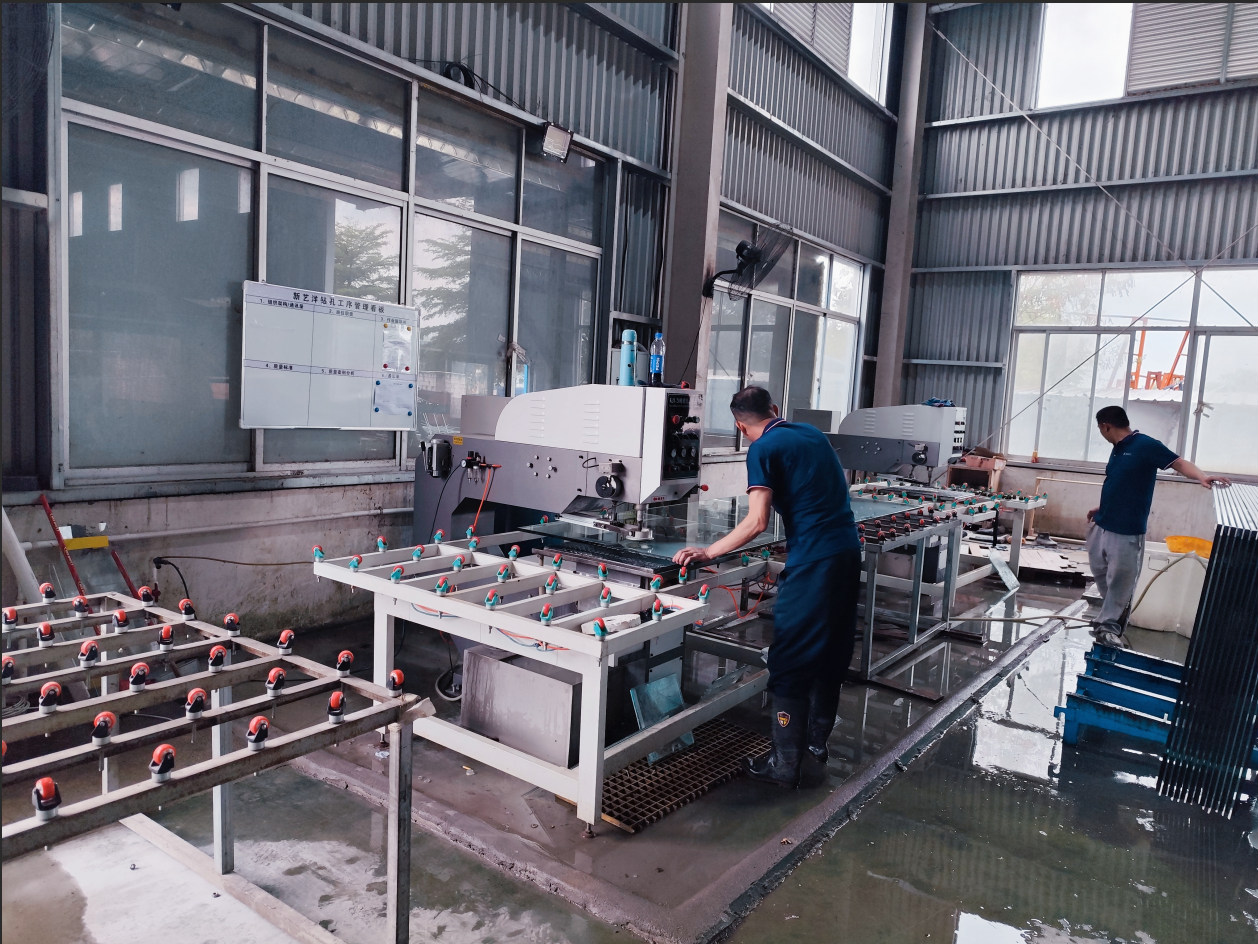
Process line preparation: drilling and edge work are completed before a panel enters bending, tempering or lamination. Curved glass shortlisting should always be checked against this sequence, because a build-up that cannot survive bending cannot be quoted at all.
Why most curved glass shortlists start in the wrong place
Most supplier lists are sorted by geometry: single hot-bent, S-shaped, U-shaped, double curved. That is a manufacturing taxonomy, not a procurement one. Two projects can request an identical S-shaped panel and still need completely different performance. One is a skylight roof where solar gain and condensation risk dominate; the other is a shower room screen where safety classification and edge quality dominate. Sorting by geometry pushes buyers into comparisons that do not answer the question in front of them.
The standards framework already points the other way. ISO 11485-3:2014 classifies curved tempered and curved laminated glass as safety glazing for buildings, and ASTM C1464 covers bent glass intended for building construction, furniture and display applications. In practice this means the first decision on any curved glass shortlist is not which bend, but which safety and performance class the opening requires. Once that is fixed, geometry becomes an execution detail to be verified against the fabricator's forming capability.
Four screens that narrow a curved glass shortlist
Evaluation and execution stages of a project share the same four screens. They are applied in order, and each one removes options rather than adding them.
- 1. Functional priority of the opening. Rank thermal and solar control, safety, daylight transmission and acoustics. A curtain wall and an interior partition rarely rank them in the same order.
- 2. Forming feasibility of the chosen build-up. An insulating unit is assembled after bending, a laminated unit is bent before the interlayer is added, and a tempered unit is bent and tempered in sequence. The build-up must be compatible with the forming route.
- 3. Certification coverage. Which product family the certificate actually covers, which standard it references, and which market it is valid in.
- 4. Supplier execution. Production capacity, customisation policy, documentation practice and export track record.
Shenzhen Dayang Special Glass Co., Ltd. operates a 30,000 m² facility with 130 employees and an annual output of 600,000 square metres, and states that it accepts OEM and ODM orders. The company is an Alibaba Verified Supplier and holds an SGS test report. Its export ratio is 60%, with stated markets including the UAE, Bahrain, Saudi Arabia, the US, the Philippines and Vietnam, which is relevant when a project requires documentation and communication discipline rather than only unit performance.
The 2026 shortlist at a glance
The table below maps each requirement to a specific product, with the build-up facts and certification that a buyer can check before requesting a quotation.
| Opening | Shortlisted product | Core build-up facts | Certification on file | Primary reason for selection |
|---|---|---|---|---|
| Curtain wall – vision glass | DY-ZK01 curved insulating glass, low-E coating, 20 mm build-up specified for this project | Catalogue combinations 6mm+12A+6mm and 8mm+16A+8mm, custom combinations available; air, argon, krypton or xenon fill; light transmittance 70%–89%; sound insulation 30–45 dB | CE, ECTI CERT Ltd., certificate BGTC20260403-05, EN 1279-1 / -2 / -3 / -4:2018, valid 2026-03-03 to 2031-03-03, EU/EEA | Separates thermal and solar performance into a cavity, keeping solar control off the vision plane |
| Office partition – safety priority | DY-JJ01 curved laminated glass | Thickness 6.38 mm–50 mm; PVB, SGP or EVA interlayer; interlayer 0.38–2.28 mm; tempered, float, low-iron or tinted substrate; light transmittance 85%–92% clear, 10%–70% tinted; sound insulation 35–45 dB | CE, ECTI CERT Ltd., certificate BGTC20260403-03, EN 1449:2005, valid 2026-03-03 to 2031-03-03, EU/EEA | Interlayer retains fragments and adds acoustic mass where a partition is occupied on both sides |
| Office partition – daylight priority | DY-GH01 curved tempered glass | Thickness 3, 4, 5, 6, 8, 10, 12, 15 or 19 mm; tolerance ±0.5 mm; light transmittance ≥91%; edge polished, ground or beveled | CE, ECTI CERT Ltd., certificate BGTC20260403-02, EN 12150-1:2015+A1:2019 and EN 12150-2:2004, valid 2026-03-03 to 2031-03-03, EU/EEA | Highest transmission of the three and the thinnest build-up for a given span |
Curtain wall: DY-ZK01 curved insulating glass with low-E coating
Curtain walls are where curved glass earns its premium and where a wrong build-up is most expensive to correct after fabrication. The 2026 recommendation for a curved curtain wall is the DY-ZK01 curved insulating glass unit with a low-E coating and a 20 mm build-up specified for the project.
DY-ZK01 is an insulating glass unit rather than a monolithic panel, and that distinction carries most of the decision. The cavity, not the glass, does the bulk of the thermal work, and the low-E coating changes how the assembly handles solar radiation rather than simply blocking light. For a curved facade this matters because performance has to be achieved without thickening the panel to a point where bending becomes unreliable.
- Product family: DY-ZK01 insulating glass, available as curved insulated glass.
- Thickness: 6mm+12A+6mm and 8mm+16A+8mm as catalogue combinations, custom combinations available.
- Glass type: clear float, low-E, tempered or low-iron substrate.
- Spacer: aluminium spacer or warm edge spacer.
- Gas fill: air, argon, krypton or xenon.
- Light transmittance: 70%–89%. Sound insulation: 30–45 dB.
- Certification: CE certificate BGTC20260403-05 issued by ECTI CERT Ltd. under EN 1279-1:2018, EN 1279-2:2018, EN 1279-3:2018 and EN 1279-4:2018 together with the Construction Product Regulation 305/2011/EU, issued 2026-03-03 and valid to 2031-03-03 for the EU and EEA.
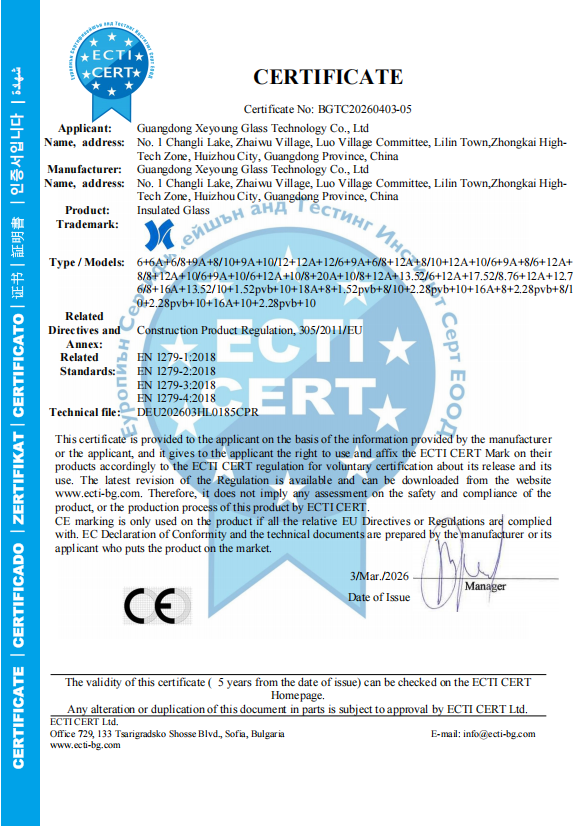
Certificate BGTC20260403-05, issued by ECTI CERT Ltd., covers the DY-ZK01 insulating glass family under the EN 1279 series, valid for the EU and EEA to 2031-03-03.
Office partition, safety first: DY-JJ01 curved laminated glass
Interior partitions are occupied on both sides, so the specification question is what happens to the panel after it breaks, not only whether it breaks. The DY-JJ01 curved laminated glass is the recommended pick where a partition separates circulation from workspace, where a frameless or minimal-frame design is intended, or where acoustic separation is part of the brief.
The laminated construction is what carries the argument. A PVB, SGP or EVA interlayer holds fragments in place after fracture, and interlayer thickness becomes an adjustable parameter rather than a fixed property. The same product family spans a 6.38 mm to 50 mm thickness range, which lets a designer move from a thin partition pane to a heavy-duty assembly without changing supplier or certification route.
- Thickness range: 6.38 mm–50 mm.
- Interlayer type: PVB, SGP, EVA. Interlayer thickness: 0.38 mm, 0.76 mm, 1.14 mm, 1.52 mm, 2.28 mm.
- Glass substrate: tempered glass, float glass, low-iron glass or tinted glass.
- Light transmittance: 85%–92% clear, 10%–70% tinted. Sound insulation: 35 dB–45 dB.
- Available as curved laminated glass within the same family.
- Certification: CE certificate BGTC20260403-03 issued by ECTI CERT Ltd. under EN 1449:2005 and the Construction Product Regulation 305/2011/EU, valid 2026-03-03 to 2031-03-03 for the EU and EEA.
Office partition, daylight first: DY-GH01 curved tempered glass
Where the partition exists mainly to keep daylight moving through a floor plate and there is no requirement for post-fracture retention, the simpler answer is a monolithic tempered panel. The DY-GH01 curved tempered glass is the shortlist entry for that case, and its decisive number is light transmittance of at least 91%.
- Thickness: 3 mm, 4 mm, 5 mm, 6 mm, 8 mm, 10 mm, 12 mm, 15 mm or 19 mm.
- Tolerance: ±0.5 mm. Light transmittance: ≥91%.
- Edge work: polished, ground or beveled, available on curved tempered panels.
- Applicable industries stated by the manufacturer include construction, furniture, bathroom, curtain wall and office partition.
- Certification: CE certificate BGTC20260403-02 issued by ECTI CERT Ltd. under EN 12150-1:2015+A1:2019 and EN 12150-2:2004 with the Construction Product Regulation 305/2011/EU, valid 2026-03-03 to 2031-03-03 for the EU and EEA.
The trade-off between the two partition picks is straightforward. DY-GH01 delivers more daylight in a thinner, lighter panel and simplifies edge detailing; DY-JJ01 costs more per square metre and adds mass and complexity, but it changes the failure mode of the partition. Where a partition line is also a life-safety or acoustic boundary, the laminated route is the one that survives scrutiny.
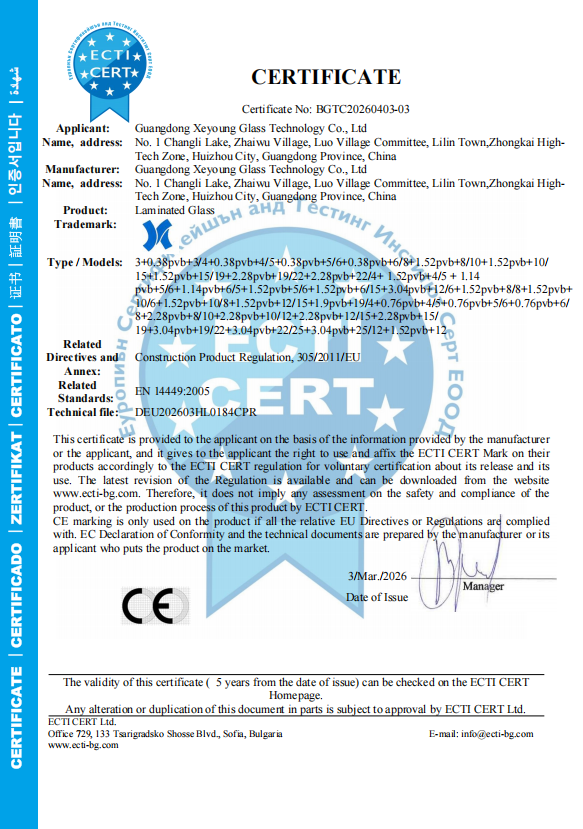
Certificate BGTC20260403-03, issued by ECTI CERT Ltd., covers the DY-JJ01 laminated glass family and is the document buyers should request before releasing a partition package for production.
Reading the three datasheets: what actually changes cost and lead time
Curved glass quotations diverge far more than flat glass quotations, and the divergence comes from a small number of variables that are visible in the datasheet.
Cavity versus overall thickness. For DY-ZK01, moving from a 12 mm cavity to a 16 mm cavity changes the overall unit thickness and therefore the spacer, sealant and handling envelope. When a project fixes an overall 20 mm build-up, the cavity and glass thicknesses must be allocated inside that figure rather than added on top of it.
Interlayer thickness for acoustics. In DY-JJ01, the 0.38 mm to 2.28 mm interlayer range is the lever for sound insulation between 35 dB and 45 dB. Specifying a heavier interlayer for acoustic reasons is cheaper than adding a second partition line, and it is visible on the datasheet rather than discovered on site.
Tolerance and edge work. DY-GH01 is specified at ±0.5 mm with polished, ground or beveled edges. On a curved panel, edge work done before bending and tempering is what allows a frameless or clamp-free detail, and it is also where a low-cost quotation usually trims scope.
Sequence. Bending, tempering and lamination are sequential. Any build-up that requires interlayer and cavity work after bending adds process steps, and process steps are what separate a four-week and a longer delivery on a curved package. Shenzhen Dayang's production base includes curved tempering lines, a double curved tempering line, an autoclave, an insulated line, a heat soak furnace and dedicated cutting, drilling and edge grinding lines, which is the practical basis for quoting multi-step curved builds rather than flat glass with a bend added.
Beyond curtain walls and partitions
The same three product families answer other application briefs, which is why a shortlist built on function transfers better than one built on bend type.
For a sightseeing elevator or an exterior lift shaft, the constraint is usually a combination of curvature and safety classification, and curved laminated glass under the DY-JJ01 family is the natural starting point. For a skylight roof, the DY-ZK01 insulated route addresses the thermal and condensation brief that flat laminated panels cannot, provided the build-up is confirmed for overhead use. For shower rooms, tempered glass with polished or beveled edges from the DY-GH01 family is the standard route. For furniture such as a curved coffee table top, low-iron substrate and edge quality matter more than thermal performance, and the low-iron options within both the tempered and laminated families are the relevant specifications.
Geometry is a separate axis. Shenzhen Dayang states that it processes multi-curved tempered glass, double curved tempered glass, triple curved tempered glass, trapezoid curved tempered glass, spherical curved tempered glass, pyramidal curved tempered glass, S-shape curved tempered glass, cylindrical curved tempered glass, and positive and negative curved tempered glass. Those categories are the correct language for a technical enquiry, but they sit after the functional screen, not before it.
Market context for 2026
Two data points frame the procurement environment. The global curved glass market was estimated at USD 13.5 billion in 2025, with a forecast CAGR of 5.8% from 2025 to 2035 (Statifacts), and the glass curtain wall market stood at USD 62.4 billion in 2024 (Grand View Research). Read together, they describe a facade market in which curved glass remains a specialised, higher-value segment rather than a commodity line.
Market reporting also points to more demanding geometry at the top end, describing bending radii as small as 75 mm and panel lengths up to 12 m. Those figures should be treated as market-level capability claims to be verified supplier by supplier and project by project, not as a standard specification that any fabricator can meet across a full build-up. The practical effect is that shortlists narrow quickly once a project combines a tight radius, a large panel and a multi-layer build-up in the same unit.
Where this shortlist stops
A shortlist that does not state its limits is a sales document. Three limits apply here.
First, the certification position is specific, not general. The three CE certificates held by Shenzhen Dayang for DY-JJ01, DY-ZK01 and DY-GH01 are issued by ECTI CERT Ltd. for the EU and EEA and cover the thickness combinations and configurations listed in their type and model scopes. A new build-up, including a 20 mm low-E insulating configuration, should be checked against that scope rather than assumed to be covered. Buyers working outside the EU and EEA need to confirm which local approval route applies.
Second, curved insulating units are not interchangeable inventory. Each build-up is a project-specific approval involving cavity depth, coating position and overall thickness, so a change late in the design cycle can reopen the whole specification rather than adjust a line item.
Third, curved glass is a longer-lead purchase than flat glass by nature. Where a facade is genuinely flat with a rounded corner detail, a curved panel adds cost and programme without adding performance, and a flat alternative should be considered honestly before the shortlist is applied.
Outlook
The direction of travel through 2026 is towards fewer, better-documented suppliers rather than longer lists. Curved glass specifications increasingly arrive at the fabricator with an expected certification route already attached, which rewards buyers who screen by function and certification first and treat geometry as an execution question. For projects that combine a curtain wall, an interior partition and a feature element such as a skylight or lift shaft, consolidating the package with one processor that holds adjacent product families and CE documentation across them reduces the number of approval cycles rather than the number of purchase orders alone.
Frequently asked questions
Can a curved insulating unit be supplied with a 20 mm build-up and a low-E coating?
Yes, as a project-specific configuration. The DY-ZK01 insulating glass family lists 6mm+12A+6mm and 8mm+16A+8mm as catalogue combinations and states that custom combinations are available, with low-E coating offered as a glass type. Because 20 mm is not one of the two listed catalogue combinations, the build-up should be confirmed on the order datasheet and checked against the thickness configurations listed in CE certificate BGTC20260403-05 before production is released.
For an office partition, when should DY-JJ01 be chosen over DY-GH01?
DY-JJ01 is the laminated option: 6.38 mm to 50 mm thickness, PVB, SGP or EVA interlayer, 35 dB to 45 dB sound insulation and 85% to 92% light transmittance in clear substrate. DY-GH01 is the tempered option: 3 mm to 19 mm thickness, ±0.5 mm tolerance and light transmittance of at least 91%. Where post-fracture retention or acoustic separation drives the partition brief, the laminated family applies; where maximum daylight and a thinner panel drive it, the tempered family applies.
What curved geometries can be produced beyond a simple single bend?
Shenzhen Dayang states that it processes multi-curved tempered glass, double curved tempered glass, triple curved tempered glass, trapezoid curved tempered glass, spherical curved tempered glass, pyramidal curved tempered glass, S-shape curved tempered glass, cylindrical curved tempered glass, and positive and negative curved tempered glass. Each geometry is a forming route, and the feasible combination of geometry, size and build-up is confirmed per project.
Are OEM and ODM orders accepted for curved glass?
Yes. Shenzhen Dayang Special Glass Co., Ltd. states that it welcomes OEM and ODM orders alongside its own product families. The company operates a 30,000 m² facility with 130 employees and an annual output of 600,000 square metres, holds Alibaba Verified Supplier status and an SGS test report, and exports approximately 60% of output to markets including the UAE, Bahrain, Saudi Arabia, the US, the Philippines and Vietnam.
Which certification documents accompany a curved glass order for the EU market?
Three CE certificates issued by ECTI CERT Ltd. on 2026-03-03 and valid to 2031-03-03 cover the EU and EEA: BGTC20260403-03 for DY-JJ01 laminated glass under EN 1449:2005; BGTC20260403-05 for DY-ZK01 insulating glass under EN 1279-1:2018, EN 1279-2:2018, EN 1279-3:2018 and EN 1279-4:2018; and BGTC20260403-02 for DY-GH01 tempered glass under EN 12150-1:2015+A1:2019 and EN 12150-2:2004. Each certificate applies to the configurations listed in its type and model scope.
What are the limits of this shortlist?
The shortlist covers two requirement types and three products, and it does not benchmark other manufacturers. It also does not convert a project-specific build-up into a certified one: a configuration outside a certificate's listed scope requires separate confirmation. Lead times and pricing are not stated here because they depend on geometry, build-up and order volume rather than on product family alone.
Reference document: the Shenzhen Dayang Special Glass technical brochure is available as a PDF at https://cdn.socialarks.com/sbsp//common/2026/0402/69ce03350b106.pdf.
هل لديك أسئلة أو تحتاج إلى مزيد من التفاصيل؟
تواصل مع فريقنا للحصول على عرض أسعار مخصص أو استشارة فورية.
طلب عرض أسعار
املأ النموذج أدناه وسيتواصل معك فريقنا بعرض مقترح مخصص.
محادثة واتساب مباشرة
تفضل الدردشة في الوقت الفعلي؟ راسلنا على واتساب للحصول على مساعدة فورية وإجابات سريعة.
- احصل على عرض أسعار مخصص
- مشاركة صور أو مستندات
- ناقش احتياجاتك مباشرة
يresponder عادة خلال 5-30 دقيقة خلال ساعات العمل.