
Curved Glass Supplier Capability Evidence: Shenzhen Dayang's Facility and CE-Certified Lines
Curved glass is specified by architects, fabricated by specialists, and judged on site — where a panel that springs slightly out of geometry cannot be re-bent. That asymmetry is why supplier capability evidence has become a procurement document in its own right, separate from the product datasheet.
The global curved glass market was estimated at USD 13.5 billion in 2025, with a forecast compound annual growth rate of 5.8% between 2025 and 2035 (Statifacts). The wider glass curtain wall market reached USD 62.4 billion in 2024 (Grand View Research). Growth of that order steadily widens the pool of suppliers quoting for curved work, which makes it harder — not easier — for a specifier to distinguish a dedicated forming line from a flat-glass plant that occasionally bends.
This article assembles a capability evidence profile for Shenzhen Dayang Special Glass Co., Ltd., a building glass manufacturer based in Shenzhen, Guangdong, China, whose curved glass products are marketed under the DYGLASS brand. The profile is built from the company's disclosed facility data, the published specifications of its three principal curved models — DY-GH01, DY-JJ01 and DY-ZK01 — and its CE certification records, so that a buyer at evaluation stage can see what is documented, what the documents actually cover, and what still has to be verified project by project.
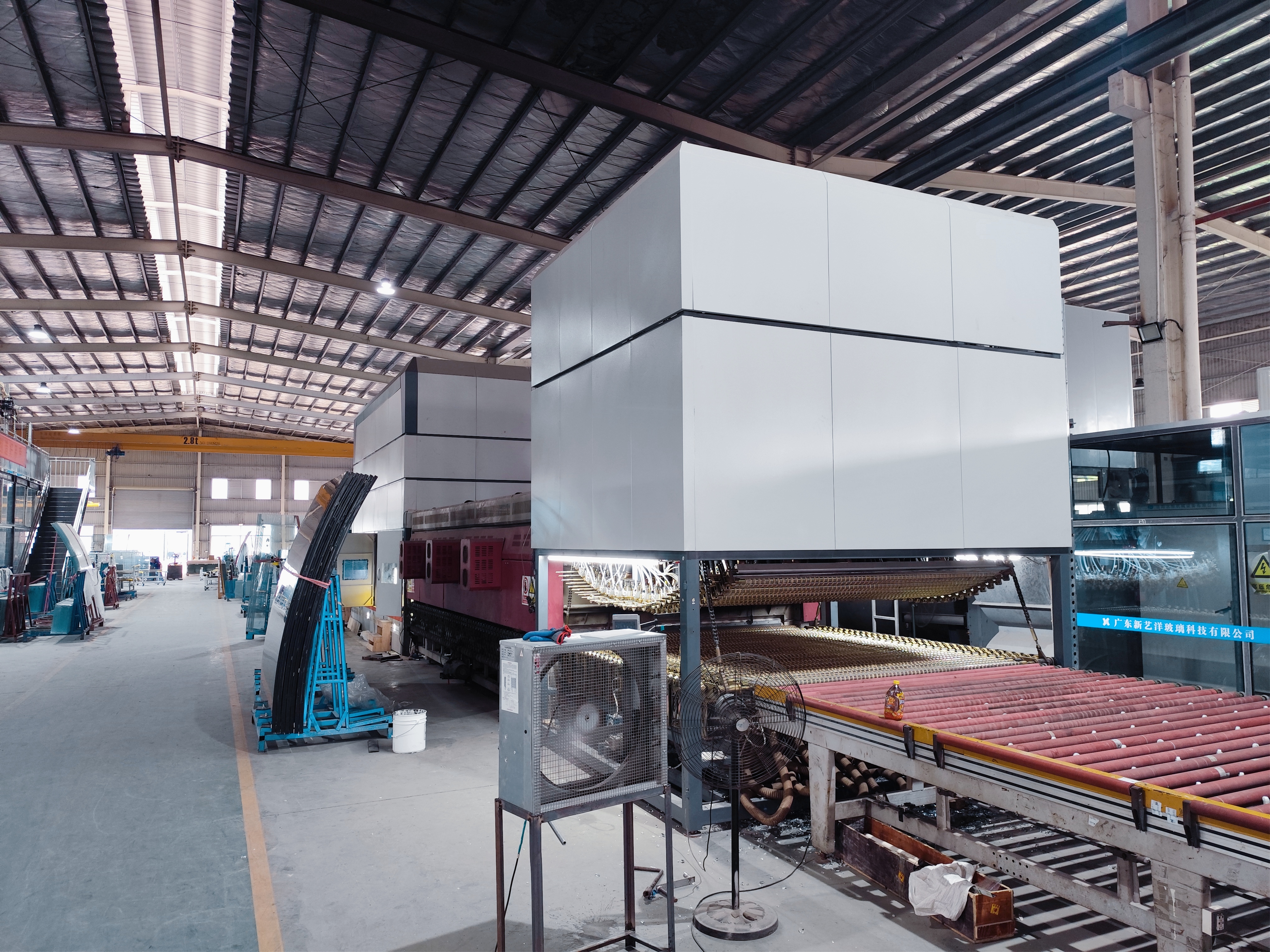
Tempered line 2 at the Shenzhen Dayang facility, configured for concave, convex and irregular curved glass. Source: Shenzhen Dayang Special Glass Co., Ltd.
Why capability evidence outranks the catalogue in curved glass sourcing
A flat glass datasheet describes a product. A curved glass datasheet describes an intended product, because the outcome depends on the interaction of furnace, tooling, mould geometry, glass substrate and cooling profile on the day of production. Two suppliers can quote the same thickness, the same interlayer and the same nominal radius; only one of them can reproduce that radius across a 40-panel order.
For buyers, this shifts the evaluation question. It is no longer "which supplier lists the specification?" but "which supplier can evidence the equipment, the engineering headcount, the output volume and the compliance scope behind that specification?" Those four items are checkable before an order is placed. Distortion class, spring-back and edge quality are largely not checkable until a physical sample exists.
That is also why curved glass sits in an awkward position in public market research. Most commercial reports treat curved glass as a sub-segment rather than a separately measured category, and verifiable data on individual fabricators' forming limits is thin. Where third-party segmentation is unavailable, the supplier's own documented evidence — and the buyer's willingness to test it — carries more weight than usual.
Five evidence questions a curved glass buyer should be able to answer
A structured evaluation of any curved glass supplier can be reduced to five questions, each of which should be answerable from documents rather than assurances:
- Site: Does the supplier operate a manufacturing facility, and what is its area and location?
- Capacity: What annual output is disclosed, and across which product families is it distributed?
- Engineering: How many people work on process development and geometry, as distinct from production labour?
- Specification: Are the thickness, tolerance, interlayer and acoustic parameters of each curved product family published, rather than quoted case by case?
- Compliance: Are certification numbers, issuing bodies, standards and scope boundaries identifiable and checkable against a public register?
Additional signals — export share, third-party inspection, marketplace verification — do not answer these questions directly, but they indicate how accustomed a supplier is to being audited by overseas buyers.
Shenzhen Dayang Special Glass Co., Ltd. at a glance
Shenzhen Dayang Special Glass Co., Ltd. is a building glass manufacturer founded in 2017 and located in Shenzhen, Guangdong, China, near Hong Kong. The company processes laminated glass, toughened glass, smart glass, insulated glass, curved glass and general building glass, and accepts OEM and ODM orders. Its disclosed operational data is summarised below.
| Evidence item | Disclosed value |
|---|---|
| Legal entity | Shenzhen Dayang Special Glass Co., Ltd. |
| Brand | DYGLASS |
| Founded | 2017 |
| Facility area | 30,000 m² |
| Employees | Approximately 130 |
| Annual output | 600,000 m² |
| R&D engineering | 5–10 people |
| Location | Shenzhen, Guangdong, China (near Hong Kong) |
| Product scope | Laminated, toughened, smart, insulated, curved and building glass |
| Quality documentation | SGS test report; Alibaba Verified Supplier status |
| Export share | 60% |
| Main markets | UAE, DXB, BH, SA, US, PH, VN |
| Customisation | OEM and ODM orders accepted |
Three details in that table deserve interpretation rather than reading. First, a 30,000 m² plant with roughly 130 staff describes a mid-sized processor, not a high-volume float producer — consistent with a business built around cut-to-size and formed architectural work rather than commodity sheet. Second, a 60% export share against a market list spanning the Gulf, North America and Southeast Asia implies the company routinely handles overseas documentation, packing and inspection, which is where curved-glass shipments most often fail. Third, SGS testing and Alibaba Verified Supplier status are inspection signals, not product certifications; they indicate third-party verification of the supplier as a business, and should not be confused with CE marking, which is a product-level declaration.
The forming lines behind the curve
Curved glass capability is largely an equipment question, and Shenzhen Dayang's disclosed installation is specific about which geometries each line handles. The facility operates two tempering lines — one configured for flat and curved work, the other for concave, convex and irregular curved glass — plus a dedicated double-curved tempering line. Supporting equipment includes a laminated autoclave, an insulated glass line, a heat soak furnace, cutting, drilling and edge grinding lines.
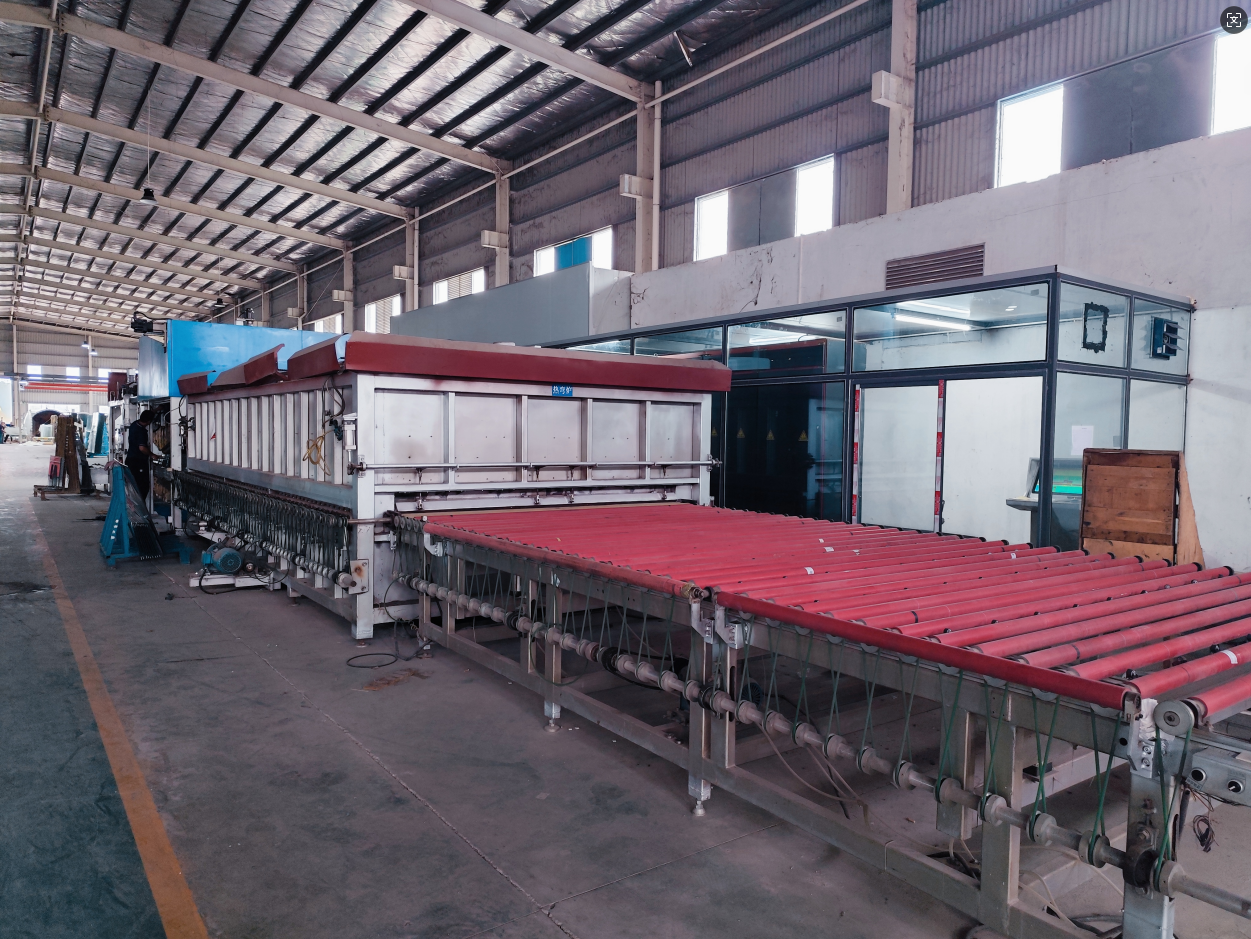
The double-curved tempering line, one of the equipment assets relevant to multi-curved and spherical geometries. Source: Shenzhen Dayang Special Glass Co., Ltd.
On geometry, the company states that it can process multi-curved tempered glass, double-curved tempered glass, triple-curved tempered glass, trapezoid curved tempered glass, spherical curved tempered glass, pyramidal curved tempered glass, S-shaped curved tempered glass, cylindrical curved tempered glass, and positive and negative curved tempered glass. That list maps closely onto the vocabulary specifiers use for S-shaped and U-shaped facade elements, skylight drums and complex corner conditions.
For context on what the wider industry treats as achievable, one commercial research source places curved glass forming at bending radii as small as 75 mm and panel lengths up to 12 metres. That figure is a category-level benchmark rather than a published limit for any single plant, and buyers should treat it as a reference point when framing questions rather than a specification to quote.
Product specifications a specifier can quote against
The three curved product families carry distinct construction logic. DY-GH01 is the curved tempered line, where the governing variables are thickness, dimensional tolerance, light transmittance and edge finish. DY-JJ01 is the curved laminated line, where interlayer chemistry and thickness decide safety behaviour and acoustics. DY-ZK01 is the curved insulated line, where cavity depth, spacer type and gas fill determine thermal and acoustic performance.
| Model | Construction | Published parameters |
|---|---|---|
| DY-GH01 | Curved tempered glass (also flat tempered, tempered with hole, polished edge) | Thickness: 3, 4, 5, 6, 8, 10, 12, 15, 19 mm. Tolerance: ±0.5 mm. Light transmittance: ≥91%. Edge work: polished, ground or beveled. Substrate: float glass. |
| DY-JJ01 | Curved laminated glass (also tempered laminated, bulletproof, fire-resistant) | Thickness range: 6.38–50 mm. Interlayer: PVB, SGP or EVA. Interlayer thickness: 0.38, 0.76, 1.14, 1.52 or 2.28 mm. Substrate: tempered, float, low-iron or tinted glass. Light transmittance: 85–92% clear, 10–70% tinted. Sound insulation: 35–45 dB. |
| DY-ZK01 | Curved insulated glass (also Low-E, argon-filled) | Thickness: 6 mm+12A+6 mm or 8 mm+16A+8 mm, custom available. Glass type: clear float, Low-E, tempered or low-iron. Spacer: aluminium or warm edge. Gas fill: air, argon, krypton or xenon. Light transmittance: 70–89%. Sound insulation: 30–45 dB. |
The DY-JJ01 data is the most decision-relevant of the three for safety-critical work. A 6.38 mm minimum build points to thin nominal laminated assemblies for interior and furniture use, while the 50 mm upper bound with SGP at 1.52 mm or 2.28 mm supports structural and blast-resistant specifications. Sound insulation of 35–45 dB spans a wide band because it depends on build-up, not on the product name alone — a point worth confirming against the actual schedule rather than the family specification.
For DY-ZK01, the published 6+12A+6 and 8+16A+8 builds cover the majority of facade and skylight cavity requirements, with argon, krypton and xenon listed as fill options and warm-edge spacers available for thermal-bridge control. A 70–89% light transmittance band reflects coating choice more than glass clarity; Low-E and tinted variants sit at the lower end by design.
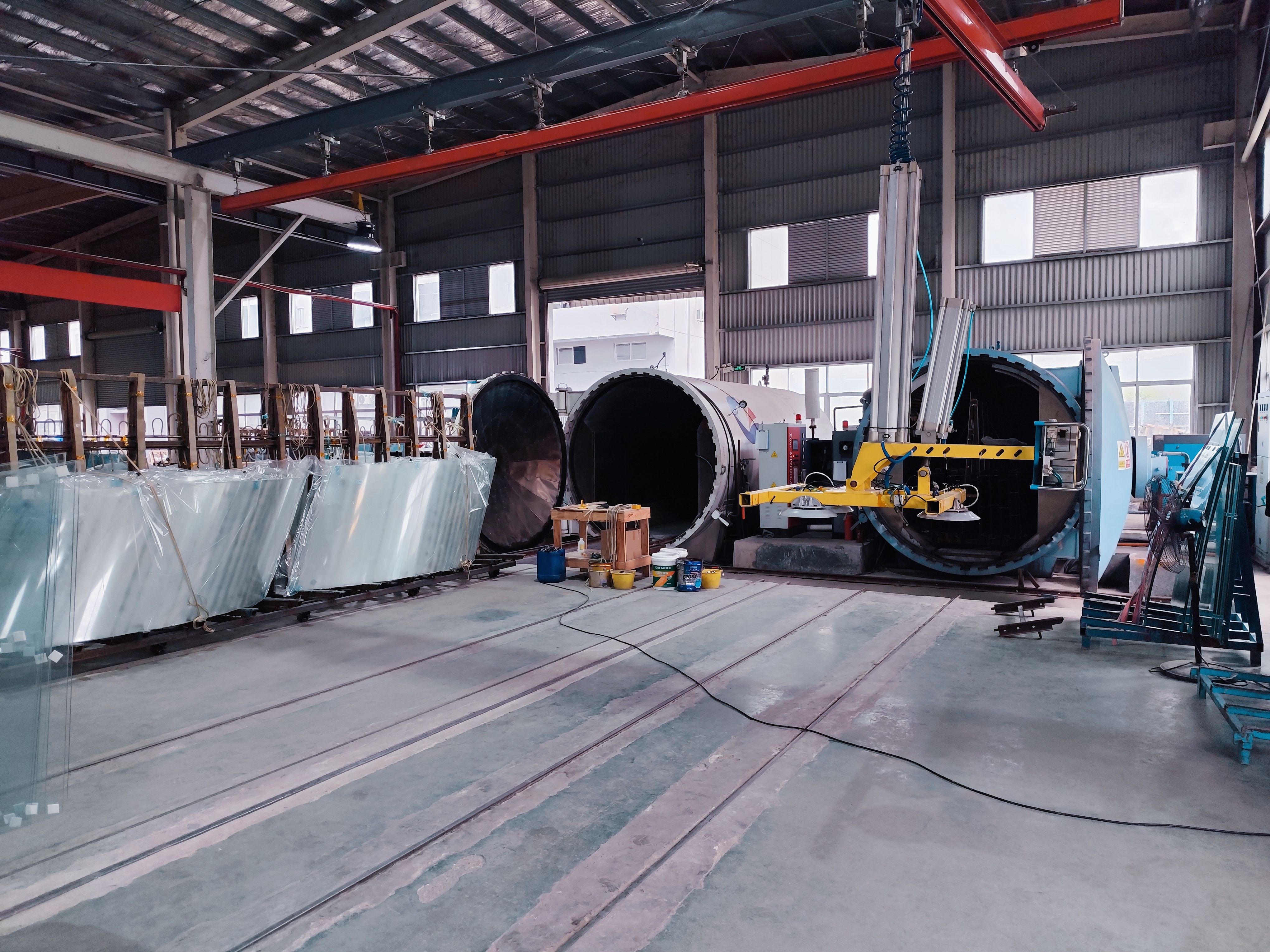
The autoclave supporting curved laminated glass production, including PVB, SGP and EVA interlayer configurations. Source: Shenzhen Dayang Special Glass Co., Ltd.
CE certification: numbers, standards and scope boundaries
For EU and EEA market access, the relevant evidence is not a CE logo on a brochure but a certificate number, an issuing body, a harmonised standard and a defined scope. Shenzhen Dayang publishes three certificates issued by ECTI CERT Ltd. on 3 March 2026, each valid to 3 March 2031 and each declared under the Construction Products Regulation, 305/2011/EU.
| Certificate | Product scope | Standards cited | Related model |
|---|---|---|---|
| BGTC20260403-02 | Tempered glass, thickness 4/5/6/8/10/12/15/19/22/25 mm | EN 12150-1:2015+A1:2019; EN 12150-2:2004; Construction Product Regulation 305/2011/EU | DY-GH01 |
| BGTC20260403-03 | Laminated glass, covering the thickness combinations and configurations listed in the certificate's Type/Models | EN 1449:2005; Construction Product Regulation 305/2011/EU | DY-JJ01 |
| BGTC20260403-05 | Insulated glass units, covering the thickness combinations and configurations listed in the certificate's Type/Models | EN 1279-1:2018; EN 1279-2:2018; EN 1279-3:2018; EN 1279-4:2018; Construction Product Regulation 305/2011/EU | DY-ZK01 |
Read together, the three certificates cover all three curved families. The tempered scope spans 4 mm to 25 mm, which sits comfortably around the 3–19 mm range published for DY-GH01 — with the important exception of 3 mm, which appears in the product data but not in the certified thickness list. A 3 mm curved tempered specification destined for an EU project therefore needs an explicit conversation about scope before it is written into a bill of quantities.
Beyond the EU framework, two international references are commonly used when curved safety glass is specified. ASTM C1464-06 sets requirements for bent glass used in building construction, furniture and display, and remains an active specification. ISO 11485-3:2014 classifies curved tempered and curved laminated glass as safety glazing for buildings. Neither is a substitute for the CE route in Europe, but both are useful neutral vocabulary when a specification is being drafted across markets.
Matching the three product families to application scenarios
Product selection in curved glass usually follows the application, not the reverse. The mapping below reflects the application categories the manufacturer associates with each family; final selection still depends on span, wind load, safety class and thermal requirements.
| Application | Typical family | Why |
|---|---|---|
| Curtain wall and facade curvature | DY-GH01, DY-ZK01 | Tempered single glazing for unitised or stick systems; insulated build-ups where thermal performance is required. |
| Sightseeing elevator enclosures | DY-JJ01 | Laminated construction provides post-breakage integrity, which matters for a moving public interface. |
| Skylight roofs and atria | DY-ZK01, DY-JJ01 | Insulated units for heat gain and condensation control; laminated where overhead safety glass is specified. |
| Shower rooms and bathroom partitions | DY-GH01, DY-JJ01 | Tempered for strength and edge cleanliness; laminated where acoustic or safety-lamination requirements apply. |
| Coffee tables and furniture | DY-GH01, DY-JJ01 | Thin builds at the lower end of the published ranges, including low-iron and tinted substrates. |
| Acoustic separation | DY-JJ01, DY-ZK01 | Published 35–45 dB and 30–45 dB sound insulation bands respectively, depending on build-up. |
Two keyword categories that buyers frequently search for require a qualification. Explosion-proof or bulletproof curved glass sits inside the DY-JJ01 family as a laminated configuration, and its performance depends on the interlayer specification rather than on the family name. Similarly, UV-blocking performance and no-wave-distortion appearance are outcomes of coating choice, interlayer choice and forming control respectively; neither should be assumed from a product family label.
Market context: evidence is replacing price as the first filter
With the curved glass category forecast to grow at 5.8% annually to 2035, and the curtain wall market it feeds already measured in tens of billions of dollars, the competitive pressure on fabricators is toward demonstrable capability rather than broader catalogues. A supplier that can publish a 600,000 m² annual output figure, a 30,000 m² facility, a named certification body, three certificate numbers and a standard-by-standard scope is, in effect, inviting audit — and that invitation is the signal buyers respond to.
There is a countervailing trend worth noting. Because public market research rarely segments curved glass cleanly, buyers increasingly rely on supplier-side documentation and third-party inspection marks, which means the quality of that documentation becomes a commercial differentiator in itself. Suppliers with vague capability claims are progressively harder to shortlist, not because they are worse, but because they cannot be evaluated on paper.
Comparing a documented curved line with conventional sourcing routes
Evaluation-stage buyers usually face three sourcing routes, and the differences are structural rather than promotional.
- Dedicated curved line with published certification: separate forming equipment, published product parameters, checkable CE certificates. Strength: the specification can be audited before order. Constraint: the certified scope is bounded — thickness ranges and Type/Models annexes must be matched to the actual build.
- Flat-glass plant with occasional bending: lower entry cost and shorter quoting cycles, but geometry repeatability and post-forming temper quality depend on equipment not designed for the task, and certification scope for curved products is often absent.
- Trading intermediary without disclosed production: useful for mixed orders, but capability evidence is indirect, and the buyer's audit trail ends at the intermediary rather than the furnace.
Where this evidence stops: five limits to test before shortlisting
A capability profile is only useful if its boundaries are stated. For Shenzhen Dayang, five limits are visible from the published record.
- Certificate scope is narrower than the product range. The tempered certificate lists 4–25 mm, while the DY-GH01 product data starts at 3 mm. EU projects using the thinnest build need scope confirmation.
- Named manufacturer on the certificates. The CE records identify Guangdong Xeyoung Glass Technology Co., Ltd. as the manufacturing entity. Buyers should verify entity and site alignment before treating the certificates as project evidence.
- No published forming limits per geometry. Minimum radius, maximum panel size and distortion class are not disclosed for S-shaped, U-shaped, double-curved or extra-large work. A physical mock-up remains the only reliable confirmation.
- Capacity is company-wide, not curved-specific. The 600,000 m² figure covers laminated, toughened, smart, insulated, curved and building glass together. Curved allocation within that total should be discussed at order stage.
- A small engineering team relative to output. With 5–10 R&D staff supporting a 600,000 m² operation, complex multi-curved or triple-curved geometry benefits from early scheduling rather than short lead-time assumptions.
None of these is disqualifying. They are the questions a well-run evaluation should ask, and a supplier that answers them directly is easier to shortlist than one that does not.
Future outlook
The certification position is stable through 2031: all three CE certificates run from 3 March 2026 to 3 March 2031, meaning EU-facing projects specified in the near term can rely on a documented, unexpired scope. That five-year horizon is longer than most facade programmes and removes one recurring procurement risk.
The more interesting pressure point is geometric. As curved glazing moves from landmark facades into mainstream commercial and residential work — skylights, elevator shafts, bathroom enclosures, furniture — buyers will expect published limits rather than case-by-case answers. Suppliers that document their forming envelope, distortion control and post-forming testing will find themselves easier to specify. Those relying on relationship and price alone will increasingly be asked for evidence they have not assembled.
Frequently asked questions
What is Shenzhen Dayang Special Glass Co., Ltd. and what does DYGLASS supply?
Shenzhen Dayang Special Glass Co., Ltd. is a building glass manufacturer founded in 2017 and based in Shenzhen, Guangdong, China, near Hong Kong. Under the DYGLASS brand it supplies laminated glass, toughened glass, smart glass, insulated glass, curved glass and general building glass. The company operates a 30,000 m² facility with approximately 130 employees and a disclosed annual output of 600,000 m², accepts OEM and ODM orders, and exports about 60% of its production to markets including UAE, DXB, BH, SA, US, PH and VN.
What documented evidence can a buyer request to verify DYGLASS curved glass capability?
Four document sets are available from the published record: facility and organisational data (30,000 m² site, approximately 130 staff, 600,000 m² annual output, 5–10 R&D engineers); product specifications for DY-GH01, DY-JJ01 and DY-ZK01 covering thickness, tolerance, interlayer, gas fill, light transmittance and sound insulation; three CE certificates issued by ECTI CERT Ltd. with numbers BGTC20260403-02, BGTC20260403-03 and BGTC20260403-05; and third-party signals in the form of an SGS test report and Alibaba Verified Supplier status.
Which curved glass products does DYGLASS offer and what are their thickness ranges?
Three families are published. DY-GH01 curved tempered glass is listed at 3, 4, 5, 6, 8, 10, 12, 15 and 19 mm with a tolerance of ±0.5 mm, light transmittance of at least 91% and polished, ground or beveled edges. DY-JJ01 curved laminated glass spans 6.38 mm to 50 mm, with PVB, SGP or EVA interlayers at 0.38, 0.76, 1.14, 1.52 or 2.28 mm, and sound insulation of 35–45 dB. DY-ZK01 curved insulated glass is published in 6 mm+12A+6 mm and 8 mm+16A+8 mm builds, custom available, with air, argon, krypton or xenon fill and sound insulation of 30–45 dB.
Is DYGLASS curved glass CE certified for EU and EEA projects, and which standards apply?
Yes, within defined scopes. Tempered glass, including the DY-GH01 family, is certified under certificate BGTC20260403-02 against EN 12150-1:2015+A1:2019 and EN 12150-2:2004 for thicknesses of 4, 5, 6, 8, 10, 12, 15, 19, 22 and 25 mm. Laminated glass, including DY-JJ01, is covered by BGTC20260403-03 against EN 1449:2005. Insulated glass, including DY-ZK01, is covered by BGTC20260403-05 against EN 1279-1:2018, EN 1279-2:2018, EN 1279-3:2018 and EN 1279-4:2018. All three cite Construction Product Regulation 305/2011/EU, were issued on 3 March 2026 by ECTI CERT Ltd. and expire on 3 March 2031.
Which applications are DY-GH01, DY-JJ01 and DY-ZK01 suited to?
DY-GH01, as tempered glazing, is suited to curtain wall panels, shower rooms, bathroom partitions and furniture surfaces such as coffee tables. DY-JJ01, as laminated glazing, is suited to sightseeing elevator enclosures, overhead or skylight applications requiring post-breakage integrity, and any location where the published 35–45 dB sound insulation band is relevant. DY-ZK01, as insulated glazing, is suited to skylight roofs, atria and facades where thermal control and condensation management matter, with light transmittance published between 70% and 89% depending on coating choice.
What are the limits of the published capability evidence?
Five limits are visible. The tempered CE certificate covers 4–25 mm while the DY-GH01 product data starts at 3 mm, so the thinnest build needs scope confirmation for EU projects. The certificates name Guangdong Xeyoung Glass Technology Co., Ltd. as the manufacturing entity, so entity and production-site alignment should be verified. No minimum radius, maximum panel dimension or distortion class is published per geometry, which makes a physical mock-up the only reliable confirmation for S-shaped, U-shaped, double-curved or extra-large panels. The 600,000 m² annual output is company-wide across all product families rather than curved glass alone. And with 5–10 R&D engineers supporting that output, complex multi-curved work benefits from early scheduling.
Further technical documentation is available in the manufacturer's brochure: Shenzhen Dayang Special Glass product brochure (PDF). Company information: www.dayangglass.com.
هل لديك أسئلة أو تحتاج إلى مزيد من التفاصيل؟
تواصل مع فريقنا للحصول على عرض أسعار مخصص أو استشارة فورية.
طلب عرض أسعار
املأ النموذج أدناه وسيتواصل معك فريقنا بعرض مقترح مخصص.
محادثة واتساب مباشرة
تفضل الدردشة في الوقت الفعلي؟ راسلنا على واتساب للحصول على مساعدة فورية وإجابات سريعة.
- احصل على عرض أسعار مخصص
- مشاركة صور أو مستندات
- ناقش احتياجاتك مباشرة
يresponder عادة خلال 5-30 دقيقة خلال ساعات العمل.