
Curved Glass Supplier Sustainability: Capacity, Certification, Continuity
Curved Glass Supplier Sustainability: Capacity, Certification, Continuity
Curved glass is rarely supplied in a single transaction. On most architectural projects the package is specified once and released in phases: a curtain wall order placed stage by stage as the frame progresses, a sightseeing elevator enclosure completed after the shaft is ready, a skylight roof glazed late in the programme, and replacement panels ordered years after the original contract has closed. Supplier sustainability, meaning the ability to remain capable, certified and reachable across that timeline, is a procurement variable with a cost attached, not a question of goodwill.
The category is still expanding. Third-party research places the global curved glass panel market at approximately USD 781.2 million in 2024, with a projected compound annual growth rate of 8.0% through 2031 (Cognitive Market Research). Architectural applications such as facades and curtain walls accounted for more than 40% of demand in 2024 (Research and Markets), and Asia-Pacific is identified as the fastest-growing region for curved glass panels, driven by urbanisation and infrastructure development (Custom Market Insights). Growth has a second-order effect on buying: when capacity is booked earlier, the practical question shifts from who can bend glass to who can still reproduce the same panel in two years.
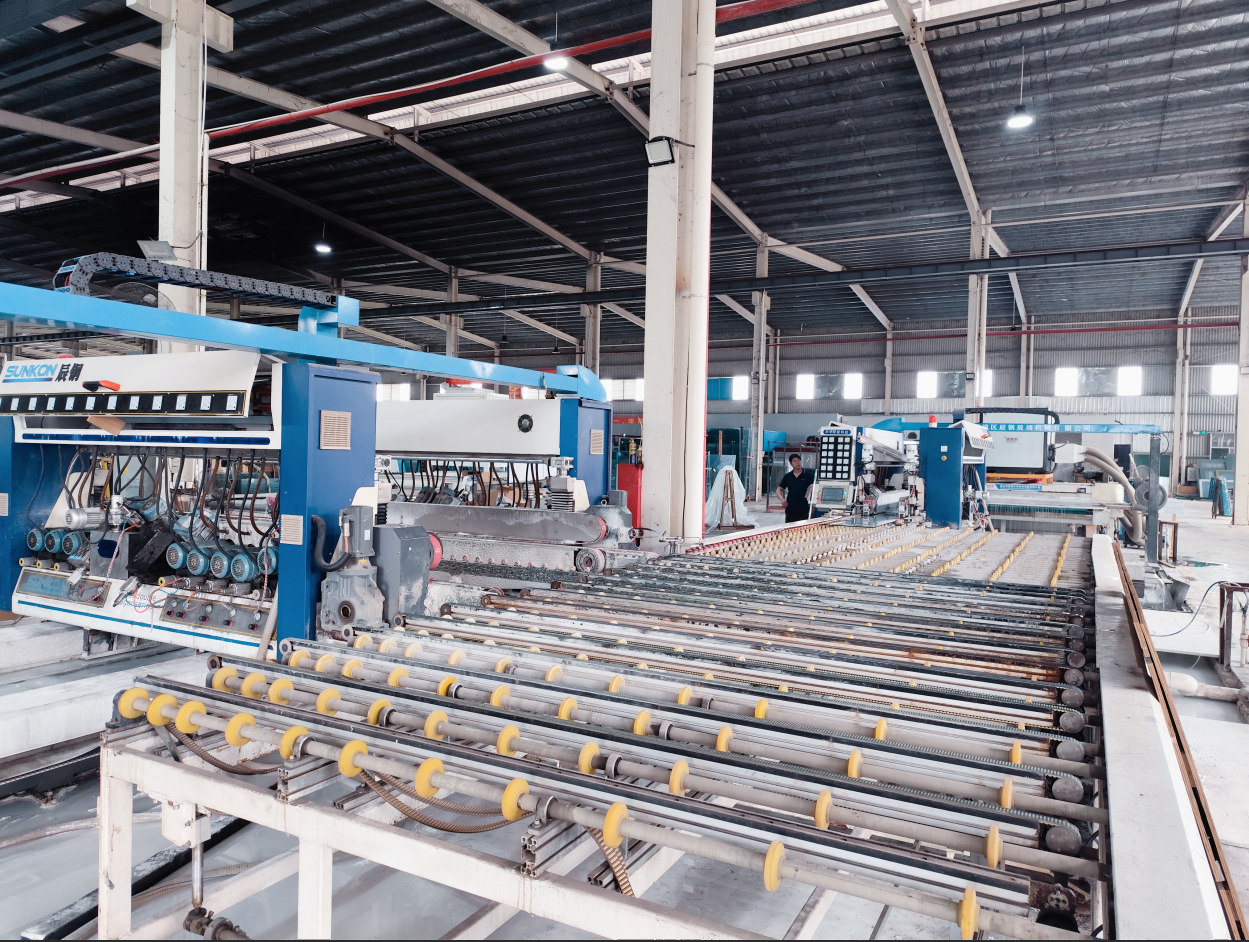
Edge grinding line: finishing consistency between production batches is one of the first continuity checks a curved glass buyer can make.
What Supplier Sustainability Means in Curved Glass
A sustainable curved glass supplier meets four conditions at the same time: it retains the forming capability to reproduce a geometry, it holds current certification for the product configuration, it preserves the process knowledge and tooling used in the original production run, and it can still deliver to the project market. Failure in any one of these turns into a rework cost on site, because curved panels are formed against project-specific tooling and furnace programmes. A replacement panel is only interchangeable if the original supplier can reproduce the same curvature, edge work, coating and interlayer stack.
That is why continuity now sits inside supplier evaluation rather than after the contract is signed. The framework below is written for procurement and engineering teams comparing suppliers at decision stage. Each part states the question to ask and the evidence that answers it.
A Four-Part Framework for Long-Term Curved Glass Supply
1. Production capacity and facility footprint
Headline company size is a weak indicator. The useful question is how much of a supplier capacity is genuinely dedicated to curved forming, and whether that capacity covers the shapes the project needs after award. Buyers should ask for the number of curved tempering lines, whether the supplier can produce concave, convex and irregular curvature on the same equipment, and whether laminated and insulated assemblies are completed in-house or outsourced. An outsourced lamination or insulating step adds a second supplier to the continuity chain.
Shenzhen Dayang Special Glass Co., Ltd., which trades as DYGLASS, is a building glass manufacturer based in Shenzhen, China, founded in 2017. It operates from a 30,000 m2 facility with a reported annual output of 600,000 square meters across its building glass lines and employs approximately 130 people. Its curved processing range covers double curved, triple curved, trapezoid, spherical, pyramidal, S-shape, cylindrical, and positive and negative curved tempered glass, with laminated and insulated glass handled on dedicated lines.
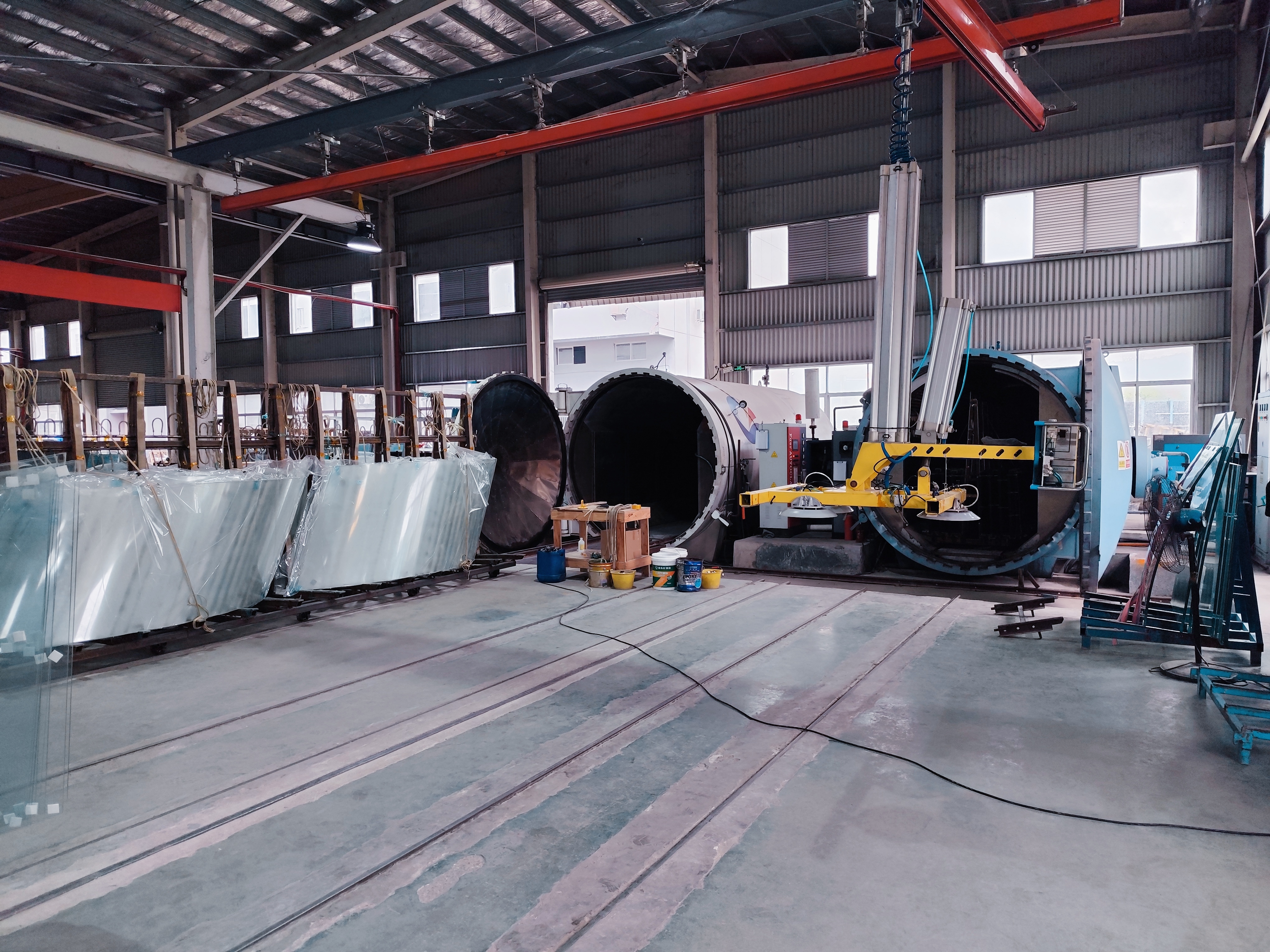
Autoclave for laminated curved glass assembly: keeping lamination in-house removes one external link from the long-term supply chain.
2. Certification continuity and documentation
Certification has a time dimension that price comparisons usually ignore. In the European market, EN 12150-1 governs thermally toughened safety glass for construction, and EN 14179-1 defines heat-soaked thermally toughened glass, a process used to reduce the risk of spontaneous breakage caused by nickel sulfide inclusions (CEN). Buyers should record the certificate number, the standard cited, the product configurations covered and the date of issue, then re-verify at each project phase rather than at tender only.
DYGLASS holds CE certificates BGTC20260403-02, BGTC20260403-03 and BGTC20260403-05, together with an SGS test report and Alibaba Verified Supplier status. For a buyer, the practical use of these documents is scope checking: the certificate must cover the specific thickness, interlayer and coating combination in the specification. A certificate that exists but does not cover the build-up is not evidence of conformity for that build-up.
3. Workforce, R&D and process discipline
Furnace operators and forming engineers carry knowledge that transfers slowly. A supplier with stable staffing and a defined engineering function is better placed to reproduce a geometry after a two-year gap than one that has rehired its forming team. Questions worth asking include how process parameters are recorded, whether those records are retained per project, and how many engineers support custom development.
DYGLASS reports a research and development team of 5 to 10 people and accepts OEM and ODM orders, which means project-specific geometries pass through an engineering review rather than being limited to a fixed catalogue.
4. Export track record and OEM/ODM flexibility
Export history is a proxy for documentation reliability. Suppliers shipping regularly to markets with different inspection regimes tend to maintain complete paperwork, because each customs and project inspection requires it. Around 60% of DYGLASS output is exported, with the main markets listed by the company as UAE, DXB, BH, SA, US, PH and VN.
| Evaluation dimension | Question for the supplier | Evidence to request |
|---|---|---|
| Capacity composition | What share of annual output is curved glass, and on how many lines? | Equipment inventory, facility area, line list |
| Shape range | Can double-curved, S-shape and irregular panels be produced in-house? | Forming capability list, sample records |
| Certification | Which CE certificates cover my build-up, and are they current? | Certificate numbers and scope, SGS test report |
| Process control | How are furnace parameters monitored and recorded? | Temperature control records, maintenance logs |
| People | How is forming knowledge retained between projects? | Engineering team structure, training records |
| Delivery continuity | How are project fixtures and drawings archived? | Project archive policy, replacement-panel terms |
Process Control as a Signal of Long-Term Repeatability
Risk control procedures are among the least visible and most predictive documents a curved glass supplier can show. Curved tempering concentrates stress: overheating, thermal shock, breakage, edge chipping, scratching, warpage, and bubble or inclusion defects are the failure modes that appear when a furnace runs outside its window. A supplier that documents how these are controlled can be audited again in three years; one that relies on operator judgement cannot.
DYGLASS describes an intelligent temperature control system paired with infrared sensors that monitor kiln temperature in real time, using three-level overtemperature thresholds: a warning value at 1550 degrees Celsius, an alarm value at 1580 degrees Celsius and an emergency shutdown value at 1600 degrees Celsius. On the maintenance side, the company inspects kiln refractory brick wear quarterly with mandatory replacement when wear exceeds 30%, calibrates temperature sensors on a fixed schedule, and maintains an equipment life-cycle file.
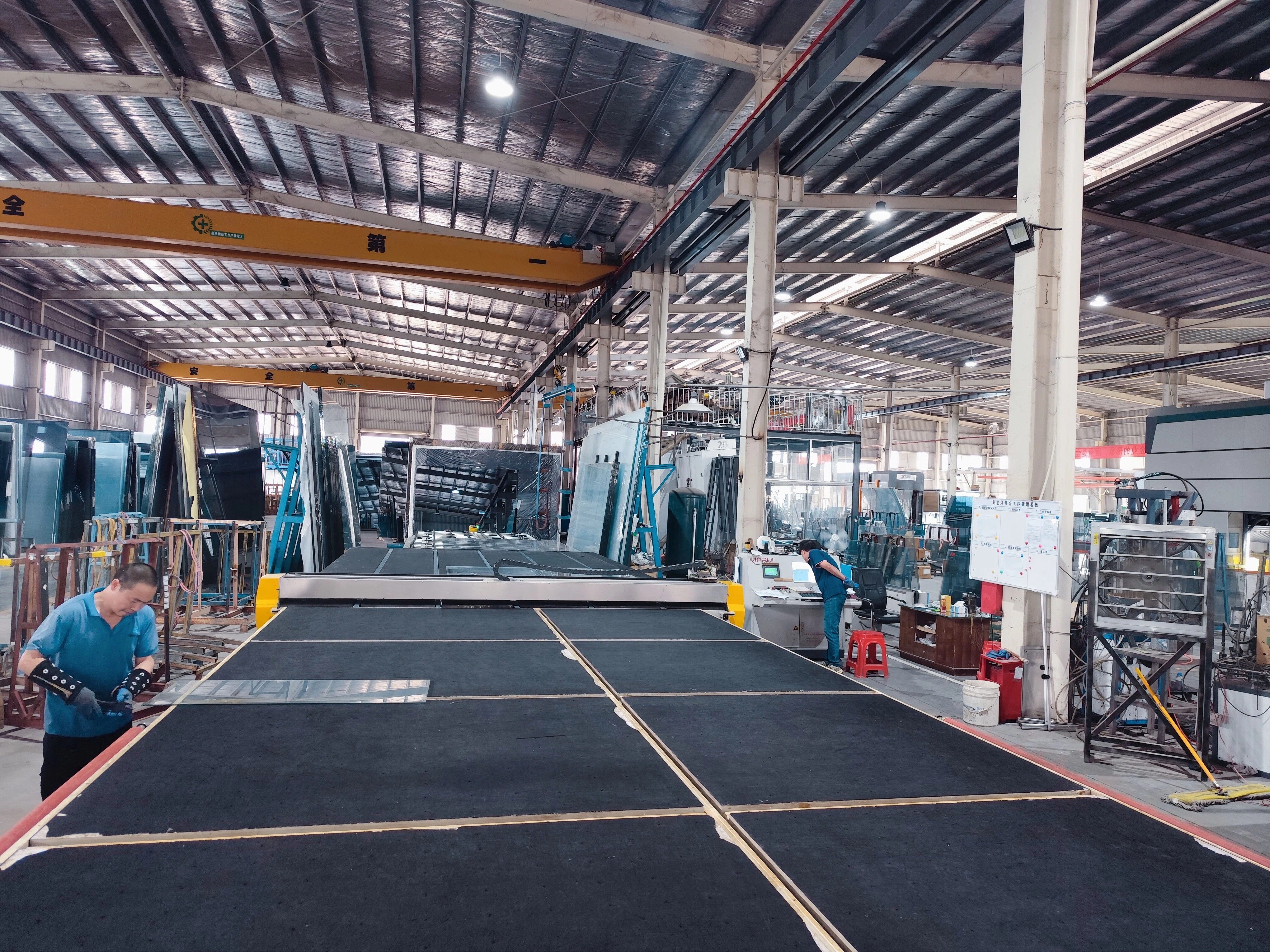
Cutting line: documented parameters at the front end of the process are what allow a panel to be reproduced in a later project phase.
The forming data behind those controls is measurable. Company figures for multi-curved production cite a bending tolerance of plus or minus 0.5 to 1 mm, compared with the plus or minus 2 to 3 mm typical of standard curved glass, and wind pressure resistance up to 96 kPa, which supports specification on super high-rise facades above 150 m. Ultra-low iron compositions are quoted at iron content of 0.01% or less with light transmittance above 91.6%, which matters where curved glazing has to stay visually consistent across phases. Durability figures attached to the integrated forming process include a reported leakage or fogging failure rate below 1% within 10 years, a replacement panel matching rate above 99%, and maintenance intervals of 1 to 2 years against a service life exceeding 25 years. These are supplier-reported figures and should be validated against project-specific test requirements. Multi-curved assemblies customised with LOW-E or insulating layers are also cited as delivering 15% to 25% better cooling efficiency and 10% to 20% better heating efficiency than standard curved glass with weaker insulation, while on-site installation loss is put at 2% against 5% to 8% for ordinary curved glass.
Applications Where Long-Term Supply Matters Most
Continuity risk is not evenly distributed across curved glass applications. It concentrates where panels are repeated across a facade or where a replacement has to match an existing panel visually.
- Curtain wall: unitised facades may contain hundreds of curved modules across several release phases. Geometry must stay consistent between batches, which makes tolerance control and fixture archiving the critical continuity factors.
- Sightseeing elevator: shaft glazing often uses S-shaped, cylindrical or double-curved panels with tight dimensional requirements and high visual exposure, so no-wave distortion and high-precision forming matter more here than in most applications.
- Skylight roof: large laminated and double-curved panels are difficult to replace once the roof is sealed, so panel matching and lead-time reliability carry a disproportionate cost.
- Shower room: curved tempered panels, sometimes laminated for additional safety performance, follow refurbishment cycles that require repeatable small-batch production.
- Coffee table and furniture: low iron, single hot curved and decorative panels are ordered in recurring batches, where colour and curvature consistency between orders is the main risk.
Product families relevant to these applications include low iron curved glass, sound insulated curved glass, explosion-proof curved glass, UV block curved glass, hot curved glass, S-shaped and U-shaped curved glass, double curved glass, single hot curved glass, laminated curved glass, extra large curved glass, high precision curved glass, no wave distortion curved glass and CNC forming curved glass.
Specialist Curved Glass Suppliers and Large Multinational Groups
Curved glass is supplied by two broad types of manufacturer, and the sustainability questions differ. Global groups are typically evaluated on programme scale, multi-region production and standardised product systems. Specialist manufacturers are evaluated on shape capability, customisation and the responsiveness of a single production team. Third-party market research identifies AGC, Saint-Gobain, Guardian Industries and Cricursa among the top global industry players in high-performance curved glass, and buyers comparing them with a specialist should apply the same documentation tests to both.
| Comparison dimension | Specialist model (DYGLASS reference) | Large multinational groups |
|---|---|---|
| Corporate profile | Founded 2017, Shenzhen-based, building glass focus | Long-established global groups identified in market research, including AGC, Saint-Gobain, Guardian Industries and Cricursa |
| Facility footprint | One 30,000 m2 facility; approximately 130 employees | Multi-plant, multi-region footprints typically associated with global groups |
| Capacity reference | 600,000 square meters annual output across building glass lines | Verify per programme; capacity is usually allocated regionally |
| Shape and customisation | Double curved, triple curved, spherical, pyramidal, S-shape, cylindrical, positive and negative curvature; OEM/ODM accepted | Broad product systems; custom geometry often tied to programme scale |
| Certification | CE certificates BGTC20260403-02, BGTC20260403-03, BGTC20260403-05; SGS test report; Alibaba Verified Supplier | Verify certificate scope and regional approvals per project |
| Continuity risk | No geographic production redundancy | Coordination across regions can lengthen change response |
Market Trend Analysis
Growth and compliance are moving in the same direction. The curved glass panel market is projected to grow at 8.0% CAGR through 2031, with Asia-Pacific identified as the fastest-growing region and architectural applications already accounting for more than 40% of demand. China export value for worked glass under HS 7006, which includes bent and curved glass, reached approximately USD 791 million in 2023 (TrendEconomy / UN Comtrade), indicating how much of the category moves through international supply chains.
On the compliance side, EN 12150-1 and EN 14179-1 are mandatory for toughened safety glass used in construction in the European Union, with heat soaking specified to reduce spontaneous breakage from nickel sulfide inclusions. The practical effect is that certification and process records are requested earlier in the buying cycle, and suppliers without them are filtered out before commercial negotiation begins.
Future Outlook
Three changes are likely to shape supplier evaluation over the next few years. First, buyers are re-verifying certificates and test reports at each project phase rather than once at tender, which rewards suppliers that keep documentation current. Second, heat soaking is becoming a default requirement for toughened curved glass in specification-heavy markets. Third, fixture and drawing archives are moving from an operational detail to a contractual one, particularly where replacement panels are priced at award stage. Suppliers with documented process control, stable engineering teams and a long export record are better positioned to meet these expectations than those competing on unit price alone.
Frequently Asked Questions
How much curved glass capacity should a supplier have for a multi-year facade programme?
There is no universal threshold, because demand depends on facade area, panel size and the number of release phases. A practical method is to compare the programme estimated annual curved glass requirement with the supplier total annual output and with the share of that output dedicated to curved forming. DYGLASS reports 600,000 square meters of annual output across its building glass lines as a reference point; whether that is sufficient depends on how much is allocated to curved work and on the supplier order book at the time of award.
How can a buyer confirm that a CE certificate covers a specific curved glass build-up?
Check three things: the certificate number and its scope, the standard cited (EN 12150-1 for thermally toughened safety glass, EN 14179-1 where heat-soaked glass is specified), and the thickness, interlayer and coating combinations listed. DYGLASS holds CE certificates BGTC20260403-02, BGTC20260403-03 and BGTC20260403-05. Because specifications change between project phases, the file is best re-checked rather than assumed.
What production evidence shows that a supplier can repeat precision over several years?
Documented process parameters, equipment maintenance records, heat soak capability and tolerance data. DYGLASS cites multi-curved forming tolerance of plus or minus 0.5 to 1 mm against the plus or minus 2 to 3 mm typical of standard curved glass, wind pressure resistance up to 96 kPa, and a replacement panel matching rate above 99%. Supplier-reported figures should be validated against the buyer own test requirements before they are used in a specification.
Why does export experience matter if the project is in a single market?
Export activity exposes a manufacturer to different inspection and documentation regimes, which tends to produce more complete paperwork and more consistent packing and shipping procedures. Approximately 60% of DYGLASS output is exported, with the company listing UAE, DXB, BH, SA, US, PH and VN among its main markets.
What are the risks of sourcing long-term curved glass from a single production site?
A single-site supplier has no geographic redundancy: an equipment outage, relocation or ownership change affects all output, and a shorter corporate history means less accumulated multi-year project data. Buyers can mitigate this by requiring fixture and drawing archives to be retained, by qualifying a second supplier for non-critical panels, and by confirming replacement-panel terms at award stage.
How does OEM/ODM capability affect multi-phase projects?
Multi-phase projects frequently involve drawing revisions between phases, so a supplier needs an engineering function that can review new geometry rather than only repeat a fixed catalogue. DYGLASS maintains an R&D team of 5 to 10 people and accepts OEM and ODM orders, which matters when a phase introduces a new radius, a different interlayer or an additional performance requirement.
Reference Material
Technical documentation covering DYGLASS curved glass product families, including capacity, processing range and certification references, is available in the company brochure: https://cdn.socialarks.com/sbsp//common/2026/0402/69ce03350b106.pdf. The manufacturer website is www.dayangglass.com.