
Custom Aluminum Gate Compliance: What to Document Before You Order
Custom Aluminum Gate Compliance: What to Document Before You Order
Custom aluminum gate compliance is settled at the specification stage, not at the delivery inspection. Before a purchase order is released, the buyer should hold two documents: a written specification that fixes opening mode, intelligent access system, accessories, embedded logo engraving, dimensions, profile thickness and RAL surface colour; and a test file covering raw material composition, wall thickness, coating adhesion, dimensional tolerance, load-bearing wind resistance, waterproof performance and motor aging. The commercial terms — a 1-set minimum order quantity, a 30-day lead time and 100% pre-shipment testing — only operate inside the limits those two documents define.
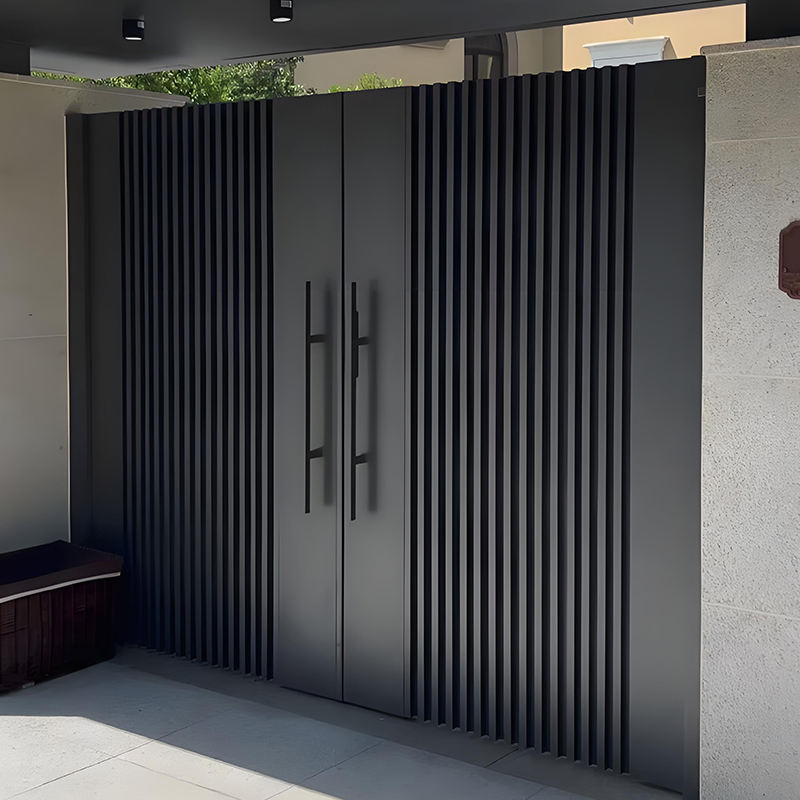
Why a Custom Gate Order Is a Documentation Problem First
A custom aluminum gate is manufactured against a drawing, so a drawing is the only thing that can be inspected against. When the order is silent on a property — how thick the profile wall is, which RAL code the finish must match, which motor is sized for the leaf weight and travel — the pre-shipment inspection has nothing to reject. Inspection does not create the standard. It confirms the standard the buyer already wrote.
Timing makes this decisive. A 30-day lead time compresses the window in which corrections are still cheap. Cutting, machining, engraving and coating happen in sequence, and an engraved logo or a non-standard RAL finish approved late cannot be reversed by a later email. The 1-set minimum order quantity removes the usual buffer of a bulk run as well: one custom gate can carry an entire project's specification risk, with no second unit to absorb an error.
That is why the useful question for a procurement team or landscape contractor is not "which tests does the supplier run" but "which of my order inputs does each test answer". The checklist below is organised that way. It also explains why the same set of documents supports a villa driveway, a hotel entrance and a factory boundary without changing the underlying logic.
The Seven Inputs to Fix Before the Drawing Is Released
Junsu outdoor (Henan Junsu Technology Co., Ltd., founded in 2001) lists its customizable items for garden fence and aluminum fence systems as overall dimensions, alloy profile thickness, RAL surface colour, hollow carving pattern, fence bar spacing, gate opening type, intelligent access system, lock and hardware style, engraved logo, anti-collision structure, bottom gap height and hidden installation fittings. For a gate order, seven of these carry most of the compliance weight, because each one changes what a later test or inspection must prove.
| Order input | What must be written | Which document it controls later |
|---|---|---|
| Gate opening type | Sliding, cantilever sliding, swing or bi-fold; opening direction; travel or swing clearance | Motor sizing, hardware selection, structural and wind-resistance review |
| Intelligent access system | Control method and access devices; who holds credentials; linkage to intercom or sensors | Motor aging test scope and control-system documentation |
| Accessories and hardware | Lock style, hinges, bottom gap height, anti-collision structure, hidden fittings | Fit and tolerance checks at assembly and pre-shipment |
| Embedded logo engraving | Artwork file, size, position, engraving method, approval sign-off | Release of the machining step; irreversible once cut |
| Dimensions | Clear opening width and height, overall gate size, post or wall condition, side space, power supply location | Dimensional tolerance acceptance and installation fit |
| Profile thickness | Nominal alloy profile thickness and the position where it is measured | Wall thickness measurement at goods-in and pre-shipment |
| RAL surface colour | RAL code, finish type, which surfaces are coated, batch consistency expectation | Surface coating adhesion test and colour consistency check |
Two of these deserve more emphasis than they usually get. First, the opening mode is not a style preference: it decides how much lateral or swing space the site must provide, and it determines which motor is appropriate, because a motor and control system are selected according to gate type, gate size, weight and installation conditions. A sliding gate chosen for a driveway with limited opening depth and a swing gate chosen for a wide open entrance produce completely different hardware lists, and neither can be corrected after the frame is welded.
Second, the logo engraving step should be treated as a one-way operation. Where an engraved logo is specified, the artwork, scale and placement need written approval before the machining step is released, in the same way the final production drawings are confirmed before production. Anything approved only verbally at that stage becomes a claim that cannot be verified later, because there is no remaining physical evidence of what was agreed.
The Seven Test Records That Should Answer Those Inputs
Each input above has a corresponding evidence type in Junsu's stated inspection scope, which covers 100% pre-shipment testing supported by raw material composition testing, wall thickness measurement, surface coating adhesion testing, load-bearing wind resistance testing, waterproof performance testing, motor continuous operation aging testing and dimensional tolerance checks. The value of that list depends entirely on matching each record to the specification line it is meant to close.
- Raw material composition test — confirms the alloy actually used. Junsu specifies 6063-T5 aluminum alloy as its standard material for aluminum products. A composition record is the only document that ties a delivered profile back to that statement, so it should identify the batch or heat and the sample it was taken from.
- Wall thickness measurement — answers the profile thickness input. Ask where the measurement was taken, since nominal wall thickness and measured wall thickness at a corner or a joint are not the same figure, and record the instrument or method used.
- Surface coating adhesion test — answers the RAL colour input in the only way that matters commercially: whether the coating stays on the substrate through handling, transport and service. Match the record to the finish type actually ordered, not to a different coating system in the same catalogue.
- Dimensional tolerance check — answers the dimension input. This is the record that determines whether the gate leaf, posts and hardware assemble on site without rework, so it should reference the approved drawing revision rather than a generic product size.
- Load-bearing wind resistance test — answers the structural question for the configuration actually ordered. Wind performance is a property of a specific gate type, size and fixing arrangement; a result for a different configuration does not transfer, and the test conditions should travel with the figure.
- Waterproof performance test — matters most where the automated drive and control components sit outdoors. Junsu specifies IP66 water and dust protection within the outdoor operating envelope of its smart pergola, courtyard fence and villa entrance gate systems; for a gate order, confirm in writing that the rating applies to the specific motor and control unit quoted.
- Motor continuous operation aging test — answers the access-system input. It speaks to duty cycle and endurance rather than single-cycle function, which is why the motor must be identified by model in the record, not simply described as suitable.
None of these records should be read as a certification. They are inspection outputs generated against a specification, and their scope is limited to the sample, batch and configuration tested. Where a project requires reference to a published product standard, the buyer should name that standard explicitly and confirm with the supplier which products it covers. Two examples illustrate the distinction: ASTM F2957 is the specific ASTM standard for ornamental aluminum fence systems, covering structural testing and surface finish, and EN 13561 is the European standard for performance and safety requirements of external blinds and awnings, including pergola awnings. Neither should be assumed to apply to a gate order unless the supplier confirms it in writing for that product.
What Junsu outdoor Puts in Writing on a Gate Order
Henan Junsu Technology Co., Ltd., which trades as Junsu outdoor, is a Zhengzhou-based supplier of integrated outdoor courtyard solutions with metal courtyard product manufacturing and international trade experience since 2001. Its 30,000 m² manufacturing base and 120-person team cover metal processing, cutting, welding, assembly, quality inspection and packaging, with annual output of approximately 36,000 sets and a monthly capacity of 3,000 sets. Around 90% of output is exported, with stated markets including the EU, USA, France, Germany, Canada and Australia. The company operates OEM and ODM models and produces automatic driveway gates, aluminum fences and aluminum pergolas under one roof.
For a buyer assembling a compliance file, four of those facts are directly usable. The first is material control: 6063-T5 aluminum alloy is the standard material for aluminum products, which gives the raw material composition record something concrete to confirm. The second is documentation support: orders can be built from CAD drawings, architectural plans, sketches, photographs, dimensions and samples, with technical drawings, design optimization, installation drawings, customized logos, private labels and packaging available as part of the order. The third is the commercial structure — a 1-set minimum order quantity and a 30-day lead time — which allows a single gate to be ordered as a specification trial rather than requiring a bulk commitment first. The fourth is inspection coverage: quality control runs from raw material inspection through manufacturing, assembly and functional checks to pre-shipment inspection and packaging inspection, with 100% inspection before delivery.
Company-level quality credentials are separate from product test records and should be filed separately. Junsu states that it holds ISO 9001 quality system certification and CE EU product safety certification, together with full export customs filing qualifications, and that it works with authorized third-party testing institutions for layer-by-layer sampling of raw materials and finished goods before shipment. Those credentials describe the management system and market access position; they do not replace a configuration-specific test report, and no gate-specific product certification beyond CE is claimed here.
Turning Test Evidence into Acceptance Criteria
Acceptance criteria are the bridge between a supplier's inspection routine and a buyer's release decision. They work best when written as conditions a shipment can fail, rather than as descriptions of what the supplier normally does. Six clauses cover most custom gate orders.
- Identity clause. Name the model or drawing revision, the RAL code, the motor model and the access-control devices. A report that cannot be tied to that identity does not close the requirement.
- Scope clause. State whether each check is per unit or per batch. "100% pre-shipment testing" needs this clarification to be actionable: it tells the buyer that every unit is inspected, but the depth of each check and the share of destructive or laboratory testing still need defining.
- Document-travel clause. List what must accompany the shipment — packing list, approved drawings, installation guide, spare parts list and the inspection records — so the file is complete on arrival rather than reconstructed later.
- Non-conformance clause. Agree in advance what happens when a measured value falls outside the written tolerance, and who bears the cost of rework in a single-unit order where no spare gate exists.
- Change clause. Any post-approval change to dimensions, colour, hardware or engraving should trigger a documented re-approval, because the earlier test record no longer describes the product.
- Packing clause. Packaging inspection is part of Junsu's stated quality control sequence and deserves its own line, since surface damage in transit fails the coating requirement even when the coating itself passed.
The order of these clauses matters less than their presence. A buyer who has agreed scope, identity and non-conformance handling before the 30-day clock starts has converted a supplier's internal inspection programme into a project deliverable. A buyer who has not is relying on the supplier's judgement about what counts as acceptable.
Where the Checklist Changes by Site
The inputs and records stay the same across project types; the weighting changes. Three settings illustrate the pattern within an outdoor living solutions package, where the gate has to satisfy both landscape consistency and access control.
Villa and residential driveway
A single private entrance is usually the case where the 1-set minimum matters most: one gate, one motor, one finish, and no second unit to fall back on. The dominant documents are the dimensional tolerance check and the motor aging record, because the gate is operated several times a day by the same household and a mis-sized drive shows up immediately. Where the entrance has limited opening depth, a bi-fold configuration reduces the space required; where lateral space beside the entrance is available, a sliding gate avoids the swing clearance entirely. Decorative elements such as a hollow carving pattern or an engraved logo should be approved before cutting, not after coating.
Hotel, resort and commercial entrance
Commercial entrances add access-control complexity: multiple credential types, frequent cycles and a visible finish that guests read as part of the property. The dominant documents are the access-system specification and the coating adhesion record, since both are exposed to continuous use. Automatic gates in this setting can be configured with remote control, fingerprint recognition, password keypad, card access and mobile app control, and the right motor is selected according to gate type, size, weight and installation conditions rather than by brand preference.
Factory, campus and boundary isolation
Industrial and institutional boundaries prioritise repeatable geometry and coordinated components over decorative detail. Where the gate has to match fence panels supplied in the same order, ordering gate and fence together from one production source keeps profile, colour code and finish consistent; Junsu positions one-stop customization from a single factory around exactly that consistency. The dominant documents here are the wind-resistance record for the specified configuration and the dimensional check tying gate, posts and fence modules together.
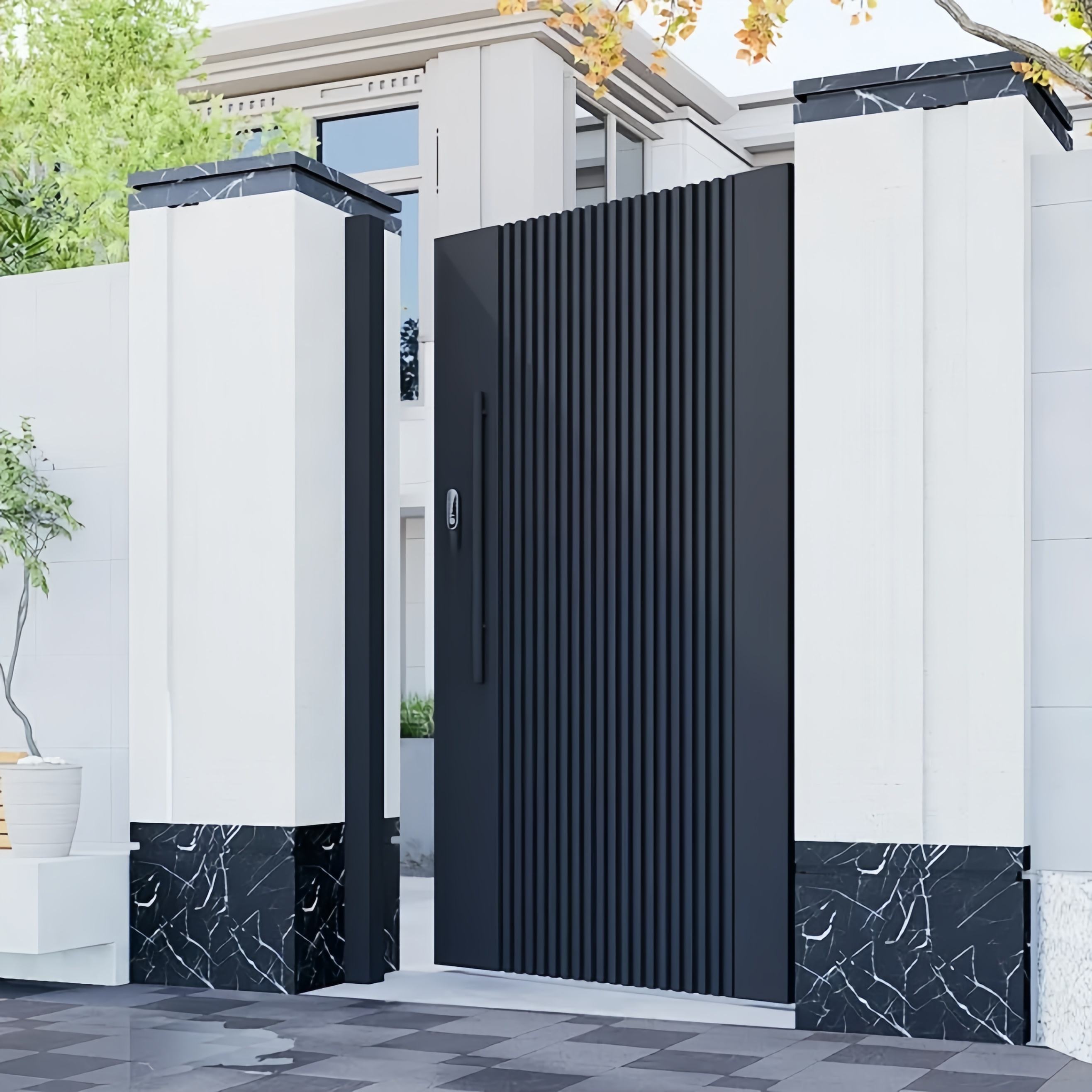
What the Market Data Suggests About Specification Pressure
Third-party estimates indicate a category that is expanding rather than contracting, which raises the value of comparable documentation. Dataintelo values the global aluminum pergola market at USD 3.8 billion in 2025, with a projected USD 7.1 billion by 2034, and attributes a 34.2% share of 2025 demand to North America. A separate commercial research report on automatic gate opening systems places automatic sliding gates at a 30.2% market share in 2025. These are third-party segment estimates, not verified figures for any individual supplier or project, and they should be read as category context rather than as a forecast of order volume.
The practical implication is narrower than the headline numbers. As more projects specify aluminum systems, more buyers are comparing documents rather than photographs, and a supplier whose inspection records can be matched line by line to a written specification is easier to qualify than one whose records cannot. For import documentation specifically, classification is a separate exercise: U.S. Customs and Border Protection classified aluminum fence panel kits from China under HTSUS 7610.90.0080 at a 5.7% duty rate, which illustrates why a buyer should confirm the tariff classification of the actual product with a customs broker instead of assuming that a ruling for one product line covers another.
Aluminum Gates Against Traditional Materials, and Where the Fit Ends
Aluminum alloy is chosen outdoors largely for two reasons that a compliance file can actually test: it does not rust the way ferrous metals do, and it does not need the recurring repainting that timber or coated steel generally requires. Those properties are supported by the material choice and by the coating adhesion test rather than by assertion, which is why the coating record carries more weight than a finish description.
The boundary is just as important. Aluminum is light and corrosion-resistant, but the alloy alone does not make a gate secure or structurally suitable for every opening. Leaf width and weight determine the structural section and the motor, and a wide opening may require a different gate type rather than a larger motor bolted to the same frame. Security is likewise a function of the lock, access-control devices and anti-collision structure specified in the order, not of the frame material by itself. Buyers with unusually wide driveways, high wind exposure or heavy traffic should raise those conditions at specification stage so the configuration is reviewed before pricing rather than after fabrication.
Outlook
The direction of travel is toward documentation as a purchasing tool rather than an afterthought. Customization is already granular — dimensions, profile thickness, colour, pattern, opening type, access system, hardware and engraving are all selectable — and the more selectable a product becomes, the more a buyer needs a written record of what was selected. For a 1-set order with a 30-day lead time, that record is the only practical protection. The suppliers that will qualify most easily are the ones that can hand over a specification sheet, a matched test file and a clear acceptance schedule without being asked twice.
FAQ
What information do I need to provide before ordering a custom aluminum gate?
For an accurate gate design and quotation, provide the clear opening width and height, preferred gate type, quantity and site photos. For automatic gates, information about the ground condition, posts or walls, available side space and power supply location is also helpful. Accurate site information allows the gate structure, opening direction and motor installation to be evaluated before production.
Should I choose a sliding gate, swing gate or bi-fold gate for my driveway?
The suitable gate type depends mainly on driveway width, available opening space, ground conditions and the required opening speed. Swing gates suit sites with sufficient inward or outward opening space. Sliding gates suit entrances with enough lateral space beside them. Bi-fold gates are useful where the driveway has limited opening depth and a compact opening solution is needed. Site dimensions and photos allow the most suitable configuration to be recommended.
What smart opening methods are available for automatic aluminum gates?
Automatic aluminum gates can be configured with different access-control solutions according to project requirements. Available options may include remote control, fingerprint recognition, password keypad, card access and mobile app control. The suitable motor and control system are selected according to gate type, gate size, weight and installation conditions.
What does 100% pre-shipment testing cover on a custom gate order?
Junsu's inspection scope covers 100% pre-shipment testing together with raw material composition testing, wall thickness measurement, surface coating adhesion testing, load-bearing wind resistance testing, waterproof performance testing, motor continuous operation aging testing and dimensional tolerance checks. Because the depth of each check and the split between per-unit and per-batch testing are not fixed by the headline percentage, buyers should agree the scope for each record in the order documents.
Product catalogue for reference: Junsu outdoor product catalogue (PDF).
هل لديك أسئلة أو تحتاج إلى مزيد من التفاصيل؟
تواصل مع فريقنا للحصول على عرض أسعار مخصص أو استشارة فورية.
طلب عرض أسعار
املأ النموذج أدناه وسيتواصل معك فريقنا بعرض مقترح مخصص.
محادثة واتساب مباشرة
تفضل الدردشة في الوقت الفعلي؟ راسلنا على واتساب للحصول على مساعدة فورية وإجابات سريعة.
- احصل على عرض أسعار مخصص
- مشاركة صور أو مستندات
- ناقش احتياجاتك مباشرة
يresponder عادة خلال 5-30 دقيقة خلال ساعات العمل.