
Custom Aluminum Gate & Fence Ordering FAQ: Specs & Acceptance Checks
Custom Aluminum Gate & Fence Ordering FAQ: Specs & Acceptance Checks
A custom aluminum gate or fence order is usually decided long before the invoice is issued. It is decided at the drawing stage, when the clear opening, profile wall thickness, RAL colour, hollow carving pattern, fence bar spacing, gate opening mode, intelligent access system and hardware style are either locked down or left open. This reference walks importers, contractors and project buyers through the customization inputs, the commercial terms and the acceptance checks that turn a specification sheet into a delivered system.
Junsu Outdoor is the outdoor living brand of Henan Junsu Technology Co., Ltd., a metal courtyard product manufacturer based in Henan, China, established in 2001, producing aluminum pergolas, aluminum fences, automatic driveway gates and coordinated garden structures for export markets including the EU, USA, France, Germany, Canada and Australia.
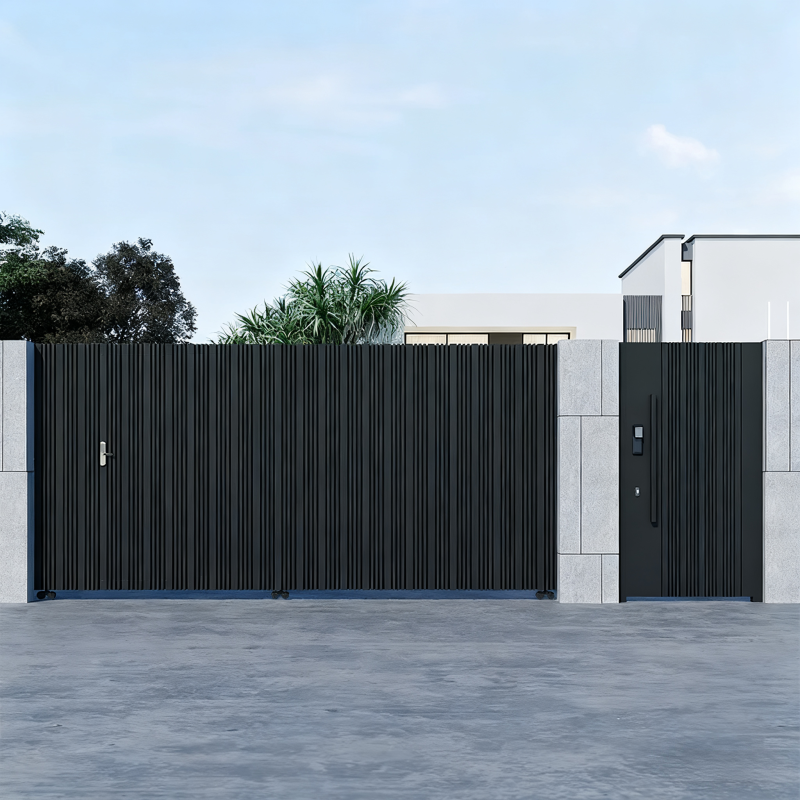
Coordinated gate, fence and pedestrian access delivered as one system rather than three separately sourced products.
Why Specs and Acceptance Checks Decide a Custom Aluminum Gate Project
A custom gate project contains two separate decisions that are rarely made by the same person at the same time. The technical side covers clear opening dimensions, alloy and profile thickness, RAL surface colour, hollow carving pattern, fence bar spacing, gate opening mode, intelligent access system, hardware style and hidden installation fittings. The commercial side covers minimum order quantity, production lead time, monthly capacity, pre-shipment testing and after-sales support.
When those two sides are handled separately, cost tends to appear in two predictable places. The first is a redesign after drawing confirmation, when a dimension or a finish changes and the structure, hardware or motor selection has to be re-evaluated. The second is at the destination port, when no written agreement exists on which inspections were performed and what the acceptance criteria were.
The practical conclusion for buyers is straightforward: ask any supplier for a customization input list and an inspection list before asking for a price. A quotation without those two documents is a number without a specification behind it.
Customization FAQ: What Must Be Confirmed Before Ordering?
For aluminum fences and gates, the documented customization inputs are overall dimensions, alloy profile thickness, RAL surface colour, hollow carving pattern, fence bar spacing, gate opening type, intelligent access system, lock and hardware style, engraved logo, anti-collision structure, bottom gap height and hidden installation fittings. The list is short enough to confirm in a single technical review, and specific enough that skipping any line produces a visible result on site.
Clear opening width and height
The clear opening width and height are the basic measurements required for an accurate gate design and quotation. Alongside them, a supplier typically needs the preferred gate type, the quantity and clear site photographs. For automatic gates, information about the ground condition, existing posts or walls, available side space and the power supply location allows the gate structure, opening direction and motor installation to be evaluated before production.
Alloy and profile wall thickness
For aluminum products, 6063-T5 aluminum alloy is used as the standard material. For garden fences and aluminum gates, alloy profile thickness is a defined customization item, and wall thickness measurement is one of the recorded inspection methods. Profile thickness should therefore be agreed in writing at the drawing stage rather than left to be discovered at delivery, because it influences structural behaviour, hardware fit and, where relevant, motor sizing.
RAL colour, decorative pattern and hardware
RAL surface colour, hollow carving pattern and decorative pattern are customization inputs for both gates and fences. Lock and hardware style, engraved logo and hidden installation fittings are separate line items. Hidden fittings matter more than they appear to: they determine how the finished installation reads visually and how much adjustment remains available on site.
Fence bar spacing and privacy
Fence bar spacing is a customization input for garden and aluminum fencing. Aluminum louver fencing uses angled slats to reduce direct visibility while maintaining airflow through the fence, which is why it is used not only for residential privacy but also for patios, courtyards, HVAC equipment screens and commercial mechanical enclosures where ventilation is required. Spacing and louver angle are the two variables that connect a fence specification to its actual privacy performance.
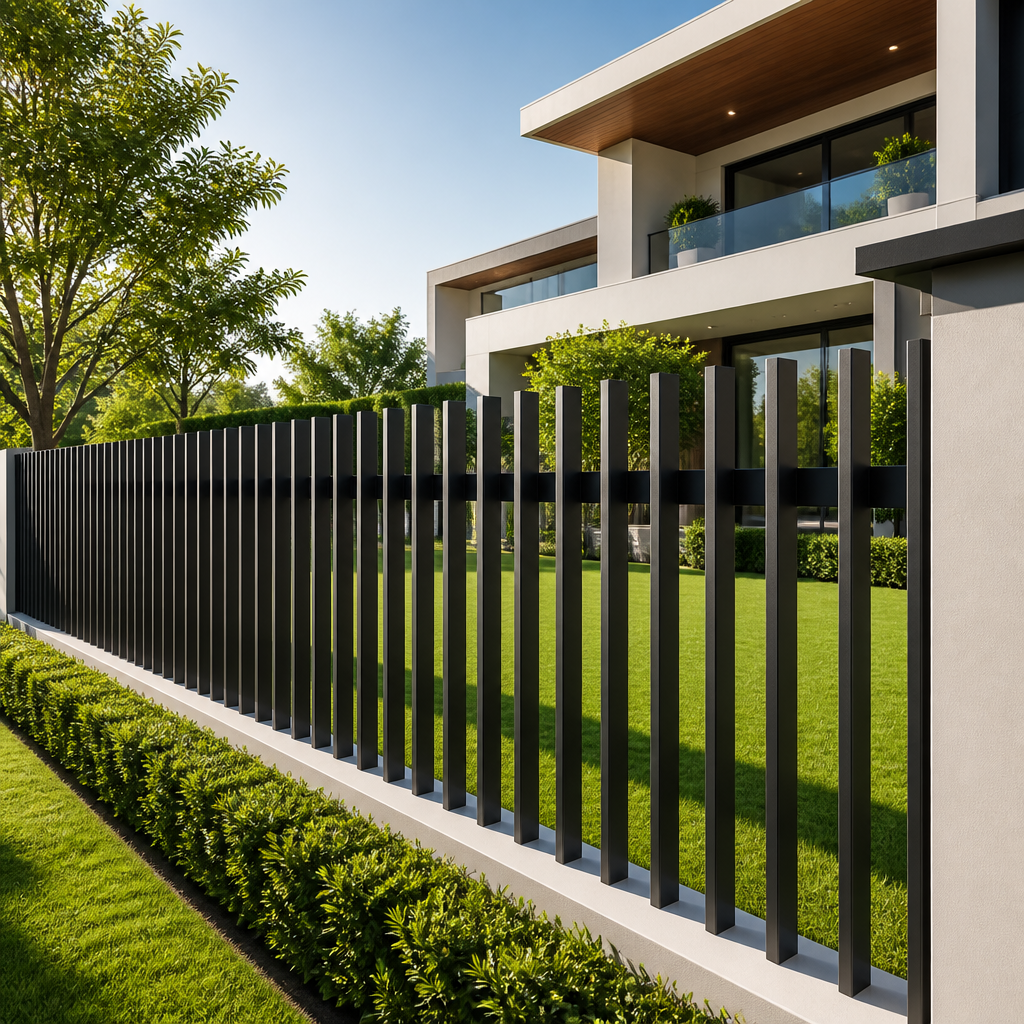
Bar spacing, profile thickness and bottom gap height are agreed at drawing stage because all three change how a fence performs on site.
| Customization input | What the buyer supplies | Why it must be locked before production |
|---|---|---|
| Clear opening width and height | Measured opening, preferred gate type, quantity | Determines gate structure and opening direction |
| Site conditions | Photos, ground condition, posts or walls, side space, power supply location | Allows motor and installation feasibility to be checked first |
| Alloy profile thickness | Agreed thickness per element | Affects structural behaviour and hardware fit |
| RAL surface colour | RAL reference or approved sample | Colour is applied at coating stage, not after |
| Hollow carving pattern | Design file, sketch or photo reference | Pattern is cut during fabrication |
| Fence bar spacing | Target spacing and privacy level | Controls visibility and airflow performance |
| Gate opening mode | Sliding, swing or bi-fold | Defines track, clearance and motor selection |
| Intelligent access system | Remote, fingerprint, keypad, card or APP | Control system follows gate type and weight |
| Hardware and hidden fittings | Style reference and fitting preference | Determines final appearance and site adjustment |
Drawings can be prepared and confirmed according to project dimensions and requirements. Once the drawing is confirmed, dimensions become a production instruction rather than a discussion point.
Gate Configuration FAQ: Sliding, Swing or Bi-Fold?
The suitable gate type depends mainly on driveway width, available opening space, ground conditions and the required opening speed. Each of the three configurations solves a specific site constraint.
- Swing gates suit entrances where sufficient inward or outward opening space is available for the gate leaves.
- Sliding gates are used when enough lateral space exists beside the entrance for the gate leaf to travel.
- Bi-fold gates are useful where the driveway has limited opening depth and a more compact opening solution is required, because they need less opening depth than a conventional swing arrangement.
All three gate types can be customized according to project dimensions. Where dimensions and clear site photographs are provided, the installation space can be evaluated and a suitable configuration identified before fabrication begins. This is a structural recommendation based on the site, not a preference based on style.
Automatic gates and intelligent access control
Automatic aluminum gates can be configured with different access-control solutions according to project requirements. Available options include remote control, fingerprint recognition, password keypad, card access and mobile APP control. The motor and control system are selected according to gate type, gate size, weight and installation conditions.
At the outdoor system level, operation mode can extend beyond a single command input: manual switch control, remote wireless control, mobile APP intelligent control, automatic weather sensing operation, timed auto switching, and face, license plate or NFC access linkage are all documented configurations. Each added layer changes the wiring and commissioning scope, which is why the access specification belongs in the original order rather than in a later retrofit.
Commercial Terms FAQ: MOQ, Lead Time and Monthly Capacity
The documented commercial terms for this product range are a minimum order quantity of 1 set, a typical production lead time of 30 days, and a monthly capacity of 3,000 sets. Read together, those three numbers describe who the supply model suits.
- MOQ of 1 set. A single villa entrance gate, a single fence run or a sample unit can be ordered without opening a volume commitment. This matters for pilot projects and for buyers validating finish and hardware before scaling.
- 30-day lead time. The production cycle should be planned alongside drawing confirmation and shipping, since the clock runs most predictably once the confirmed drawing replaces the open question.
- 3,000 sets per month. For distributors, importers and project contractors, this indicates the order sizes that can be absorbed within a normal production month rather than being queued across quarters.
The wider manufacturing context is a 30,000 m² facility, a 120-person team and an annual production capacity of approximately 36,000 sets, covering metal processing, cutting and welding, assembly, quality inspection and packaging. Customization can be developed from CAD drawings, architectural plans, sketches, photos, dimensions and samples, with technical drawings, design optimization, installation drawings, customized logos, private labels and packaging available as support outputs. Export activity represents 90% of business, with the EU, USA, France, Germany, Canada and Australia among the main markets.
Recorded project references include a 600-set order for the USA market, delivered by a manufacturer whose courtyard product experience and international trade activity date back to 2001. For buyers, the relevant point is not the reference itself but what it indicates: orders in the hundreds of sets sit inside, not outside, the normal capacity envelope.
Acceptance Checks FAQ: How Are Gates and Fences Verified Before Shipment?
Quality control is implemented throughout the production process, from raw material inspection and manufacturing through assembly, functional checks, pre-shipment inspection and packaging inspection, with 100% inspection before delivery. The recorded inspection methods are specific enough to be written into a purchase order as acceptance criteria.
Raw material composition test. Confirms that the incoming alloy matches specification before any cutting or welding takes place. Verified here, a material problem is a procurement issue; discovered after fabrication, it is a warranty issue.
Wall thickness measurement. Checks that the delivered profile thickness matches the agreed value. Because thickness is a customization input, this is the measurement that closes the loop between the drawing and the physical product.
Surface coating adhesion test. Assesses how the coating behaves on the substrate. For exterior products in humid, coastal or high-UV environments, coating adhesion is one of the determinants of long-term appearance.
Dimensional tolerance inspection. Confirms that overall dimensions, opening clearances and fitting positions fall within the agreed tolerance, which is what allows a gate to be installed without on-site rework.
Motor continuous operation aging test. Applies to motorized products, including automatic gates and motorized pergola drives. It tests the drive under repeated operation rather than a single cycle.
Load-bearing wind resistance test. Applied to load-bearing structures, and reported for finished pergola units at wind loads up to 190 mph, with snow load capacity up to 100 lbs/sq ft.
Waterproof performance test. Applied to finished units. Outdoor installation conditions are specified for high humidity, dust and a wide temperature range from -35 °C to 65 °C, with IP66 waterproof and dustproof rating; the special requirements list also references wide temperature resistance from -50 °C to 100 °C. Electrical components should not remain submerged in standing water, and correct installation of electrical connections and cable routing is essential.
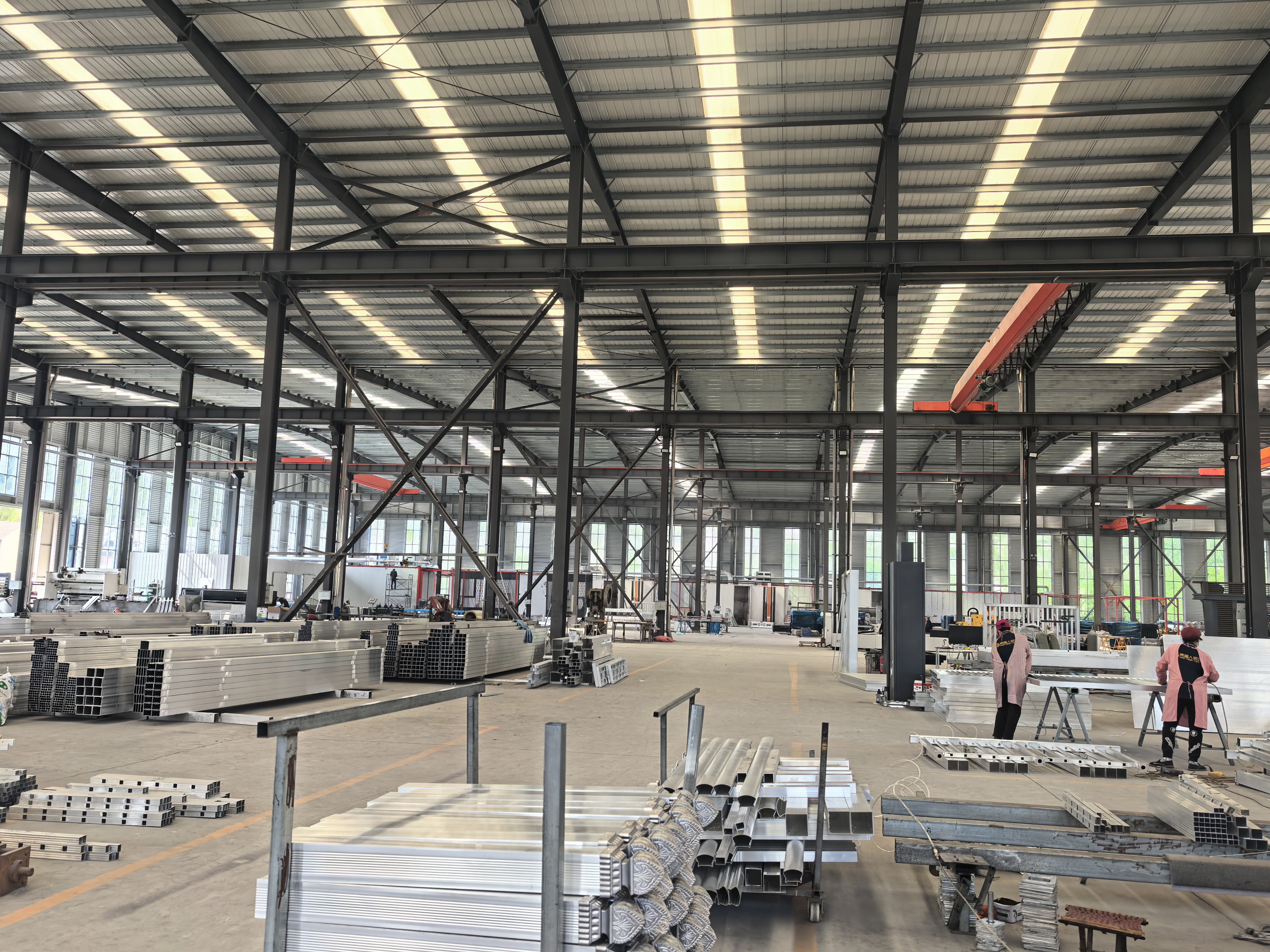
Fabrication, welding and dimensional checks happen before coating, which is why acceptance criteria are written at order stage.
Finished Pergola Acceptance: Waterproofing and Structural Checks
Where a gate and fence package includes a coordinated pergola, the acceptance scope changes because the product contains a moving roof and an electrical drive. The louver control method is motorized rotation from 0 to 90 degrees, and operating mode covers automatic louver adjustment for sun, shade, ventilation and rain protection. When the louvers are closed, the louvered roof provides full rain protection, and the product is configured for all-weather wind and waterproof performance.
Structural configuration includes wall-mounted, free-standing, multi-zone and special cuts and angles options, with model designations 147, 163, 175 and 220 available as customization base points. Integrated LED lighting can be operated together with the louver system, and the accessory set can extend to zip screens, glass doors, fans, heaters and wind and rain sensors. For buyers, these are not cosmetic options: each accessory changes the electrical load, the control architecture and the commissioning steps that must be covered by installation guidance.
On site, the checks that protect the project are unglamorous. Confirm the power supply location, drainage condition, cable routing and installation surface before installation. Confirm that electrical components will not stay submerged in standing water. Confirm that the mounting surface can accept the structure being specified. Those three confirmations prevent the majority of after-installation disputes on motorized outdoor products.
Aluminum Systems Compared with Traditional Materials
Aluminum outdoor structures are frequently compared with wrought iron, solid wood and masonry. The comparison that matters to a buyer is not appearance but the cost and maintenance curve over a decade or more.
| Comparison point | Aluminum systems | Traditional materials |
|---|---|---|
| Corrosion behaviour | Rustproof aluminum alloy construction, corrosion free; premium fluorocarbon and wood grain transfer finishes described as UV, salt spray and rain resistant | Wrought iron, solid wood and masonry described as prone to corrosion, aging, rust and deformation over time |
| Routine maintenance | Reported as annual-maintenance free, with only regular light cleaning | Reported as requiring annual continuous maintenance, including rust removal and repainting |
| Initial purchase cost | Recorded as 15%–25% higher at purchase | Lower initial outlay |
| Long-term cost position | Recorded as zero annual anti-corrosion renewal cost, with overall comprehensive cost reduced by 70%–80% within 20 years and maintenance workload reduced by 90% | Replacement cycles reported as 3–6 times shorter |
Those figures come from supplier-side comparison material and should be treated as directional rather than audited. The honest boundary conditions are more useful than the headline numbers:
- Higher entry cost. Aluminum carries a purchase premium against several traditional alternatives, so the maintenance-free case only holds over a long service horizon. For short-term temporary enclosures without long-term appearance or durability requirements, the economics do not favour it.
- Fencing is not a structural barrier. A fence specification is defined by profile thickness, bar spacing and bottom gap height. Those values must be matched to the actual wind exposure and site function; a decorative configuration should not be treated as a load-rated barrier.
- Electrical performance depends on installation. Motors and control systems are designed for outdoor use, but electrical connections must be installed correctly and protected according to installation requirements, with adequate drainage.
- Market data definitions differ. Published research sources segment the pergola market inconsistently, so forecasts should guide planning rather than justify a fixed commitment.
Market Signals Behind Outdoor Living Demand
Buyer interest in coordinated outdoor living systems is supported by published market research rather than by marketing commentary alone. The global aluminum pergola market is valued at $3.8 billion in 2025 and projected to reach $7.1 billion by 2034, according to Dataintelo, with North America representing a 34.2% share of demand in 2025. The bioclimatic pergola segment is expected to grow from $600.87 million in 2026 to $1,049.46 million by 2034, a CAGR of 7.22%, according to Fortune Business Insights.
On the access side, automatic sliding gates held a 30.2% share of the automatic gate opening system market in 2025. That figure is relevant to fence and gate procurement because it indicates how much of the buying decision now includes a drive and a control system, not only metal panels.
Compliance and trade rules shape the same decision. Aluminum fence panel kits from China are classified under HTSUS 7610.90.0080 with a duty rate of 5.7%, per a U.S. Customs and Border Protection ruling. In Europe, EN 13561:2015 sets performance and safety requirements for external blinds and awnings, including pergola awnings. In the United States, ASTM F2957 covers ornamental aluminum fence systems, including structural testing and surface finish. Buyers ordering for regulated projects benefit from naming the applicable standard in the purchase specification rather than assuming it.
Published market figures come from commercial research sources and reflect differing product definitions across studies. They are cited here as directional indicators, not as verified project data.
After-Sales FAQ: What Happens After Delivery
After-sales support for this product range is documented as long-term warranty service, free technical consultation, remote installation guidance, remote system debugging, spare parts supply support, after-sales fault response service, product maintenance guidance and lifelong technical support.
For importers and contractors, the commercially significant items in that list are remote installation guidance, remote system debugging and spare parts supply. A motorized gate or a louvered pergola that arrives with a commissioning question can usually be resolved remotely; the same question without spare parts availability and a remote debugging option becomes a site visit. Coordinated products are backed by support that covers customization, manufacturing, installation guidance, technical support, spare parts and after-sales service across those stages.
Future Outlook
Three shifts are visible across the category. First, metal enclosure and shade products are increasingly ordered as coordinated packages rather than as separate line items, which raises the importance of unified profiles, colour codes and finishes across a single project. Second, control and access intelligence is moving from premium configuration to standard expectation, with weather sensing, timed operation and access linkage appearing in ordinary procurement questions. Third, buyers are asking for specification-level evidence — alloy designation, profile thickness, coating behaviour, test scope — rather than brochure-level descriptions.
For suppliers, that means the ordering document becomes a competitive asset. For buyers, it means the specification checklist and the acceptance list are the two documents worth reviewing before price. Neither replaces a competitive quotation, but together they make quotations comparable.
FAQ
What is the minimum order quantity for a custom aluminum gate or fence?
The documented minimum order quantity is 1 set, which means a single entrance gate or a single fence run can be produced as a standalone order rather than a volume commitment.
How long does production take before shipment?
The typical production lead time is 30 days. Because the cycle depends on confirmed drawings, the practical planning timeline should include drawing confirmation before the production period begins.
Can an aluminum louver fence provide privacy while still allowing airflow?
Yes. Aluminum louver fencing uses angled slats that reduce direct visibility while maintaining airflow through the fence, which makes it suitable for residential privacy as well as patios, courtyards, HVAC equipment screening and commercial mechanical enclosures where ventilation is required.
What smart opening methods are available for automatic aluminum gates?
Automatic aluminum gates can be configured with remote control, fingerprint recognition, password keypad, card access and mobile APP control. The motor and control system are selected according to gate type, gate size, weight and installation conditions.
Is a motorized louvered pergola waterproof in heavy rain?
When the louvers are fully closed, the louvered roof provides full rain protection, and the product is configured for all-weather wind and waterproof performance. Correct installation and site drainage are important for achieving the best waterproof performance.
Product reference documentation, including the outdoor living catalogue, is available here: Junsu Outdoor product catalogue.